30th Sunday in Ordinary Time: Column and Cover Art

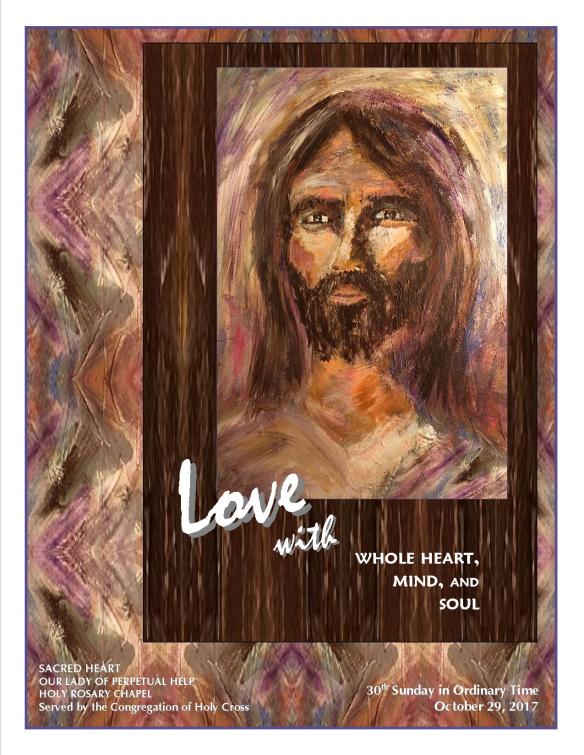
October 29, 2017 bulletin cover

Cover art: Ronald Raab, CSC

Dear Followers of Jesus,

Our Sunday gospel, Matthew 22:34-40, invites us into the profound connection of God’s love and living out that love toward all people. I believe this gospel is the core of the Church’s mission and integrity in our world. We love God with heart, mind and soul and our neighbors as our selves.

Many people have dismissed Pope Francis’ emphasis of love and mercy. They do so because they believe Pope Francis is soft on the rules of the Church. I hear in conversations nearly every week that only adhering to the rules and laws of the Church will revive our sagging institution worldwide.

God’s emphasis on the beauty and mystical qualities of the dignity of all life are important to adhere to no matter what happens. However, the way we invite people into the Church must be based on love and integrity. Love never ends. Love is the ingredient that is so often lost in the Church. Love is the most important reason Jesus gave us the Eucharist and the Sacraments. Love is the reason Jesus died and rose for us sinners.

Love has changed the Pope’s heart. I believe there are two reasons for this. First of all, Pope Francis is a professed religious and a Jesuit priest. His prayer and his education are very different from his predecessors who were diocesan priests.

Second, Pope Francis has befriended many people in poverty during his entire ministry. This is the real reason how Pope Francis found love. What happens when we befriend powerless people is that we, too, need God. The ache, rawness and emptiness of a difficult life help us all turn toward the love God has for us. All we need to do to find this truth is to read the lives of the Saints.

Jesus asks us two things in life. He begs us to be open to receiving the love the Father has for each of us. He also asks us to live this love among our neighbors. We are stubborn to receive God’s love because it encourages us to change. We never want to change. We are hard pressed to let go our bloated egos. We are reluctant to let go of our culture power.

However, when we finally rest in God’s love for us, we live differently in our world. We can befriend deep pain, diversity, ambiguity and powerlessness. We can enter into the mystery that all people need God, the profound love that sets us free.

One of the ways in which we enter into a prayerful bond in our three church communities is to pray for the dead. This week we celebrate All Saints and All Souls. We also will gather on Friday, November 3 at 6:30 pm to pray with all the grieving of our parish communities for the loss of their loved ones. We celebrated nearly 40 funerals this year and we stand with the grieving in the love that God has for us all.

Blessings to you,

Fr. Ron

On the Margins: Matthew 22:34-40

fr_ron_and_kbvm_readingBW

On the Margins from Mater Dei Radio, Portland, OR

Thirtieth Sunday in Ordinary Time, October 29, 2017

LISTEN NOW: CLICK HERE

Gospel MT 22:34-40

When the Pharisees heard that Jesus had silenced the Sadducees,
they gathered together, and one of them,
a scholar of the law tested him by asking,
“Teacher, which commandment in the law is the greatest?”
He said to him,
“You shall love the Lord, your God,
with all your heart,
with all your soul,
and with all your mind.
This is the greatest and the first commandment.
The second is like it:
You shall love your neighbor as yourself.
The whole law and the prophets depend on these two commandments.”

29th Sunday in Ordinary Time: My cover art and column

Oct. 22 Bulletin Cover

Dear Believers in the Christ,

Today’s gospel, Matthew 22:15-21, invites us once again into our true identity. What belongs to Caesar and what belongs to God?

Even in our day, we get confused as to what belongs to God and what belongs to the society in which we live. Our true identity does not rest in the nation in which we live. As Christians, our home is in God, the Kingdom that has broad and far reaching boundaries. Our ultimate home rests in the Kingdom prepared for us by the Passion, Death and Resurrection of Christ Jesus.

These lines are constantly blurred even in our day and age. We face the legality of abortion, yet we are called to uphold the dignity of all life. We go to war, yet we should stand before God as peacemakers. We live with the death penalty, yet God desires us to uphold life to it’s natural end. We sometimes tell people in poverty to get their acts together, pull themselves up by their bootstraps, yet we hear from Jesus that the poor and outcasts will inherit the very Kingdom to which we all belong. We want to build walls that separate nations and yet we are challenged by God to welcome people, to offer hospitality, to build up the Kingdom of God here on earth. We shun the alcoholic, the person with mental illness and the person who speaks a foreign language, yet in the Kingdom of God, all are welcome.

In the Kingdom, God tells us that the last shall be first. The poor will find healing and love before we can find it ourselves. Jesus reminds us that tax collectors and prostitutes will enter the Kingdom of Heaven before the religious leaders of the day. Although we may serve others under great power and wealth, God challenges us to step into life and faith with profound humility and powerlessness.

Here are some questions for you to consider this week:

How do you determine what belongs to “Caesar” and what belongs to God?

What obstacles and challenges do you face in determining how to move beyond our cultural boundaries into the mystery of God?

How do you see the overall dignity of life that God has in mind for us going against our cultural values?

Can you describe such obstacles?

How do you interpret faith in light of the differences?

How does prayer form your notion of what belongs to God?

Blessings,

Fr. Ron

On the Margins: Matthew 22: 15-21

fr_ron_and_kbvm_readingBW

On the Margins from Mater Dei Radio, Portland, OR

Twenty-Ninth Sunday in Ordinary Time, October 22, 2017

LISTEN NOW: CLICK HERE

Gospel MT 22:15-21

The Pharisees went off
and plotted how they might entrap Jesus in speech.
They sent their disciples to him, with the Herodians, saying,
“Teacher, we know that you are a truthful man
and that you teach the way of God in accordance with the truth.
And you are not concerned with anyone’s opinion,
for you do not regard a person’s status.
Tell us, then, what is your opinion:
Is it lawful to pay the census tax to Caesar or not?”
Knowing their malice, Jesus said,
“Why are you testing me, you hypocrites?
Show me the coin that pays the census tax.”
Then they handed him the Roman coin.
He said to them, “Whose image is this and whose inscription?”
They replied, “Caesar’s.”
At that he said to them,
“Then repay to Caesar what belongs to Caesar
and to God what belongs to God.”

On the Margins: Matthew 22:1-14

fr_ron_and_kbvm_readingBW

On the Margins from Mater Dei Radio, Portland, OR

LISTEN NOW: CLICK HERE

28th Sunday in Ordinary Time, October 15, 2017

Gospel MT 22:1-14

Jesus again in reply spoke to the chief priests and elders of the people
in parables, saying,
“The kingdom of heaven may be likened to a king
who gave a wedding feast for his son.
He dispatched his servants
to summon the invited guests to the feast,
but they refused to come.
A second time he sent other servants, saying,
‘Tell those invited: “Behold, I have prepared my banquet,
my calves and fattened cattle are killed,
and everything is ready; come to the feast.”‘
Some ignored the invitation and went away,
one to his farm, another to his business.
The rest laid hold of his servants,
mistreated them, and killed them.
The king was enraged and sent his troops,
destroyed those murderers, and burned their city.
Then he said to his servants, ‘The feast is ready,
but those who were invited were not worthy to come.
Go out, therefore, into the main roads
and invite to the feast whomever you find.’
The servants went out into the streets
and gathered all they found, bad and good alike,
and the hall was filled with guests.
But when the king came in to meet the guests,
he saw a man there not dressed in a wedding garment.
The king said to him, ‘My friend, how is it
that you came in here without a wedding garment?’
But he was reduced to silence.
Then the king said to his attendants, ‘Bind his hands and feet,
and cast him into the darkness outside,
where there will be wailing and grinding of teeth.’
Many are invited, but few are chosen.”

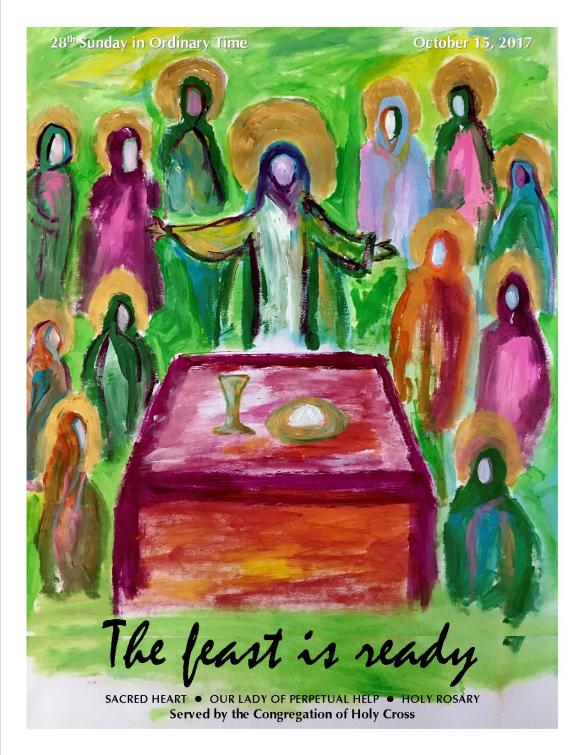
28th Sunday in Ordinary Time: My column and my cover art

October 15 Bulletin Cover

Dear Believers in the Real Presence,

We are invited to the feast in today’s gospel, Matthew 22:1-14. Since we have been worshipping in the gym at Sacred Heart, I have been reflecting on the gym floor a lot in my own prayer. I have never used the dirty floor as a source of prayer before. The temporary set up for Mass on Saturdays and Sundays intrigues me. We are praying on the weekends from the altar that was in the church. The old sanctuary furniture is set up for the weekends and then put into a temporary closet during the weekdays. What happens on the old gym floor connects our prayer and service like we have never experienced before. This is the real mission of the Church.

The floor is a profound source of prayer. The floor of our Parish Center now carries the lives, bodies, the wheelchairs, the children and the elderly of our parish community in prayer. There are no obstacles of steps or tattered carpeting to be a stumbling hazard. The floor is a host of great diversity welcoming people to the Eucharist. The tiles enable a steadiness with people leaning on their canes. The flat floor creates surefootedness for our older parishioners who are approaching the ambo to read the scriptures as well as a solid surface for baby strollers and parents carrying young children. What happens on Sundays is the core of our Christian faith, the celebration of the Body and Blood of Christ, the feast to which we are invited to not only attend but also the feast that we are invited to become.

This becoming happens immediately after the Mass. When the Eucharist has ended, the room is immediately transformed into a dining room. On Sunday evenings, we host the Lord’s Dinner where over 100 of our neighbors dine with one another and with volunteers from one of the nine different churches hosted by Westside Cares. The floor becomes common ground for people carrying their possessions on their backs and others who have not eaten all weekend. Parents carry their infants and toddlers into the gym with diaper bags and a few articles of clothing. The floor becomes the host for mutual hospitality, the place of communion with conversation and food.

The Eucharist invites us to be fed on Sunday mornings. We carry the invitation forward by learning how to feed other people on Sunday evenings. I hear these echoes of invitation across the gym floor. I never thought of using the gym floor as a source of prayer, but when I stop for a moment and walk in the place where our faithful walk and pray, I can hear the echoes of people who ache for food, love, conversation and communion. I hear the longing for God, for healing and hope for tomorrow. On the gym floor, I do not know from which group these echoes come.

Welcome to the feast,

Fr. Ron


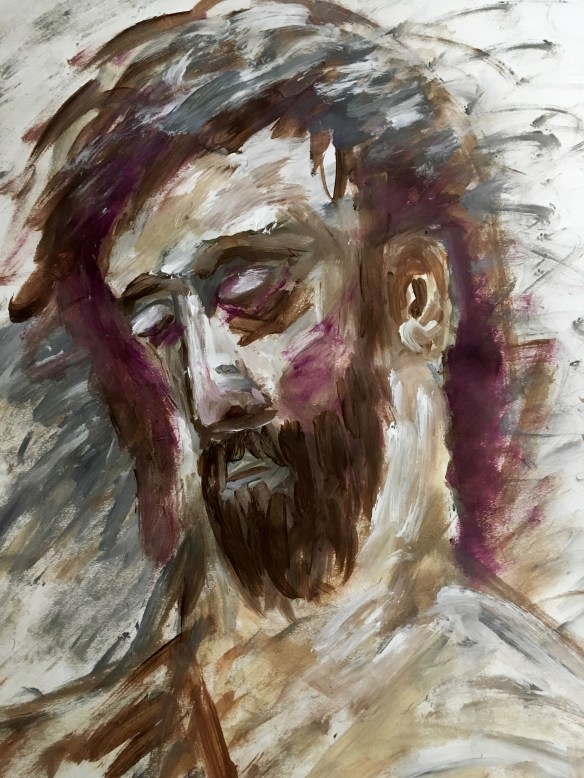
Jesus grieves for us…

Version 2

“Jesus grieves for us…” Painting, using a rag by: Ronald Raab, CSC October 9, 2017

Jesus grieves for us…

In the center of the storms that ravage our homes and landscape…

In the middle of such destruction and uncertainty…

In the core of our hearts as we let go of our belongings…

In the divisions we find in our souls as we bury the dead…


Waiting for us to awaken to the real and unknown destruction…

Waiting for us to reach out to our neighbors and enemies…

Waiting for us to begin rummaging through the rubble…

Waiting for us to find him in the letting go…


Standing with us as we argue over weapons and rights…

Standing with us as we search for causes and reasons…

Standing with us when we are blind to mental illness…

Standing with us when we become obsessed with control…


Embracing us when we weep at graves of the young and talented…

Embracing us when we think you have abandoned us…

Embracing us when we encircle our lives with entitlement and self-righteousness…

Embracing us when we turn our faith into national politics…


Loving us when we disregard our children and people…

Loving us when we toss hope aside…

Loving us when we think we can survive on our own…

Loving us when we are discouraged and so lost…


Forgiving us when we argue over skin color and language…

Forgiving us when we hoard our wealth, knowledge and expertise…

Forgiving us when we abuse power, control and superiority…

Forgiving us when we have lose our identity of your Kingdom…


Jesus, grieve for us…

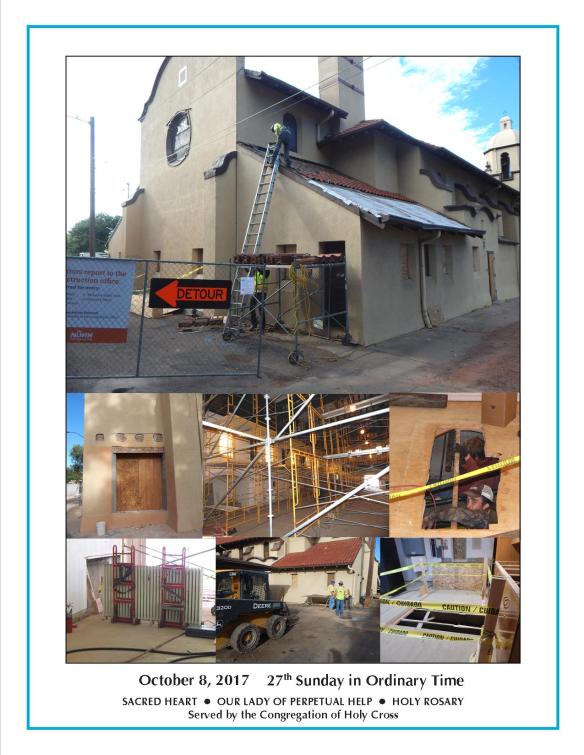
27th Sunday in Ordinary Time: Cover and my column

October 8 Bulletin Cover

Dear Followers of the Anointed One,

We are very aware of the destruction of the fields, the crops and our food in the recent hurricanes, storms and earthquakes. Our plans for such security come to nothing when natural disaster strikes. The basics of life are swept away, destroyed and our lives are at risk. In faith, we know that our true lives depend on the Kingdom of Heaven, the true source of hope. However, in light of the destruction, our view is of the earth, our survival and the care of so many of our brothers and sisters.

Let’s look at today’s parable opening up another image of God’s Kingdom, our true and eternal home. This parable and image may seem so otherworldly, so out of place in the tragedies of our recent months. Yet, we gain hope in our faith during all the destruction as we place our hope in God.

Today, we break open another parable about the Kingdom of Heaven in Matthew 21:33-43. Jesus tells the story about a landowner who carefully plants, protects and equips the vineyard, and about the tenants who take progressively more violent steps to usurp what is not theirs. Jesus issues judgment against the chief priests and elders. The Kingdom of God will be given to those who understand what is given— the promises made here on earth of the glory and hope of the Kingdom in Heaven.

There are many questions to be asked. What is the fruit of the kingdom? How are we to find it now? The only way to discover such a gift is to die to our selves, to discover the life that is greater than our own plans, our own egos and our own desires. This is the fertile soil on which we plant hope for the breaking open of our hearts and lives.

We die to certainty on earth. This is a difficult way to find God and yet it is the only way. There are few people who are willing to risk security and a full ego to find the true fruit of the Kingdom of Heaven here on earth. When we take the risk, God’s fidelity and love grow more deeply in the soil of our hearts, our actions and our decisions. Love only flourishes when we let go of our hatred, our violence and our illusions in order to discover a life of prayer and hope in God. The fruit of God’s Kingdom is lasting and true.

Here are some questions to consider for this week:

What have you learned in the recent storms and natural disasters? Where are you finding hope? What lessons have you learned in such experiences of powerlessness? How are you praying through these events? What does it mean for you to die to self and discover the Kingdom within your life? What does it mean for you to enter and care for the vineyard of God’s Kingdom?

Blessings,

Fr. Ron

On the Margins: Matthew 21:33-43

fr_ron_and_kbvm_readingBW

On the Margins from Mater Dei Radio, Portland, OR

LISTEN NOW: CLICK HERE

Twenty-Seventh Sunday in Ordinary Time, October 8, 2017

Gospel  MT 21:33-43

Jesus said to the chief priests and the elders of the people:
“Hear another parable.
There was a landowner who planted a vineyard,
put a hedge around it, dug a wine press in it, and built a tower.
Then he leased it to tenants and went on a journey.
When vintage time drew near,
he sent his servants to the tenants to obtain his produce.
But the tenants seized the servants and one they beat,
another they killed, and a third they stoned.
Again he sent other servants, more numerous than the first ones,
but they treated them in the same way.
Finally, he sent his son to them, thinking,
‘They will respect my son.’
But when the tenants saw the son, they said to one another,
‘This is the heir.
Come, let us kill him and acquire his inheritance.’
They seized him, threw him out of the vineyard, and killed him.
What will the owner of the vineyard do to those tenants when he comes?”
They answered him,
“He will put those wretched men to a wretched death
and lease his vineyard to other tenants
who will give him the produce at the proper times.”
Jesus said to them, “Did you never read in the Scriptures:
The stone that the builders rejected
has become the cornerstone;
by the Lord has this been done,
and it is wonderful in our eyes?

Therefore, I say to you,
the kingdom of God will be taken away from you
and given to a people that will produce its fruit.”

26th Sunday in Ordinary Time: Cover and my column

Ocober 1 Bulletin Cover

Dear Believers in the Messiah,

When I was in the seminary, one of our retired priests used to say, “Ninety percent of life is just showing up.” I admit the truth of his words the longer I am in the Church and struggle to become a person of prayer. Showing up is a gift to God. God can work with us only when our hearts become ready and willing, when our lives are given freely.

Matthew 21:28-32 gives us a story about our own stubborn ways and our own willingness to show up. Two sons are asked to work. One says yes and then no. The other says no then yes. This very human response is revealed in each one of us. The two sons are examples of reactions we all have within our human attitudes and hearts.

It is always interesting to me how in so many human circumstances, we tend not to ask someone to do something whom we know will not show up to accomplish the task. We usually ask the person who is already incredibly busy and generous because we know the project will get done. The not so generous person can often get away with remaining distant and sometimes lazy and not involved.

God welcomes all people; sometimes it just takes time for us who are more selfish and stubborn to find our way toward God’s generous and inviting life. We have untold opportunities to accept the invitation toward God’s mercy and fidelity.

I remember when I first starting writing for publication. One of my writing mentors told me two things to remember when working with editors of magazines. He said, “Never say no to an invitation no matter how pressured you are with other work and always get the work accomplished before the deadline.” He told me that if I do those two things, editors would continue to ask me to write for that particular magazine. I have followed his advice and have published many articles in a number of magazines since 2002.

I may not be so successful in other areas of my life about showing up and allowing God to work within me, especially when I find the task tedious and not in my expertise. However, I know that God is not finished with me or with any of us quite yet. We are all invited into the Kingdom of God, no matter how stubborn or selfish, no matter how we are awakened to the gift, no matter how we are taken by the love that is being offered us.

Here are some things to consider this week: I say yes to God and then don’t follow through when… I say no to God when… What brings me to change my mind is… I remember when I felt so discouraged about showing up in prayer because… Then God changed my mind through…

Blessings to you,

Fr, Ron