Unknown's avatar

About Ronald Patrick Raab, C.S.C.

Ronald Raab, C.S.C.,serves as religious superior at Holy Cross House, a medical and retirement home for the Congregation of Holy Cross, Notre Dame, Indiana

She Keeps Calling Out

Originally published by Ministry & Liturgy Magazine, May 2011
– PDF version –

I so admire the Canaanite woman. I always look forward to hearing her strong voice calling out to Jesus and the disciples (Matthew 15:21-28). She was crippled in fear because of her daughter’s illness. She desired the healing touch of Jesus even though she was not a lost sheep of the house of Israel. The strong-voiced mother clamored at Jesus’ side to change his mind about who could receive his love.

We enter into this courageous story again on the Twentieth Sunday of Ordinary Time (August 14). This nameless woman’s voice bellows out to us from long ago and it is still not silent. From her suffering comes a profound model of persistence and hope. Her love for her daughter was not going to be neglected, put aside or buried in society’s rules. Her voice rings out to Jesus’ ear and across the generations to our day and time.

This persistence and patience rises from deep faith. Her determination was fueled by the fact that she was out of the bounds of Jesus’ love because of her heritage and background. I am so intrigued that someone from the margins of Christ’s care teaches the rest of us how to pray tirelessly and how to bring our deepest suffering to the person of Christ. This woman, like so many women, teaches us how to believe and how to come to God with profound honesty.

I am reminded now of my dear friend, the Canaanite woman, because a year ago we welcomed a new pastor to the Downtown Chapel. His installation as pastor took place during our Saturday Vigil Mass. Parishioners presented him with the Gospel Book, the Sacramentary, a green stole, the Oil of the Sick and the collection basket. At the exact same time, a group of prostitutes were meeting in the basement directly below the chapel. I kept hearing people enter the building from the side entrance. I wondered if our new pastor really understood where those liturgical symbols were going to lead him if he accepted them with his whole heart. The voices of women caught in human trafficking were right under our feet. All during the liturgy, my mind kept going downstairs, deep into the darkness of the building where the women in need were stirring. Our parish hosts this group every Saturday evening. On that evening I really heard the voices calling out for new life, change and healing.

The Canaanite woman’s persistence celebrates for me the many voices of women who beg us for acceptance, healing and belonging. I see this persistence in our chapel, our basement and in every part of our parish community. A group of retired women nurses wash feet, cut curly-long toenails and offer advice for caring for diabetes every Wednesday morning, also in the basement. These women act out the Scriptures, speak up about people’s needs and offer prayer for people in profound need. This hidden, often silent action of our community helps us all transform our indifference into genuine prayer and concern.

I pray I never become deaf to the cry of the Canaanite woman. As I hear the prayers from a homeless mother whose child needs diapers, medical care and shelter, I know I cannot rest. I must continue to work to bridge the lives of suffering people into the mission of the Church. I hear the cries of tireless immigrant mothers having to leave their children back in the home country. I cannot turn a deaf ear to a middle-aged child who has to leave behind her aging mother in a nursing home in another state because she has to care for her fatherless children. I must open my ears, heart and prayer to the woman who struggles for food, rent assistance and education for her children. The strong voices calling out for new life are all around us, even in the basement.

Our ministry among God’s people surviving poverty encounters much resistance. We struggle with health care, other people’s prejudice, indifference and apathy. However, I take great consolation from a woman who had no power, authority and voice in the culture of Jesus’ time. In the midst of her powerlessness, she changed Jesus’ mind. She told him that even dogs receive table scraps. Her faith saved her and healed her daughter.

I cling to the fact that there are enough scraps from our common altars to feed the needs of all people. There is enough love from us, the Body of Christ, to hear the voices of people calling out in need well beyond our common sanctuary steps. From the basement to hospital beds, from migrant worker camps to the suburban poor, we must all have the courage to help change the mind of Christ by our faithful and humble prayer.


Urgent Care

Originally published by Ministry & Liturgy Magazine, April 2011
– PDF version –

Every morning our parish welcomes lost street pilgrims into dry shelter. Our staff and dozens of volunteers strip away our preconceived notions about stinky people and jobless wanderers. We hear the frightening outbursts from homeless sufferers of undiagnosed mental illness and we welcome all people to rest awhile.Our acceptance of these forgotten people barely holds back the waves of citywide discussions of the undesirable homeless teens, the filthy street urchins playing guitars while sitting on public sidewalks. Our open-door hospitality barely sways public opinion about the lazy, crazy and filthy people who do nothing for society. We welcome people because stomachs are empty, bodies are tired and naked, feet are dirty, wives are abused, jobs are lost and friends are still imprisoned. This is the urgent, daily work of hospitality in our parish community.

Living the gospel call to true, authentic hospitality challenges our parish community daily. Our morning hospitality remains scrutinized by the judgmental opinions of so many jobholders walking by our building. Some people in long-term recovery accuse us of being in denial and label us as “enabling.” Welcoming the lost and forgotten, without bias, judgment or superiority tests our faith to the core. This core of authentic welcome lies within the persons of God, the relationships among the Trinity.

I rest in this message of the Holy Trinity. I believe with my whole heart that the hidden relationships among God the Father, Christ our Savior and the communion of the Holy Spirit offer all Christians a definitive model of hospitality. As I reflect on the liturgical gospel for the Solemnity of the Most Holy Trinity, I feel this urgency of hospitality. I capture a glimpse of eternal life when tired folks rest with a cup of hot coffee, enter into an honest conversation and receive some clean clothing.

Every Christian community must take the risk of living the mystery of the Holy Trinity. The Sign of Cross is not just a mark on our mortal bodies, but radical welcome for all people to live within the love of God. The Trinity is not an obscure concept celebrated in our sanctuaries, but an invitation for all people to risk love, kindness, compassion and true hospitality. Radical acceptance among strangers enables people to experience a glimpse of eternity. Living the mystery of the Holy Trinity suggests that all people must be welcomed no matter their place in life.

Every morning we circle our volunteers around a table to reflect on the upcoming Sunday gospel. College students, retirees, parishioners and other volunteers from all walks of life hear the sacred text proclaimed in our hospitality center. The formation from these gospels propels even non-believers to connect the foundations of the Christian faith to service among God’s beloved. In these morning sessions, we all experience this urgency of hospitality because we understand we may only have one opportunity to welcome a stranger.

Our parish is just a few blocks from the train station and bus terminal. People step off the train and hear by word of mouth that our parish is the place to go for basic needs. A young unwed mother hops off the bus and is told that we can help with diapers for her infant. An elderly man needs a blanket for the night and a runaway teen is looking for someone to listen to his story. The Trinity manifests love in the simplest of places, among outcasts searching for basic belongings.

I also feel this urgency because so many young people do not experience the Church as a meaningful place for their lives. Our staff connects with over fourteen colleges, universities, seminaries and schools of nursing over the course of a year. Hundreds of high school students participate in formation sessions that invite students into the depths of people’s suffering. Hospitality is not wasted among the young, the lost and those who question everything.

The celebration of the Holy Trinity in every parish must open us all to the overwhelming compassion and mercy of God. We must not allow our fearful judgments and familiar prejudices to put boundaries on God’s relationship with people, or to suggest that some people are more deserving of love than others. The liturgical celebration reminds me to calm down among situations I cannot control, fix or heal. I must remember that God longs to be in union with God’s beloved.

I enter more deeply into the mystery of the Holy Trinity and experience an insistent need to welcome people who think they live far out of the bounds of God’s love. Every Christian becomes a messenger for the hidden life of the Trinity, an expression of deep love, commitment and belonging. I discover every day that the true mission of the Church is to live in the tight circle of the Trinity, accepting everyone into the life of God’s redeeming love.


Holding On

Originally published by Ministry & Liturgy Magazine, March 2011
– PDF version –

I hold much fear within my body. I struggle to find my way out of the self-doubts and worries I carry with me from the past. Fear clings to me when new situations demand more of my attention or concern for others. I even realize how selfish I can be when one door closes in my life. Waiting for new life makes me impatient and restless. I wait for the depths of Pentecost in my own life.

I cannot imagine the fear that locked doors and huddled the disciples together after the death of Jesus. Painful uncertainty cramped their future plans. Grief suffocated their thoughts about living the example Jesus offered them. They crouched down in fear and hung on to the hands of each other behind those barred doors. The room and their lives seemed forever darkened.

Pentecost was birthed from this hand wringing and sweat about the future. Christ appeared in the stuffy room behind the closed and locked doors of their hiding. He opened up their lives with his very presence and the offering of his lasting peace. The key to stepping out of the dark room and into their future was the healing balm of Christ’s love and forgiveness. The hands of Christ’s followers opened up to receive him. Fear seemed forever useless.

I heard a new image of clinging to fear a few months ago. On First Fridays I lead a daylong retreat exposing people to matters of faith and poverty. The retreat includes a tour of our neighborhood that reveals controversial issues of adequate housing, nutritional food and affordable healthcare for people surviving poverty. I led this particular tour with a group of deacon candidates and their wives.

After the tour, one of the candidates shared that a deep memory of his mother surfaced during the tour. He remembered his mother taking him by the hand on a street corner and crossing to the other side to avoid homeless, smelly people. He began to cry as he realized that holding his mother’s hand taught him to fear people who were different from him. He acknowledged his mother’s instinct to protect him. He then confessed to the group that it was time for him to grow up, to let go of the hands of people who teach him to be afraid. This was Pentecost for this middle-aged man preparing to be ordained to serve the needs of people. This wake-up call released him from years of prejudice and ridicule toward God’s people living on the streets. This memory opened the door to discovering Christ’s peace within him and in people he has been called to serve.

Every worshipping community must let go fear in order to serve people in need. Pentecost pries open our fingers and challenges us to embrace God alone. Every community must let go of preconceived notions of people considered to be society’s outcasts. Pentecost invites us all to let go of the relationships that still teach us to stingingly criticize other people. We must not believe that separation and isolation are Gospel values. We must release our grasp from people who keep us in our childish ways. When we wake up to the Gospel our old patterns of negative thoughts and inaction fade. We welcome the Spirit as adults in full, active membership within the Body of Christ.

Pentecost vibrates our conscience and activates our hearts. Pentecost is not about shrouding the sanctuary in red silk, but celebrated when people have enough food to eat and sufficient clothing and adequate housing. This great celebration happens when our negative attitudes are replaced with genuine community, the Church. This solemn feast continues to break down walls and barriers. We must believe that we are called to welcome people who have given up on the Church, who are tired of the fight of being isolated because of mental illness, sexual orientation or living below the poverty line. We must listen to the sojourner no matter her experience. We must walk among the brokenhearted no matter how he has been treated in the past. Pentecost cannot be tapered to fit our prejudices or slip comfortably into our oppression of other people.

I witness doors flying open to new life every day as I am changed living among the marginalized. Only God heals people from destructive patterns of drug abuse, prostitution, broken marriages and thoughts of suicide. God’s beloved people teach me to let go of the hands that intended to protect me but also taught me to fear. Ministry among people who have no power in society is celebrated with great joy not only on Pentecost Sunday but every day, when we all decide not to live in fear and darkness.


Getting Our Feet Wet

Originally published by Celebrate! Magazine, Spring 2011
– PDF version –

I admire our young whistleblowers. I am not referring to corporate moles or people who want to snitch on other people’s errant behavior. I am speaking about the young volunteers in our parish who are trying to tell us that so many situations in life need changing. These young students and many other twenty-something believers are finding their true vocations among suffering people.

These faith-filled followers of the gospel are blowing the whistle on the fact that so many people are starving for nourishing food, genuine companionship, available housing and affordable health care. These vocations are rooted deeply in the belief that God is still healing people and that everyone deserves at least the basics of life. Because these vibrant young people believe in the love of God, they are speaking out about the apathy, prejudice and lack of faith they find within the church today.

On October 17, 2010, the Church of Canada and all of our ministries in the Congregation of Holy Cross celebrated the canonization of Brother Andre Bessette, CSC. His legacy to our religious community is one of profound healing and hospitality among the sick and marginalized.  On that morning during Eucharist here at the Downtown Chapel in Portland, Oregon, two young people spoke about how their lives have been changed volunteering and ministering among God’s forgotten flock.

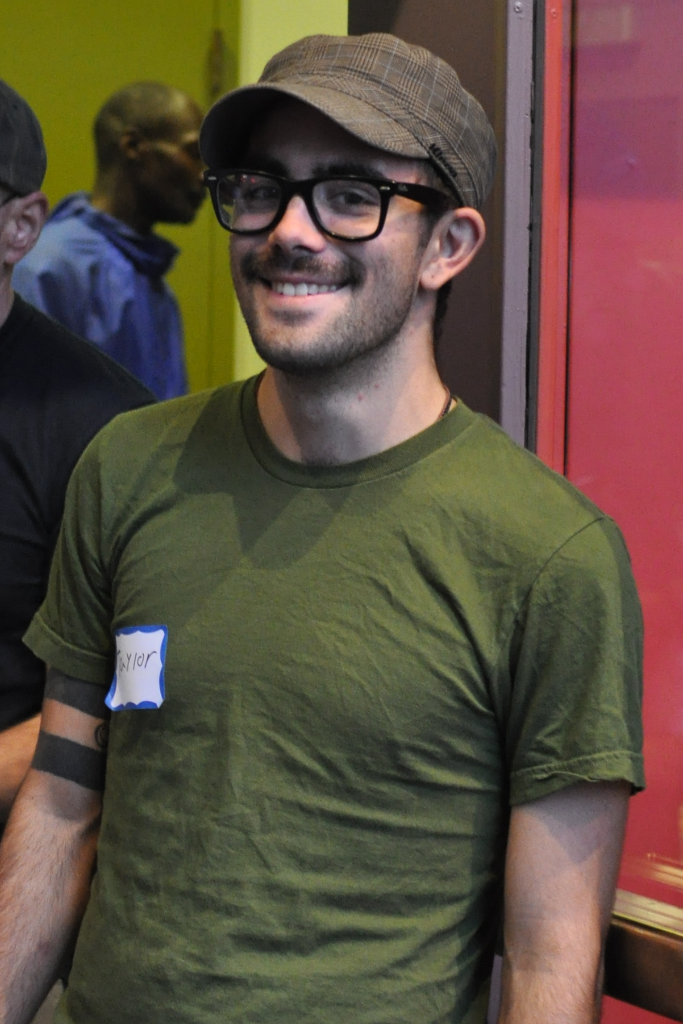
Taylor hobbled up on crutches to the microphone. He spoke deliberately, with great strength even though he had broken his leg in a bicycle accident. He told us that he has been volunteering here since he was fourteen years old. Taylor arrived here as a shy, skinny junior high student struggling with many personal issues. He has remained at the chapel volunteering because he has found his voice and purpose in life. Taylor now is a senior at the University of Portland and envisions his future tackling issues of poverty both locally and globally. He also served migrant worker camps while attending high school. He traveled to Kenya last year to explore environmental issues and now wishes to operate an orphanage in Kenya after college. His words on that day of celebration seemed so piercing and hope filled. He reminded us that faith lived out in this parish has profound meaning.  I felt such great gratitude for what God continues to reveal to Taylor and his response to people in need.

Valerie approached the microphone next feeling homesick for our community. She traveled from Chicago back home to Portland for the weekend to celebrate Saint Andre with our parish. She served as a staff member here and misses her hands-on work.  Valerie now attends the University of Chicago pursuing a degree in social work. She believes the link to real personal and social healing is through serving people surviving poverty. She connects Andre’s life of healing and hospitality with the vision and purpose of Dorothy Day.

I am so inspired by Valerie’s faith. Valerie told us that she was received into the Catholic Church as a senior at the University of Portland. One of her defining moments of faith was standing in a line for free health care during college. She was so afraid of being identified as “poor.” While she was standing in that line she was reading a book about Dorothy Day’s life that explained the concepts of human dignity being revealed by God’s love. It was a true moment of insight and conversion for Valerie. Her deep desire to serve people surviving homelessness and mental illness was born.

I reflect on these young vocations of love and service as we enter into the Easter season.  The Fourth Sunday of Easter in particular point us into the direction of Jesus, the Good Shepherd. On this Sunday we traditionally pray for the next generation of church vocations. There is much fear in the church today about the decreasing numbers of vocations to religious life and priesthood. People blame parents for not inviting children into traditional vocations while other people blame the sex crimes of the clergy for dwindling numbers of young men considering seminary. Some people blame a new liberalism while others blame the new conservative trappings of religious life.   There seems to be human blame in all directions, while Jesus is inviting young people to discover new roles as servants of the Shepherd.

Taylor and Valerie have entered the gate of Jesus through their own suffering. Jesus has welcomed them into a vocation of dedicated service that will last for years to come. These vocations are so genuine and honest, so faithful and solid. I am humbled as a priest that members of this generation continue to guide me into the Shepherd’s gate with their lives of integrity and purpose.

Valerie shared with me after the celebration of Saint Andre that she remembers standing in our lobby during one of her first weeks at the parish. One of her duties was to welcome people through our red doors for the various services we provide such as food, clothing and hygiene products.  She remembered that her feet were wet from riding her bike to work that morning in the rain. As she welcomed people she realized that everyone’s feet were wet, except the shoes of homeless people were squishing water. She realized she was called by God to offer dry socks. She then told me that she prayed she would have enough faith to offer shoes. Valerie then realized that she would need more faith to get people housing so they do not have to sleep in the rain. After visiting the parish for Andre’s celebration, Valerie realized that she could imagine healing large enough now to end homelessness.

Entering the gate for any believer to care for the shy sheep means dealing with messy situations. Walking through the gate also demands tremendous faith. These hands-dirty vocations of our young people show me that Christ is still inviting people into the life of passion, death and resurrection. I see the red door of our parish building being the eternal gate of welcome and hospitality, the entry into the sheepfold. I see shepherds of young people relating to people lost among the briars of prejudice and selfishness and forgotten among the wealthy and well deserving.

Valerie and Taylor know their sheep. The sheep also know their voices. These two vocations are authentic because both Taylor and Valerie have known suffering, personal loss, fragile egos and hurtful relationships. People suffering poverty respond to Valerie and Taylor because they do not hide their need for God or their own personal loneliness and poverty. They are leaders who are one with the sheep.

I long to get my feet wet in service alongside these new vocations. They hear the Shepherd’s voice with clarity and purpose and teach me to persevere. I want to work among Taylor and Valerie and others who believe that faith will heal people and that working together will someday bring homes for everyone to protect them from the rain.

Foot Crossing

Originally published by Ministry & Liturgy Magazine, March 2011
– PDF version –

Every weekday morning, more than 100 pairs of tired feet cross the threshold of our parish building. A newly homeless couple trying to find resources for survival stands on their weary, calloused feet, waiting to enter our hospitality center. A man drenched from the morning rain and reeking from alcohol limps into the familiar lobby, hoping to get a dry pair of socks and a jacket. A heavy Vietnam War veteran wearing an unbuttoned shirt and feathers tied to his long hair waits for a new pair of shoes to fit his swollen, infected feet.

People’s feet tell the stories of homelessness and disease. Some of our guests carry within them deep secrets of how they landed on hard times. Others may be silent about their past physical traumas or how they have abused drugs. They may even try to hide their need for food, companionship, or a new pair of underwear. Our volunteers and staff understand that people often do not want to admit their vulnerability. However, people cannot hide their homelessness, illnesses, and defenselessness when our nurses and volunteers deal with people’s sore, filthy feet.

Foot care ministry
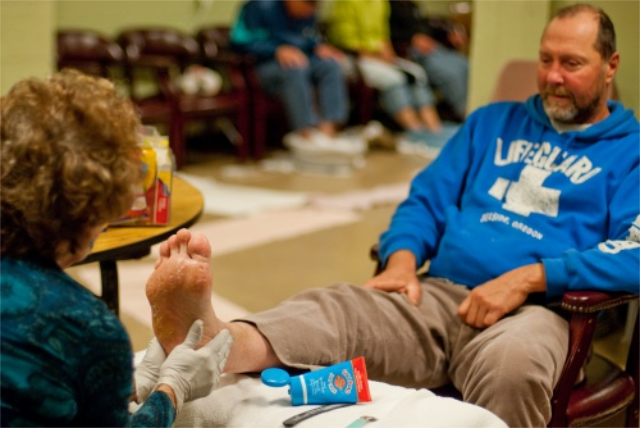
Every Wednesday in our hospitality center at the Downtown Chapel Roman Catholic Parish in Portland, Oregon, the staff and volunteers provide foot care. This once-a-week offering affords people an opportunity to make sure their feet are given proper medical treatment. This ministry began not with the notion of medical assessment and management but with the ancient tradition of foot washing and welcome.

Roy contacted us nearly a decade ago from a suburban parish. He inquired about offering sessions on centering prayer for people surviving poverty. Roy told our staff that he had already facilitated groups in local jails and also various groups of people living with HIV/ AIDS. He wanted to pass on what he himself had discovered in his own life: the deep and abundant love of God. Roy quietly spoke his own story to our staff of his years of wretched anger and hatred toward family members. He told us that his hardened, heated life had been transformed with prayer. Roy assured us that God was still healing his relationships with his wife and children. He was also the foster father of more than a dozen at-risk children. So the members of the staff agreed to his request for offering a time of contemplative prayer among people who live outside and who suffer the many issues of poverty.

After several months of facilitating group prayer, Roy came back to our parish staff with another request. He and his wife longed to discover why Jesus washed his disciples’ feet. Roy said to our staff, “1 know that Jesus ate with his disciples everyday, but on the night before he died, he ate with them one more time and then washed his friends’ feet.” He said with an intense desire, “1 have to find out what that means.”

Thus Roy and his wife began our foot ministry. They welcomed people into a small room with gentle conversation and intentional hospitality. The couple was shy and intimidated at first as they provided soothing salts to soak putrid feet. They trimmed long, yellow toenails and provided clean white socks that they had purchased themselves. While they stooped before people with aching feet, they internally prayed for each person. Our foot ministry was born of a man who admitted to both his selfishness and to his life’s being completely transformed by personal prayer.

After several months of washing rank and sore feet, the couple came back to speak to our staff. The holy couple explained that they glimpsed a reason why Jesus washed his disciples’ feet. Roy quietly said to us, “I believe Jesus washed the feet of his beloved so to see their faces at a different angle, in a new light, in the intimacy of genuine humility.” Roy and his wife continued their service in their own lives by receiving two more foster children into their home. When the couple left our foot ministry, our parish nurse continued it. Today, Sharon and other volunteer nurses, student nurses, and other volunteers receive people on Wednesday mornings. Now the focus is not only to bathe people’s feet but also to provide more medical assistance.

Sharon provides soothing Epsom salts, healing lotions, and creams. The nurses look for deep infections and open wounds that will not heal. They know when to send our guests to a doctor or an emergency room. The volunteers fill plastic bins with hot water and sudsy healing salts. They invite people to soak their feet, and the volunteers enter into people’s lives through the stories of their feet. Sharon and others listen to the words people share and become attuned to their hope that someday homelessness, poverty, and addictions may also be soothed and cured. They wipe each toe with bleached towels, and each foot is examined and dried. They teach our guests how to care for their feet when disease and infection are present because of diabetes. They cut curly long nails and wipe scaly skin with care and concern. The nurses deliberately dress each foot with new white sweat socks.

We provide our foot ministry as an extension of our morning hospitality center because feet are the main source of transportation for many people living outside. Most of our guests cannot afford appropriate health care, and in most cases health care is not accessible to people living on the streets. We also provide this basic foot care because people live in the reality of Portland’s rain and cool weather all year long. Every day, people’s feet are not just damp but squishy wet. People come to us with prune~likeskin and yellow, tough nails. The rank smell of feet permeates our entire bUilding and lingers long into the day. People expose their secrets by crossing our parish threshold and offering theideet to be cared for by our volunteers.

Our volunteers and nurses enter into the mystery of Holy Thursday’s Mandatum every Wednesday morning. This ministry extends the mission of Jesus from the ancient liturgy of the Triduum. The Gospel of John reminds us that our foot ministry is not just a reenactment of the past but a vital ministry in our generation. The ritual gesture is neither fake nor meaningless in our community. Our foot ministry puts into daily action the call of Jesus to become people of hospitality, to enter into the mystery of people’s stories. Our foot care volunteers show us that intimacy happens when we see people’s faces from the perspective of love and service. People’s feet tell us stories, especially when we listen to them from the angle of looking up into their weathered, beautiful faces.

Holy Thursday foot washing
The liturgy of Holy Thursday invites people in every parish into the role of hospitality. The act of washing feet is still a sacred form of worship. Some parishes are quick to replace the foot washing on Holy Thursday with hand washing or shoe shining. These replacements seldom work; they do not bear the weight of the intimate act of exposing dirty feet to the community. Those other acts do not reveal vulnerability or suggest that people actually need God or the community for survival in daily life. Naked feet expose the Body of Christ in real need on Holy Thursday.

Entering into the mystery of the Mandatum on Holy Thursday evening invites every person into the earthy, human need for Christ’s redeeming love. Our parish sets up chairs in our three aisles before the liturgy begins. After the Gospel and homily, the people designated for “foot washing go to their preassigned chairs and remove their shoes and socks. Every person who attends this Mass should see naked feet. People should be able to enter into the action of this rite. The presider and servers process around the chapel to hold, wash, and wipe the human foot. The feet of our people are seldom beautiful, and their nails rarely (if ever) receive a pedicure. The smell of sour feet needs to be part of the rite – not perfumed, perfect feet.

The Mandatuin tells the story of every worshiping community and reveals how each one listens to the Gospel during the entire year. The stories of vulnerability told in naked feet connect to the ways the parish serves people. The foot washing is linked to a young mother wiping the bottom of her infant after a bout of diarrhea. Foot washing connects to the middle-aged man who washes the aging body of his father after he has suffered a stroke. A mother holds the forehead of a grade-school-age daughter vomiting in the toilet. A wife washes the blood off her husband after surgery. A husband cleans up food from his wife’s body after feeding her stomach through a tube. The Mandatum on Holy Thursday connects the human vulnerability we all face in caring for those we love with the public ritual of the church.

Foot washing on Holy Thursday reminds every parish community that we begin each ministry from Jesus’s call to prayer and service. Many parish communities resist entering into such filthy concerns, but we are all called to enter local hospitals with prayer and willingness to be changed by the suffering of our friends and neighbors. We are challenged dUring the Triduum to get our own feet wet from sweat by building a home or painting a garage. We must walk the extra mile to support fundraising efforts for breast cancer or AIDS. On Holy Thursday, we are reminded that we do all of those things because of the intimate love of Jesus, who offered his life for each person.

I recently asked Gwen, one of our regular foot washing volunteers,to articulate how this ministry has changed her. I wish everyone could see her in action, using few words as she carries tubs of sloshing water in our basement to prepare for our guests. She washes and bleachestowels, wipes up floors, and invites people to experience foot washing. These actions go well beyond her words. She said to me, “I appreciate the trust our guests develop in our abilities as well as limitations to provide for what they need.” She also added, “The community helps me to maintain an attitude of grateful living, to not take things for granted, and to do what I am able.” Gwen does so much without the notice of so many. Gwen can also be seen on Holy Thursday serving the Eucharist or reading the Scriptures.

Gwen’s daily actions guide our Triduum. Her actions, along with those of all of our volunteers, speak the reality of John’s Gospel. She and the many nurses and volunteers live the Mandatum every week. The connection of prayer and service is lived on Wednesday mornings in our parish basement. I do not have to look very far to preach the Gospel on Holy Thursday. The feet that cross our threshold each day are signs of the crucified Savior. Their smell reminds me always to walk with people who suffer.
The Faces of Friday

The stations of the cross are a traditionally practiced prayer and meditation by which to view all human suffering. This version, The Faces of Friday, articulates the raw suffering we encounter daily at our parish here in Portland, Oregon.

Before viewing, you are invited to read an introduction to The Faces of Friday from an article in Celebrate! Magazine.

You can also read an article in today’s Catholic Sentinel about The Faces of Friday.


Litany for Evening Prayer: Celebration of Saint Andre

Litany for Evening Prayer: Celebration of Saint Andre
Cathedral of the Immaculate Conception

Cantor: Hear us, O God
Response: Hear us, O God (or whatever short sung response works best)

Saint Andre of Montreal; open our communities to the hospitality of Christ Jesus…
To the lost sinner and the illiterate friend…
To the abandoned child and to the aging widow…
To the weary traveler and the teenage prostitute…
To the bashful student and the struggling teacher…
To the hungry stranger and runaway teen…

Saint Andre of Montreal; open our communities to the healing of Christ Jesus…
To people suffering from every addiction…
To people with every incurable disease, illness and affliction…
To our friends, relatives and neighbors longing for reconciliation…
To every religious community that seeks peace and non-violence…
To nations locked in war and violence…

Saint Andre of Montreal; open our communities to the mission of Christ Jesus…
To students seeking a new education…
To people discerning their vocations …
To the renewal of professed religious life and fidelity in marriage…
To the next generation discovering faith and service…
To our missionaries in foreign lands…
To a greater commitment to prayer and love of God…

Saint Andre of Montreal; open our hearts to the love of Christ Jesus…
To the care of Saint Joseph, Husband of Mary…
To the consolation of Mary, Our Lady of Sorrows…
To the Cross of Christ, our Only Hope…

Cantor: Hear us, O God
People: Hear us, O God

Cantor: Hear us, O God
People: Hear us, O God

Food For Friday

Originally published by Ministry & Liturgy Magazine, February 2011
– PDF version –

I crave the Eucharist on Good Friday. Perhaps my hunger is most pronounced then because Good Friday is the only day of the year in which the celebration of the Eucharist does not take place. Nevertheless, my hunger grows strong. I intellectually realize that the Body of Christ is distributed on this sacred day consecrated from the Evening Mass of the Lord’s Supper on Holy Thursday. Even with that knowledge, my hunger pains cry out. These liturgical arguments do not take the longing away from my soul. Nothing really soothes my hunger on Good Friday.

I experience great hunger on Good Friday because I pray with people who feed only on their loneliness and suffering on most other days of the year. People stream into our chapel at high noon on Good Friday. Some cross the line from the business world to the world of poverty by simply walking across Burnside Street. Some people stroll into the chapel after spending the morning in our Hospitality Center seeking clothing, a new backpack or clean pair of underwear, or just to be acknowledged by name. Some people stroll in recalling childhood memories of kissing the cross, inhaling bellowing incense and humming long Latin chants. Still others are curious about what Catholics do on Good Friday since Jesus stays on the cross all year long in our sanctuaries.

No matter the curiosity of some people or the memory of others, there remains a collective hunger for God. For so many people the hunger is bone deep because they are crushed by relationships of abuse. Many of our worshippers hate themselves for how their lives have turned out from serving in wars or selling their bodies for drugs. The collective hunger in our worshipping assembly settles into our common songs and liturgical responses. People remain emotionally empty and are looking for a way out of the circumstances that have brought them down. We are all hungry for God’s love and compassion on the day when we remember the death of Christ Jesus.

Several years ago our staff tried to address this common hunger in a different way during the Good Friday liturgy. We looked to a common item that we distribute each day that comforts people, yet a reminder of hunger itself – a bag of food. On most weekdays, our community distributes food bags to people living in single-room occupancy hotels. These single rooms are no larger than a parking space. People need food to get by because the monthly rent remains outrageously high. So our community offers bags of canned goods and items that can be warmed on a small hot plate.

These food bags are a reminder of poverty itself. They speak volumes about our inability to feed people’s needs. We only offer them a few cans and packages to survive a long month of high rent and skyrocketing food prices. The presence of these brown bags reminds people of their own hunger as they also symbolize our help for them.The bags tell the stories of severe loneliness that eats away at those whose lives are so tenuous. Living alone in a bug-infested, noisy room destroys one’s dignity. The bags of food become a sign of hope even in the midst of poverty and loneliness, of hunger and broken dreams.

We stationed members of our staff carrying bags of food on each side of the cross as people came forward to reverence the cross. We then invited people to also touch the bag, to pray for our starving neighbors and the millions of starving people around the world. Since so many people count on our bags of food this was a simple reminder that the Cross of Christ is lived here on this block amidst great hunger. Many visitors ignored the invitation; some did not get the connection to Christ’s presence. However, for many people the Cross of Christ and the bag of food became the source of real and substantial nourishment.

I realize this gesture would not work for every worshipping assembly. I know it may even confuse many people. However, I keep trying to discover ways that people in poverty can find their home in any of our worshiping communities. I am at a loss to feed people’s unfathomable and lasting pain. This is Good Friday. Only God can restore people’s lives and feed their deepest needs. This is the place in which I learn to trust God. The Cross of Christ is the place for real, rich and sustaining food even though I remain so hungry on Good Friday.


Lenten Rhythm

Originally published by Ministry & Liturgy Magazine, December 2010
– PDF version –

Several years ago I sat around the kitchen table in the rectory with a friend discussing our upcoming Lenten discipline. My friend taught Scripture at a Catholic university and she had been received into the Catholic Church the previous Easter. She challenged me to look at Lent differently. We stumbled on an image of Lent being a delicate dance, a relationship with God who longs to offer us healing and love.

Our discussions led us into this unique dance of partners that Lent offers us, sacrifice and grace, sin and forgiveness, contrition and change, suffering and love. We discussed our need to understand the Scriptures differently than in previous years. We realized that we needed to go beyond taking the gospels for granted, beyond our automatic responses and our usual patterns of praying and living them.

We then tripped over the idea to actually take a few dance lessons for our Lenten offering. Somehow I agreed to sign up for Tango, the most complicated dance of all. All of a sudden I found myself in a downtown dance studio just after Ash Wednesday. The instructor assumed we were a couple and just could not quite figure our motives for pursuing dance since neither of us was at all a natural.

We laughed more than we danced, we tripped over our feet more than we felt the rhythm of the music and we embarrassed ourselves during the three weeks of lessons. Real dance is more complicated than we thought, the footwork, the balance and the emotions. Our insights and discouragements led us back to the Lenten gospels to examine the relationships that are crucial in this season.

Jesus encounters a delicate relationship with the temptations of the devil. The two tango with the scriptures and God who promises support even when we dash our feet against a stone. We partake in this sacred dance when our two left feet deal with our sin against helping people who cannot stand up for themselves or feed their children. In Lent our relationships with overeating, drug use and extramarital affairs stop us in our tracks. Our convictions must speak louder than the din of anger, rage and neglect. Lent must be centered on the real pain of our people, the disillusionment of our spirits and the temptations of our emotions.

Lent calls us to get a new perspective on our lives. This perspective is not from a high mountaintop, but an inner awareness that a new vision is possible even for the most stubborn among us. Fear is the culprit we must all deal with in Lent. Dancing with fear can lead us to self-absorption, lack of love and empty relationships. Taking fear by the hand can lead us all into the love that God has for even the most callused or confused partner.

The woman of Samaria danced around her past in the presence of Jesus. He knew her heart and the real person behind the water jar and the fear. He named her real thirst, gave her hope to drink and sent her on her way to set others free. This marvelous dance at the well at noontime still shows us that Christ is in relationship with sinners, doubters and outcasts. This holy dance is for everyone. Christ opens up faith to be about people, not certainty, correct rubric or dancing the tightrope of politics.

Jesus still spits on the ground making clay with saliva in order for us all to see. We are still blind to teenagers having sex in schools, adults shooting heroin in movie theaters and gangs murdering our elderly grandparents. We still do not think people suffering homelessness are our sisters and brothers nor do we really see that children need food in an era of severe obesity. The Lenten dance takes us by the heart, puts spittle on our ears and courage in our souls.

We also realize we cannot dance in the dark. Jesus finally goes to his friend Lazarus and teases him out of the grave. Lazarus slowly moved his body in a divine dance, being released from the burial clothes and the bonds of death. We too, shake ourselves from even the fear of death in order to live a new life in Christ. We wake up to life when the bandages of fear are slowly unraveled in faith, hope and love.

Lent beckons the soul in a dance of new life. We discover our faith again in the radical rhythms of Christ’s death and resurrection. These gospels of the Lenten season take us by the hand and form in us authentic life.

This is the beginning of conversion for us no matter where we worship. Even though my friend and I did not master the Tango, I entered that year more deeply into the invitation that God takes the lead of every aspect of my life. The task for us all is to keep dancing in the love God offers each person no matter our stumbling, no matter our falling and no matter our lack of rhythm.


Door Man: St. André Bessette

Originally published by U.S. Catholic, December 2010
– PDF version – Online version –

Brother André Bessette didn’t need fancy degrees to know how to welcome the sick who came to the Holy Cross community. Now, he’s the order of educators’ first saint.

My path to the priesthood, as with all priests in the United States, involved many years of higher education. I earned two degrees from the University of Notre Dame before being ordained a priest in the Congregation of Holy Cross in 1983. Later I received yet another master’s degree from Notre Dame. I learned all the appropriate professional skills. I studied the correct rubrics from scholars of liturgical history. The vision of the Second Vatican Council prepared me for what I thought my work would entail.

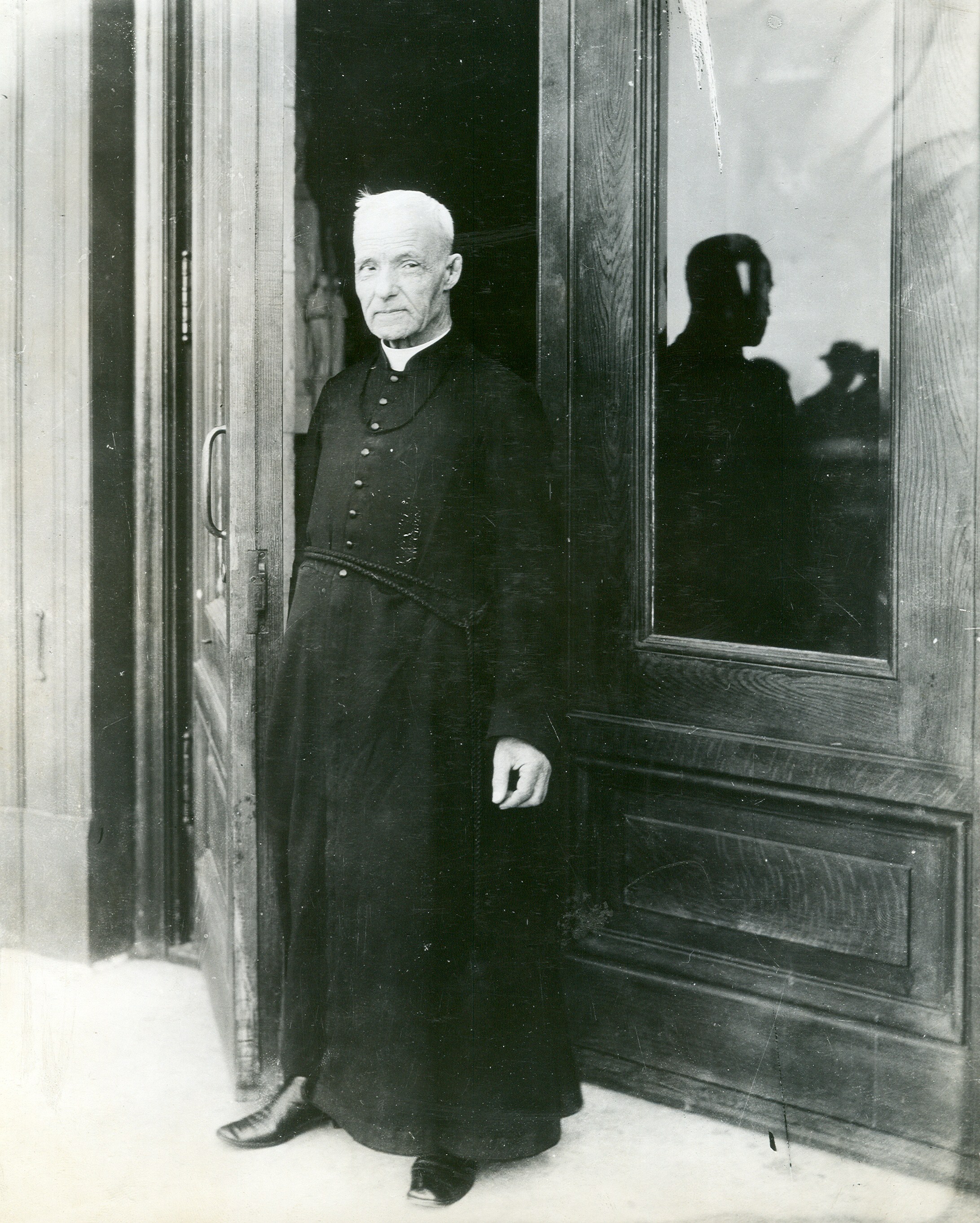
The education that truly formed me, however, has been learning to pray through my own suffering and the inconsolable pain of others. I am now a student of an uneducated orphan and sickly man, Brother André (Alfred) Bessette, C.S.C., born 30 miles from Montreal in 1845. Ironically, the frail, illiterate brother is our first saint in the Congregation of Holy Cross, a religious order that is best known for our achievements in education.

Brother André dedicated his life to St. Joseph and to people suffering from spiritual and physical illness. He convinced the Holy Cross community in Montreal in the early 1900s to build St. Joseph’s Oratory. Today, the oratory houses the many crutches, canes, and wheelchairs left behind by healed pilgrims who prayed to St. Joseph upon Brother André’s request.

Because of his ill health, members of Holy Cross did not initially want Brother André as a member of the Congregation. His novice master begged the community to allow him to stay because of his intense prayer. He professed vows and was assigned as porter at Notre Dame College in Montreal, the only formal ministry he held his entire life. He began to welcome the sick and the fragile, the ill and the outcast. His door became his entry into people’s deep suffering and isolation. André’s formally educated confreres quickly became displeased with so many sick people congregating around the schoolyard.

Brother André persevered in his devotions. He told people who were ill to pray to St. Joseph, to rub oil on their wounds, to believe in the miracles of Christ Jesus. He experienced God’s healing of thousands of people. He became known as the “miracle worker of Mount Royal.”

Now that I have come to the doors of the Downtown Chapel in Portland, Oregon, I have learned to pray and serve from Brother André’s example. These red steel doors open every day to hundreds of people who cry for help dealing with mental illness or who are consumed with unending loneliness.

Our parish staff and volunteers welcome to our daily hospitality center people struggling to get off drugs, the recently unemployed, and those who have spent their entire adult lives living outside. We welcome people who lash out at others because they cannot heal from their own sexual abuse. We welcome people with gangrene and people who have just been released from jail. Every day we are confronted with our insufficient answers to unsolvable problems.

I arrived here at the red doors of the Downtown Chapel more than eight years ago disillusioned with many aspects of the church. I arrived here in great need of spiritual healing. I turned to Brother André to welcome me, just as he welcomed others in need of healing and consolation in Montreal. Now I experience what André encountered, the inconsolable pain of people. People living in poverty are now my teachers.

Because he could not read, André memorized the Beatitudes and other passages of scripture that offer hope to people in pain. He believed that faith alone was the answer to real human suffering. Confronted with hundreds of people each day waiting to speak with him, André often lost his patience. He was often rude and curt with people who did not want to pray. His curmudgeonly style did not deter people from wanting to be physically touched and emotionally affirmed by God.

I lose my patience as well when I realize in recent years the church has moved away from its healing mission, relinquishing many hospitals, nursing homes, and orphanages. The personal touch of healing has been replaced by large corporations and impersonal technology. At our parish doors, I realize that faith alone can motivate people to give of themselves when other people hurt in so many ways.

Brother André died on January 6, 1937. More than a million pilgrims streamed to Montreal for his funeral. In those days before jet planes, the Internet, and cell phones, the real communication of faith and gratitude spread rapidly among believers.

The Catholic Church canonized Brother André Bessette in Rome on Sunday, October 17, 2010. On that day, I unlocked our red doors in Portland and praised God for André’s example.