Unknown's avatar

About Ronald Patrick Raab, C.S.C.

Ronald Raab, C.S.C.,serves as religious superior at Holy Cross House, a medical and retirement home for the Congregation of Holy Cross, Notre Dame, Indiana

Advent Alarm

Originally published by Ministry & Liturgy Magazine, October 2010
– PDF version –

I wake up every morning to the sound of a dozen or more people talking as they line up around our parish building. Some people are still sleeping in the shelter of the inset near our front door. Others pack up quickly to claim a place in line for our morning hospitality center. Still others will sleep off the cheep booze from the night before.

Waking up to this reality wears me down, especially during the Advent season. Sleeping in a heavenly peace seems like such a dream. This reality seems more like nightmares for people carving out a warm place to be safe under mounds of damp cardboard. Others go weeks without slumber because of drug overuse. Other people sleep all day long due to deep depression. A few people sleep at our door with no blankets, no possessions, no cardboard box or coat or hat, just the concrete for a pillow.

The issues of sleep and waking up create real problems for our parish community. Every morning members of our staff come to work and nudge people out of sleep who are blocking the entrance to the building’s door. During the noon Eucharist when our offices are closed, other people obstruct the exit trying to catch a quick nap. Some people fall asleep in our pews during the noontime Mass – especially the corporate executives.

Advent is the time for people in every parish community to wake up to the reality that surrounds us all. Stay awake! This command in Matthew’s Gospel challenges us to wake up to our timidity toward people’s needs. Advent instills in our communities the deep passion for why Jesus came into the world in the first place. We need to get off our common couches and do something about how people are living in the world.

Advent calls us to claim the dignity of all people. We do this by waking up to the real paradoxes of our day. In this time of year when we overeat, we are called to acknowledge the billion people in the world starving for basic bread. In this time of buying, accumulating, fussing over the correct gifts, Advent scriptures should claim a new awareness of our possessions no matter in which community we live.

No believer wears camel hair and feasts on locusts anymore, but the Sunday gospels need to capture our imaginations about whether or not people have decent clothing. We need more than ever in a downward economy to rouse new attitudes about how we care for elderly people or the mentally ill person who needs a community in which to rest. As members of any worshipping community, we need to find new ways to welcome our homosexual children back from college, our cousin who lost everything gambling on the Internet and our uncle who walked out of his marriage. We all need to come to grips with our real possessions, our relatives and friends.

The Advent Gospels proclaimed in every parish shake us up to see that the lame walk, lepers become cleansed, the deaf hear and the poor have good news proclaimed to them. This is the time to rouse communities from the sleep of apathy and complacency. We need to preach about the needs of people living in poverty even though other people do not want to hear about it. We need now to invite our children into real and dedicated service so that they can witness the parish community doing something worthwhile. We need to invest not only in people who cannot make ends meet, but also in our children who are walking away from our worshipping communities.

Waking up is never easy, but the issue of our sleepy attitudes is the core of the Advent season. We open ourselves to real people because Christ became flesh and invested himself humbly in our human world. He took on the humility of flesh so that we could see all people as divinely loved.

A couple of Christmas’ ago a strong-willed, homeless woman, Bonnie, blocked our only doorway during Christmas Eve Mass. She piled up blankets and carts in a matter of minutes by our red doors. She opened containers of food and invited street people to join her. She smoked a few cigarettes and spoke loudly to passersby. She prepared a place to sleep while members of the parish sang carols and broke bread and shared the cup and proclaimed that Christ is born for people.

I walked out into the lobby as Mass ended and could not believe my eyes. No one could exit the chapel. I scurried to persuade her to move her belongings. Some parishioners helped her move her camp to the side of the building. Knowing Bonnie and seeing her bright eyes, I am convinced she held us captive in the chapel so we could wake up to the meaning of the Incarnation, the Body of Christ in our real world.

A Foot in the Door: A Community Modeled after Brother Andre Bessette, CSC

Originally published by Ministry & Liturgy Magazine, October 2010
– PDF version –

The only outside doors to our parish building symbolize welcome and hospitality to our neighborhood in downtown Portland, Oregon. Members of our pastoral staff and volunteers tell stories of homeless people recommending the “red doors” to other people living on the streets. Many among the urban poor people in our neighborhood do not realize we are a Roman Catholic parish, but the bright red doors are known by everyone as the place to receive many of the essentials of life.

People queue up to receive clothing once a month or a laundry voucher once a week from our daily hospitality center. Some residents of the single-room occupancy hotels enter our doors to seek money for non-narcotic prescription medications, or stand in line for a flu shot clinic. Others wait at our entrance for coffee and donated food, excess from local restaurants and grocery stores. Some homeless women may sleep at our red doors during the night. Some drug dealers may urinate on our doors during any hour of the day. One local newspaper even shared a picture of someone who had vomited on a competitor’s newspaper at the entrance to our building. Our doors were then named the “Best Place to Puke” in Old Town, Portland, Oregon.

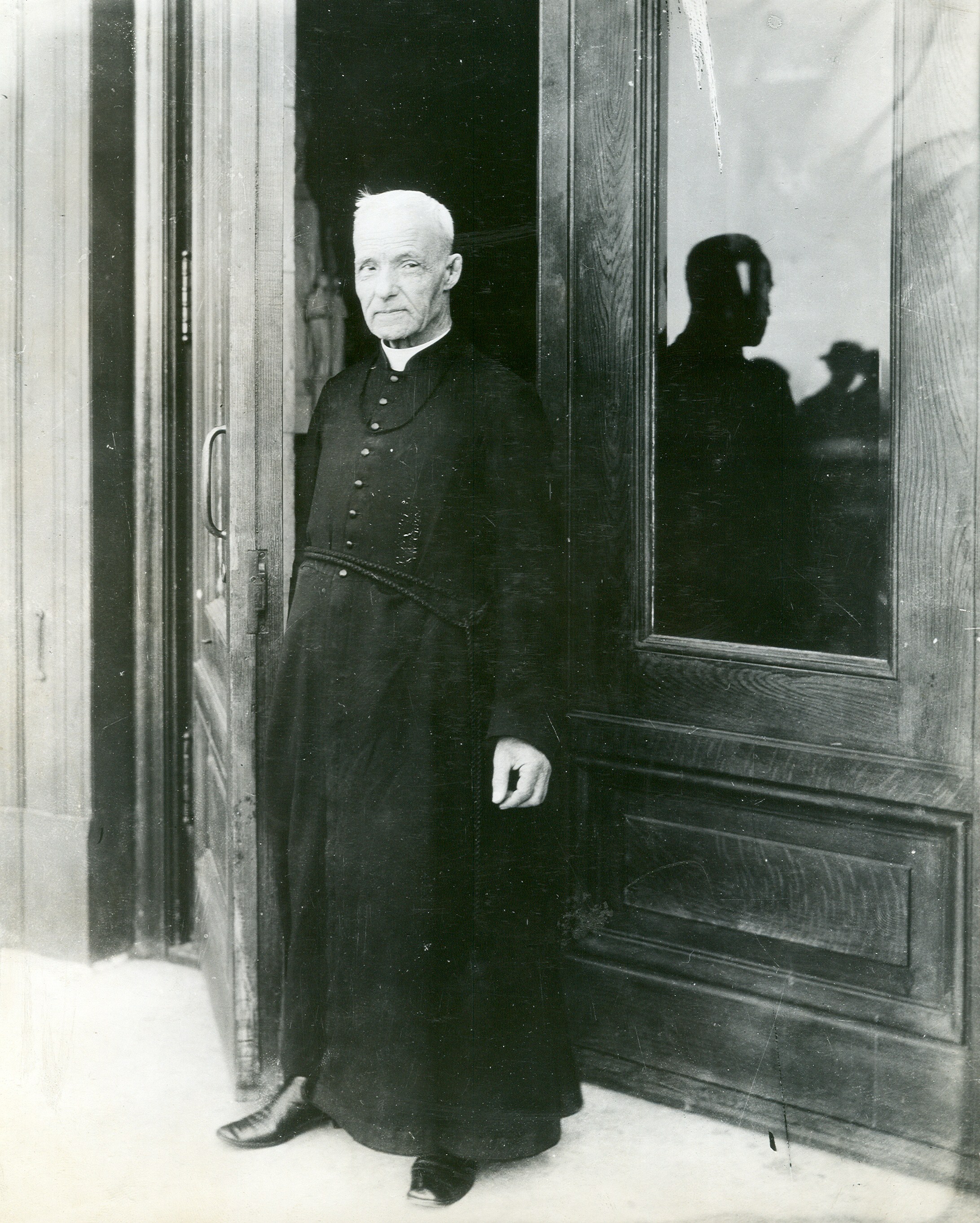
These sacred doors also lead to the chapel where we celebrate Eucharist every day. When we celebrate Eucharist we all realize the importance of our community so people may find hospitality and healing. Last February we announced to our Sunday assembly that Blessed Brother Andre Bessette, CSC will be canonized in Rome on October 17, 2010. The congregation applauded and cheered. Nearly everyone here knows that our community is a community that Brother Andre helps build.

I was standing at our open doors after that Mass and one of our parishioners came up to our pastor and said, “This is where we find Brother Andre, at these doors, in this community!” Indeed, we rely on the intercession of Blessed Brother Andre, because each day we are faced with undying suffering, with questions no one can solve and with ingrained pain that has not healed for generations.

I remember when I first stepped through our steel and glass threshold. I was overwhelmed by the body odor that had clung to the inside of the building. There is no pine-scented chemical that clears away such an odor. I do not even notice that smell anymore after nearly nine years at the parish. There are so many more important aspects of people’s lives to consider.

Blessed Brother Andre, CSC was a member of my religious community, the Congregation of Holy Cross. He died on the Feast of the Epiphany, January 6, 1937. His service to people long ago in need of healing, comfort and consolation continues in our parish as we welcome people living outside or who do not know where to turn because of their mental illness or in their inability to find sufficient health care.

I do not look to Brother Andre for simple solutions to the problems we face at our door. However, his life tells a tale of great faith and dedication. Alfred (Andre) Bessette was born thirty miles from Montreal, Quebec, in Canada on August 9, 1845, the eighth of twelve children. He was always sickly. His mother instilled in him a great love of prayer and dedication to Christ and a special loyalty to Saint Joseph.

Alfred grew up in poverty, especially after his parents died. As an orphan he never finished school. He was illiterate but memorized many passages from Scripture, especially the Passion narratives of Christ. The superiors in the Congregation of Holy Cross did not want to accept Alfred into the community because of his frail health and lack of education. A local pastor, Father Andre Provencal, convinced the Holy Cross superiors to accept Alfred Bessette as a member. He added a note saying, “I am sending you a saint.”

It was through great prayer and the help of friends that Alfred became Brother Andre. He desired a life of poverty, celibacy and obedience. His sole assignment within the community was to serve as the Porter at Notre Dame College in Montreal. His ministry at the door of the college became his path toward love and holiness. He never imagined or dreamed how his life would change or how others would respond to him.

Almost immediately, people were drawn to Brother Andre. He told many who were sick to ask Saint Joseph for help, or to attend Mass. He anointed the sick with special oil found in a lamp near the Saint Joseph statue. He rubbed people’s wounds with a blessed medal of the saint. People were cured of many ailments, diseases and sufferings. Many people began leaving their crutches, canes and prostheses at the college. Brother Andre believed strongly that God’s healing was available for every person surviving poverty.

Some members of the Congregation of Holy Cross criticized Brother Andre because of his ministry of healing and his devotions. Parents at the college feared that sick people would get too close to their children. Brother Andre never saw himself as a healer nor was he concerned in the slightest about his reputation. Andre recognized that healing happened not through him alone, but because people believed in the works of Christ and the intercession of Saint Joseph.

Several years ago a young Jesuit novice entered through our red doors to volunteer in our hospitality center. He noticed Brother Andre’s image hanging on the wall. The novice immediately recognized the image and told us that Brother Andre was his great-great-uncle. He told us a story of a relative going to see Brother Andre. She stood for hours in a long line. Finally she got the opportunity to hold Brother Andre’s hand and tell him that she was a relative from the United States. He told her to move along; his time was for people who really needed him. This story has stayed with their family for years. When relating the story, his relatives told everyone that Brother Andre was a curmudgeon, a cranky old guy who did lots of good things.

Indeed, Andre did not have time for people who were merely curious about him. His single-minded devotion to suffering people was evident well beyond the borders of Canada. He became friends with many people who believed in him and his life was rich with friendships even when he was exhausted from speaking with the thousands of people every week that wanted to see him.

I continue to learn much from the small-framed, pious man who was poor, orphaned and homeless. Our shared religious community, the Congregation of Holy Cross, is best known in the United States for higher education among the privileged. We are priests and brothers, educators in the faith, known for outstanding college football and living comfortable lives. That the frail, illiterate doorkeeper and barber, Brother Andre will become our community’s first official saint, is a great paradox. I pray that we all have the courage to understand his life and celebrate his sainthood.

The poor believed in Andre because he too was poor. He did not see his religious life as an opportunity to escape from poverty or from hard work. Andre’s hospitality was a lived example of Jesus’ desire to run after the one lost sheep even when he was exhausted and afraid. Christ’s command to search diligently for the lost coin is seen in Andre’s acceptance of people. Jesus’ request to ask for what you need, knock on the door with faith and seek always was the total life of Brother Andre.

I am challenged by Andre’s legacy as I stand at our parish doors. I am not economically poor and my faith often wavers from hearing stories of traumas I cannot heal. My greatest poverty comes in my sheer loneliness and deep sadness that I cannot heal the abuse people have suffered as children. I cannot mend their horrific memories. I do not have the power to repair people’s ability to keep a job. I possess no answers when people weep because they do not have love or intimacy in their adult lives. I have only the profound example of Brother Andre as he lived Christ’s invitation to welcome people into community.

People often bend my ear at our parish doors, arguing that if the homeless would just get jobs they would not be a burden on society. I have not read any description of Andre yelling and screaming at passersby, but I often want to shout at people when I hear their judgments. People come to us abused, addicted, and mentally ill and possessing no self-esteem. In this economic recession even the most educated and the most beautiful find employment difficult to attain. We welcome people living in poverty, following Brother Andre’s example, and do not blame people for the struggles and challenges of their lives.

Many church doors are still locked and some of our communities remain inaccessible to certain people within our Church and society. Some doors are barred to children of gay and lesbian parents. Many doors are closed to pregnant teens. Doors are bolted shut to recovering drug addicts who try to heal from multiple abortions. Other doors are closed to the elderly who seek help after being abused. There often seems to be no one on the other side of parish doors to help in times of deep depression, bouts of lashing out from mental illness and landing in jail or even for former clergy seeking help with alcohol addiction.

These are the parish doors that worry me, that keep me awake during the night. Our answers rest in the models of service and hospitality that Brother Andre still shows the Church. I must believe that Christ’s love is the cure for such loneliness and despair among so many people living on the margins of our culture and Church.

Before I open our church doors, I must become vulnerable to God. As I step into the unknown of people’s lives, I remember that only God can reconcile the broken, heal the sick and feed the hungry. There are days when I cannot come to God with anything but fear and a deep knot in my chest. On these days I try to be counted among the disciples who scurried to a dark room, locked the doors and wondered what to do next. Then I search for the words the resurrected Christ offered to them and now offers to everyone, “Peace be with you.” In these words I turn toward Andre’s legacy of living each day in deep prayer and rich satisfaction of the peace and joy offered by God alone.

I admire Brother Andre because he lived his life with passion. He lived an utterly simple life. Other people had to force him to wear a warmer coat and to replace his worn-out shoes. I am deeply changed by this man who simply lived what he believed, that the love of God would be enough for him. God’s love, as it turned out, was more than enough for him.

Every Friday night our parish doors are opened for a meal of soup and sandwiches. People eat seated in chairs stretched along the sidewalk after receiving the meal in our small lobby. We name this soup line “Brother Andre Café.” Simple food becomes the message of hospitality and an extension of the Holy Eucharist. We offer this community event even in the pouring rain or when few volunteers come downtown to help. We welcome people from local low-income housing apartments and people who live under Portland bridges. This is people’s Friday night out, a time to relax on plastic chairs and converse with new volunteers and friends. Brother Andre’s spirit is with us even in the peanut butter and jelly sandwiches.

Through Andre’s dedication, hard work and endless prayer, the Oratory of Saint Joseph in Montreal, Quebec in Canada, stands today as a place of devotion and prayer for many pilgrims from around the world. When Brother Andre died, over a million people fought the frigid weather and deep snow to get a brief moment to view his earthly remains. I truly believe that Brother Andre Bessette, CSC still opens doors for people surviving poverty and living with the consequences of physical pain, mental illness and devastating emotional disease.

Saint Andre of Montreal, pray for us and welcome us home.

Heart

Brother Andre Series: Number Nine

I often listen to our student volunteers question their futures. High school students wonder if college is the best solution for future employment. College seniors panic about how to find next year’s job so they can start paying off student loans. As the students spend time at the Downtown Chapel, they begin to realize that faith and service are key ingredients to their future lives and careers. The young volunteers discover from people living in poverty that real relationship and genuine kindness will open many doors to the future.

Many students volunteer in our parish hospitality center searching for a deeper meaning in their lives. These talented people simply want to give their hearts to a real cause, a purpose, to make a difference in the world. Even though they worry about the weak economy, high rates of unemployment, student debt, and even expectations from parents, they simply desire to offer their hearts in service to real people.

Brother Andre simply gave his heart to God. Even though he was illiterate and sickly he chose to listen to the worries of the sick. Even though the Congregation of Holy Cross hesitated to accept Brother Andre, he was always obedient to his superiors. Brother Andre was determined to dedicate his daily life to Saint Joseph, the patron of Canada and the Brothers of Holy Cross. Brother Andre’s compassionate heart was fashioned from his own suffering and his faith strengthened from receiving people on the margins of society.

Brother Andre invited people into prayer as they lined up to speak with him. He envisioned a chapel where people could come in pilgrimage to Saint Joseph and to pray in gratitude to God. On October 19, 1904, the first chapel was officially opened. Because of the large number of people streaming to the chapel for prayer, worship and healing, a new, larger chapel was built by November of 1908. Then in 1914, the Superior General of the Congregation of Holy Cross granted permission for Saint Joseph’s Oratory to be built. The construction took many years and was only completed after Brother Andre’s death.

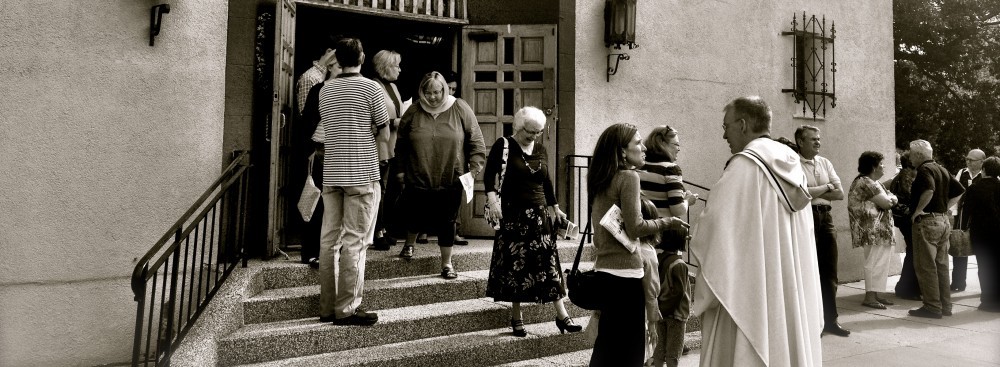
Saint Joseph’s Oratory stands today in Montreal as a beacon of love and healing for many people. The prayerful setting welcomes thousands of visitors and pilgrims each year. This place of prayer reminds everyone of Brother Andre’s complete dedication to God. Today, Brother Andre’s physical heart is on display at the Oratory. This French custom reminds us that Brother Andre literally gave his heart to the mission of God’s work, to people in need of spiritual, emotional and physical healing.

The students in our daily hospitality center remind me to offer my own prayer and work for the purpose of God’s people. Brother Andre’s story shows us that our searching must rest in God’s love for people in need of hospitality, healing and hope. In faith, we shall all discover our heart’s desire.

Photo: Steve Scardina, (Brother Andre’s heart at Saint Joseph Oratory in Montreal)

Holiness

Brother Andre Series: Number Eight

I learn a new reliance on God every single day. God teaches me this greater dependence because I do not know where else to turn with people’s overwhelming concerns. I cannot fix a young man who was in recovery from heroin and relapses just before his child is born. A young prostitute sneaks into the chapel to speak with me about the men who control her. An elderly man battling severe mental illness and loneliness confesses to me again in our hospitality center of his ongoing addiction to pornography. The circumstances of people’s lives demand from all of us a deep and unending faith.

Our ministry at the Downtown Chapel invites me into days of unanswerable questions, never-ending emotional turmoil and unsolvable situations. From the lives of people living in poverty, I learn how to trust God and come to terms with the fact that God alone heals. I must believe that there is more to come, that God is not finished with even the most stubborn of personalities. This is the place in ministry that challenges me into a deep and profound holiness.

Brother Andre exuded a real and often harsh holiness. He was often impulsive and certainly not perfect in his dealing with people who needed him the most. He stood on his feet for hours listening to people, and constantly being present to people was hard work for him. Especially as the years passed by and his own health grew precarious he grew more emotionally exhausted from his office hours. However, he never let go of his role to offer people a kind word and to lead them to Saint Joseph and ultimately to the love of Christ.

Brother Andre’s relationship with God and his real humanity grew together in his ministry and with his aging. Father Cousineau, Brother Andre’s Superior, recalls this daily tension, “During the early years of his work, Brother Andre rarely showed any signs of impatience….As he neared the end of his life, especially in the last three or four years, he did indeed express impatience more frequently….Many people, frightened by his ascetic expression or by the abruptness with which he put an end to meaningless conversations, failed to notice that Brother Andre maintained, despite his abrupt demeanor, a facial serenity which was the mirror of his inner peace….His outbursts of impatience were attributable, at least in my opinion, to his old age, to his failing health, and to the weariness his work caused him…”

Brother Andre’s holiness comes from entering into people’s unending physical and emotional suffering. He knew that only God could heal the people who came to him. He became harsh when he understood that healing was possible but the people doubted. He teaches us still in our day to believe in the power of Christ Jesus no matter our pain and uncertainty.

Hunger

Brother Andre Series: Number Seven

People from our neighborhood pour into our small lobby for a Friday evening meal. Our neighbors living in single-room occupancy hotels socialize on the sidewalk outside the Downtown Chapel. Members of other parishes volunteer monthly to create their special recipes for soup. They provide sufficient welcome with sandwiches and fruit at our red doors in downtown Portland. Our parishioners pour lemonade and brewed Fair Trade coffee. We welcome familiar faces that live outside and make sure people know they know they are more important than even the food.

We serve food in our lobby and on our street corner for many reasons. This low-barrier event welcomes people who normally fear institutions and especially churches. We continue this soup supper outside even in the pouring rain because so many drug dealers use our sidewalk. For a couple of hours on Friday nights, we claim the sidewalk ourselves to satisfy human hunger as well as a deeper hunger for belonging and community. Our presence outside also shows local business people and folks attending bars and restaurants that we are a Christian presence in the neighborhood.

Since Brother Andre served as porter in Montreal, we name this evening meal to honor him. The Brother Andre Café serving at our front door attracts dozens of student volunteers from the University of Portland and many other colleges, high schools and grade schools throughout the year. Volunteers from several Portland parishes including Holy Redeemer and alumni of the University of Notre Dame all cook soup and purchase peanut butter and bread for sandwiches.

Brother Andre practiced mortification even in his diet. Even though he was sickly throughout his life, he ate very little food. His favorite food was a mixture of flour and hot water. His restrained diet sometimes included a simple pea soup or beans. He rarely served meat when he hosted people in his simple room above the chapel where he lived. He rarely ate with his Holy Cross community because of the demands of his role as porter.

His diet was also an extension of his spirituality. Brother Andre wanted to identify with people who were hungry so he would be hungry for God alone. He never wanted to go against his vows of poverty even concerning his own health. Even his friends could not talk him into a full course meal or a rich dessert.

Our staff and volunteers at the Downtown Chapel admire Brother Andre’s quest to place his life among people living in poverty, those whom he chose to serve. During our Friday evening meal we see the dire effects of physical hunger among our guests. We also witness the deeper hunger of people who desire a voice in society, who wait for their daily bread and who long to find their authentic place around God’s table.

Humility

Brother Andre Series: Number Six

People surviving poverty sign up for some life essentials on weekday mornings at the Downtown Chapel. Some people need a heavier coat to protect them from the Portland rain. Others need clean white socks and shoes. Walking is the primary mode of transportation for many of our guests. A man whispers to a volunteer that he needs clean underwear because he could not find an open bathroom in the early morning. Socks, underwear, jeans and jackets become essential for people who live under bridges or in doorways of local businesses.
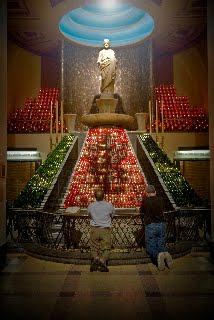
I see masks of embarrassment and fear on the faces of people who ask for such personal items. No person should have to inquire to strangers for such intimate bits and pieces of hygiene and clothing. These awkward moments are very humbling for so many people. These overwhelming situations become an opportunity for volunteers to enter into people’s suffering and listen to their stories. These instances have the potential not for rash judgment and condemnation, but of genuine conversation and real relationship.

Brother Andre expressed his reliance on members of Holy Cross by asking for the basics of life. His black religious habit that he always wore was threadbare. He never wanted to spend money on himself. The soles of his shoes were worn out and he only reluctantly accepted new ones. Brother Andre’s room was decorated with a single bed, a wooden chair and crucifix. He was quoted often, “There’s no point in seeking material comfort because it’s more difficult, then, to follow God’s way, as one should.”

Brother Andre’s ideas about material belongings were not just pious, scrupulous notions. He continued to live from his upbringing of poverty and suffering. He wanted to model his religious life on people who are forced to ask for the essentials of life in order to survive. He needed to live the struggle of finding a coat that fit him and shoes that would survive the winter. Andre humbly desired to open his life to the grace of God. He timidly relied on God for everything, including every material possession. He depended on God’s grace in such practical matters so he could be an instrument of God’s greater physical and spiritual healing for all the strangers who knocked on his door.

I struggle with the meaning of my many material possessions. I am still learning to rely on God and trust in providence. My teachers are people who line up under my bedroom window every day waiting patiently to change out of their wet clothing or get their toenails trimmed or their hair cut. The example of Brother Andre challenges me to live among our parishioners and friends struggling to ask us for their daily needs. I learn slowly to trust God for all things, to humbly ask for all I need in order to love and serve.

Healing

Brother Andre Series: Number Five

I arrived at the Downtown Chapel in March of 2002. My two and a half day journey from South Bend, Indiana was filled with anxiety and restlessness. I wasn’t sure I wanted to be here in the first place. I left my previous assignment emotionally fragile and quite uncertain about my life within the Church. I questioned my own abilities, gifts and even my desire to continue in ministry.
After unpacking my belongings and sorting through all my doubts and questions, I gradually began to be present to people who live with very few possessions and who face incredible suffering. I slowly saw my fear melt away as I entered into relationship with people here. As the weeks and months turned into years, I grew into realizing that my suffering was the real place to meet other people’s pain and hardship.

Brother Andre ministered among suffering people because he understood all too well his own ill health, his lack of education and even his isolation after losing his parents. For Andre, suffering was a vehicle to God’s love and grace. As many people approached him for healing, he sought first to heal their souls. He expected an act of faith or a sign of trust from the hearts of people who were physically ill. His deepest desire was to have people believe wholeheartedly in the love of God. To Andre, God’s grace was the only source for emotional and physical healing and maturity.

Brother Andre instructed people with simple requests such as holding a medal of Saint Joseph or praying a simple act of trust to God. He invited people to go to confession or to receive Communion or pray a penance. By May 9, 1878, the first written testimony of five cures attributed to Brother Andre was published. Brother Andre’s complete trust in God led him to offer people great hope as he requested healing of their bodily pain.

Brother Andre told this story in utter amazement, “A man who was wounded while hunting came to my office. The lead shot buried in his flesh had poisoned it and the doctors said his hand had to be amputated. I rubbed it with Saint Joseph’s oil. The poisoned flesh dripped to the ground like melting grease. My hands were covered with it. He left perfectly cured…” There are many signs of healing in Saint Joseph Oratory, canes, crutches and wheel chairs that hang on walls as symbols of trust, love and the comfort of Christ Jesus.

Unfortunately, most forms of healing at the Downtown Chapel are not so immediate. The healing we know does not come in an instant, no matter how strong our belief. Healing in most cases is fragile, unsteady and may take years to be fully realized. The life-long battles of mental illness require medication for the body and community for the soul in order to heal. The consequences of being abused as a child, loss of employment, and the emotional turmoil of life after war all take time and patience to endure. Healing comes from a radical belief in God and in the unfolding of all of our lives.

(Photo: By: Steve Scardina, Saint Joseph Oratory 2010)

Preference for Pink, and Perserverance

Originally published by Ministry & Liturgy Magazine, September 2010
– PDF version –

I caught the shade of a large tree as I waited for people to arrive at the cemetery. A gentle breeze blew through the branches of the oak. We gathered on the sunny July morning to commit my mother to her grave. Her sister and brothers and their spouses sat in the folding chairs near the large hole in the earth. Large bouquets of white flowers were propped up against the casket waiting for us to say goodbye. My stoic body straddled the green artificial turf covering the mound of dirt that created the opening for my mother’s grave.

The warm breeze felt refreshing after wearing heavy vestments during the funeral at the church some miles away. The moment caught me in a loneliness that I will never forget. Here, in this time and place, this cemetery, I had to say a last goodbye to my mother, the person who birthed me into the world.

After praying the rite of committal, we all waved to my mother with both hands. This was a gesture she used in all her goodbyes. I stood silently in this solemn moment that connected heaven and earth. I tried to feel the light breeze on my skin, the fake grass under my feet, and the ancient prayer book in my hands. I absorbed the vision of her siblings’ aching faces and the empty expressions of my brother and his family.

In that quiet second, something amazing happened. An African-American woman wearing a bright red dress darted up to me. She grasped my right hand and took my arm to her breast. Looking me in the eyes, she told me that she was a seer. She whispered in the breeze that she felt my mother’s passing. Holding tight to my arm, she told me that my mother told her two things to pass on to me.

The stranger told me that my mother enjoyed the white flowers, but she preferred pink ones. She then bent even closer to my face and said that my mother wants me to persevere in my priesthood. The strong-gripped sage told me that I did not need to know her name or anything about her. She let go of my arm and drifted into the crowd, got into her car and drove out of the cemetery.

I could not believe my ears or my eyes. No one overheard that she felt my mom’s passing and no other mourner experienced her grip or felt her words. When I arrived at the luncheon after the services I asked everyone if they knew the red-dressed guest. My relatives and friends assumed she was another friend of mine especially after hearing her sing during the rite of committal.

I reminisce about my experience in light of the gospels proclaimed during the last weeks of our liturgical year. As I look back on that sacred moment, I feel deeply the promise of Paradise. Standing on artificial grass that morning I experienced the beginning of a new heaven and a new earth. The line between this world and the next blurred with the words of a stranger. I never try to guess the sage’s identity or wonder from where she came. I take her at her words. I want to live in the mystery that I do not have all the answers nor can I control how the end of life will take place.

Standing under the shade tree at the cemetery also takes me to the time of Zacchaeus risking his life climbing a tree to glimpse Jesus. Instead, Jesus tells Zacchaeus he wants to stay at his home. On that July morning, I felt the invitation of Jesus to feel the shade of the oak and know that all of life was in his hands. I believe on that sunny morning salvation came to our family’s house.

I felt the humility of the tax collector praying in the temple. He humbled himself and was exalted. He knew his place in prayer in light of his life and sinfulness. Leading my mother’s funeral was indeed a humbling experience, especially hearing the red-dressed woman remind me to persevere in priesthood in good times and bad. Her words were especially humbling knowing that they reflected my mother’s intentions.

I do not know the real identity of the woman at the cemetery or the legitimacy of her words. However, I do know I always sent my mother white flowers, but in fact her favorite color was pink. I always felt my mother’s support and love in my priesthood when she was alive, even on days when I wanted to give up. In these November days, I carry myself back to the moment under the shade tree and remain grateful for my mother and my conversation with a red-dressed stranger.

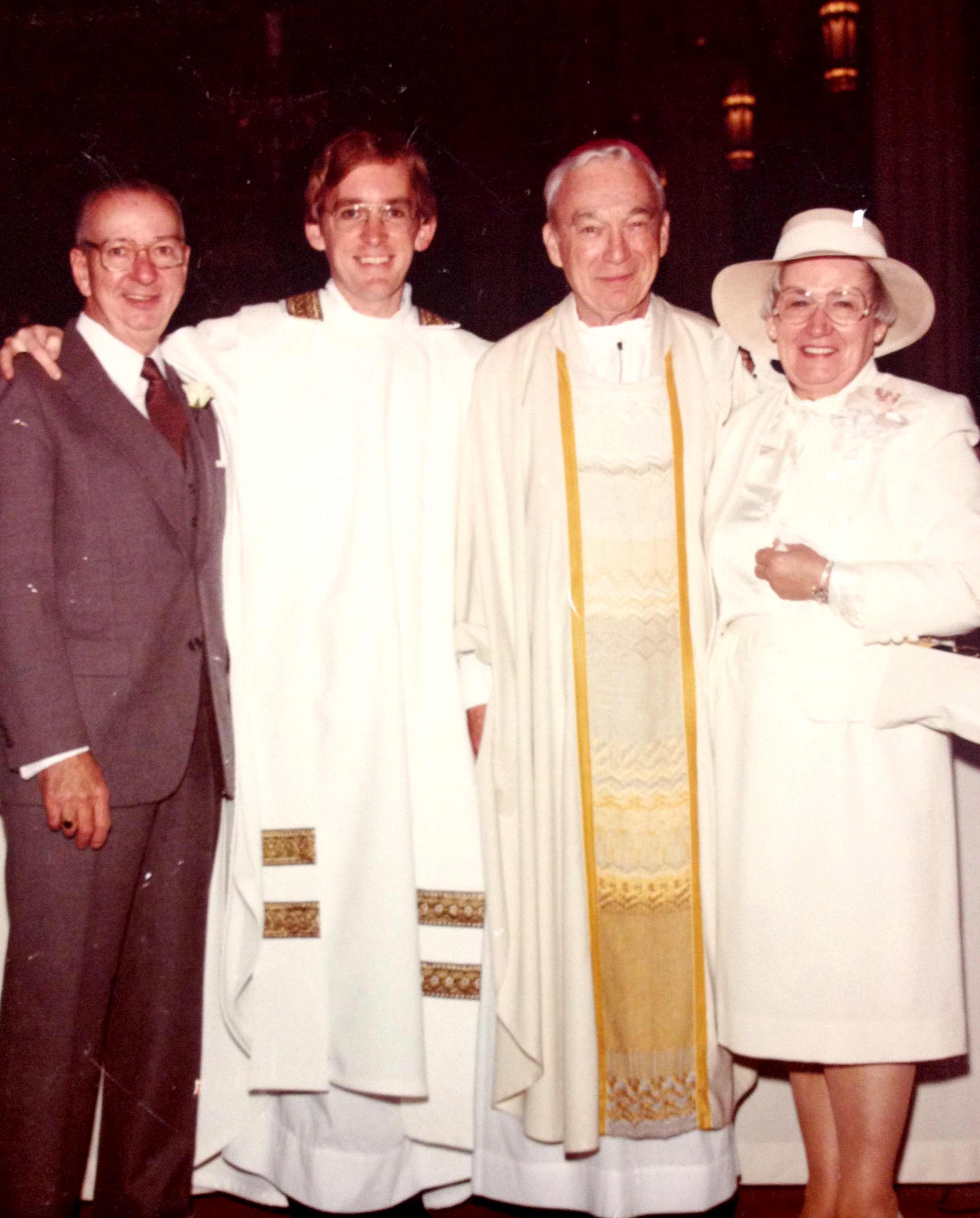
Albert John Raab, Jr., Ronald Patrick Raab, C.S.C., Bishop William McManus, Rosemary Raab

Saint Doorkeeper

Originally published by Celebrate! Magazine, September 2010
– PDF version –

Every morning various groups of people anticipate the unlocking of the front doors to our parish building. People seeking a change of clothing or fresh hygiene products line up beginning at 6:00 a.m. Members of the staff arrive one by one beginning at 7:30, but struggle to approach the only door their key will open because a man is sleeping under a tarp in front of the door. Volunteers line up before 9:00 a.m. greeting one another and meeting the new group of nursing students who will volunteer in our morning hospitality center.

The unlocking of our red steel doors at our urban parish, the Downtown Chapel in Portland, Oregon ritualizes the opening of our two-hour weekday hospitality center. After one of the large doors is propped open, over a hundred people stream single file to our front office. They inquire about emergency travel, money for prescription drugs, or wait to receive a pair of clean white socks. People living in the single-room occupancy hotels gather to socialize or to receive a weekly voucher to a local Laundromat. A staff member then opens the hospitality center leading everyone in prayer so people may voice their pain and needs.

On Friday evenings, our parish community hosts a soup line in our very small lobby. Strangers and friends gather to socialize and to feed on a banquet of homemade soup and peanut butter sandwiches. We serve the anticipated food at our front door because some people suffering mental illness may feel trapped by coming into a public building. At our red doors even runaway teens who fear the church trust the hands that offer them hearty soup and hot chocolate.

Opening our parish doors ritualizes our ministry among God’s people living in poverty because the Congregation of Holy Cross staffs our parish. On October 17, 2010, my religious community will celebrate a man of weakness becoming a saint for everyone in the Church.Blessed Brother Andre Bessette, C.S.C. from Montreal, Quebec, in Canada whose only formal ministry was being a porter, will be the first canonized saint in the Congregation of Holy Cross.

Brother Andre officially welcomed all people at the door of Notre Dame College in Montreal beginning in 1872, the year of his profession of vows as a Holy Cross religious. Andre’s humble presence to strangers and firm devotion to Saint Joseph compelled him to believe in God’s healing power. Saint Joseph is the patron of Holy Cross Brothers as he humbly lived in the presence of Jesus. Brother Andre believed that our lives on earth should reflect this humble posture of living, working and serving always in the presence of Christ Jesus.

Brother Andre (Alfred) was born eighth of twelve children. His parents baptized him immediately after birth since he was so tiny and frail, and wasn’t certain to survive. He grew up with fragile health and became an orphan at twelve years old. The Congregation of Holy Cross even postponed his religious profession because of his ill health. He lived with the sensitivity of illness that turned him to greater reliance on God. He was singled hearted in his life of penance, simplicity and devotion believing that healing was possible for all kinds of pain and illness. By May 9, 1878, the first written testimony of five cures attributed to Brother Andre was published.

The ministry of our many volunteers, staff and parishioners teaches me that faith must be grounded in real suffering. Our work among people living in poverty and brokenness is not pious, fake or self-indulgent. The issues we face in our parish starkly remind us that we carry no real answers to people’s addiction to drugs. We do not have sure-thing answers to people living with severe mental illness as a result of being sexually abused as children. We cannot protect the short-skirted street princess, the stoned dealer roaming ruts in our front sidewalk or the strung-out Iraq veteran shouting obscenities on our corner. I cannot even protect myself from the loneliness I feel living in the midst of my homeless neighbors. However, people’s suffering must lead us all to greater faith and service no matter on which corner of the world we find ourselves.

I cling to the image of Andre welcoming strangers at the door. He stood for hours each day speaking with people for just a moment because he believed in God’s compassion to those who are suffering. This image forms our ministry here at the Downtown Chapel and should form the core of every parish no matter how much we want to hide our individual anguish from one another. The model of ministry of this humble man opens the doors to every worshiping community and crosses the boundaries of race, culture, education and national borders, and any other way we might seek to divide ourselves from one another.

Celebrating sainthood is never easy for the rest of us on earth. We tend to create new images of these people because we are afraid of how they challenge us today. I see this in how we reinterpret Brother Andre in art. He was a sickly, illiterate man, short in stature. In stained glass in our Cathedral of the Immaculate Conception in Portland, Oregon, Andre sits among other North American saints looking healthy and robust. In the Cathedral of Our Lady of Angels in Los Angles, California, an image of Brother Andre processes in the communion of saints woven in tapestry. There the image of Andre is six feet tall, broad-shouldered and looking as if he worked out at Muscle Beach. The image of Brother Andre in our midst must be grounded in the humility and love he personified on earth.

Even in my own religious community in the United States, as members of our American culture, we struggle to be changed by Brother Andre’s work among the poor. We prefer most often the well-educated rather than the illiterate, the prosperous rather than people suffering poverty, and the wholesome student rather than the addict or person suffering mental illness. When we honestly celebrate the saint’s mission in the Church, then we have to change our lives of privilege into greater dependence on God. We have to translate our community’s politics into real mission among the poor. We have to cultivate our vocations of love over our desire for self-promotion.

Brother Andre worked tirelessly to build Saint Joseph’s Oratory in Montreal, Quebec. Yet, he really opened the door there for the sick, lonely and poor to find a home in the healing power of Christ Jesus. When he died in 1937 over a million people made a pilgrimage to Montreal for his funeral. Miracles of healing still occur today. I witness these miracles welcoming people suffering poverty, isolation and illness every day as we open once again our red, steel doors of our parish and rely on God alone. Our holy doorkeeper still lives among God’s poor. Saint Andre of Montreal, pray for us.