Ronald Raab, C.S.C.,serves as religious superior at Holy Cross House, a medical and retirement home for the Congregation of Holy Cross, Notre Dame, Indiana
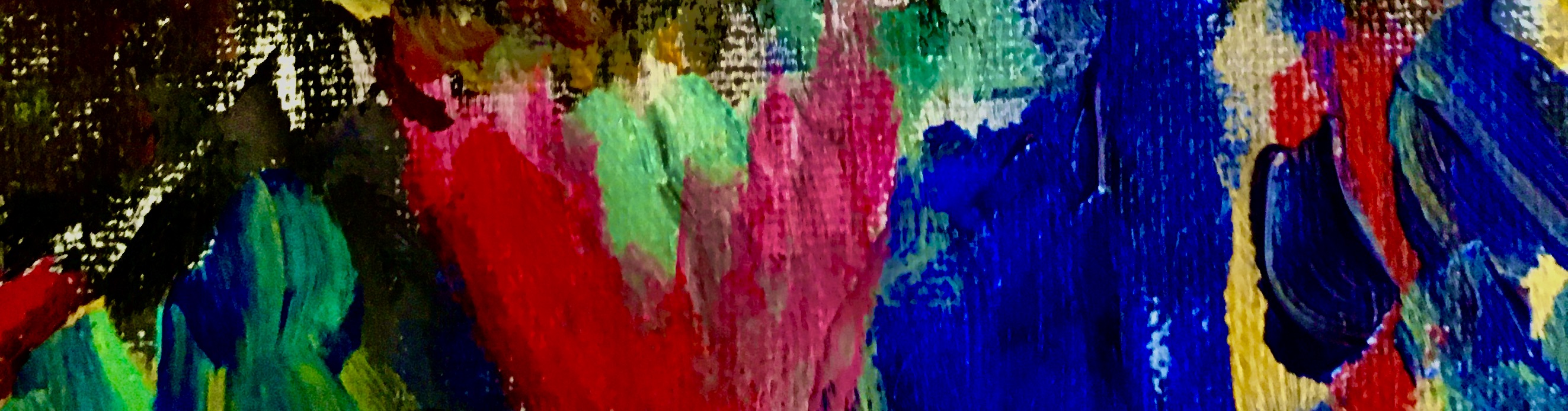
What a delightful evening! I have over 100 originals of my art for sale, in a drawing, silent auction, and simple donation. The art is a reflection of my time at Sacred Heart in these past eight years. I started painting only when I arrived in 2013 as pastor.
Some of these images have been reproduced in our bulletins and some across the globe. Some have appeared in magazines in Chicago and New Zealand. Others have appeared on parish bulletins or orders of worship in Manhattan and The Netherlands. My art has been used as our bulletin covers since Advent 2016. What a joy it was for me last evening to know the originals will be spread across the city.
Construction of Saint Andre House began this week. The former rectory will have accessible restrooms and meeting rooms. The completion of the project will be in Spring of 2022.
Mark 10:46-52 is one of my favorite gospel stories. There is abundant grace in hearing this text at Mass this weekend. A blind man is begging along the roadside. This man, however, is named in the gospel. His name is Bartimaeus.
It is rare for a poor man to be named in the scriptures. A name has power and recognition. A name reveals the dignity of the person. To call someone by name is honoring the person. I can imagine that in the early Christian community, the followers of Jesus must have learned to respect the man who had been healed along the roadside. I suspect that his name was passed down in the oral tradition and found its way into this story because people knew the man and wanted to make sure his name was always associated with the healing touch of Jesus. Bartimaeus is his name for all eternity. We, too, can learn to see him in his dignity.
I would love to find out how Bartimaeus knew who Jesus was before the encounter with him. There seems to be an incredible gift of the Holy Spirit at work here. The blind man knew who Jesus was and what he could do for him. Jesus, then, must have known this blind man, Bartimaeus. In my imagination, I want them to be classmates or perhaps their families were neighbors down the way. There seems to be a relationship even before this story begins. How else would Bartimaeus understand what Jesus could do for him? It seems to be more than hearsay.
Each line of this story is so rich. It demands of us a moment of prayer, taking each line of this text to heart. Bartimaeus calls out to Jesus. He gives voice to his need. He gives voice to his blindness. He gives voice to his faith in Jesus who he senses is near, “Jesus, Son of David, have pity on me.” He continues to call out even though the people around him want to quiet him. I love the gumption and the deep faith of this blind beggar on the roadside.
The people finally say to him, “Take courage; get up, Jesus is calling you.” Gosh, I love this. This may be the most beautiful thing anyone could say to someone who is hurting. So, he goes to Jesus. Jesus then asks him what he wants. First, though, he throws off his cloak. This garment is an image of his old life. It will be replaced with a new cloak, that of baptism. The garment is a sign to us that new life is happening.
Bartimaeus declares to Jesus, “Master, I want to see.” His request is so honest and so real. His answer does not only come from his physical limitations, but from his deep faith in the one he knows will set him free.
The divine question embedded in this text is not just for Bartimaeus, but it is also for us. Jesus says to him, “What do you want me to do for you?” I wonder what you would say if you had witnessed this exchange. I wonder what I would say to Jesus, if along the roadside, I had encounter him. This is one of the questions of Jesus’ life that we need to take into our deafness, into our blindness, and into our inability to speak. It is a question for all our hardships in life. I pray we can listen to this question with all our faith, our hope and our understanding of what Jesus can do for us.
Jesus said to him in reply, “What do you want me to do for you?” The blind man replied to him, “Master, I want to see.” Jesus told him, “Go your way; your faith has saved you.” Immediately he received his sight and followed him on the way.
Mark 10:35-45 is the gospel passage we pray at Eucharist this weekend. This text holds together many opposing realities. In many ways, it is a summary of faith, holding together death and life, suffering and hope, and prayer and service. It begins with James and John coming to Jesus and asking him to fulfill their desires. They want him to place one of them on his right and the other on his left in glory for all eternity.
At first glance, we may affirm James and John’s request to Jesus. After all, they had heard Jesus speak of the Kingdom of God. They watched him heal the sick and offer forgiveness to the sinner. They wanted to be in his graces for all eternity. In many ways, I don’t blame them for wanting to be at the side of Jesus, benefiting from all his promises for all eternity. If I am honest with myself, I want the same thing. I suspect we all do.
We can feel the hesitancy of Jesus in this text when he hears James and John. We can almost feel him cringe. Jesus knows the kind of suffering it will take to get to the Kingdom. Jesus is asking the two men if they are ready to suffer. They will have to let go of all earthly pride and ambition to be placed at the side of Jesus. There will be numerous forms of dying. They have a long way to go to discover how death will transform them. Drinking from the cup of suffering will bring about death, however, Jesus’ death will bring about a new covenant. Jesus is inviting them into a new covenant of heaven and earth. They will have to see for themselves if they are ready to enter such a mystery of dying and rising even in their lives on earth.
The text continues to hold together the authority of Jesus and his call to serve. Jesus tells the men that if they want to truly find a place in heaven with him, then they will have to act differently on earth. He warns them not to hold authority over the heads of others, but to learn how to serve in ways that will truly change people. This service is another form of dying. It is learning how to acknowledge the gift of people, not to put others down, and how to lift people into the richness of God’s love. The paradox of authority and service becomes another way in which we all are being led to the place of Jesus’ side in heaven. We die to self; we die to false power; we learn then to serve God among the lowly on earth.
In this liturgical year, which ends in November, the gospels lead us to the end of time and what it takes for us to live the message of Jesus’ dying and rising that we have proclaimed all year. Easter takes its course in leading us all to the Kingdom. We do not live with a sense of entitlement because we believe. We live instead with a spirit of humble service to welcome the Kingdom in our midst here on earth.
Our rewards are not for us to determine. We leave that to the Father’s will. In the meantime, we learn a gentle way of acknowledging the beauty of all life here on earth. We learn how to lift the poor out of despair and how to welcome the lost one into the center of the community.
So, what does your heart desire? For what do you ask Jesus? How is Jesus calling you into a deeper commitment here on earth?
Rather, whoever wishes to be great among you will be your servant; whoever wishes to be first among you will be slave to all. For the Son of Man did not come to be served but to serve and to give his life as a ransom for many.
In Mark 10:17-30, a man approaches Jesus to find out if he can inherit eternal life. Jesus articulates the commandments and realizes the man already knows them. The man says that, in fact, he has lived the commandments since his youth. Jesus says to him that there is one thing missing. He must sell his possessions and give to the poor. Then, when he is completely powerless on earth, he will possess his desire to enter the Kingdom.
The liturgical gospel passages have been challenging us to the core. They command that we examine our earthly attachments. Our hearts are set on the love of the Kingdom, and nothing should get in the way of our life in Christ. We all know how challenging these gospels are in our personal lives. We all have responsibilities to others we love. These responsibilities mean we help provide for our children’s lives and futures, both financial and physical realities.
To what are our hearts attached?
I don’t take this question lightly. In most cases we tend to ignore these commands of Jesus because we all live busy lives with great responsibilities. However, when we quiet our lives and take stock of our personal identities, we realize we are attached to many things that become obstacles to love. We may be attached to our sense of entitlement, resenting even Jesus who challenges us to live with generosity. We may be overly attached to alcohol or food or making sure we always position ourselves to look good in every situation. We may be addicted to belittling other people. We may be attached to what others think of us. We may never fully appreciate our own gifts and talents. We may attach our self-worth to the car we drive and the job we have and what school we attended. We may strive to always be in charge and in control and never let life change us. No matter how we want to ignore these questions of Jesus, when push comes to shove, we need to examine our lives.
If we are honest with ourselves and with God, we come to terms with everything that is false. Pride is never generous. There is no job title that becomes our real identity. Our children’s lives are not the identity of the parent’s life. Examining the human heart takes time and energy and focus. We are challenged by Christ to give up our status and our control and instead delight in the life God has for us. We are to give what we own to those who most need us. We are to offer others supplies for daily survival.
Jesus tells the man that it is easier for a camel to pass through the eye of a needle than for a rich man to enter the Kingdom. Jesus says to us that all things are possible in God. This is the core of our existence, the possibility of God’s presence and love in our midst. The possibility of change, of forgiveness, of mercy, of true love and tenderness, all become God’s activity in our human lives when we finally rest in God and recognize the value of our humanity. Jesus invites us to clear away the debris in our hearts, in our attachments to disrespect and false power, and rest in him. God is within us. The Incarnation of Jesus Christ reveals life’s value and love. Being human is a pure and joyous gift in God.
Jesus looked at them and said, “For human beings it is impossible, but not for God. All things are possible for God.”
We listen to Mark 10:2-16 today as a child of God. The covenant of God among each person on earth is indeed a marriage bond. The fidelity of God in all creation is true and beautiful. Each person beholds the dignity of God’s breath of creation. Each person matters. Each person reflects the generosity and conviction of ongoing creation.
I am not married. Nor do I have children. However, this gospel opens doors to fidelity. Marriage is not easy, yet the Church holds up the ideal because it reflects God’s covenant within us. Raising children is not easy, yet marriage and community, all support the love and encouragement needed to raise the next generation.
This gospel upholds God’s generativity. At the heart of all commitment, lies the grace of our Creator to help us through the difficulties of life. This gospel is rock for us. It upholds an ideal. Of course, life is not so clean and easy. Divorce, suffering, and losing a child to addiction, abuse, and heartache, is also real. Our commitments hold within them God’s desire to love us. Sometimes we lose our way.
We uphold God’s love within us. Yet, we cannot judge those whose commitments have lost meaning and love. It is not the role of the Christian community to shake an angry fist at others who are divorced or whose children have made their own decisions about life, sexuality, or commitment. Our role is strictly to love our neighbors and support the next generation no matter how life turns out.
As I read this gospel again, my heart goes back to January 1979. At the time, I was in the first class of our novitiate in Cascade, Colorado. We were sent to various places of ministry for a couple of weeks in January. I was sent to Phoenix. During my visit, a Holy Cross Brother planned for me and a classmate to be in a birthing room at the hospital to witness a birth.
I met the mother, father, and doctor just minutes before birth. The father gave me his camera and told me to take photos. I could not believe it, but I took the camera and not only witnessed the birth, but also photographed the moment of sheer miracle. I still hold on to that moment, seeing the expressions on the faces of the doctor, nurses, and aids and indeed the family as we all experienced the child’s first crying out in our world. I admit, I see life very differently after that moment.
God’s covenant needs nurturing. Life is incredible. Birth, love, commitment, are all beyond our human endeavors. Life is painful, messy, unpredictable, underappreciated, and full of joy. Each moment of breath needs to be cared for, supported, and given a place to expand. Every person on earth is lovely.
When we read this gospel with such a wonder about life and commitment, we see the need to come before God every day to be grateful, to put back into the hands of God the very miracle of life.
Mark 9:38-43,47-48, challenges us to follow Jesus with urgency. We live with the expectation from Jesus Christ that our focus is to remain on the Kingdom of God, and we are to help others find that conviction. We seek healing for the sake of the Kingdom. We seek love and justice even if we are to put our humanity aside. There is an exaggeration in this text that is hard to imagine in our own lives. Yet, Jesus desires us to live with the full hope that our hearts and actions are set on the path of justice for people and the richness of eternal life for even the sinner and the outcast.
When I served at Sacred Heart in the mid-1980’s, I proclaimed this text at the Saturday evening Mass. The church was filled with people. In those days, I used various physical props often to support a point of a homily. A psychologist and her daughters were sitting in the front pew that evening. A woman suffering from mental anguish was sitting halfway down the church in the middle of the pew.
So, each time I read a shocking line, “If you hand causes you to sin, cut it off,” the woman in anguish yelled at the top of her lungs, “No, Father, don’t do it!” She yelled out every time she felt threatened by the text. No one in the assembly flinched. No one seemed to react to the emotion of the woman who as appalled by the gospel.
After I proclaimed the complete gospel, I walked down to the psychologist and asked her to help the woman who had screamed out. She looked at me puzzled. I asked her what the matter was. She said to me, “Oh, I thought she was one of your props!”
Now, after all these years, I remember that moment every time I read this gospel. I think of the woman in anguish who had a genuine emotional reaction to this story in the gospel. That woman can teach us how to listen to this text and the dramatic stories of Jesus. We need to be appalled at this text. This story should wake us up. We have all grown too familiar with these gospels and have yet to fully understand the ramifications of the story itself. We should all be screaming out in our pews, “No, Father, don’t cut off your hand!”
Jesus rouses fear to get our attention because he desires us to live virtuous lives here on earth. He invites us to help others to do likewise. His commands to us are countercultural. He desires justice in our relationships and in our systems on earth. He commands we act for the good of people and the good of the earth. He wants us to live for the common good and to put his Kingdom first in every action on earth. Jesus demands that we preach with authenticity so to help all people achieve his gift of eternal life.
If our preaching or actions are false, then it would be better if a great millstone were to be put around our necks and cast into the sea. No person could survive the sea with a millstone around the neck. The weight of our wrong intentions against other people bears an enormous weight in our faith. Christ desires us to lift others from sin, division, and injustice.
This gospel story strikes us like a swift sword. It wakes us up to our own actions in Christ. Let us be vigilant in Christ’s desire for every person to be with him in paradise.
“Whoever causes one of these little ones who believe in me to sin, it would be better for him if a great millstone were put around his neck and he were thrown into the sea.”
In Mark 9:30-37, today’s gospel, Jesus reveals to his disciples that something new will happen. The something new is that he will be handed over to people who will kill him and after three days he will rise. These words along the trip to Galilee could not be comprehended by the followers of Jesus. These words were too much for them.
The disciples thought that the teachings of Jesus were going to bring them a new identity. They believed they would sit in a circle of power on the earth that was going to create for them authority and control over other people. Jesus invited them to realize that his death and resurrection was the authority they were seeking.
So, Jesus corrected their thoughts about authority and power. He told them, “If anyone wants to be first, he shall be last of all and servant of all.” This statement must have haunted the disciples because they thought following Jesus would provide for them much privilege and status. Instead, Jesus called them to stop arguing among themselves about who would be given the greatest role and be held up in great esteem.
To demonstrate his corrective, Jesus invites a child into their midst. Of course, a child at that time represented not power, but powerlessness. A child had no rights or status. The child could not own land or be given high esteem among the people. A child and a widow at the time were without cultural status.
In this text, the child can also be considered as a new perspective on life, a new generation of thinking, status, and a way of life. The child in their midst is a metaphor of what will happen to Jesus. He will rise from the dead, and that will be a new view of life. There will be a new generation who will think differently. The child represents baptism. Those made new in Christ will bring new life to the world. A new view of God will be revealed in the child. And Jesus wants his disciples to become childlike, to take on this role of faith, by dying to self and to rise in his new authority even here on earth.
The child stands among the disciples to live differently in the world. The child is innocence and wonder. The child is also viewed as a dependence on God, to rely on God for everything. The child is a world view that is both new and extremely challenging. Baptism brings us to becoming childlike on the earth. The new, the child, the newly initiated, become a new innocence of love.
Following Jesus is demanding. Yet, we are to be childlike in doing so. Following Jesus is not a club or a quick ticket to get what we want. Following Jesus becomes a letting go of the old and receiving new. This constant conversion of dying and rising brings us new life on earth. This is our status, this is our power, to die to self and to accept the person of Jesus in our lives.
How do we become bearers of such innocence in Christ Jesus? How do we let go of our control, our posture of power in our world to allow Christ into our actions, our ways of life? These are questions for every follower of Jesus. We can get stuck in our old ways, in the surety of doings things the same from generation to generation. We can hold tight to rituals, prayers and certainties with hearts that are tight with pride, control, and only human authority. The richness of faith is that we are constantly being made new; we are constantly children of God.
We come open hearted to God as children teach us on earth. We reach out to the Father’s hand to be guided in all we do on earth. We live on earth to die to self and to become filled with the riches of God’s love and mercy. Our authority on earth is to bear the name of Jesus Christ who fills us with hope.
Our innocent hearts are filled with the power of Christ Jesus.
“Whoever receives one child such as this in my name, receives me; and whoever receives me, receives not me but the One who sent me.”