Unknown's avatar

About Ronald Patrick Raab, C.S.C.

Ronald Raab, C.S.C.,serves as religious superior at Holy Cross House, a medical and retirement home for the Congregation of Holy Cross, Notre Dame, Indiana

Reflections on Art Exhibit 2021: The Stations of the Cross in Atonement for Abuse and the Healing of All

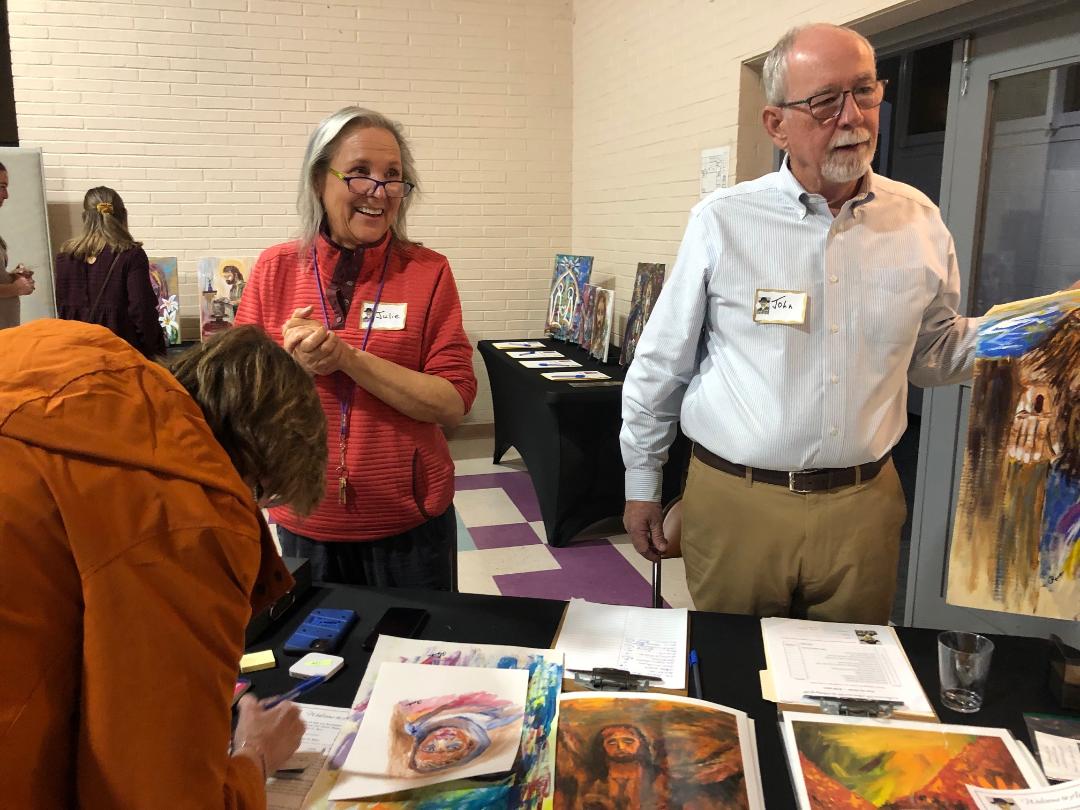
This thank-you note was written on the blackboard at the entrance of Cottonwood Center for the Arts in Colorado Springs during my May exhibit. It stopped me in my tracks one day as I walked in the gallery. From this note, I want to express my gratefulness to those who impressed me with comments and insights. Here is a summary of my reflections about my first professional art show of the fourteen originals from the book, “The Stations of the Cross in Atonement for Abuse and the Healing of All.”

“Fr. Ron, usually the image of Jesus is the same in each station. However, as I walked to the next station, I knew him! I saw him in my heart. You captured so many aspects of Jesus’ path to the cross” This comment came from an older woman as the opening of the show on May 7, 2021, was ending. There were only a few people in the gallery. I wish I could capture her body language as she spoke similar words to me. Her entire spirit recognized and captured the person of Jesus. As she said this, she put her hand to her heart. Tears formed in her eyes. She knew him. The art brought out her relationship with Jesus in a new way. I could not have asked for more as people walked around the room praying these images. For the Catholics who viewed these Stations, their hearts and souls were familiar with the handmade crosses that topped each image. Many people are familiar with how the images were displayed as prayer. They were used to walking the prayer of Jesus’ passion. As she held her hand to her chest, her complete body understood the pain of abuse and the path to Jesus’ death. Faith was revealed deeply from this exhibit, in ways I am still pondering from people’s comments.

“Fr. Ron, you said you allowed the images to emerge in each station. Yet, you traced the handprints in most of them. Could this be that children want to be perfect? And this perfection was a way to hide the abuse. They desired to touch the mystery, yet only in a way a child can without being overwhelmed.”  I thought this was incredibly insightful. I used the handprint as a tag, or a badge on the images. The handprints are a visual way to control the chaos, to allow access to children and the child within each of us to enter the overwhelming reality of Jesus’ death and the unspeakable nature of much of the abuse. The handprints tame the chaos. They put innocence in the art, which is both negative and positive. This person really captured the meaning of the handprint and her insight moved beyond my intention. I loved her ability to take this art seriously. The woman who suggested this knows family suffering. These were the kind of comments that filled the first evening of the show and the parish gathering on May 23. People took this exhibit seriously. It was far deeper than a simple show of illustrations in a book. Faith and real-life issues brought about much discussion.

“Fr. Ron, you said that chaos is an important character in the story. As I view all of them, the chaos seems to diminish toward the last images. Why” This is a key observation and question. I had never viewed the art as an entire series until seeing it at Cottonwood. First, as I examine this question, I see the surrender of Jesus in the last few images. I see how his face and body surrender to death, as if he knows that in the end, all will be well. I want to hold on to that. There is another aspect of this for me. Perhaps I grew more afraid the closer I got to the death. Perhaps, I did not want to face Jesus’ death and the horrific abuse of children the closer I got to the image of death and burial, so I started to control the images again. I think this is only a human reaction, one which is brought out in this incredibly insightful question.

“Fr. Ron, it is good to be in a room that admits harm was done. We need to see the reality of lament by the church beyond the boundaries of church walls.” This comment came from a young person. He names the reality that the Church does not want to admit sin and crime. This version of the Stations of the Cross is the first resource available to help communities pray through the issues of abuse. Our congregations need to hear that harm was done to families. We must cease the generational abuse that is past down to us in silence.

“Fr. Ron, I was abused as a child…” I heard this statement many times during the month of May. In the center of a crowded room surrounded by the paintings, I heard this from parishioners and strangers. The Stations, the art, the topic of abuse, all came together to provide a safe place for people to examine their own lives. Our families deserve such honesty. Many people commented to me that the exhibit was the first time they saw the combination of faith, provocative art, and the naming of abuse. I continue to pray for them and for all people who remain silent about the past. We all have much work to do, to name our experiences, and to help change the stigma of emotional and sexual abuse in our church and society.

These were a few conversations that opened me to the ongoing reality of connecting faith to the reality of life. There were dozens of times during the month of May that surprised me, brought me to tears, and revealed to me the beauty of faith in so many people. I want to thank benefactors and friends who worked so hard to make this exhibit possible.

Fourteenth Sunday in Ordinary Time 2021: Art, Column

Sunday July 4, 2021

Dear Believers,

Mark 6:1-6, today’s gospel, invites us to reflect on wisdom.  Jesus comes back to his native place and people wonder how he became filled with such ease and authority, with such wisdom. People around Jesus were both astonished at his gift and also afraid of it. They questioned his beginnings. They thought they knew his roots being a carpenter and the son of Mary. They took offense at him because wisdom has a cutting edge. People familiar with Jesus   grew jealous because of the gift he was given and his expression of such a gift in the world. People were both curious and afraid. His folks were warmed by his wise heart and at the same time felt the heat of him seeming to be better than others. Wisdom changed many of Jesus’ relationships, including those who were closest to him.

Wisdom is challenging to many people. Many folks like mediocrity. Sometimes it seems to be a more comfortable place to be, because to engage in wisdom means change for everyone. So, in the middle of the summer, it is difficult to participate is such a profound gift of wisdom proclaimed by the gospel. Yet, this scripture invites us into such a reflection on this Fourth of July weekend.

We are unshuttering our lives from the pandemic. This weekend, our enthusiasm about life is flapping in the wind, in a weekend that for many people is carefree, a time away from the daily grind of work. However, we still live with responsibilities of caring for our families and our faith communities and our nation. Our common values are lived not in whim or fancy. They are grounded in love and hope. This is our faith, genuine care and concern for our neighbor and for the real issues of our lives. Wisdom, even on the waning months of a pandemic, remains challenging at best for all of us.

As we celebrate Independence Day, I wonder what it means for us to seek wisdom. For in faith, community means learning an inter-dependence, since the source of wisdom is community. Having a sense of community is a real starting place for many people as we eek our way out of the pandemic. What will community be like now? How will we learn to trust one another? What is it that we all want from our communities? Are we expecting too much? Can we grieve the loss of family gatherings, hugs, handshakes and socializing, all from this past year? How will wisdom form our lives, our churches and our world?

There is much to ponder as we celebrate the Fourth of July. Our common life is deeper than eating hot dogs and lighting sparklers. We have many roads and options to consider. Faith always deepens our lives and broadens our horizons. Wisdom helps us expand our notion of God and how to live in the world. Wisdom broadens our world view, expands our imaginations of caring for the planet, the earth, the sea, and every person under heaven. Wisdom is not a luxury, but a way of believing in God with our lives firmly planted on earth.  

Jesus healed people; these were miraculous actions. Jesus continues such awesome wonders.

“Where did this man get all of this?”

God give you peace.

Fr. Ron

Thirteenth Sunday in Ordinary Time 2021: Column, Art

June 27, 2021

Thirteenth Sunday in Ordinary Time

Dear Believers,

In Mark 5: 21-43, I can feel the press of the crowd longing for Jesus under the hot sun. Everyone seems to have caught a glimpse of what Jesus could offer. I so wonder how they knew. How did they get the word of his identity?  His healing touch seemed so different. His very presence seemed otherworldly, yet the earthiness of presence brought hope to everyone there.

I imagine the woman with the hemorrhage struggling to be well. Her body must have been exhausted, her search seemed meaningless after seeking so many doctors. I see her eyes cast down to the sand, her body and spirit rather lethargic.  Imagine the spark of faith inside her, the moment in her heart where she knew she needed to turn to Jesus. She was worn down, stripped of energy and options. Also, as a woman, she was culturally powerless, not having anyone else to help her.

Her faith sparked an inkling of Jesus’ care for her. She shyly approached him. I can feel her sincerity, her trust, her patience. “If I but touch his clothes, I shall be cured.”  I can feel her longing, for all she desired was a moment of his presence. I can see her hand reaching out to his cloak along the roadside. I feel her genuine desire to be well. She believed that Jesus would set her free. Hope made a home within her. In Jesus, healing could be her friend.  

In these summer days, we may experience such a longing for healing. If only during this pandemic, we could touch the mystery of Jesus. If but only a morsal of love from him, we could find our way through the tragedies and uncertainties of our human life and the exhaustion of our souls.

We can touch him. We can reach out to him with simplicity, and he will be with us. The Eucharist reveals to us that not only can we reach out to touch him, but we can receive his Real Presence, his loving care and his hope for all of us. We have more than his cloak. At the Eucharist, we also become what we eat, that is as we share in his divine meal, we are given the courage to reach out to others who need help and healing. Jesus invites us then to become instruments of love, healing and hope in our world.

Faith is not a spectator’s sport. This gospel opens us up to healing and also invites us into our world to become agents for Christ’s love. We may first be shy and unwilling to live our vocation of hope in our world, but if we can begin with the inkling of faith to reach out to him, that is all we need to change our lives forever.

I wonder how the woman spent the rest of her day. She must have spun with enthusiasm and her family must have shared her healing joy. I am sure she slept well that night and woke up to an entirely new life. She must have spent days telling everyone. She certainly models for us that all we need is a small moment of faith and our lives can be different.

We are not alone in our desire for healing. It is the world at large that really desires to touch the cloak of Jesus where we are assured of love and his ability to heal our ills.

“If I but touch his clothes, I shall be cured.” Immediately her flow of blood dried up.

God give you peace,

Fr. Ron

Catholic Media Association Awards: Honorable Mention, The Stations of the Cross in Atonement for Abuse the Healing of All

Liturgical Press has received Honorable Mention recognition for Paul Turner’s book, The Station of the Cross in Atonement for Abuse and the Healing of All. Details

To learn more about the book, click here.

I remain so grateful to be part of this important work in the church. The issues of abuse are not subsiding anytime soon. We must be willing to pray through the pain. This book is the only resource I am aware of that helps congregations face the severity of abuse and to place our common pain in the dying and rising of Jesus Christ. My illustrations speak boldly of our longing to touch such mystery. With appreciation to Paul Turner and John Kyler, editor, and everyone at Liturgical Press.

Twelfth Sunday in Ordinary Time 2021: Bulletin Art, Column

Dear Followers of Jesus,

In Mark 4: 35-41, we have the privilege of entering a scene with Jesus in a boat loaded with fearful disciples. In the center of a storm, they fear for their lives and are frustrated with Jesus who is asleep. In the center of the chaos, the presence of Jesus is calm and trusting. 

I remember some years ago I had lunch with Fr. Clem (Fr. Leroy Clementich, CSC) when I served in Portland, Oregon. We had served together here at Sacred Heart. I remember talking on and on about some crazy thing I was disturbed about. He listened patiently. Then he turned to me at the lunch counter and said, “Oh, Ron, be at peace. Ron, Ron, just be at peace.”

His kindness runs through my veins all these years later. If my faith was true and lasting, peace would flow. Within this gospel text, I find the tale of Fr. Clem and I sitting close together on stools in a diner in downtown Portland. My fret could not shake his faith; my worry could not disturb his peace. I realized how often I am tied to such fear outside of my own life rather than gazing upon the face of Jesus curled up in the corner of my heart. 

This gospel is remedy for the fear that rocks all of our boats. The disciples were beside themselves with anxiety. They could do nothing about the storm but ride the waves. The chaos did not even awaken Jesus. We all face much fear in our daily lives. However, I wonder if we ever gaze underneath our fear and find the person of Jesus who has been guiding us all along. 

Sometimes faith is seen as adhering to a set of guidelines that make us prideful and sets us apart. Faith is not something we memorize, or think is written in stone. Faith is utter trust in God. Faith is absolute belief that all will be well by the guidance of the Holy Spirit. This trust is not blind, but deeply rooted in our lives of intelligence and reality. The disciples learned in this situation that they could do little but ride the waves of the storm. They had to work the best they could to be safe, and in the end, they realized Jesus does not keep them from the storm, but is in the center of the storm all along. This is crucial to our lives of faith. 

The disciples deepened their wisdom in the boat in this scene of the gospel. We also must learn what to fight for, what to worry about and how to serve in the various storms that rock us on a daily basis. In the end, we have very little control over many of the storms that shake us up. Faith is not about relying on Jesus to keep the storms of doubt, grief, and hopelessness away, but to trust that he is within our hearts in every moment of life. 

Let us cast our worries on the Savior. Let us take our place among those who have believed before us, and even among the great mystics, that all will be well. The divine question that floats to the top of this gospel is so important in how we live and how we believe, “Why are you terrified?” This challenging question remains a lifeline in the chaos that gets us down on a daily basis. 

I pray we may listen to Jesus and to Fr. Clem. “Ron, Ron, just be at peace.”

God give you peace,

Fr. Ron Raab, CSC, Pastor

The Solemnity of the Most Sacred Heart of Jesus 2021: Art, Prayer

Sacred Heart of Jesus,

In your heart, we find ours.

In your heart, we know love.

In your heart, we sing of your miracles.

In your heart, we experience healing and home.

In your heart, steady mine.

In your heart, wash away fear.

In your heart, caress my loss.

In your heart, speak to me.

In your heart, suffering is named.

In your heart, justice is known.

In your heart, freedom is lived.

In your heart, you are found.

Eleventh Sunday in Ordinary Time 2021: Bulletin Column, Art

Dear Followers of Jesus,

Today’s gospel, Mark 4:26-34, invites us deeper into an image of the Kingdom of God. A small seed becomes a place of shelter, protection and new life for others. If we examine this image of seed as our hearts and lives, we shall awaken to new growth and perspective and even imagination about our lives of faith. 

I often hear parents tell me that the summer growth spurts of their children are such a wonderous gift of life to them. They say, “our children are growing like weeds.” Our children take on a life of their own, their own identity, their own talents and gifts, and it all happens very quickly, as if during the night such growth happens. Parents seem so delighted that their children become what God is inviting them to be. For some parents, of course, this is a real time of adjustment to let them flourish and to not smother such gifts. 

I admit that I also love to see young people with a beginner’s mind and a kernel of faith. In the riches of their own hearts, added with naivete, and much grace, young people begin to form a trust that the seed of hope given to them by God will flourish in the world. I adore watching the seed of faith grow and blossom into a life steady on the earth in trust and love. 

The seed of faith given to our young needs help to flourish. We all have to trust that the Kingdom of God is at hand in ways we can’t even imagine. We cannot grow bitter or angry as elders when we see the gifts of our young people change the world. Allowing a tree to grow takes patience, tenderness and good will. This also takes on our part, the ability to trust God and the next generation. Learning to trust our children is never easy, at least that is what parents tell me since they always want to be the parent of a child whom they have raised and loved. 

This image of the Kingdom of God is beautiful and offers us a garden of hope if we can learn to trust in life itself. The Kingdom can sprout up in the most unexpected places. The Kingdom is here even when we are so often blind to the process of life. The Kingdom changes us and what it offers us is a new way of seeing ourselves and the world. This gospel today invites us also into a new way of being in the world. The Kingdom reveals everything, even the smallest seed can grow and influence the world in so many ways. The Kingdom leads to truth, to fidelity, to solid hope, to a life of gratitude. All we have to do is stand back and watch it happen and trust in God who is always restoring life and hope in our world. 

Please take some time this week to pray for our children and our children’s children. In doing so, we may even see hope spring up in our lives fashioning within us a place where the Kingdom of God will surprise us. 

“To what shall we compare the Kingdom of God or what parable can we use for it? It is like a mustard seed that, when it is sown in the ground, is the smallest of all the seeds on the earth. But once it is sown, it springs up and becomes the largest of plants…”

God give you peace,

Fr. Ron Raab, CSC, Pastor