Pouring Out Prayer On Concrete

Originally published by Ministry & Liturgy Magazine, December 2011
– PDF version –

I began praying the Triduum noticing the floor. This was the first Triduum without the old burgundy carpet in the chapel. The simple concrete floor with noticeable old screw holes, chips, scratches and flaws invokes a rugged, urban environment. The poured concrete aisles also convenience our friends in wheelchairs and others who come in with soaking-wet boots and soggy backpacks. I noticed that everyone moved around the chapel with ease and purpose without the threadbare carpeting. I realized that I never really noticed the floor as we began the sacred dance of death and resurrection.

Rosie wheeled herself in through the doors and into her usual spot near the sanctuary as we prepared for the evening Mass of the Lord’s Supper. Living with cerebral palsy, Rosie is a bold presence in our neighborhood. Her lifelong disease stiffens her body and makes her speech very difficult to understand. She protested in City Hall and held banners in parades rousing attention for civil rights for people suffering disabilities. As we began the Holy Thursday liturgy, I saw her ease her motorized chair into her usual spot with a flick of her finger. I cannot take her suffering away but at least she no longer has to battle the carpeting.

We washed feet on the concrete aisles. Watered splashed, dripped and danced everywhere. Dirty socks and assorted sneakers spotted the grey aisles. I poured out the water along with my prayer for all of us who walk the treacherous ground of street life and the uneven ground of church life.

We processed with the consecrated Eucharist to a small altar near the emergency exit. Mary’s image is there. We invited everyone to follow in the procession. I approached the small altar after weaving our way on the concrete path. I noticed Rosie had been first in line to follow the sacred bread and wine. We all sang with yearning from our broken hearts.  I stood at the small table watching the faces of people who desperately need God. My gaze was interrupted, as I smelled an unpleasant odor. Rosie’s urine bag leaked during the sojourn. A stream of urine trickled along the aisles to the place of holy reservation. Jesus invites everyone to wait with him. I felt the deep love of his tears streaming on to the rocks in the garden.

I quietly processed alone on the concrete aisle as we began the liturgy on Good Friday. I prostrated myself before the sanctuary on the cold concrete. I felt the floor under my entire body for the first time. I breathed and relaxed there. I was there on behalf of everyone. I felt in my entire being the people who wheel themselves around the chapel and people who are too tired to stand up and the people who are too depressed to understand their own lives. The cold floor makes us one in offering everything to God.

I heard a woman weeping. I noticed her as I stood up and continued the liturgy. She is not Catholic and lives in daily recovery. When the liturgy was over she came to speak with me on the sidewalk. She was still crying as she began telling me of what happened just before the liturgy began. As she approached the chapel before noon, she noticed a man sleeping on the sidewalk near the chapel covered with a large, bright red blanket. All of his possessions were piled up next to him. She told me as she noticed me prostrate on the concrete floor with my body covered in red vesture her heart realized the profound connection of Christ’s suffering for us. She could not stop crying as she continued to connect the sleeping man on the street and her priest on the chapel floor.

After flipping on the light switches on Easter morning, I walked into the chapel and noticed white candle wax dotting the grey floor. Some leaflets had fallen to the ground in the rush of cleaning up after the Easter Vigil. Bags of canned goods and assorted used clothing piled up near the sanctuary were donated during the Easter duty. I remembered Jesus’ used clothing next the open grave.

We buried Rosie this past year. Her body could no longer be bound in such suffering. Many people suffering disabilities assembled for her funeral in another parish. Our floors could not take the size of the crowd. I told the story of her urine bag leaking on Holy Thursday. I reminisced of her determined prayer no matter what the obstacles.

We continue to pray without the old carpeting. Many stories will walk, stumble, hobble or be wheeled into our chapel in the year to come. In future Holy Weeks, I will pay more attention to our prayerful dance of Christ’s passion, death and resurrection on the chipped concrete.


Finger Pointing

Originally published by Ministry & Liturgy Magazine, November 2011
– PDF version –

My parents taught me not to point my finger at strangers. I was told it was rude to point to another person and whisper behind his or her back. As a child I dare not point to a person with a different skin color or another child who somehow did not fit into my scheme or pattern of life. It was simply rude to be seen in public pointing to other people. Most other children were also taught not to point at anyone in public.  However, on playgrounds everywhere, new kids, different kids, gentle kids, smart kids, big-eared kids, freckled kids and fat kids were all pointed at by just about everyone I knew.

I live now on a block where children and adults still point. Strangers point at other adults who line up on the sidewalk outside our doors.  They also point in the direction of a teen who is so stoned he cannot walk across the street. Other passersby do more than point– they spit, wag their fists and kick men who are sleeping on the sidewalk. I still believe it is impolite even to point.

As we listen to the Scriptures during the beginning of Ordinary Time, once again John the Baptist appears strong and sure. We relied on him to show us the way to Christ and the Kingdom of God all during the Advent season and even during the Christmas holiday. John continues to do one thing—he points toward Jesus. John has been portrayed in art throughout the centuries as pointing to Jesus. He has been caught in paintings and in sculpture doing the very thing so many parents and teachers have taught us not to do, that is point to another person in public.

John’s pointing is different. He points to his cousin because he is sure Jesus is the one who will bring unity and peace to the world.  John points to Jesus during his baptism because Jesus is the revelation of the Father’s love. John assures us that the Spirit will continue to point us all into the direction of the Kingdom. John also points to Jesus with more than his index finger. John’s heart, mind and soul are also oriented into the direction of Christ Jesus. His very soul knows that the only way through earthly life will be in the direction of the Kingdom of Heaven.

John’s voice is also pointing to Christ. As Jesus walks by, John proclaims with his entire being, “Behold, the Lamb of God.” This is one of the most sacred statements and recognitions in the Scriptures. This is an act of sheer love and deep awareness of the living Christ. This statement is a profoundly contemplative act on John’s behalf. This statement is the result of John’s years of pointing into the direction of the holy. This is an awakening moment, a joy filled expression, which comes from a loving and profound understanding of Christ on the earth.

As we continue in this Ordinary Time, we all need to reflect on how our lives point toward Christ. We need to take some retreat time for our parish staffs to view where we are heading.  We need to evaluate our liturgies, education and service if they are rooted in our deep awareness of the Lamb of God. Do we recognize the Lamb of God from our hearts and in our worshipping assemblies? Do we have the conviction and the awareness to know Christ in such a passionate way? Perhaps our finger pointing is to our own selfishness or to point out the differences of other parishes in order to make ourselves look good. We point to the fact that we have more money and parishioners. We point to our music ministry because our liturgical style is certainly better than the parish next door. We point out that we are glad we have no one sleeping at our church doors and that no homeless people are sitting in our pews. Fingers, hearts and lives may be pointed in many other directions than the Lamb of God.

These days of Ordinary Time also show us that Christ is pointing directly to us. Jesus rebukes our unclean spirits. He reaches out with his entire hand to heal Simon’s mother-in-law. He heals many who are sick with various diseases and drives out demons. Jesus also stretches out his hand to touch the people we have pointed to as dirty such as the lepers. Even the leper pointed to him and asked to be made clean.

Our finger pointing must imitate John the Baptist so we may know who Jesus is among us. We also need to continue to stretch out our hands in the name of Christ Jesus and heal the lepers, the outcasts, the marginalized and ever person whom we judge as different from ourselves. I long to point my finger in love, “Behold, the Lamb of God.”

What You Have

Originally published by Ministry & Liturgy Magazine, October 2011
– PDF version –

I unlocked the red steel doors of our parish building last Christmas morning, noticing a special holiday silence on the streets. The business executives were safely tucked in the suburbs and the night clubbers were sleeping off a Christmas Eve drunk. Only the drug dealers were roaming the city streets in the early hours on Christmas morning. More people purchase illegal drugs during the holidays because people have to spend more time with their families, I guess. I did notice one thing as I unlocked the panic bar of one of the heavy doors. A man was sleeping next to the door near the corner of the building. He was covered with blankets to protect him from the Christmas rain. However, his face was uncovered. I did not recognize him and there was no reason to wake him up and have him move from that spot. So I went back into the chapel to prepare for our simple Christmas Mass.

As the Eucharist ended, I processed outside to greet the humble assembly on the sidewalk. I noticed that my sleeping friend was awake with his belongings piled up and covered with plastic near the wall. He was bearded and exceptionally tall. He noticed me and I felt his energy standing behind some parishioners I was greeting. He approached me bashfully; his head swaggering from sided to side. He said to me, “ I hope you don’t mind, but I stood in the lobby and listened for about five minutes.” I immediately assured him this is the very reason why we are here on this corner. I then stopped listening. I started telling him that we were closed and would not open for clothing and supplies until after the New Year. He put up his hand to stop me. “No”, he inserted, “I am not here for clothing, I am here for what you have inside now. What do you call the service today?”

I was completely taken aback. I felt red embarrassment dance on my face. I was so quick to judge, so sure I was correct. Then I realized I had to explain what we have inside. I fumbled to explain the Eucharist, the God-made-flesh, the Christmas miracle among the marginalized of the city.

As I reflect on the Christmas scriptures again, his piercing question still unsettles me. I take what we have inside for granted. I now have a new sensitivity for people seeking God and who long for the simplest of praying communities. I was also tied up with my own Christmas loneliness, the holiday haze that still covers my heart and perspective on Christmas morning. His statement snapped me out of my holiday selfishness.

Christmas morning is time for John the Baptist’s testimony to the Light. Every parish community must give testimony to God even though we are exhausted trying to meet everyone’s spiritual expectations. Every worshiping assembly should stop mid-Christmas Eve and find the silence to understand what we are doing in our churches and try to articulate what we have. We have the Word becoming flesh even among the scraggly-bearded and the foul breathed. We have treasures of college students back home only going to church so to keep peace in the family. We need to feed people not only with the Bread of Heaven but also with words of welcome and actions of true acceptance. We need to sort out our disappointments and get over our hurts before we preside at the Eucharist or lead the tired, elderly choir. We have so much of what really matters.

Every worshipping assembly in every corner of the earth proclaims God’s saving power. Every corner may include a man tucked under a bridge or sleeping in the church entryway. Every corner may include a veteran just home from war and full of anxiety to be in a crowded church on Christmas morning. Every corner should include the lonely heart of the priest and the grief of a new widower sitting in the last pew of the assembly. Every corner may include the angry preteen that only wants acceptance from her parents after telling them of her first sexual encounter. Every corner may include the new gay couple that started coming to Mass after a friend’s suicide. These are the corners of the world in need on Christmas morning. People want so much of what we have but we do not see the miracles.

When I open the doors this Christmas morning, I will remember my friend from last year. I am sure I will not see him. I will be reminded of him when I meet the next stranger and invite him to join us inside the chapel. I will invite him to stay beyond five minutes and experience the treasure of all we possess inside our small community of people who believe God-with-us.

Competing Voices

Originally published by Ministry & Liturgy Magazine, September 2011
– PDF version –

I learn the deep meaning of Advent from people who hear voices all during the year. For many people who experience lifelong mental illness, sorting out the voice of hope and love during the holidays becomes very challenging. Last Advent, I spent some intentional time with several people who regularly teach me the complexities of living in our culture and struggling to hear the voice of God.

The paradoxes between Thanksgiving Day and New Year’s Day are legion. Last year on the day after Thanksgiving, the local news stations were reporting that the advertisements in the Oregonian newspaper weighed four and a half pounds. We were all expected to begin the season listening to the voice of consumerism, carrying the heavy load of a newspaper and the burden of purchasing gifts for loved ones. People living in poverty show me the problem of such expectations. Most people cannot afford such gifts. More importantly, most people suffering mental illness do not have loved ones to buy a gift for in the first place. Many families disown their members with chronic mental illness. Other families may be more supportive, but mental illness itself may cause a son or daughter, parent or spouse to break off contact completely. People living on the streets or in low-income housing have little family support and few friends.

I listen to the voice of the Advent gospels with a new ear. I hear the adult voice of Jesus telling us to be watchful and alert. These words get wrapped around much apprehension for many people who hear voices telling them that they are not worthy of Jesus. So many people become agitated and anxious because they feel they do not live up to Jesus’ standard already. Hearing the voice of Jesus in Advent becomes difficult when people already live with a deep sense of unworthiness and depression. The voice of the beloved Savior eludes so many people.

John the Baptist cries out from the desert to prepare us for Christ’s second coming. His clear and sharp voice may also be interpreted in many other ways. For many people who suffer from post-trauma related conditions, John’s voice may bring much fear to their lives. They clench their muscles and cringe when a sudden voice calls out in the night or when there is a knock on the door. I learn to turn down the volume of John’s insistency to straighten up our lives. John wears minimal clothing and eats little food as do so many people who already live outside and survive the cold nights.

Advent articulates the many competing voices of despair and hope, darkness and light, loneliness and communion. These are the mix of emotions so many families face in preparing for the holidays and the coming of Christ. These are the voices our parish communities must help people discern and sort through. We need so desperately to find the voice of God in our lives and parishes. So many people long to sort through the competing and complicated voices that shout that purchasing material things will make us all happy. We need to help people find life amid the overwhelming expectations that every person is happy, joyful and fulfilled in every way. We must sort out for our children their ingrained sense of entitlement that they deserve every toy, gadget and European trip during the holiday season. This is the real work of our worshipping communities during the time between Thanksgiving and the end of the Christmas season.

A twenty-something college graduate stood in line to be anointed after Mass during Advent. I had spoken to him only one time before. He told me that his mental illness was getting worse. He stood in front of me sobbing, leaning his head on my shoulder. I tried with all my faith to find the words of an angel that greeted Mary “Do not be afraid.” So many people are unable to receive the consoling voices of scripture when the many voices inside them are so convincing. The message of fearlessness must be interpreted in every parish community in so many different ways during the Advent season. We all need the many angels of consolation and hope.

Last year at the conclusion of the Advent season, I noticed a sign posted in our parish office window. “On Wednesday, December 23 we will be distributing sleeping bags and backpacks.” I stood before the sign and started to cry. The sign was a reminder of how people were going to spend Christmas, alone in the cold. However, I was also grateful for the small step to provide something warm for people. Advent and life come wrapped in many unfortunate realities amid God’s voice of love.


The Glittered Dead

Originally published by Ministry & Liturgy Magazine, August 2011
– PDF version –

November in particular exposes memories of the dead. The liturgy celebrates what so many people experience out of doors as seasons change, that life itself gives way to death. The celebration of All Saints and All Souls opens a flood of recollections of the dead. As days get shorter our memories become more intense. The holidays become tender experiences for so many people unable to face the death of loved ones. Love is an incredible bond but so are guilt, regret and shame.

I realized this tension among people who straddle love and regret in the passing of a loved-one some years ago. Members of a family entered my office to prepare a memorial service for a relative. I noticed immediately hardened tension among the living. Each person told me that he or she was closer to the unmarried deceased man than the other relatives. The niece of the gentleman claimed to know him the best. The son raged against her claiming his spot among his father’s affection. The unnamed issues continued to do battle in the confines of my office space.

As the day for the funeral arrived, I felt the tension at peak level. However, what caught my attention before the funeral were the arrangements of funeral flowers that had been delivered to the church. A large colored ribbon flowed out of each traditional display of autumn chrysanthemums and long gladiolas. A word appeared on each ribbon describing the relationship between the person who purchased the flowers and the deceased, -“father”, “uncle” and “cousin”. Each name on the ribbon was written in glue and colored in glitter. The arguments over who was the most important heir continued over which floral design was most expensive and which ribbon carried the largest glittered name.

As I reflect on the gospels for the closing weeks of the liturgical year, I examine the priorities Jesus wants to instill within our discipleship. Jesus insists that the light of the Kingdom will shine brighter among the peacemakers, the poor in spirit and people who mourn humbly in the face of death. My experience teaches me that we need to give people the tools to mourn their losses and grieve prayerfully throughout life. The battles that were exposed during this family’s funeral tell me that we all struggle with our finite existence on earth. So many people are reluctant to believe they have a place in heaven and that relationships on earth can ever be healed, loved and forgiven.

Jesus reminds us that we need to be wise in our preparations for the Bridegroom. My ministry teaches me that we have lost sight of our basic belief that death gives way to life. Many families no longer celebrate funerals. Instead, “Celebration of life” parties have taken the place of the funeral liturgy. A local funeral home has been in business for 160 years. The owner recently remodeled the former chapel to act as a party room instead. Video screens, a grand piano and banquet tables have replaced the pulpit, pipe organ and pews. So many people coming to the funeral do not want any physical evidence of religion, ceremony or ritual. Party planners are replacing funeral directors. The wisdom of God’s invitation is replaced with our human control over how death will be celebrated on earth.

Jesus also tells us that in the end only a few things will be required of us. The kingdom will be offered to those who simply feed the hungry, care for the sick, visit the prisoner and clothe the naked. As believers we will find our true light when we offer service to one another. The person on earth with least influence is our key to heaven. This is the hidden grace of our faith. The Kingdom is open for us who are willing to sit with the dying who make us uncomfortable. The Promised Land is prepared for us who see Christ amid hardship, loneliness, imprisonment and hunger. Christ’s words are clear and challenging, yet our fear of death and our guilt over how we live remain so unyielding. We do not serve people in order to inherit their earthly goods after they die. We serve people in order to discover our true home in heaven and real love now on this earth.

I remember cleaning up glitter for weeks after that funeral. Celebrating each Mass during that time period I saw a speckle or two of glitter somewhere in the sanctuary. I claimed again the family in prayer at the sight of each sparkle. During the month of November, every parish community is invited into people’s memories of the dead. We all minister among arguments and hurt feelings around death so that we may encourage families that our differences will be sorted out in love.


Lost Among Translations

Originally published by Ministry & Liturgy Magazine, June 2011
– PDF version –

Last autumn I attended the annual priest convocation for the Archdiocese of Portland, Oregon. Most of the agenda was focused on the new translation of the Roman Missal. We gathered in a familiar setting near the ocean and the structure of the week was similar to previous years. I overheard many priests express their anxiety about the new translation and how it would be received in their parishes. I heard many others speaking of the week simply as a time to relax and talk with one another. The view of the ocean through the window that led to the meeting room seemed a compelling enough reason to me to be present at the convocation.

We did receive an education about the translation of the Roman Missal. We listened to words of many of the presider’s prayers and people’s responses. We discussed our responsibility for implementing the changes. We discussed the need for more education about the liturgy in every worshipping community. However, these are not the issues that I found powerful and provocative about the meeting.

We adjourned for a fifteen-minute break after the last session on the new translation of the liturgy. The meeting then turned quickly to another topic. We reconvened to learn more about the dire topic of human trafficking. The sex trade in Portland is so bad that city officials asked the Archbishop if they could address all the priests of the Archdiocese. Portland is the place for pimps. The sex trade has found its home along the Interstate 5 freeway because Portland is readily accessible to Canada to the north and Mexico to the south. We learned how easily young high school girls are solicited in our local suburban malls by conniving johns. Pimps lure teenage girls into prostitution who seem timid or shy, who wander the mall looking lost, forgotten and in need of attention. These men may find such girls after school walking alone in a mall or a city sidewalk. Most often the young girls do not get along with their parents. They are easy targets for a john who promises freedom from parental authority, offers many material possessions and entices her with a chance to travel.

It took me more than a few minutes to make the mental transition from the Roman Missal to local prostitution. I could not comprehend the vulnerability of these young women and the brutality of their johns. In stunned silence we viewed a PowerPoint presentation on prostitution. The attention of every person in the room was directed on the horrifying statistics of poverty, neglect, abuse and prostitution. I realized during that meeting with my fellow priests how many people are lost amidst our inability to translate our faith into the real issues of life.

As we reflect on the liturgical gospels for the Twenty-fifth Sunday of Ordinary Time until the Thirty-first Sunday in Ordinary Time, I understand once again the connection of translating the gospel message into the messiness of real life. People need a second chance from the landowner who wants to hire workers for the vineyard. Those of us who listen to the gospels every weekend in the comfort of our sanctuaries must be able to welcome people who come to faith even in the eleventh hour. The addict from the suburbs speaks to me on the phone because he wants yet another chance to keep his children after experiencing a weekend blackout. God’s invitation supersedes our rigid rules and certain limits about who is worthy to receive a daily wage. The last will be first and the first will be last.

I hear the gospel of the son hesitating to work in the vineyard when I experience my own uncertainty accepting the smelly veteran or the woman who has stolen from us. I cannot put limits on people’s response to God and to the invitation to believe in miracles. Our worshipping communities must not write off people we label as lost, mentally ill, dirty, abused or people who just feel they do not belong. Everyone belongs within the mercy of God even when we wait until the eleventh hour to believe in God’s invitation.

Jesus tells us that tax collectors and prostitutes are entering the Kingdom of God ahead of other people. I see this with my own eyes in our parish community. The lives of the marginalized and destitute form our humble worship every day. This is the real, honest and genuine translation of the liturgy that our faith must be lived in real life. I realize my hesitancy to accept the girl who continues to cut her self and the one-tooth man with halitosis. Even when I am most tired, I hold on the holy words of Jesus to believe that God still loves our broken world.

The real translation of the Mass in every generation invites every person to the feast. From the byroads of Interstate 5 to the back roads of city alleys, the feast is always ready for everyone to attend. We gather with friends and strangers alike, filling our sanctuaries. The liturgy sends us out into the world to translate bread and wine into the living Body of Christ.


She Keeps Calling Out

Originally published by Ministry & Liturgy Magazine, May 2011
– PDF version –

I so admire the Canaanite woman. I always look forward to hearing her strong voice calling out to Jesus and the disciples (Matthew 15:21-28). She was crippled in fear because of her daughter’s illness. She desired the healing touch of Jesus even though she was not a lost sheep of the house of Israel. The strong-voiced mother clamored at Jesus’ side to change his mind about who could receive his love.

We enter into this courageous story again on the Twentieth Sunday of Ordinary Time (August 14). This nameless woman’s voice bellows out to us from long ago and it is still not silent. From her suffering comes a profound model of persistence and hope. Her love for her daughter was not going to be neglected, put aside or buried in society’s rules. Her voice rings out to Jesus’ ear and across the generations to our day and time.

This persistence and patience rises from deep faith. Her determination was fueled by the fact that she was out of the bounds of Jesus’ love because of her heritage and background. I am so intrigued that someone from the margins of Christ’s care teaches the rest of us how to pray tirelessly and how to bring our deepest suffering to the person of Christ. This woman, like so many women, teaches us how to believe and how to come to God with profound honesty.

I am reminded now of my dear friend, the Canaanite woman, because a year ago we welcomed a new pastor to the Downtown Chapel. His installation as pastor took place during our Saturday Vigil Mass. Parishioners presented him with the Gospel Book, the Sacramentary, a green stole, the Oil of the Sick and the collection basket. At the exact same time, a group of prostitutes were meeting in the basement directly below the chapel. I kept hearing people enter the building from the side entrance. I wondered if our new pastor really understood where those liturgical symbols were going to lead him if he accepted them with his whole heart. The voices of women caught in human trafficking were right under our feet. All during the liturgy, my mind kept going downstairs, deep into the darkness of the building where the women in need were stirring. Our parish hosts this group every Saturday evening. On that evening I really heard the voices calling out for new life, change and healing.

The Canaanite woman’s persistence celebrates for me the many voices of women who beg us for acceptance, healing and belonging. I see this persistence in our chapel, our basement and in every part of our parish community. A group of retired women nurses wash feet, cut curly-long toenails and offer advice for caring for diabetes every Wednesday morning, also in the basement. These women act out the Scriptures, speak up about people’s needs and offer prayer for people in profound need. This hidden, often silent action of our community helps us all transform our indifference into genuine prayer and concern.

I pray I never become deaf to the cry of the Canaanite woman. As I hear the prayers from a homeless mother whose child needs diapers, medical care and shelter, I know I cannot rest. I must continue to work to bridge the lives of suffering people into the mission of the Church. I hear the cries of tireless immigrant mothers having to leave their children back in the home country. I cannot turn a deaf ear to a middle-aged child who has to leave behind her aging mother in a nursing home in another state because she has to care for her fatherless children. I must open my ears, heart and prayer to the woman who struggles for food, rent assistance and education for her children. The strong voices calling out for new life are all around us, even in the basement.

Our ministry among God’s people surviving poverty encounters much resistance. We struggle with health care, other people’s prejudice, indifference and apathy. However, I take great consolation from a woman who had no power, authority and voice in the culture of Jesus’ time. In the midst of her powerlessness, she changed Jesus’ mind. She told him that even dogs receive table scraps. Her faith saved her and healed her daughter.

I cling to the fact that there are enough scraps from our common altars to feed the needs of all people. There is enough love from us, the Body of Christ, to hear the voices of people calling out in need well beyond our common sanctuary steps. From the basement to hospital beds, from migrant worker camps to the suburban poor, we must all have the courage to help change the mind of Christ by our faithful and humble prayer.


Urgent Care

Originally published by Ministry & Liturgy Magazine, April 2011
– PDF version –

Every morning our parish welcomes lost street pilgrims into dry shelter. Our staff and dozens of volunteers strip away our preconceived notions about stinky people and jobless wanderers. We hear the frightening outbursts from homeless sufferers of undiagnosed mental illness and we welcome all people to rest awhile.Our acceptance of these forgotten people barely holds back the waves of citywide discussions of the undesirable homeless teens, the filthy street urchins playing guitars while sitting on public sidewalks. Our open-door hospitality barely sways public opinion about the lazy, crazy and filthy people who do nothing for society. We welcome people because stomachs are empty, bodies are tired and naked, feet are dirty, wives are abused, jobs are lost and friends are still imprisoned. This is the urgent, daily work of hospitality in our parish community.

Living the gospel call to true, authentic hospitality challenges our parish community daily. Our morning hospitality remains scrutinized by the judgmental opinions of so many jobholders walking by our building. Some people in long-term recovery accuse us of being in denial and label us as “enabling.” Welcoming the lost and forgotten, without bias, judgment or superiority tests our faith to the core. This core of authentic welcome lies within the persons of God, the relationships among the Trinity.

I rest in this message of the Holy Trinity. I believe with my whole heart that the hidden relationships among God the Father, Christ our Savior and the communion of the Holy Spirit offer all Christians a definitive model of hospitality. As I reflect on the liturgical gospel for the Solemnity of the Most Holy Trinity, I feel this urgency of hospitality. I capture a glimpse of eternal life when tired folks rest with a cup of hot coffee, enter into an honest conversation and receive some clean clothing.

Every Christian community must take the risk of living the mystery of the Holy Trinity. The Sign of Cross is not just a mark on our mortal bodies, but radical welcome for all people to live within the love of God. The Trinity is not an obscure concept celebrated in our sanctuaries, but an invitation for all people to risk love, kindness, compassion and true hospitality. Radical acceptance among strangers enables people to experience a glimpse of eternity. Living the mystery of the Holy Trinity suggests that all people must be welcomed no matter their place in life.

Every morning we circle our volunteers around a table to reflect on the upcoming Sunday gospel. College students, retirees, parishioners and other volunteers from all walks of life hear the sacred text proclaimed in our hospitality center. The formation from these gospels propels even non-believers to connect the foundations of the Christian faith to service among God’s beloved. In these morning sessions, we all experience this urgency of hospitality because we understand we may only have one opportunity to welcome a stranger.

Our parish is just a few blocks from the train station and bus terminal. People step off the train and hear by word of mouth that our parish is the place to go for basic needs. A young unwed mother hops off the bus and is told that we can help with diapers for her infant. An elderly man needs a blanket for the night and a runaway teen is looking for someone to listen to his story. The Trinity manifests love in the simplest of places, among outcasts searching for basic belongings.

I also feel this urgency because so many young people do not experience the Church as a meaningful place for their lives. Our staff connects with over fourteen colleges, universities, seminaries and schools of nursing over the course of a year. Hundreds of high school students participate in formation sessions that invite students into the depths of people’s suffering. Hospitality is not wasted among the young, the lost and those who question everything.

The celebration of the Holy Trinity in every parish must open us all to the overwhelming compassion and mercy of God. We must not allow our fearful judgments and familiar prejudices to put boundaries on God’s relationship with people, or to suggest that some people are more deserving of love than others. The liturgical celebration reminds me to calm down among situations I cannot control, fix or heal. I must remember that God longs to be in union with God’s beloved.

I enter more deeply into the mystery of the Holy Trinity and experience an insistent need to welcome people who think they live far out of the bounds of God’s love. Every Christian becomes a messenger for the hidden life of the Trinity, an expression of deep love, commitment and belonging. I discover every day that the true mission of the Church is to live in the tight circle of the Trinity, accepting everyone into the life of God’s redeeming love.


Holding On

Originally published by Ministry & Liturgy Magazine, March 2011
– PDF version –

I hold much fear within my body. I struggle to find my way out of the self-doubts and worries I carry with me from the past. Fear clings to me when new situations demand more of my attention or concern for others. I even realize how selfish I can be when one door closes in my life. Waiting for new life makes me impatient and restless. I wait for the depths of Pentecost in my own life.

I cannot imagine the fear that locked doors and huddled the disciples together after the death of Jesus. Painful uncertainty cramped their future plans. Grief suffocated their thoughts about living the example Jesus offered them. They crouched down in fear and hung on to the hands of each other behind those barred doors. The room and their lives seemed forever darkened.

Pentecost was birthed from this hand wringing and sweat about the future. Christ appeared in the stuffy room behind the closed and locked doors of their hiding. He opened up their lives with his very presence and the offering of his lasting peace. The key to stepping out of the dark room and into their future was the healing balm of Christ’s love and forgiveness. The hands of Christ’s followers opened up to receive him. Fear seemed forever useless.

I heard a new image of clinging to fear a few months ago. On First Fridays I lead a daylong retreat exposing people to matters of faith and poverty. The retreat includes a tour of our neighborhood that reveals controversial issues of adequate housing, nutritional food and affordable healthcare for people surviving poverty. I led this particular tour with a group of deacon candidates and their wives.

After the tour, one of the candidates shared that a deep memory of his mother surfaced during the tour. He remembered his mother taking him by the hand on a street corner and crossing to the other side to avoid homeless, smelly people. He began to cry as he realized that holding his mother’s hand taught him to fear people who were different from him. He acknowledged his mother’s instinct to protect him. He then confessed to the group that it was time for him to grow up, to let go of the hands of people who teach him to be afraid. This was Pentecost for this middle-aged man preparing to be ordained to serve the needs of people. This wake-up call released him from years of prejudice and ridicule toward God’s people living on the streets. This memory opened the door to discovering Christ’s peace within him and in people he has been called to serve.

Every worshipping community must let go fear in order to serve people in need. Pentecost pries open our fingers and challenges us to embrace God alone. Every community must let go of preconceived notions of people considered to be society’s outcasts. Pentecost invites us all to let go of the relationships that still teach us to stingingly criticize other people. We must not believe that separation and isolation are Gospel values. We must release our grasp from people who keep us in our childish ways. When we wake up to the Gospel our old patterns of negative thoughts and inaction fade. We welcome the Spirit as adults in full, active membership within the Body of Christ.

Pentecost vibrates our conscience and activates our hearts. Pentecost is not about shrouding the sanctuary in red silk, but celebrated when people have enough food to eat and sufficient clothing and adequate housing. This great celebration happens when our negative attitudes are replaced with genuine community, the Church. This solemn feast continues to break down walls and barriers. We must believe that we are called to welcome people who have given up on the Church, who are tired of the fight of being isolated because of mental illness, sexual orientation or living below the poverty line. We must listen to the sojourner no matter her experience. We must walk among the brokenhearted no matter how he has been treated in the past. Pentecost cannot be tapered to fit our prejudices or slip comfortably into our oppression of other people.

I witness doors flying open to new life every day as I am changed living among the marginalized. Only God heals people from destructive patterns of drug abuse, prostitution, broken marriages and thoughts of suicide. God’s beloved people teach me to let go of the hands that intended to protect me but also taught me to fear. Ministry among people who have no power in society is celebrated with great joy not only on Pentecost Sunday but every day, when we all decide not to live in fear and darkness.


Foot Crossing

Originally published by Ministry & Liturgy Magazine, March 2011
– PDF version –

Every weekday morning, more than 100 pairs of tired feet cross the threshold of our parish building. A newly homeless couple trying to find resources for survival stands on their weary, calloused feet, waiting to enter our hospitality center. A man drenched from the morning rain and reeking from alcohol limps into the familiar lobby, hoping to get a dry pair of socks and a jacket. A heavy Vietnam War veteran wearing an unbuttoned shirt and feathers tied to his long hair waits for a new pair of shoes to fit his swollen, infected feet.

People’s feet tell the stories of homelessness and disease. Some of our guests carry within them deep secrets of how they landed on hard times. Others may be silent about their past physical traumas or how they have abused drugs. They may even try to hide their need for food, companionship, or a new pair of underwear. Our volunteers and staff understand that people often do not want to admit their vulnerability. However, people cannot hide their homelessness, illnesses, and defenselessness when our nurses and volunteers deal with people’s sore, filthy feet.

Foot care ministry
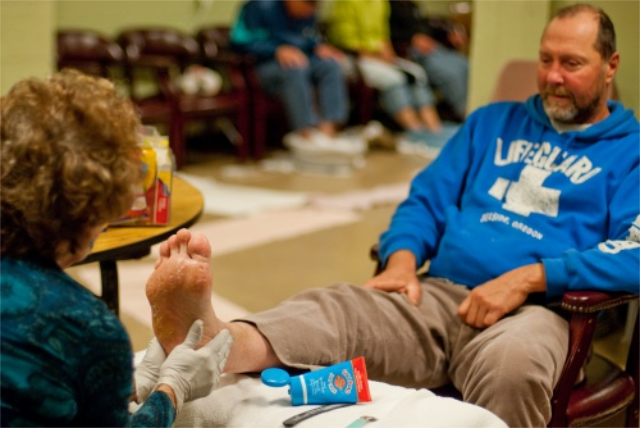
Every Wednesday in our hospitality center at the Downtown Chapel Roman Catholic Parish in Portland, Oregon, the staff and volunteers provide foot care. This once-a-week offering affords people an opportunity to make sure their feet are given proper medical treatment. This ministry began not with the notion of medical assessment and management but with the ancient tradition of foot washing and welcome.

Roy contacted us nearly a decade ago from a suburban parish. He inquired about offering sessions on centering prayer for people surviving poverty. Roy told our staff that he had already facilitated groups in local jails and also various groups of people living with HIV/ AIDS. He wanted to pass on what he himself had discovered in his own life: the deep and abundant love of God. Roy quietly spoke his own story to our staff of his years of wretched anger and hatred toward family members. He told us that his hardened, heated life had been transformed with prayer. Roy assured us that God was still healing his relationships with his wife and children. He was also the foster father of more than a dozen at-risk children. So the members of the staff agreed to his request for offering a time of contemplative prayer among people who live outside and who suffer the many issues of poverty.

After several months of facilitating group prayer, Roy came back to our parish staff with another request. He and his wife longed to discover why Jesus washed his disciples’ feet. Roy said to our staff, “1 know that Jesus ate with his disciples everyday, but on the night before he died, he ate with them one more time and then washed his friends’ feet.” He said with an intense desire, “1 have to find out what that means.”

Thus Roy and his wife began our foot ministry. They welcomed people into a small room with gentle conversation and intentional hospitality. The couple was shy and intimidated at first as they provided soothing salts to soak putrid feet. They trimmed long, yellow toenails and provided clean white socks that they had purchased themselves. While they stooped before people with aching feet, they internally prayed for each person. Our foot ministry was born of a man who admitted to both his selfishness and to his life’s being completely transformed by personal prayer.

After several months of washing rank and sore feet, the couple came back to speak to our staff. The holy couple explained that they glimpsed a reason why Jesus washed his disciples’ feet. Roy quietly said to us, “I believe Jesus washed the feet of his beloved so to see their faces at a different angle, in a new light, in the intimacy of genuine humility.” Roy and his wife continued their service in their own lives by receiving two more foster children into their home. When the couple left our foot ministry, our parish nurse continued it. Today, Sharon and other volunteer nurses, student nurses, and other volunteers receive people on Wednesday mornings. Now the focus is not only to bathe people’s feet but also to provide more medical assistance.

Sharon provides soothing Epsom salts, healing lotions, and creams. The nurses look for deep infections and open wounds that will not heal. They know when to send our guests to a doctor or an emergency room. The volunteers fill plastic bins with hot water and sudsy healing salts. They invite people to soak their feet, and the volunteers enter into people’s lives through the stories of their feet. Sharon and others listen to the words people share and become attuned to their hope that someday homelessness, poverty, and addictions may also be soothed and cured. They wipe each toe with bleached towels, and each foot is examined and dried. They teach our guests how to care for their feet when disease and infection are present because of diabetes. They cut curly long nails and wipe scaly skin with care and concern. The nurses deliberately dress each foot with new white sweat socks.

We provide our foot ministry as an extension of our morning hospitality center because feet are the main source of transportation for many people living outside. Most of our guests cannot afford appropriate health care, and in most cases health care is not accessible to people living on the streets. We also provide this basic foot care because people live in the reality of Portland’s rain and cool weather all year long. Every day, people’s feet are not just damp but squishy wet. People come to us with prune~likeskin and yellow, tough nails. The rank smell of feet permeates our entire bUilding and lingers long into the day. People expose their secrets by crossing our parish threshold and offering theideet to be cared for by our volunteers.

Our volunteers and nurses enter into the mystery of Holy Thursday’s Mandatum every Wednesday morning. This ministry extends the mission of Jesus from the ancient liturgy of the Triduum. The Gospel of John reminds us that our foot ministry is not just a reenactment of the past but a vital ministry in our generation. The ritual gesture is neither fake nor meaningless in our community. Our foot ministry puts into daily action the call of Jesus to become people of hospitality, to enter into the mystery of people’s stories. Our foot care volunteers show us that intimacy happens when we see people’s faces from the perspective of love and service. People’s feet tell us stories, especially when we listen to them from the angle of looking up into their weathered, beautiful faces.
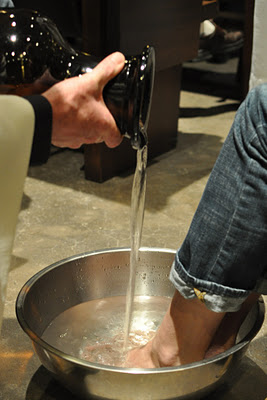
Holy Thursday foot washing
The liturgy of Holy Thursday invites people in every parish into the role of hospitality. The act of washing feet is still a sacred form of worship. Some parishes are quick to replace the foot washing on Holy Thursday with hand washing or shoe shining. These replacements seldom work; they do not bear the weight of the intimate act of exposing dirty feet to the community. Those other acts do not reveal vulnerability or suggest that people actually need God or the community for survival in daily life. Naked feet expose the Body of Christ in real need on Holy Thursday.

Entering into the mystery of the Mandatum on Holy Thursday evening invites every person into the earthy, human need for Christ’s redeeming love. Our parish sets up chairs in our three aisles before the liturgy begins. After the Gospel and homily, the people designated for “foot washing go to their preassigned chairs and remove their shoes and socks. Every person who attends this Mass should see naked feet. People should be able to enter into the action of this rite. The presider and servers process around the chapel to hold, wash, and wipe the human foot. The feet of our people are seldom beautiful, and their nails rarely (if ever) receive a pedicure. The smell of sour feet needs to be part of the rite – not perfumed, perfect feet.

The Mandatuin tells the story of every worshiping community and reveals how each one listens to the Gospel during the entire year. The stories of vulnerability told in naked feet connect to the ways the parish serves people. The foot washing is linked to a young mother wiping the bottom of her infant after a bout of diarrhea. Foot washing connects to the middle-aged man who washes the aging body of his father after he has suffered a stroke. A mother holds the forehead of a grade-school-age daughter vomiting in the toilet. A wife washes the blood off her husband after surgery. A husband cleans up food from his wife’s body after feeding her stomach through a tube. The Mandatum on Holy Thursday connects the human vulnerability we all face in caring for those we love with the public ritual of the church.

Foot washing on Holy Thursday reminds every parish community that we begin each ministry from Jesus’s call to prayer and service. Many parish communities resist entering into such filthy concerns, but we are all called to enter local hospitals with prayer and willingness to be changed by the suffering of our friends and neighbors. We are challenged dUring the Triduum to get our own feet wet from sweat by building a home or painting a garage. We must walk the extra mile to support fundraising efforts for breast cancer or AIDS. On Holy Thursday, we are reminded that we do all of those things because of the intimate love of Jesus, who offered his life for each person.

I recently asked Gwen, one of our regular foot washing volunteers,to articulate how this ministry has changed her. I wish everyone could see her in action, using few words as she carries tubs of sloshing water in our basement to prepare for our guests. She washes and bleachestowels, wipes up floors, and invites people to experience foot washing. These actions go well beyond her words. She said to me, “I appreciate the trust our guests develop in our abilities as well as limitations to provide for what they need.” She also added, “The community helps me to maintain an attitude of grateful living, to not take things for granted, and to do what I am able.” Gwen does so much without the notice of so many. Gwen can also be seen on Holy Thursday serving the Eucharist or reading the Scriptures.

Gwen’s daily actions guide our Triduum. Her actions, along with those of all of our volunteers, speak the reality of John’s Gospel. She and the many nurses and volunteers live the Mandatum every week. The connection of prayer and service is lived on Wednesday mornings in our parish basement. I do not have to look very far to preach the Gospel on Holy Thursday. The feet that cross our threshold each day are signs of the crucified Savior. Their smell reminds me always to walk with people who suffer.