Food For Friday

Originally published by Ministry & Liturgy Magazine, February 2011
– PDF version –

I crave the Eucharist on Good Friday. Perhaps my hunger is most pronounced then because Good Friday is the only day of the year in which the celebration of the Eucharist does not take place. Nevertheless, my hunger grows strong. I intellectually realize that the Body of Christ is distributed on this sacred day consecrated from the Evening Mass of the Lord’s Supper on Holy Thursday. Even with that knowledge, my hunger pains cry out. These liturgical arguments do not take the longing away from my soul. Nothing really soothes my hunger on Good Friday.

I experience great hunger on Good Friday because I pray with people who feed only on their loneliness and suffering on most other days of the year. People stream into our chapel at high noon on Good Friday. Some cross the line from the business world to the world of poverty by simply walking across Burnside Street. Some people stroll into the chapel after spending the morning in our Hospitality Center seeking clothing, a new backpack or clean pair of underwear, or just to be acknowledged by name. Some people stroll in recalling childhood memories of kissing the cross, inhaling bellowing incense and humming long Latin chants. Still others are curious about what Catholics do on Good Friday since Jesus stays on the cross all year long in our sanctuaries.

No matter the curiosity of some people or the memory of others, there remains a collective hunger for God. For so many people the hunger is bone deep because they are crushed by relationships of abuse. Many of our worshippers hate themselves for how their lives have turned out from serving in wars or selling their bodies for drugs. The collective hunger in our worshipping assembly settles into our common songs and liturgical responses. People remain emotionally empty and are looking for a way out of the circumstances that have brought them down. We are all hungry for God’s love and compassion on the day when we remember the death of Christ Jesus.

Several years ago our staff tried to address this common hunger in a different way during the Good Friday liturgy. We looked to a common item that we distribute each day that comforts people, yet a reminder of hunger itself – a bag of food. On most weekdays, our community distributes food bags to people living in single-room occupancy hotels. These single rooms are no larger than a parking space. People need food to get by because the monthly rent remains outrageously high. So our community offers bags of canned goods and items that can be warmed on a small hot plate.

These food bags are a reminder of poverty itself. They speak volumes about our inability to feed people’s needs. We only offer them a few cans and packages to survive a long month of high rent and skyrocketing food prices. The presence of these brown bags reminds people of their own hunger as they also symbolize our help for them.The bags tell the stories of severe loneliness that eats away at those whose lives are so tenuous. Living alone in a bug-infested, noisy room destroys one’s dignity. The bags of food become a sign of hope even in the midst of poverty and loneliness, of hunger and broken dreams.

We stationed members of our staff carrying bags of food on each side of the cross as people came forward to reverence the cross. We then invited people to also touch the bag, to pray for our starving neighbors and the millions of starving people around the world. Since so many people count on our bags of food this was a simple reminder that the Cross of Christ is lived here on this block amidst great hunger. Many visitors ignored the invitation; some did not get the connection to Christ’s presence. However, for many people the Cross of Christ and the bag of food became the source of real and substantial nourishment.

I realize this gesture would not work for every worshipping assembly. I know it may even confuse many people. However, I keep trying to discover ways that people in poverty can find their home in any of our worshiping communities. I am at a loss to feed people’s unfathomable and lasting pain. This is Good Friday. Only God can restore people’s lives and feed their deepest needs. This is the place in which I learn to trust God. The Cross of Christ is the place for real, rich and sustaining food even though I remain so hungry on Good Friday.


Lenten Rhythm

Originally published by Ministry & Liturgy Magazine, December 2010
– PDF version –

Several years ago I sat around the kitchen table in the rectory with a friend discussing our upcoming Lenten discipline. My friend taught Scripture at a Catholic university and she had been received into the Catholic Church the previous Easter. She challenged me to look at Lent differently. We stumbled on an image of Lent being a delicate dance, a relationship with God who longs to offer us healing and love.

Our discussions led us into this unique dance of partners that Lent offers us, sacrifice and grace, sin and forgiveness, contrition and change, suffering and love. We discussed our need to understand the Scriptures differently than in previous years. We realized that we needed to go beyond taking the gospels for granted, beyond our automatic responses and our usual patterns of praying and living them.

We then tripped over the idea to actually take a few dance lessons for our Lenten offering. Somehow I agreed to sign up for Tango, the most complicated dance of all. All of a sudden I found myself in a downtown dance studio just after Ash Wednesday. The instructor assumed we were a couple and just could not quite figure our motives for pursuing dance since neither of us was at all a natural.

We laughed more than we danced, we tripped over our feet more than we felt the rhythm of the music and we embarrassed ourselves during the three weeks of lessons. Real dance is more complicated than we thought, the footwork, the balance and the emotions. Our insights and discouragements led us back to the Lenten gospels to examine the relationships that are crucial in this season.

Jesus encounters a delicate relationship with the temptations of the devil. The two tango with the scriptures and God who promises support even when we dash our feet against a stone. We partake in this sacred dance when our two left feet deal with our sin against helping people who cannot stand up for themselves or feed their children. In Lent our relationships with overeating, drug use and extramarital affairs stop us in our tracks. Our convictions must speak louder than the din of anger, rage and neglect. Lent must be centered on the real pain of our people, the disillusionment of our spirits and the temptations of our emotions.

Lent calls us to get a new perspective on our lives. This perspective is not from a high mountaintop, but an inner awareness that a new vision is possible even for the most stubborn among us. Fear is the culprit we must all deal with in Lent. Dancing with fear can lead us to self-absorption, lack of love and empty relationships. Taking fear by the hand can lead us all into the love that God has for even the most callused or confused partner.

The woman of Samaria danced around her past in the presence of Jesus. He knew her heart and the real person behind the water jar and the fear. He named her real thirst, gave her hope to drink and sent her on her way to set others free. This marvelous dance at the well at noontime still shows us that Christ is in relationship with sinners, doubters and outcasts. This holy dance is for everyone. Christ opens up faith to be about people, not certainty, correct rubric or dancing the tightrope of politics.

Jesus still spits on the ground making clay with saliva in order for us all to see. We are still blind to teenagers having sex in schools, adults shooting heroin in movie theaters and gangs murdering our elderly grandparents. We still do not think people suffering homelessness are our sisters and brothers nor do we really see that children need food in an era of severe obesity. The Lenten dance takes us by the heart, puts spittle on our ears and courage in our souls.

We also realize we cannot dance in the dark. Jesus finally goes to his friend Lazarus and teases him out of the grave. Lazarus slowly moved his body in a divine dance, being released from the burial clothes and the bonds of death. We too, shake ourselves from even the fear of death in order to live a new life in Christ. We wake up to life when the bandages of fear are slowly unraveled in faith, hope and love.

Lent beckons the soul in a dance of new life. We discover our faith again in the radical rhythms of Christ’s death and resurrection. These gospels of the Lenten season take us by the hand and form in us authentic life.

This is the beginning of conversion for us no matter where we worship. Even though my friend and I did not master the Tango, I entered that year more deeply into the invitation that God takes the lead of every aspect of my life. The task for us all is to keep dancing in the love God offers each person no matter our stumbling, no matter our falling and no matter our lack of rhythm.


Blessed

Originally published by Ministry & Liturgy Magazine, November 2010
– PDF version –

I regret many of the words that fly out of my mouth. The sarcastic one-liners, the zingers and the offensive phrases that effortlessly role off my tongue. I catch myself only when my comments have already hurt another person. I hear myself and then realize I had better options. I could have used words as precious instruments of blessing. Rather than being put-downs or the continuation of gossip, my words can build up people from their hurt or misfortune.

I often fail to connect the daily words I speak with the gesture of prayer I model at the end of Mass. My hand rises up in the sign of the Crucified to bless people in all aspects of daily life. My fingertips reach for my forehead and then touch my chest then rest on my shoulders. I understand in my heart that God wishes to transform every aspect of my life and relationships as well. This blessing is not just a perfunctory gesture, an empty ritual or an ancient archaic rite, but the reality that God has already marked us with blood in Christ’s death and resurrection. This intention to offer ritual blessing on the community is simply expressing our true identity.

This holy gesture shelters nameless sinners, defiant unbelievers, stubborn children, rowdy teens and helpless elders in God’s forgiveness and mercy. The blessing reminds us how Jesus lived out his Father’s mission to offer welcome to outcasts, kindness to the weary and acceptance to the undeserving. The words of blessing invite our worshipping assemblies into living out God’s plan for all people. These words consecrate people’s lives, bridge relationships and invite people into the community as God’s beloved.

As I listen to the liturgical gospels from the Second Sunday of Ordinary Time until the Ninth Sunday in Ordinary Time, I am reminded of Matthew’s desire to bless the meek and lowly. John the Baptist points us into the direction of the Lamb of God. Jesus will bless us not only with water as John did, but with the Holy Spirit. This blessing will bring fire and compassion to peoples’ lives.

Jesus then calls the disciples out from the ordinary means of life. No longer will they haul heavy nets of fish, but they will carry the burden of fishing for believers. These days of heavy work will only be carried out by the grace and blessing that is offered them from Christ’s life and example.

Jesus also calls his new followers to a mountainside and he begins to teach them about how to continue this message of blessing, healing and love. These words of beatitude, of extraordinary blessing come directly from Jesus’ mouth. These words come as a shock, so much so that to this day we have yet to put them into practice. The people who will fall under the arms of Christ’s blessing are the poor in spirit. They include people who mourn the loss of a loved one in death, the meek who cannot inherit land by law and people thirsting for the springs of righteousness. Jesus names those whose intentions are honorable and whose hearts are clean of anger, hatred and violence. He calls peacemakers those who will be blessed by God. These people stand in the shadows of any culture, yet are called into the light of God’s rich blessing.

Jesus blesses his believers to become salt and light for the forgotten and the doubtful. He tells us still that no light can ever cast a shadow over this bright light of faith and goodness. He continues to tell his followers that real blessing comes in authentic forgiveness even when wronging a brother. He commands followers to turn the other check when wronged, give the extra coat to warm a stranger, walk the extra mile for the needy and give something worthwhile to the beggar.

Jesus also tells us that we cannot receive such blessings by serving two masters. If we all in fact give ourselves to God then worry shall be stripped from our hearts. This blessing will enable us all to have adequate clothing, enough food to eat and be sheltered from the cold and even our sorrows.

Every day I feel my fingertips at my forehead and my hands on my shoulders being blessed under the love God has for every person. I know from my ministry among the marginalized that today brings many problems. Blessings of food, shelter, kindness and companionship become real miracles. Reaching out to bless the lowly, the ill and impatient become the reasons why any Christian community exists. The blessing that Christ offers us transforms not only our thoughts about what we own but about other people who long for us to serve them.


Advent Alarm

Originally published by Ministry & Liturgy Magazine, October 2010
– PDF version –

I wake up every morning to the sound of a dozen or more people talking as they line up around our parish building. Some people are still sleeping in the shelter of the inset near our front door. Others pack up quickly to claim a place in line for our morning hospitality center. Still others will sleep off the cheep booze from the night before.

Waking up to this reality wears me down, especially during the Advent season. Sleeping in a heavenly peace seems like such a dream. This reality seems more like nightmares for people carving out a warm place to be safe under mounds of damp cardboard. Others go weeks without slumber because of drug overuse. Other people sleep all day long due to deep depression. A few people sleep at our door with no blankets, no possessions, no cardboard box or coat or hat, just the concrete for a pillow.

The issues of sleep and waking up create real problems for our parish community. Every morning members of our staff come to work and nudge people out of sleep who are blocking the entrance to the building’s door. During the noon Eucharist when our offices are closed, other people obstruct the exit trying to catch a quick nap. Some people fall asleep in our pews during the noontime Mass – especially the corporate executives.

Advent is the time for people in every parish community to wake up to the reality that surrounds us all. Stay awake! This command in Matthew’s Gospel challenges us to wake up to our timidity toward people’s needs. Advent instills in our communities the deep passion for why Jesus came into the world in the first place. We need to get off our common couches and do something about how people are living in the world.

Advent calls us to claim the dignity of all people. We do this by waking up to the real paradoxes of our day. In this time of year when we overeat, we are called to acknowledge the billion people in the world starving for basic bread. In this time of buying, accumulating, fussing over the correct gifts, Advent scriptures should claim a new awareness of our possessions no matter in which community we live.

No believer wears camel hair and feasts on locusts anymore, but the Sunday gospels need to capture our imaginations about whether or not people have decent clothing. We need more than ever in a downward economy to rouse new attitudes about how we care for elderly people or the mentally ill person who needs a community in which to rest. As members of any worshipping community, we need to find new ways to welcome our homosexual children back from college, our cousin who lost everything gambling on the Internet and our uncle who walked out of his marriage. We all need to come to grips with our real possessions, our relatives and friends.

The Advent Gospels proclaimed in every parish shake us up to see that the lame walk, lepers become cleansed, the deaf hear and the poor have good news proclaimed to them. This is the time to rouse communities from the sleep of apathy and complacency. We need to preach about the needs of people living in poverty even though other people do not want to hear about it. We need now to invite our children into real and dedicated service so that they can witness the parish community doing something worthwhile. We need to invest not only in people who cannot make ends meet, but also in our children who are walking away from our worshipping communities.

Waking up is never easy, but the issue of our sleepy attitudes is the core of the Advent season. We open ourselves to real people because Christ became flesh and invested himself humbly in our human world. He took on the humility of flesh so that we could see all people as divinely loved.

A couple of Christmas’ ago a strong-willed, homeless woman, Bonnie, blocked our only doorway during Christmas Eve Mass. She piled up blankets and carts in a matter of minutes by our red doors. She opened containers of food and invited street people to join her. She smoked a few cigarettes and spoke loudly to passersby. She prepared a place to sleep while members of the parish sang carols and broke bread and shared the cup and proclaimed that Christ is born for people.

I walked out into the lobby as Mass ended and could not believe my eyes. No one could exit the chapel. I scurried to persuade her to move her belongings. Some parishioners helped her move her camp to the side of the building. Knowing Bonnie and seeing her bright eyes, I am convinced she held us captive in the chapel so we could wake up to the meaning of the Incarnation, the Body of Christ in our real world.

A Foot in the Door: A Community Modeled after Brother Andre Bessette, CSC

Originally published by Ministry & Liturgy Magazine, October 2010
– PDF version –

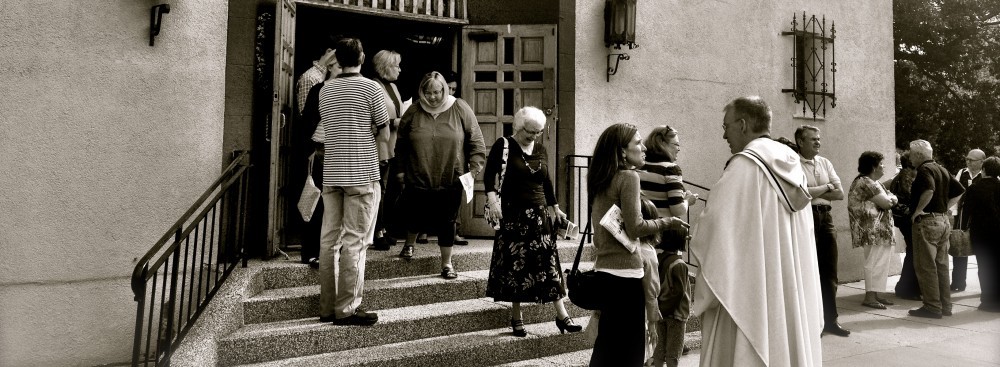
The only outside doors to our parish building symbolize welcome and hospitality to our neighborhood in downtown Portland, Oregon. Members of our pastoral staff and volunteers tell stories of homeless people recommending the “red doors” to other people living on the streets. Many among the urban poor people in our neighborhood do not realize we are a Roman Catholic parish, but the bright red doors are known by everyone as the place to receive many of the essentials of life.

People queue up to receive clothing once a month or a laundry voucher once a week from our daily hospitality center. Some residents of the single-room occupancy hotels enter our doors to seek money for non-narcotic prescription medications, or stand in line for a flu shot clinic. Others wait at our entrance for coffee and donated food, excess from local restaurants and grocery stores. Some homeless women may sleep at our red doors during the night. Some drug dealers may urinate on our doors during any hour of the day. One local newspaper even shared a picture of someone who had vomited on a competitor’s newspaper at the entrance to our building. Our doors were then named the “Best Place to Puke” in Old Town, Portland, Oregon.

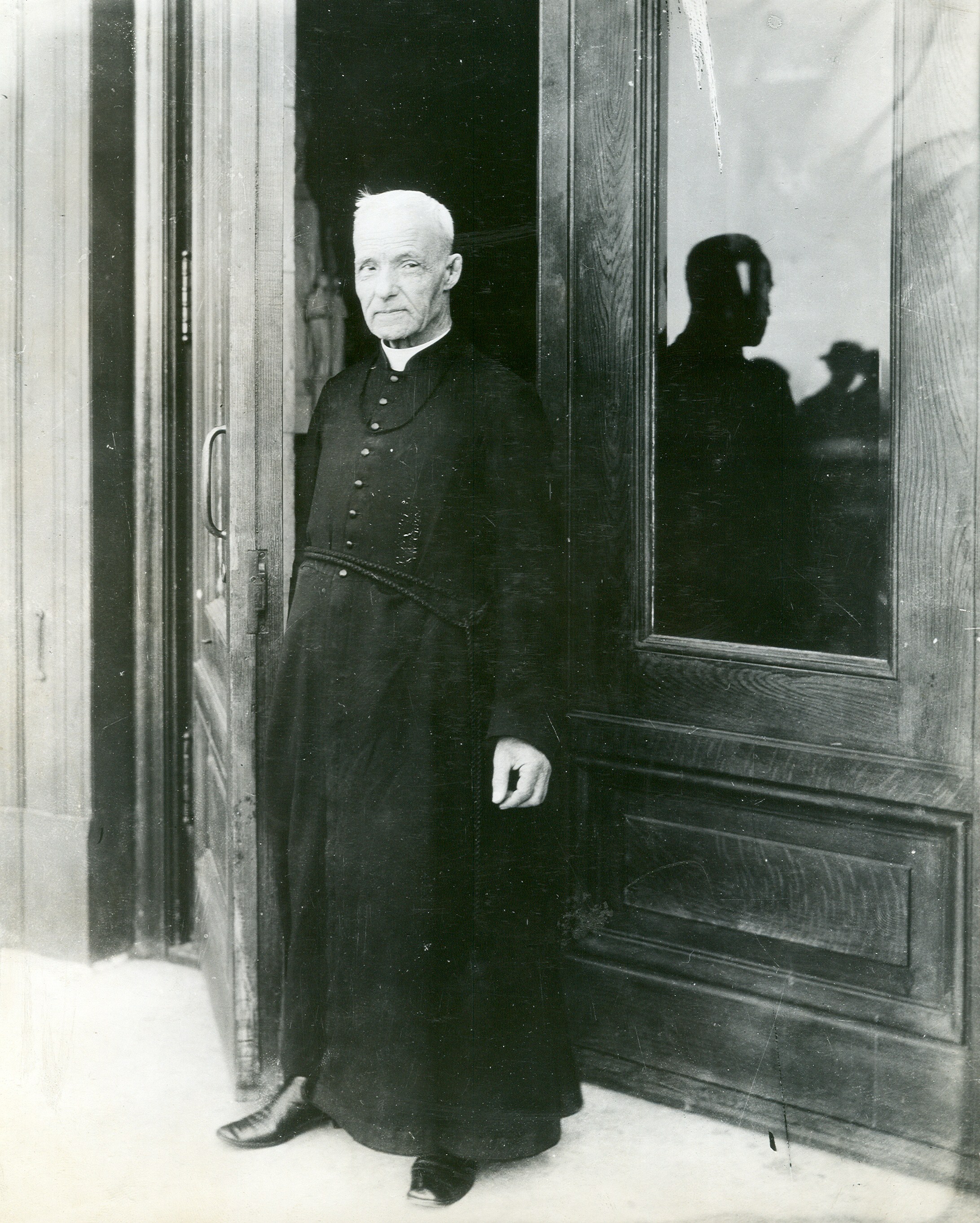
These sacred doors also lead to the chapel where we celebrate Eucharist every day. When we celebrate Eucharist we all realize the importance of our community so people may find hospitality and healing. Last February we announced to our Sunday assembly that Blessed Brother Andre Bessette, CSC will be canonized in Rome on October 17, 2010. The congregation applauded and cheered. Nearly everyone here knows that our community is a community that Brother Andre helps build.

I was standing at our open doors after that Mass and one of our parishioners came up to our pastor and said, “This is where we find Brother Andre, at these doors, in this community!” Indeed, we rely on the intercession of Blessed Brother Andre, because each day we are faced with undying suffering, with questions no one can solve and with ingrained pain that has not healed for generations.

I remember when I first stepped through our steel and glass threshold. I was overwhelmed by the body odor that had clung to the inside of the building. There is no pine-scented chemical that clears away such an odor. I do not even notice that smell anymore after nearly nine years at the parish. There are so many more important aspects of people’s lives to consider.

Blessed Brother Andre, CSC was a member of my religious community, the Congregation of Holy Cross. He died on the Feast of the Epiphany, January 6, 1937. His service to people long ago in need of healing, comfort and consolation continues in our parish as we welcome people living outside or who do not know where to turn because of their mental illness or in their inability to find sufficient health care.

I do not look to Brother Andre for simple solutions to the problems we face at our door. However, his life tells a tale of great faith and dedication. Alfred (Andre) Bessette was born thirty miles from Montreal, Quebec, in Canada on August 9, 1845, the eighth of twelve children. He was always sickly. His mother instilled in him a great love of prayer and dedication to Christ and a special loyalty to Saint Joseph.

Alfred grew up in poverty, especially after his parents died. As an orphan he never finished school. He was illiterate but memorized many passages from Scripture, especially the Passion narratives of Christ. The superiors in the Congregation of Holy Cross did not want to accept Alfred into the community because of his frail health and lack of education. A local pastor, Father Andre Provencal, convinced the Holy Cross superiors to accept Alfred Bessette as a member. He added a note saying, “I am sending you a saint.”

It was through great prayer and the help of friends that Alfred became Brother Andre. He desired a life of poverty, celibacy and obedience. His sole assignment within the community was to serve as the Porter at Notre Dame College in Montreal. His ministry at the door of the college became his path toward love and holiness. He never imagined or dreamed how his life would change or how others would respond to him.

Almost immediately, people were drawn to Brother Andre. He told many who were sick to ask Saint Joseph for help, or to attend Mass. He anointed the sick with special oil found in a lamp near the Saint Joseph statue. He rubbed people’s wounds with a blessed medal of the saint. People were cured of many ailments, diseases and sufferings. Many people began leaving their crutches, canes and prostheses at the college. Brother Andre believed strongly that God’s healing was available for every person surviving poverty.

Some members of the Congregation of Holy Cross criticized Brother Andre because of his ministry of healing and his devotions. Parents at the college feared that sick people would get too close to their children. Brother Andre never saw himself as a healer nor was he concerned in the slightest about his reputation. Andre recognized that healing happened not through him alone, but because people believed in the works of Christ and the intercession of Saint Joseph.

Several years ago a young Jesuit novice entered through our red doors to volunteer in our hospitality center. He noticed Brother Andre’s image hanging on the wall. The novice immediately recognized the image and told us that Brother Andre was his great-great-uncle. He told us a story of a relative going to see Brother Andre. She stood for hours in a long line. Finally she got the opportunity to hold Brother Andre’s hand and tell him that she was a relative from the United States. He told her to move along; his time was for people who really needed him. This story has stayed with their family for years. When relating the story, his relatives told everyone that Brother Andre was a curmudgeon, a cranky old guy who did lots of good things.

Indeed, Andre did not have time for people who were merely curious about him. His single-minded devotion to suffering people was evident well beyond the borders of Canada. He became friends with many people who believed in him and his life was rich with friendships even when he was exhausted from speaking with the thousands of people every week that wanted to see him.

I continue to learn much from the small-framed, pious man who was poor, orphaned and homeless. Our shared religious community, the Congregation of Holy Cross, is best known in the United States for higher education among the privileged. We are priests and brothers, educators in the faith, known for outstanding college football and living comfortable lives. That the frail, illiterate doorkeeper and barber, Brother Andre will become our community’s first official saint, is a great paradox. I pray that we all have the courage to understand his life and celebrate his sainthood.

The poor believed in Andre because he too was poor. He did not see his religious life as an opportunity to escape from poverty or from hard work. Andre’s hospitality was a lived example of Jesus’ desire to run after the one lost sheep even when he was exhausted and afraid. Christ’s command to search diligently for the lost coin is seen in Andre’s acceptance of people. Jesus’ request to ask for what you need, knock on the door with faith and seek always was the total life of Brother Andre.

I am challenged by Andre’s legacy as I stand at our parish doors. I am not economically poor and my faith often wavers from hearing stories of traumas I cannot heal. My greatest poverty comes in my sheer loneliness and deep sadness that I cannot heal the abuse people have suffered as children. I cannot mend their horrific memories. I do not have the power to repair people’s ability to keep a job. I possess no answers when people weep because they do not have love or intimacy in their adult lives. I have only the profound example of Brother Andre as he lived Christ’s invitation to welcome people into community.

People often bend my ear at our parish doors, arguing that if the homeless would just get jobs they would not be a burden on society. I have not read any description of Andre yelling and screaming at passersby, but I often want to shout at people when I hear their judgments. People come to us abused, addicted, and mentally ill and possessing no self-esteem. In this economic recession even the most educated and the most beautiful find employment difficult to attain. We welcome people living in poverty, following Brother Andre’s example, and do not blame people for the struggles and challenges of their lives.

Many church doors are still locked and some of our communities remain inaccessible to certain people within our Church and society. Some doors are barred to children of gay and lesbian parents. Many doors are closed to pregnant teens. Doors are bolted shut to recovering drug addicts who try to heal from multiple abortions. Other doors are closed to the elderly who seek help after being abused. There often seems to be no one on the other side of parish doors to help in times of deep depression, bouts of lashing out from mental illness and landing in jail or even for former clergy seeking help with alcohol addiction.

These are the parish doors that worry me, that keep me awake during the night. Our answers rest in the models of service and hospitality that Brother Andre still shows the Church. I must believe that Christ’s love is the cure for such loneliness and despair among so many people living on the margins of our culture and Church.

Before I open our church doors, I must become vulnerable to God. As I step into the unknown of people’s lives, I remember that only God can reconcile the broken, heal the sick and feed the hungry. There are days when I cannot come to God with anything but fear and a deep knot in my chest. On these days I try to be counted among the disciples who scurried to a dark room, locked the doors and wondered what to do next. Then I search for the words the resurrected Christ offered to them and now offers to everyone, “Peace be with you.” In these words I turn toward Andre’s legacy of living each day in deep prayer and rich satisfaction of the peace and joy offered by God alone.

I admire Brother Andre because he lived his life with passion. He lived an utterly simple life. Other people had to force him to wear a warmer coat and to replace his worn-out shoes. I am deeply changed by this man who simply lived what he believed, that the love of God would be enough for him. God’s love, as it turned out, was more than enough for him.

Every Friday night our parish doors are opened for a meal of soup and sandwiches. People eat seated in chairs stretched along the sidewalk after receiving the meal in our small lobby. We name this soup line “Brother Andre Café.” Simple food becomes the message of hospitality and an extension of the Holy Eucharist. We offer this community event even in the pouring rain or when few volunteers come downtown to help. We welcome people from local low-income housing apartments and people who live under Portland bridges. This is people’s Friday night out, a time to relax on plastic chairs and converse with new volunteers and friends. Brother Andre’s spirit is with us even in the peanut butter and jelly sandwiches.

Through Andre’s dedication, hard work and endless prayer, the Oratory of Saint Joseph in Montreal, Quebec in Canada, stands today as a place of devotion and prayer for many pilgrims from around the world. When Brother Andre died, over a million people fought the frigid weather and deep snow to get a brief moment to view his earthly remains. I truly believe that Brother Andre Bessette, CSC still opens doors for people surviving poverty and living with the consequences of physical pain, mental illness and devastating emotional disease.

Saint Andre of Montreal, pray for us and welcome us home.

Preference for Pink, and Perserverance

Originally published by Ministry & Liturgy Magazine, September 2010
– PDF version –

I caught the shade of a large tree as I waited for people to arrive at the cemetery. A gentle breeze blew through the branches of the oak. We gathered on the sunny July morning to commit my mother to her grave. Her sister and brothers and their spouses sat in the folding chairs near the large hole in the earth. Large bouquets of white flowers were propped up against the casket waiting for us to say goodbye. My stoic body straddled the green artificial turf covering the mound of dirt that created the opening for my mother’s grave.

The warm breeze felt refreshing after wearing heavy vestments during the funeral at the church some miles away. The moment caught me in a loneliness that I will never forget. Here, in this time and place, this cemetery, I had to say a last goodbye to my mother, the person who birthed me into the world.

After praying the rite of committal, we all waved to my mother with both hands. This was a gesture she used in all her goodbyes. I stood silently in this solemn moment that connected heaven and earth. I tried to feel the light breeze on my skin, the fake grass under my feet, and the ancient prayer book in my hands. I absorbed the vision of her siblings’ aching faces and the empty expressions of my brother and his family.

In that quiet second, something amazing happened. An African-American woman wearing a bright red dress darted up to me. She grasped my right hand and took my arm to her breast. Looking me in the eyes, she told me that she was a seer. She whispered in the breeze that she felt my mother’s passing. Holding tight to my arm, she told me that my mother told her two things to pass on to me.

The stranger told me that my mother enjoyed the white flowers, but she preferred pink ones. She then bent even closer to my face and said that my mother wants me to persevere in my priesthood. The strong-gripped sage told me that I did not need to know her name or anything about her. She let go of my arm and drifted into the crowd, got into her car and drove out of the cemetery.

I could not believe my ears or my eyes. No one overheard that she felt my mom’s passing and no other mourner experienced her grip or felt her words. When I arrived at the luncheon after the services I asked everyone if they knew the red-dressed guest. My relatives and friends assumed she was another friend of mine especially after hearing her sing during the rite of committal.

I reminisce about my experience in light of the gospels proclaimed during the last weeks of our liturgical year. As I look back on that sacred moment, I feel deeply the promise of Paradise. Standing on artificial grass that morning I experienced the beginning of a new heaven and a new earth. The line between this world and the next blurred with the words of a stranger. I never try to guess the sage’s identity or wonder from where she came. I take her at her words. I want to live in the mystery that I do not have all the answers nor can I control how the end of life will take place.

Standing under the shade tree at the cemetery also takes me to the time of Zacchaeus risking his life climbing a tree to glimpse Jesus. Instead, Jesus tells Zacchaeus he wants to stay at his home. On that July morning, I felt the invitation of Jesus to feel the shade of the oak and know that all of life was in his hands. I believe on that sunny morning salvation came to our family’s house.

I felt the humility of the tax collector praying in the temple. He humbled himself and was exalted. He knew his place in prayer in light of his life and sinfulness. Leading my mother’s funeral was indeed a humbling experience, especially hearing the red-dressed woman remind me to persevere in priesthood in good times and bad. Her words were especially humbling knowing that they reflected my mother’s intentions.

I do not know the real identity of the woman at the cemetery or the legitimacy of her words. However, I do know I always sent my mother white flowers, but in fact her favorite color was pink. I always felt my mother’s support and love in my priesthood when she was alive, even on days when I wanted to give up. In these November days, I carry myself back to the moment under the shade tree and remain grateful for my mother and my conversation with a red-dressed stranger.

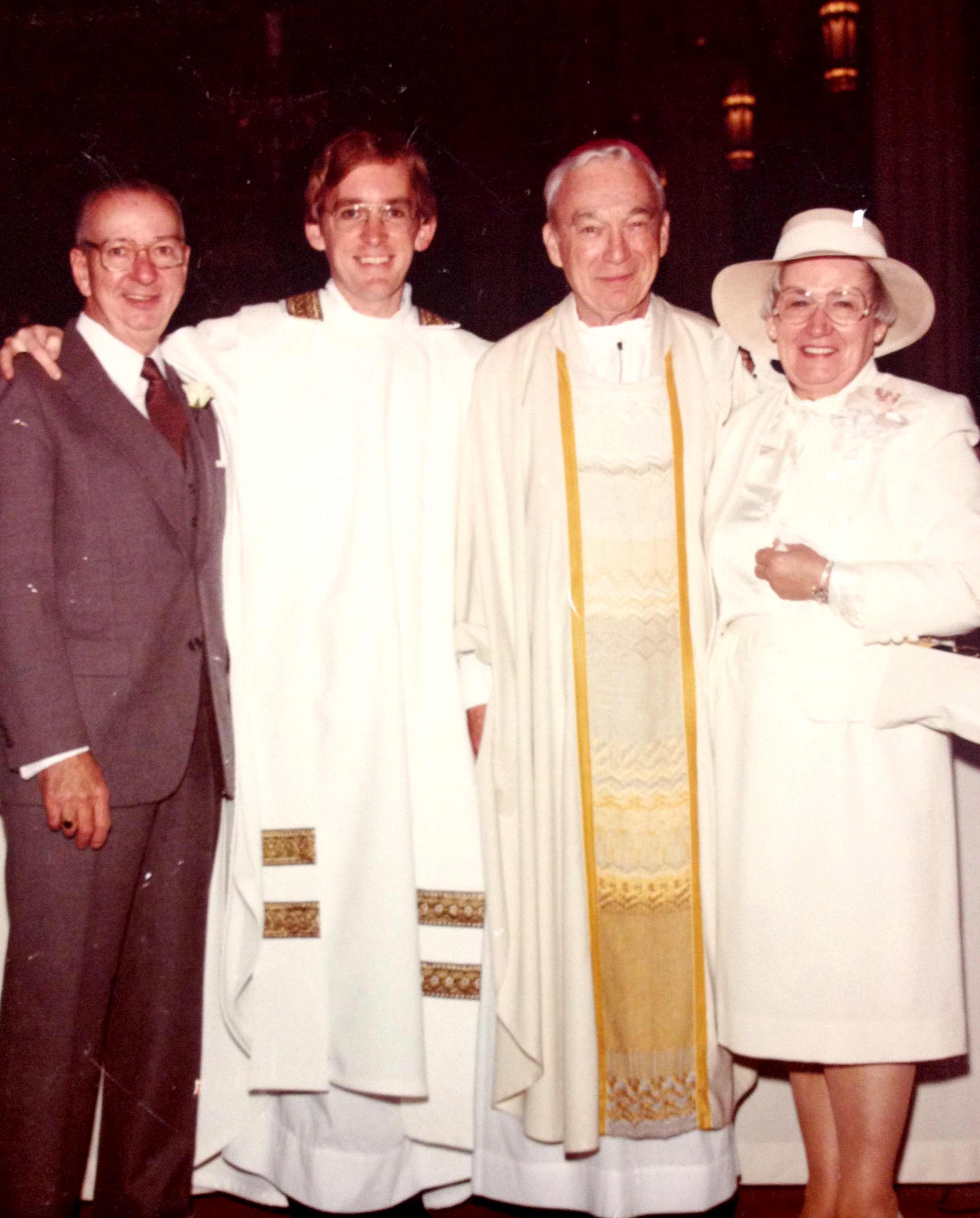
Albert John Raab, Jr., Ronald Patrick Raab, C.S.C., Bishop William McManus, Rosemary Raab

Besmeared

Originally published by Ministry & Liturgy Magazine, August 2010
– PDF version –

I cringe when I notice the dirt on the door windows leading into the chapel. Our janitor cleans these windows daily and staff members occasionally wipe them spotless during business hours. However, by Sunday morning, handprints, coffee, food, body grease and makeup keep the windows smeared and dull. I often think that these greasy windows reflect on the staff and our ability to keep our chapel clean and appropriate for people to pray.

As I reflect on the Gospel passages beginning on the 25th Sunday in Ordinary Time until the 29th Sunday in Ordinary time (September 19-October 17), I see through my own ego. I also see through the smears on the windows and some aspects of faith much more clearly. I see the reasons why the greasy, ugly prints show up in the first place. The grunge on the windows speak loudly about our ministry among those who sleep at our doors, the dozens and dozens of people who come to us needing our attention and the basics of life.

Luke’s Gospel reminds me that to be concerned with my own ego is to serve two masters. When the besmeared windows cast a light on our staff, we serve ourselves rather than the people we are called to befriend in the first place. We must not fritter away our property and not squander our accountability of our stewardship. However, the real property and the authentic stewardship are the people who struggle for clothing, food and a warm place to rest on weekday mornings. To see these people clearly is to become trustworthy in small things. Jesus reminds us that we will become children of light when we see through the opaque nature of our mistrust. When I see through my own foibles, insecurities, failures and moments of self-protection, I serve God and not mammon. I see then more clearly even through the dirty windows to the people who are looking back at me.

Another passage in Luke’s Gospel challenges me to see Lazarus at my door. Jesus’ story is also reflecting back to the fact of my physical safety, emotional comfort and abundant resources. Jesus tells the story of the rich man encountering the poor man at his own door. This story retells itself every day at our urban chapel. Not only Lazarus, but Ethel, Joe, Irene, Bill, Big-Feather, Isaac and Beshawn come waiting at our red steel doors. Some of these people sleep at our doors, leave food, press their greasy foreheads to the windows to peer inside and even urinate on our doors. Pet dogs provide companionship to many homeless people but they also leave their waste near the entrance to the chapel.

The parish doors remain dirty all day because of our hospitality, our welcome to the Lord’s Table. My preoccupation with having clean windows remains a deterrent to my place in the bosom of Abraham. The place in the next world is already being prepared for the staff and the people who wait at our doors. This relationship of those on the inside and those on the outside remains important to the salvation of everyone. This Gospel story reminds me again to listen to the one who has already risen from the dead, the one who will provide a place of welcome for everyone in the next world, Christ Jesus.

The apostles want to know for sure how to increase their faith. They think it will be all up to them to finish the race. Instead, Jesus tells them to put on an apron and get to work. There are more people at the door, more food to prepare, more hospitality to provide, more kindness to offer, more clothing to give away. He asks us to be servants of his Word and stewards again of his real property, the people at the door. The call to serve will always be our obligation, our way into the door of heaven.

Jesus also touches lepers and heals them. He breaks down limits, boundaries and borders to get to people in need. Jesus shows us that getting dirty, touching sores and seeking after the afflicted will provide for us a new way of life. He calls us in the meantime to be grateful. Jesus warns us to be careful whom we consider a leper. It might just be people who remain ego centered, caught in the trappings of cultural expectations, preoccupation with appearance, and people who cannot recognize the value of people.

I peer through the besmeared windows of our doors and see the dignity of dirt, the purpose of our community and the need for my own growth. As I invite people into our chapel, I see the light. In the chapel sanctuary itself there are no windows. I cherish the bright light of my relationship with real people.


Lifting Up

Originally published by Ministry & Liturgy Magazine, June 2010
– PDF version –

Ministry in our parish introduces me to some threatening forms of power. I see the pecking order for dominance and survival each day even among people our society claims have no power. People who sleep in their cars look down on people who sleep under the bridge. People living under the bridge often ignore people living in the doorways along our street. People who are not addicted to alcohol or drugs put down those who are stoned or drunk standing in line at our church door.

Every day I observe the deep human need for people to look down on other people. This moment of control defines so many human situations. This power struggle is seen in prostitution, child abuse, drug use, gangs, wars and even on a grade school playground. The misuse of power happens in marriages, workplace relationships and among children of wealth as well as children of poverty. These struggles for control and dominance separate the employed and the jobless, the well educated and the illiterate, and the dominance of one race over another. This battle for power happens among siblings and between adult members of religious communities.

As I read the Gospel passages beginning on The Assumption of the Blessed Virgin Mary through the Twenty-Fourth Sunday in Ordinary Time, I see Luke assessing our use of power. Luke puts very strong words into the mouth of Mary, “He has cast down the mighty from their thrones and has lifted up the lowly.” These prophetic words place opposing people on the same plane, on the same level ground, with the same view of life. To live a life of faith then, we must be able to look other people in the eyes, to recognize their worth, to honor their dignity, to serve people simply because they are human beings.

These Gospel passages help us all, even in the Church, to sort out how we may put other people down by our unkind words, knee-jerk reactions, obsessive thoughts and threatening gossip. Luke reminds us when we think our way is the only way that some who are last will be first and some who are first will be last. Luke’s message is not just that we need to watch out for people living in poverty, but that we need to quit putting down others whom we think are beneath us. He is asking us for a change of attitude, a conversion of heart, a transformation of reaction and a new way of living our faith.

Jesus invites people who have chosen the place of honor at a banquet to sit elsewhere. He unseats the proud and haughty. He offers a new seat of honor to the man who humbled himself. Jesus lifts up those who know their real place in life. These stories remain not just proper etiquette, but invite us to a deeper conversion of how we live our faith in the world. These passages mold our view of how we see the stranger at Mass and the kinds of judgments we place on people who look different from ourselves. These Gospel words form us into true believers when our automatic response is to put others down. This changes our instinct when we think false power makes us look better, or feel more worthy or deem us more acceptable.
Jesus says to us, “Anyone of you who does not renounce all his possessions cannot be my disciple”. These possessions are not only physical, but even include negative thoughts that cloud our judgments of people. These are not just possessions we store in our hope chests, but the dreams of other people that we destroy by prejudice, bigotry, sexism and homophobia. Our possessions include all the ways in which we speak about people, making them less than ourselves.

Jesus runs a mile for a lost sheep, leaving the rest. He expects us to search our homes for the lost coin and to run far and wide to embrace our lost child. This is the real mystery of God, to ponder the unthinkable, to retrieve the cast-off, to reunite the lost and to forgive when forgiveness is unthinkable.

We risk letting go of false power because of Christ’s dying and rising. The Paschal Mystery is not just a way of worship and belief for us, but a radical new way of thinking and treating other people. The power that Jesus broke through was death itself, so there are no other deaths of put-downs, biases, threats, bullying, abuse or neglect that will ever win. Our parish communities must find our balance of power again after scandals, sex crimes and our judgments of people.

Every day I observe people striving to claim their place in life through false power. As followers of Christ we can live beyond our instincts to put people down, to put destructive labels on others to make us righteous. My ministry among people living in poverty shows me these power struggles and teaches me to love.

Behind Illusion

Originally published by Ministry & Liturgy Magazine, May 2010
– PDF version –

I wake up to the reality of my own selfishness every day. People living under bridges or under caves of cardboard reveal to me how I take for granted the easy life I live as a priest. People suffering severe illnesses of the mind model for me a sincere trust in how life unfolds.

I worry about my own survival even when my religious community pays for my health insurance, even when I sleep in a safe, heated room on a clean bed each night. I cling to my internal fretting even though I overeat each and every day. I remain anxious even though I have friends to shelter me from the bitter cold of loneliness and self-pity. Each day I see more clearly beyond my illusions of fear as I look into my own heart, as I ponder the incredible gifts God gives me.

Living and working among people suffering poverty allows me to realize that I cling to my external possessions and fears. I hold on because I believe that these possessions identify me in the world. Without these labels I fear I would lose my place in society, my status in the Church, my image among my friends. I live the labels of priest, preacher, friend, writer, or cook because without these names I fear I would not be known to God or to myself.

I listen to the Gospel of Luke in these four weeks of mid-July through mid-August realizing our possessions do not name us. Luke invites us again to examine our relationship with all that claims us. Our real identity rests in letting things go to discover God behind our illusions.
Jesus tells us to not be afraid any longer even when we are asked to sell all we own and give alms. Jesus promises us that our lasting treasure, our authentic identity and relationships will come in this action. In fact, we will also find our genuine selves, our hearts’ desire and even eternity in Christ.

Many Church leaders live in fear today. It is our natural instinct to want to protect our children after the crisis of the sex crimes of the clergy. We worry over fewer young people attending Mass, and we fret over vocations to the priesthood when we bury our aged clergy. We agonize over the rules of the Church in days when our faith seems watered down as we struggle to find our authentic Catholic identity. We stew over mixed- culture parishes when downsizing and consolidation seem to be the only answers for survival.

Luke invites us not to worry over our struggles, our identities and our futures. He challenges us to view even our faith as a possession. We are called to welcome those who challenge us, love those who hate us, and offer hospitality to those who cannot repay us. Luke shows us that we must rid ourselves of everything that gets in the way of living the passion, death and resurrection of Christ Jesus.

If we listen carefully to these passages of Luke’s Gospel, we will learn to rely on the daily bread that is offered us and even in turn offer it to someone who begs at nightfall. He teaches us in these summer weeks not to worry about the externals of the church and not to hide our deep trust in God’s love for us. We may fret and be anxious as Martha was serving the person of Christ. However, we must realize that the true presence of Christ is within us forever.

We must learn from people in poverty who Luke calls us to serve. This knowledge offers survival to our communities of faith. We give alms to realize our trust in God. We do not give alms to make us feel better about our own generosity. We offer people faith and love so we may be converted to even a deeper love. We do not offer the marginalized food, shelter, clothing and communion to show other people how much faith we have or to make us look good to someone else.

If we are to live the model of the sacramental church, then we must be converted when the Bread of Life is broken and shared, when the Cup of Salvation is poured out for the many. This sacramental action will allow us to release our grasp on many of our possessions and allow us to become the people we claim to be, followers of Christ who gave up even his life for our sake. The action of the Eucharist becomes Luke’s message for us to give up our pretense, our security and everything we own to become people of authentic trust and deep love.

People who live on the edge of survival teach me to trust this genuine life God gives me. This process of self-stripping, of letting go of my false identity, gives me courage to live out the gospel message to serve people in poverty and to receive my portion of God’s offering of daily bread.


Someone Else’s Clothing

Originally published by Ministry & Liturgy Magazine, April 2010
– PDF version –

I still hang on to several pairs of jeans in my closet that do not fit me anymore. I should say I have gained too much weight to fit into my old jeans. However, I cling to the illusion that someday I will learn how to take better care of myself. This is the self-talk that keeps those perfectly good jeans hanging out of my sight. I do not want to admit that they need to be given away to people who need them today, to survive the cold springtime of Portland, Oregon.

The longer I minister among people who live outside or who suffer beyond my imagining with diseases of the mind, I realize my sickness of clinging to clothing that does not fit me anymore. I have yet to fully comprehend that it is not only the clothing that does not fit me anymore, but my view of who I am as a person and as a priest that has changed ministering among our society’s fragile, vulnerable and physically naked.

I evaluate the contents of my closet every Saturday evening as I unlock the chapel door on our urban corner in downtown Portland, Oregon. I open the steel doors and Irene is always waiting there to enter. She carries with her in a wire cart the contents of her entire closet. All the clothing she owns from her single-room-occupancy apartment is wadded up in the shopping cart and in several bags she carries on her shoulder. She tells me she brings her belongings to Mass because she fears someone will break into her apartment and steal everything. She lives in great fear that her second-hand clothing will become another hand-me-down to a thief.

I do not know if the thief is coming. However, she provides for me serious reflection about what I carry with me, not only the clothing on my back but the attitudes, values and lived reality of my priesthood. She stands every Saturday as a reminder that I do not own my possessions. I am not what I wear. My true identity comes from my real nakedness, the intentions of my heart and life.

Several years ago after welcoming Irene into the chapel and helping her carry her clothing to her pew, I entered the sacristy to vest for Mass. I opened the closet in the sacristy and reached for my alb that is twenty-eight years old. The familiar beige cloth comforted me and reminded me of these many years of liturgical prayer. I have clothed myself with the same alb to bury strangers and family members. I have worn the alb to witness the commitments of hundreds of couples and to receive the heartfelt confessions of strangers. The dark stains on the sleeves reveal the illnesses of people who have been anointed with holy oil. It smells of sweat and aftershave. I have stood at the altar in dozens of churches amidst varieties of circumstances. Holding the garment next to my body, I realized how I have been changed, not from what I wear, but from the many people who have challenged me, taught me, and shown me how to become a real person beneath the alb of prayer.

I reached for the green chasuble that the parish owns. I stopped, held the garment, and realized for the first time in all my years of priesthood that I was wearing someone else’s clothing. I am also a person of poverty. Not only did I realize I did not possess the garment, but I understood that the garment would never be fully owned by any person. This garment belongs to everyone. This garment has been handed down for centuries, not as a sign of separateness, but as a witness that nothing belongs to us. At that moment, I felt profound joy and relief that I have not physically grown out of the clothes I wear to celebrate the Eucharist.

Now, every time I reach for a colorful chasuble, I am reminded of all who are naked, those who wait in lines and have to ask for the basics of life. I bring to mind the grueling fact that so many people in our country of privilege have to ask someone else for clean underwear. Everyone in church leadership should witness the humble faces of people who have to ask another person for such personal items. These people’s humility and courage would teach us all how to relate to the entire worshipping assembly.

My liturgical vesture calls me to prayer by showing me that so many people own only the clothing on their backs and another person first owned that clothing. These vestments tells me not to claim false power, or find privilege in leading prayer, or get caught in the trap of how some people want to treat me with privilege.
I wear a stole for liturgical prayer that calls me first to stand emotionally and spiritually naked in moments of quiet, personal prayer. I must be ready to acknowledge the source of my life in God before I can lead other people to the mystery of Christ’s dying and rising. I must know firsthand that the piece of cloth around my neck does not provide for me places of honor. I cannot place burdens on people that I would not carry myself. The longer I wear the stole, the more I see it as a means of self-stripping, letting go of so much that separates me from real people. The stole calls me to prayer so I may become more honest in my life as a priest and as leader of the Eucharist.

The stole, a yoke around my neck, speaks to me now in ways it never has before. I live a life of advantage, education and benefit. The yoke that I carry around my neck must be connected to the suffering of people who wait in line, not only for the Eucharist, but also for every daily meal. The heaviness of that simple piece of material around my shoulders must connect me emotionally to people’s suffering. I must join my prayer to people locked in the chains of prison. I must begin to feel the weight of unemployment on the shoulders of a single mother and her little girl. I must hear the story of people and feel their lost dreams of education and a solid future in this downturned economy.

Before I was ordained a priest, my mother hand sewed two chasubles for me. Her gift to me was the joy of dressing me as a priest as she had dressed me as an infant. I remember purchasing the white light-wool material, the thread and the decorative banding. My mother figured the cost of each chasuble was $9.00. I certainly did not realize the true value of those liturgical garments at the time, the handmade vestments for Eucharist sewn by my mother.

I wore both chasubles for years being reminded that ordination is so deeply rooted in the garments of baptism. Every time I put on one of the vestments over my head and on to my body, I am reminded of how my parents clothed me for many years. The vestment shows me again that I will never really out grow my baptismal garments that have called me into a life of service.
I draped one of the chasubles over my mother’s casket when I celebrated her funeral. The funeral director tucked it into her coffin before burying her. I had to let it go. In some ways I had to grow out of the garment and into another phase of life. I needed to leave it with her as a reminder of her years of love and care for me. I knew it really did not belong to me, but to her support and encouragement for my ministry.

I connect my Eucharistic vesture to many moments of ministry and to many ways our bodies are covered with gowns of suffering. I see my vesture calling me into service when I encounter an elderly man wearing a hospital gown just coming out of surgery. Finding our bodies in someone else’s clothing no matter how new or clean is always difficult. Wearing such garments is difficult for patients when the material does not completely cover the naked body. These strange gowns are always associated with body pain, loss and bland hospital food. When I see someone in a hospital gown, I pray for them when I cover my own body in the garment of love and sacrifice at the altar.

I pray for newborns in diapers, the garments that create fathers out of ordinary husbands. I connect my prayer with the clean white handkerchief I give to the young woman on the streetcar because her nose is bleeding and she has enough trouble navigating her mental illness. I associate my vestments of service with the white bandages the medics use to stop the bleeding of a man too drunk to stand up near our chapel door. In all these moments I see in my heart the white cloth that was tossed aside in the empty tomb on that morning when the disciples could not find the dead body of Jesus. The living Christ, the Spirit of God, connects me to that garment first worn by someone else.

I recently noticed a runaway teen and his girlfriend sleeping on bench near the river in downtown Portland. As I walked by I noticed the young man wearing a T-shirt that read, “The University of Notre Dame.” By seeing his tattered, baggy pants, and large over-sized shirt I realized that his clothes were obviously first worn by someone else. They both looked as if they had been living on the streets for years. I wondered if my religious community, the Congregation of Holy Cross, knows where the clothing from Notre Dame goes after the football games have ended and the students have gone home. I would have ignored this youth before realizing that I also wear clothing that once belonged to someone else.

I was ordained at the University of Notre Dame but I have deepened my formation into the Gospel by entering the mystery of people’s suffering. The T-shirt was just a T-shirt to the lad on the bench. It covered his body. The shirt looked stained with vomit from over drinking alcohol. He did not wear the shirt to prove an affiliation as a football fan or an alumnus of the school, but for sheer survival. I saw the shirt and immediately connected it with the vestments that call me into working for justice and to care for people like the youth on the park bench.

I risk being spiritually naked in front of people at the altar every day. The ancient vestments protect me from the holy fire that stirs on the altar, the Real Presence of God. This fire creates community from suffering, pain and longing. At the altar of God there are no distinctions of rich and poor, we are human beings longing to experience our real identities in Christ Jesus. The vesture is a sign of our common lives clothing us in the dying and rising of Christ. The liturgical clothing becomes our baptismal dying to human power and rising to the real presence within us of God’s healing and saving life.

Even after all these years of priesthood, I am still growing into the clothing that has been passed down to me for centuries. These hand-me-downs teach me not to get stuck in my human ego and false concerns. My vestments clothe me in overwhelming humility. Vesture is not a liturgical carapace, but a connection to our lives of human poverty. The vesture hanging in the sacristy shows me the connection I have daily to people living in poverty and who have no choice as to always wear someone else’s clothing.

I will be buried in a chasuble. I will wear someone else’s clothing for all eternity. However, my ill fitting jeans may still be hanging in the closest waiting for someone else to benefit from my inability to let them go.