Saving Face

Originally published by Ministry & Liturgy Magazine, October 2008
– PDF version –

I grieve my father’s face in Advent. He died one December in the cold Midwestern days. His mother also died years before in the same Advent month. I remember his expressions becoming frozen not from the weather outside but from the numbing effects of Parkinson’s disease. I cringe at the memory of his furrowed brow from his disappointments and regrets in his old age. His old-man face haunts my memory because his disease creased his spirit and shrunk his perspective on a life of hard work and dedication to his family.

My Advent heirloom can not escape my father’s long years of blank stares and the generational grief that has formed the life of my brother and me. Every year these days before Christmas remind me that I do not wait for a baby to be born in a manger. I long instead for a new expression on my own face that reflects God’s intervention in me now that I am not a lost child, not an heir of only loss and failure.

Every year before Christmas, I view similar faces in our urban parish that reflect subsurface suffering and losses that extend from parents to children. Many people who make their home outside often hide their longing to be connected to their past. To begin to unveil the stories behind some of the faces in our daily hospitality center, a parishioner initiated one late autumn the “Portrait Project”.

Our parish staff called upon a professional photographer and his students to sit with our guests and capture their faces on camera. When the day came to shoot the photos, some people cleaned up, and others asked if a friend could join them in the frame. Some women dabbed on makeup which so changed them I could hardly recognize their worn expressions. People felt excitement wearing grins and smiles because we wanted to capture their features, their present story. Their entire bodies lit up standing opposite a lens for the first time in years.

The finished photographs arrived back at the parish in the dark shadows of Advent. I viewed each face with a tender respect. The paper icons revealed the dignity and emotional energy of each person. Personalities jumped out from the 5 X 7 portraits, each face glowing off the golden background. From what was previously a group of wet, darkly clothed, anonymous poor who line up every day at our church door, I now see individual people. Their faces teach me to see them for who they are, with individual histories, with stories of suffering and being lost, stories that are not so different from my own as I might have thought before.

All the labels I put on others peeled away as I held that stack of portraits. I realized the variety of violent names and tags I put on other people. These human faces unmasked my own fear when I squeeze others into categories such as uneducated, smelly, or lazy. I saw in my heart the fear that keeps others at bay to attempt to protect myself from being in relationship with the real world, with people beyond my own history and comfort.

Advent reveals the faces of our ancestors because Jesus’ birth confirmed the dignity of the human condition. Our preparation for Christmas invites us to explore within our communities how we view the people around us. These four weeks stir our hearts for the God who lives behind each human face, underneath our expressions of unworthiness, fear, and loss.

When the photographs were distributed, volunteers wrote letters dictated by those who had had their portraits taken, provided Christmas cards, and addressed envelopes so people could send a loved one this very personal gift. One volunteer received this dictation, “Please forgive the wreckage I left behind. Someday I hope to come home.”

I believe if we are all honest in this Advent season, this sentiment may very well be ours. We stumble around our own conscience unable to fully believe that the Christ who once was human still heals and forgives. The Savior still is being born among all of us who need him the most. Without this faith, we will never see the true dignity of other people and never realize our own true home.

When I step out from behind my mask of success and authority, Advent reveals in me the hidden face of God. This grace opens me to a new power greater than myself and calls me to forgiveness, love and hope. The liturgies of Advent shake all of us out of our slumber and wake us to recognize the gift of people around us and our ancestors before us. My brow relaxes, my expressions become free, when finally I experience God’s saving face.


The Yellow Pages

Originally published by Ministry & Liturgy Magazine, September 2008
– PDF version –

I proclaim the Gospel during Mass holding on to the lectionary for dear life. My right thumb presses tightly along the lower corner of the page while my left hand glides along the sentences yet to be read. I caress the written words because I understand my life depends on how I interpret those words which I yank out of my throat. After twenty-five years of Gospel proclamation, through translations changes and varied lectionaries, I ponder the yellowing marks on the corners of the pages left by my greasy prints.

My soiled fingers also leave the pages of my Liturgy of the Hours book brittle with shades of yellow decay. They tell the tale that I have been faithful to the same book since the fall of 1976. Those same marks tell the story that I am more faithful to Morning Prayer than to Evening Prayer. I pray more often at the beginning of the week rather than at the end. The dirty-yellow marks on the edges of the thin pages reveal the direction of my past faithfulness. They also reveal my end-of-the-week infidelity.

With little detective work even the sacramentary traces my path of prayer. Those same greasy-yellow marks creep onto even the newest books. Our parish sacramentary, however, tells a tale of years of true-to-life prayer because the cover is being held together by white masking tape. Inevitable wine spills mark the red and black texts with a few bread crumbs hiding in the folds of the pages. Many prayers have come from the written rubrics from this book evoking responses from the faithful listeners in the pews.

Now that I have some years of experience leading communities in prayer, I realize that a liturgical spirituality may be revealed in the ordinary, tangible articles of how we pray in any community. The commonplace artifacts of liturgy speak honestly and boldly, beyond the script set out for me in graduate school or the seminary, more profound than liturgical workshops and much more interesting than discussions on prayer being “liturgically correct.”

I form liturgical ministers by teaching them to act with this same sense of intentionality. I instruct them to caress the sacred texts with fidelity and love. Lectors hold on to the lectionary because they understand now after years of proclaiming the holy Word to our needy assembly, that we all need God. The readers grasp the edges of the sacred book because on some days many of us forget that God loves us. They learn that the written words in a book become something more than a history lesson. The lectors become instruments of God’s intentional love for all His people.

These readers in our worship may also get lost in the swirl of life’s indignities. When lectors lose hope, they proclaim the Word anyway. They hold tight to the holy words even on days when they do not believe they can manage life or believe in something more than themselves. They grasp the lectionary tightly because they never know how much other people need to hear the Word of freedom and healing.

My heart aches for the elderly woman grasping the written text with arthritic fingers because she remains so tired of caring for her husband with Parkinson’s disease. She cannot lift him out of bed and she barely has the strength to lift the holy book up to her fading eye sight. On those days she proclaims the Word in the hope that someday she may believe in God’s love again.

One day Bonnie stormed into the sacristy before Mass disheveled and frantic. Her puffy eye lids told me she had been crying and not sleeping. She screamed out at me that she could not take her daughter’s drinking anymore. She threw off her coat and complained that she was tired of always rescuing her daughter after late night drinking binges. Bonnie could not handle her verbal abuse and the effects on the family. Quickly before Mass started, I tried to suggest that her entire family needed help. I could not calm her. I forgot that Bonnie was scheduled to be the first lector for the Eucharist. Bonnie walked up to the ambo after the opening prayer, held on to the lectionary with both hands and proclaimed from Isaiah, “Can a mother forget her infant, be without tenderness for the child of her womb? Even should she forget, I will never forget you.”

On that day, Bonnie left her finger prints on the Scriptures and most of her worry as well. The Scriptures in turn marked her soul. These moments reveal to me that God’s presence in the Eucharist is real and sustaining. Her proclamation of the Word also showed me that seeds of faith are nurtured and brought to fruition by God alone. Our role is simply to be present to life honestly, lovingly and understanding that we cannot force faith on anyone. On that day I grasped the Gospel book with intentional gratitude, leaving on its white pages the prints of my pride and deep concern for Bonnie and her family.

Our extraordinary Eucharistic Ministers also carry with them this ministry of intentionality. They hold the Cup of Salvation with a firm grasp that understands their fragile place in life. Even on days when life erodes their self-esteem and purpose they stand on the holy ground of our worshipping community as if they owned the place. The ministers stand solidly on the earth, breathing deeply, and realizing God is using them for His purpose. The noticeable prints on the communion cups tell me the story of our minister’s grasp for dear life, especially on the days when they do not believe in God’s presence within their pain.

Jane holds the goblet, the miracle of Christ’s real presence, in her hands with great intention because she is allergic to alcohol. Even though she does not receive the Eucharist from that vessel, she holds on tightly to the fact that she must offer the cup of freedom to other people. She stands intentionally on this place of level ground where all people are equally treated. Jane looks into the eyes of each person who approaches her and invests her prayer in people she knows by name. Jane prays especially for people who remain bashful or timid or feel unworthy to look at her in the eyes. She prays through her addiction and into the hearts of strangers who need God in ways that are beyond her imagining. Jane prays at the sight of every lipstick mark on the purificator and every fingerprint left on the sacred cup. She realizes she holds the source of love to many who feel they do not belong in the church, those who cannot forgive themselves and for those who wait to believe again someday. She waits for the day when we are all in communion with one another.

Our ritual books reveal the marks of many other profound moments of prayer. There are a few pages dusted with black marks from my thumb from Ash Wednesday after dabbing burned palms on people’s faces. I leave the dark splotches on the pages because they remind me of the fragile lives behind the greasy foreheads that long for change. These people let go of previous conclusions about sin, division and heartache. Those black-grey ashes under my nails remind me that I will join the club of heaven with all past believers when my body becomes dust.

Every week in our urban parish we celebrate the Anointing of the Sick after the noon Eucharist because so many people long for courage. I pray for healing as I ponder the oil spots left on my chasuble or the sacred oil spills on the maroon carpet in the chapel. In those greasy sights I still see my friends who suffer from mental illness or are recovering from strokes and congestive heart failure. I pray focusing on the crusty oil dried on the glass container that stores the oil during the week. The container waits again for our friends who line up in a row so to be touched with sacred oil blessed by the Bishop. I celebrate every week wearing garments spotted from past encounters of this loving sacrament and touching the foreheads in their need of Christ today.

Even the pages from the ritual book of the Rite of Funerals are warped from blessed water. The crinkly pages from the opening of the funeral mass remind me of all the times I sprinkled baptismal water on the caskets of loved ones and strangers. The texts of this ritual book are blurred from the drops of water and tears that have flooded the opening rituals of bringing dead bodies through the church doors for the last time The pages connect me to people’s lives and the hope I will be sprinkled with new life when my body enters the church door for the last time. These old, worn, faded pages celebrate for me so many lives and teach me again to let go of everything I want to cling to that is not God.

I observe the pen-marked pages of the ritual book from the Rite of Christian Initiation of Adults which remind me of all the new followers of Christ. I celebrate my twenty-five years of starting ritual fires in parking lots and on street corners. I remember these years of blessing fresh water in bowls and fonts. I pray again in memory of drenching people with this holy water and ruining their hairstyles. The dark marks on the pages remind me of the sacred chrism which connects all believers from around the world. I wait for the day when our connection to human community gives way to the true unity in our places in heaven. In God’s Kingdom we will not have to worry about our hairstyles or regret our roles in the community or fret about the correct rubrics of our worship.

I believe we must ponder the finite, ordinary aspects of our prayer to find the God of infinite love and mercy. Every aspect of the liturgy must lead us into two directions, first to people’s hearts and then ultimately to the unbelievable mystery of God. Our community worship must shed light on the here-and-now and our future with God. If people or God are missing then our prayer becomes disengaged and meaningless.

As I look back over my years of ministry, I see that the ordinary and even the trite aspects of our common worship help make our prayer honest. This is one of the first fruits of living an intentional life, being honest with God. I see His mercy in the sweat stained purple stole hanging over the chair in the confessional. I understand courage pondering the tattered edges of our chapel’s carpeting. The fringe reminds me of my friends who pray in wheelchairs that get caught along the frayed corners.

When I am transferred from this parish I will leave behind the stains, tears, and smeared pages of all our ritual books. The books will outlive my stay and they will remind others that we all prayed here with gusto and grace. I am not sure the second grader stepping on the kitchen stool to read the Scriptures at Mass will notice yet the greasy marks on the pages. The confirmation student may not even be aware of the oil spilled on the ritual book. On First Communion day the children may not be aware that the adults are holding on to the chalices for dear life. They will in time, when God settles into their lives, find grace in the ordinary, connecting their real lives to fingerprints on the chalices and the smeared, yellowing pages of the lectionary.

When the Sun Shines on the Crystal Again

Originally published by Ministry & Liturgy Magazine, September 2008
– PDF version –

The autumn sun burns most deeply into my room. Every year the hours of daylight shorten but the rays of sunlight lengthen to stretch beyond the windowsill to the crystal vase on my bookshelf. My mother passed down the crystal heirloom to me when my grandmother died. The first arms of this light bring back fond memories of my grandmother and now my parents as well. I see my past more clearly every year when the crystal seduces the sun.

The soft light so often surprises me because I always forget it will appear again.  When I finally settle into the memories, the late autumn light also brings the darkness of my loneliness and the reminder of the rapid pace of my adult life.

I first noticed the friendship of the sun and the crystal when my spiritual mentor, Richard, told me he had AIDS. He sat at the piano bathed in this light and for the first time could not play Mozart because of his dizziness. This light cracked open a new experience for me of delicate conversations with a dear friend who was dismantling his relationships, discovering a soulful and physical dying. The devastating news wore in me a new place of vulnerability and fear.

A year after sitting at the silent piano, he died. I preached his funeral in autumn after sunset. The roles of friendship reversed that final year. I mentored Richard through extreme physical suffering and letting go of all life. Now every year, I begin to fear the earthly change of cold air, shorter days, and the autumn memories of all the dead. I frolic in reminiscences like a lost child in a pile of fallen leaves. I feel the cold regrets and pray through the emptiness.

This autumn ritual catches me off guard. Yet, my body senses every year the deep experiences of all the loss in my life. No one autumn contains all my fear. No one crystal vase receives every regret or memory. Grief lives within the confines of our earthly life forever. The human heart calls for this flow of ritual, the current of memories, and the natural course of sorrow to find healing.

Every parish community in autumn must prepare people to feel their grief and connect their memories to faith. There is no way around death. We must find new ways to ritualize what is most common, the fear of loss. We must sort out ways to help people ritualize within in their own families and circles of friends the grief that keeps us numb to new ways of relating to people.

Death keeps every community honest. However, we must risk telling the truth about life. Naming real issues and celebrating loss breaks through much of the narcissism and pretense that strangles most communities of faith. This truth cuts into our natural instincts of thinking that money, power, education and fear create community.

These are the days to create this awareness of loss. Gather grief counselors, professional spiritual directors and liturgists from your assembly to facilitate discussions for parish staffs and liturgy committees on death and grieving. When we build a network of openness and honesty about what is most important, a new vital energy emerges to help people deal with sudden grief, sustained depression and the release of anger.

Create forums where the Gospels ignite genuine discussions in preparation for homilies during the months ending the liturgical year. Connect elderly people in the parish and school parents by creating opportunities to pray in silence for the dead. Instruct school age children to write follow-up letters to grieving families a month after losing a loved one in death. Suggest that volunteering among the poor is a way for every family member to memorialize a loved one. Create an opportunity in the church lobby for parishioners to write down not only names of the dead but how they grieve them at home and with family members. Organize discussions and name rituals for home reminders that grief needs to be ritualized within everyday experiences.

Ritualizing our grief comes in the everyday awareness of living life. Members of our communities need the assurance that they are not alone in the simple ways grief becomes articulated and lived. We need to live an honest life to lovingly grieve other people’s death. I wait for this autumn, when I will be reminded of those I love in death, when the sun shines on the crystal again.

Personal Poverty Retreat

Originally published by Ministry & Liturgy Magazine, February 2008
– PDF version –

Our parish church, on Burnside Street in Old Town, downtown Portland, Ore., sits on the border of a great divide. On one side corporate executives scurry one by one to tall, marble buildings, but on our side people dressed in drab colors line the sidewalk in front of our building waiting to enter our red doors for coffee or clean underwear. One day I noticed a woman executive who crossed the forbidden line. She stood on our sidewalk pointing her finger at a man, mentally ill and homeless, who was playing with his grey kitten. Dressed in grey flannel and stiletto heels, she screamed at him not to endanger the cat. After her encounter, she stormed into our lobby, where I was sweeping the floor, and yelled at me, “you have to do something about that man who is hurting that cat!” I assured her I would take care of the situation. After she left the lobby I turned to one member of our parish staff and said, “1 wait for the day when someone comes into our lobby and says, ‘We, together, should do something about that young man who suffers from mental illness and is without housing, employment and friends’.”

This encounter teaches me that we all face different forms of poverty. Dozens of times every day in ministry, I realize poverty is not an abstract reality but reveals itself through our own histories, relationships, and education. We carry poverty in our prejudices or our backpacks, in our cultural expectations or in a shopping cart. We express issues of poverty by the labels we attach to one another, no matter which side of the street we live on.

This interaction between two people dressed in grey also shows me the black and white divide between the rich and poor that continues an ancient tradition. This chasm reminds me every day of Lazarus in the doorway who longed to eat the scraps from the rich man’s table. The segregation calls to mind the journey of Jesus to a Samaritan town to reach out to a woman under the noonday sun. It underlines Jesus’s command to welcome ill strangers, people with handicaps, the former prisoner, and the newly widowed to the feast where all people fit around his open table. This ancient way of dividing the poor and rich teaches me that we have yet to understand the basics of gospel life, in which our lifestyles of fear can be replaced by reaching out to those who need the staples of love and understanding.

Our parish staff searched for ways to educate people living beyond our corner. We wracked our brains to develop a method to move believers beyond their black and white interpretations of life. The staff realized that our ministry among the poor on our side of the street could become a vehicle for real catechesis among those who already have jobs, security, and satisfying relationships. We began to realize that the poor themselves would become the teachers, the authentic catechists. The antidote to unhealthy interactions with poor people begins by learning from those who are suffering, lonely, and drug addicted. Building authentic relationships remains the answer to recognizing the dignity of all life. But the people would first have to be willing to cross the street.

And I needed to examine my own life, priorities, and actions to discover which side of the street I really live on. I needed to grapple with my own need and desire for God, my own personal poverty. I needed to authenticate God’s work in me by stepping out of my fear and comfort in order to serve people suffering physical and emotional poverty.

I found the way to bridge the chasm between faith and service right under my nose. Our daily hospitality center has changed my approach to God more than anything in my years of priesthood. When I spend two hours handing out hygiene products or laundry vouchers and listening to people’s stories, our interactions strip away all the pretense of my human ego and priestly identity. I am the one emotionally naked most days as I realize all the masks, education, and power I stand behind. Mingling in our hospitality center strips away any notion I have that people should be different than they are or that I could possibly have answers for their questions of survival or sobriety. So I invited those who live on the opposite side of the street and beyond to enter into this place of self-stripping.

The parish staff developed from our basic daily ministry an opportunity for others to join us in learning more about prayer and service. Every Friday we work a 13-hour day. We now open up this time once a month so others may join us in an unconventional retreat. We call this day of work and reflection “The Personal Poverty Retreat.” People in small groups muster the courage to cross the dividing line and participate in this day of ministry and sharing.

I gain great courage as I hear people reveal insights and stories during the debriefing sessions following morning hospitality. They understand that the trip across the street was worth the effort as they slowly unravel all their misconceptions about people who are poor, addicted, or lonely. Facing the mentally ill rouses palpable fear in people who are used to having all the answers in life, those who spend their days telling others how to live or what to do. Teachers, bankers, and retired executives often sit confused about how the experience challenges them. I watch in silence as I hear a retired grandfather express guilt over his well-earned possessions. I listen with gratitude as a businessman reveals that he must reinterpret his basic notions of a lifetime of cultural norms, his perceived masculine role in society, and the threats he feels to the American dream. Encountering people who live in poverty becomes real catechesis to the rest of us who think relying on our own power, education, and social status will bring us to God.

After we celebrate the Eucharist at noon, we take the call of the dismissal seriously. We let go of the safety of the sanctuary and enter the streets of the neighborhood where we visit Catholic agencies serving the needs of people living on the streets or in single-room occupancy hotels. I try to resist the notion in myself that this is a poverty safari, a tour of gazing at drug dealers selling their stuff or glaring at the mentally ill person who asks for a handout along the way. This walking tour opens up all our senses, especially for those who are used to passing through this same area in the safety of their car. I see a couple having sex in a doorway, a family creating a cardboard hut near a fence, and a man telling jokes to himself. It is on this tour that people experience the issues of our city trying to eliminate housing for the poor, closing agencies that provide services, and avoiding the needs of the mentally ill people. Amidst the piercing sounds of jackhammers, ambulance sirens, and buses rushing by, we always pray in front of each service agency. This is not a tour about how the church serves the poor but an exploration of people’s consciences to find new ways to learn the needs of others and a new dependency on God who calls us out of ourselves.
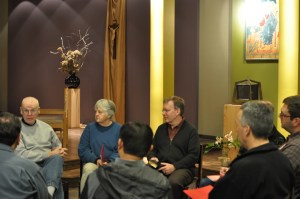
The foot-tour raises challenges and exposes consequences about people in poverty, but the two-hour reflection session afterward is where the rubber meets the road. Here we try to ask the startling questions raised by shattered notions of who poor people are and about the God who calls us to do something with our lives. I introduce the session by reading aloud about one of my mentors in Scripture. The Canaanite woman perks us all up after the walk outside, challenging us to shake our fists at Jesus to change his mind about the needs of her daughter. She teaches us to advocate not only for those we love but also for those we just met along the way. This holy woman in Matthew’s Gospel reveals that what we must do to change people’s lives is to storm heaven with our prayer to make sure Jesus is paying attention to his lonely and forgotten.

l am profoundly changed by the challenges people face while sharing in this group setting. One by one people share their real poverty. Suddenly people are making the connections that a recent divorce isa path to God or that the powerlessness they experience with a tormented teenager is the way to a new life of compassion and change. I witness the Spirit softening the anger of a middle-class parent realizing that his years of anger and hatred toward his homeless son need to change. He now understands through the course of the day that he cannot fix his son’s addictions and ‘that he simply needs to love him and offer support. I am amazed at how people let go of so much control and regret, old patterns of life, church, and family. The people on retreat realize that their answers to questions of family, society, and church do not always work for every person, no matter how hard they try to convince people of their correctness. This kind of catechesis does not come from a religious education manual or a tidy parish program but is found in real and honest relationships with those who find themselves on the margins of society and church.

Our evening ends by sharing a meal with other volunteers and then working in our soup line, The Brother Andre Cafe. In our church lobby we encounter people from the neighborhood coming to us not only for food but for an affirmation that their lives count. They come because this is about community, even as broken and tenuous as it is. I try to make the connection with our folks on retreat that this line is an extension of the sanctuary where people feel cared for and welcomed. It is the human and complicated table where people learn that profound hunger brings honest community. This safety of community sometimes is shattered by a man who acts out his mental illness violently or by people just wanting to stir up a fist fight.

I am deeply inspired when people realize Christians are not U do-gooders. People begin to learn that serving under our own power only gets us to burnout and anger. They make the connection that discipleship comes from realizing that we are all loved by God and then we are called into loving others. We do for others what only God can first do for us – that is simply to love. This is the real grace I witness when people come to the conclusion that they do not possess all the answers in life, that finally they need God to do the work only God can accomplish.

I learn from people encountering the needs of the poor that admitting suffering is the road to true community. This admission and conversion is a struggle in every parish community. This is the key to building bridges between people on both sides of the street. This model of retreat convinces me that parishes only need to look to those who are suffering in their midst to begin to understand that people need to be loved as they are and not made over according to our prejudice or ambivalence. Once we admit our own poverty, our own need and desire for God, we can learn to walk together, no matter which side of the street we may live on.

I look forward to the day when we all stand on the same side of the street believing in something more than our fear. We can work together to change these initial instincts into actions of acceptance and service. Participants on our retreat show me that attitudes change when we cross the barriers that separate us from other people’s suffering. Barriers fall through the simple encounters of people as they strip away their black and white differences and share a cup of coffee and a warm bagel.