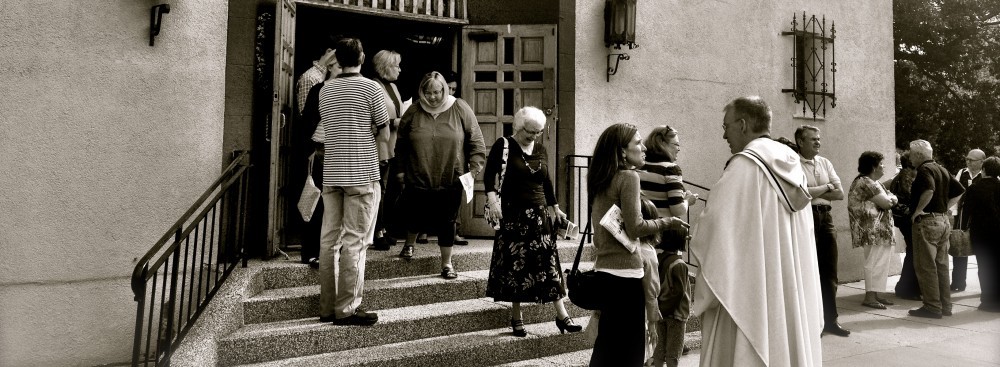
Summoning Us To Glory

Originally published by Celebrate! Magazine, Summer 2012
– PDF version –

PREFACE I OF THE SUNDAYS IN ORDINARY TIME
It is truly right and just, our duty and our salvation,always and everywhere to give you thanks, Lord, holy Father, almighty and eternal God, through Christ our Lord.
 
For through his Paschal Mystery, he accomplished the marvellous deed, by which he has freed us from the yoke of sin and death, summoning us to the glory of being now calleda chosen race, a royal priesthood, a holy nation, a people for your own possession, to proclaim everywhere your mighty works,for you have called us out of darknessinto your own wonderful light…
                    
PREFACE II OF THE SUNDAYS IN ORDINARY TIME
… For out of compassion for the waywardness that is ours, he humbled himself and was born of the Virgin;by the passion of the Cross he freed us from unending death,and by rising from the dead he gave us life eternal. And so, with Angels and Archangels, with Thrones and Dominions, and with all the hosts and Powers of heaven, we sing the hymn of your glory,as without end we acclaim:   
 

I stand praying the preface on humble ground. This is the earth on which Christ emptied himself of heavenly affections. I stand on common soil with Jesus who bent down to write in the sand words of forgiveness for an adulterer. This is the soil that he mixed with saliva to heal the blind and the ill. This is the earth in which chaos, wars and violence still rage as we live his command for peace. On this ground, Jesus sacrificed his life, his ministry and teaching on a cross between two thieves. This is the ground, the sacred earth in which Christ rose from the dead after three days in the dark cave that held his body.

This ground of sacred prayer is anything but ordinary. These prefaces during Ordinary Time are not throwaway prayers. They are not meant to be prayed out loud only while people fumble with kneelers, change positions, calm children and ready themselves for the consecration of the bread and wine. These prayers reveal the vulnerability of people who beg God for healing as we all try to make sense out of our lives. These prayers summarize the mystery we celebrate even far from the altar table, as God possesses us. Mighty works are revealed in our humility during Ordinary Time.

I pray these texts often feeling awkward and out of place. I have not always felt emotionally comfortable standing on the earth. I have often felt unworthy to stand in the position behind the altar because I have been reluctant to claim my place among God’s chosen. I have spent years in therapy healing the past, in spiritual direction claiming the Spirit in the present, allowing my spirit and body a place on the planet. I pray these prayers walking on the earth, ministering among the marginalized, discovering my own life and God’s love within me.

As a priest and human being, I know I must continue to claim my faith among this holy nation of believers. I hear so often from other priests that they are burned out from always proclaiming the Paschal Mystery.  So many ordained men never really believe the reality of love and forgiveness within their own lives.  I listen to clergy beaten down by age, restlessness and severe loneliness.

Many years ago as a younger priest, I facilitated a retreat for clergy. I heard volumes of anger from priests about their positions behind the altar as leaders of parishes and larger institutions. They were exhausted from proclaiming, preaching and teaching about faith because so many priests in that group had not experienced God’s consolation and love. They were so angry amidst God’s people and the larger institution of the Church. They wept with me in private conversations and among one another about not finding meaning standing alone at the altar table.

I remember one priest screaming at me that there must be something more than the passion, death and resurrection of Jesus. He asked me to find some other method of teaching, pattern of healing or philosophy of life to speak about. I wept with him as he cried on my shoulder. I tried to comfort him with only what I had come to realize even as a young priest, that I find a place on the earth only in the healing love of Jesus, the Christ. I felt the darkness of his life on my shoulder and in my heart. I stood with him as if I were at the altar table, offering his life to God. I cannot predict outcomes or change people or even heal them. I can only remind people that we are all among God’s possessions being lifted from yokes of burden. We live even among the shadows of the healing light of Christ’s presence.

I still muster the courage to stand on the opposite side of the altar from people. The longer I pray there, the deeper my commitment is to people who are searching for something more in their lives. The preface of the Eucharistic Prayer invites every person into a dialogue of life. This dialogue goes well beyond simple words no matter the translation. This dialogue back and forth between priest and people is about the deepest aspects of our lives.

I recently met a twenty-something young man who has just been released from prison. During his incarceration because of selling drugs, he found God. He spoke with me in a soft voice in the dimly lit chapel before Mass. He told me he just spent the weekend exploring a vocation as a priest and a monk. He also told me that he has yet to be baptized. He is confident that God is calling him to be ordained.

I saw deep within his brown eyes, the desire to be healed of his heroin addiction. His sad eyes told me that perhaps moving out of the last pew to the other side of the altar would take his pain away. Perhaps being a priest would release him from his wayward ways. He longs for God to free him from the yoke of sin, addiction and heartache. I wanted to remind him that waywardness and heartache does not disappear once you get to the other side of the altar. I longed to tell him that God is in his present darkness and the light will lead him one step at a time.

Perhaps the heroin addict and the priest should change places on some days. The addict needs to constantly offer his pain up to God in order to survive another day. The priest needs to be honest about his suffering and come to need God more than anything in order to survive another day. This is the real dialogue the preface suggests. We are a chosen people who need God. We are a royal priesthood that constantly offers up our pain and suffering to God so we will all be healed. Every person on the earth is God’s possession.

Every worshipping community needs to explore this sacred dialogue. The people and the priest, the daily suffering and the daily offering to God becomes the flow of the Paschal Mystery. I have yet to imagine another place to go for meaning when a homeless mother comes and says that suicide seems to be the only answer. I do not know where else to turn when a young man is struck by a car days before his graduation. We do not know where to place our trust when a young mother offers up her newborn child in death. We turn in any worshipping community to the Lord who invites our hearts to rest and be freed from the yoke of pain, suffering and grief.

I admit that priests will have to get used to many of the prayers of the new translation of the Mass. However, many priests will also have to take stock of their life of prayer, their ability to discover God’s consolation for their lives and receive the people in real dialogue of faith. These texts from Ordinary Time will take time to settle into the hearts of priests and people. The faith behind the words will continue to show us Christ’s love and compassion for us all.

God still has compassion for our waywardness. We turn to God in the dialogues of war and destruction and his call for nonviolence. We turn to God’s compassion when we blame people living in depression and other forms of mental illness for their disease. We turn to God to feed people who are starving especially for love. We turn to God in this sacred dialogue when priests do not believe and when addicts grasp newborn faith.

I am deeply grateful for my position at the altar to articulate our communal praise to God. Even the heavens ring with praise for what is loved on the holy soil of earth. Thankfulness and gratitude form the church in prayer when our dialogue of life and faith begins at the Table of the Lord. God emptied himself of heavenly form and walked among us. He still feeds us in our humility and welcomes us in our waywardness.           

As I pray these various forms of the preface behind the altar, I plant my feet safely on the earth. Here on the rich soil of our earthly home I have come to know my place among people who live on the daily bread of hope. I stand behind an altar lifting up to God my fearful heart and lifting up the lives of people who desperately need God for human survival. We are all given a share in the richness of Christ’s resurrection so we will all find our footing in the Kingdom of Heaven.  Our gratitude is without end. 

Path and Purpose

Originally published by Ministry & Liturgy Magazine, May 2012
– PDF version –

15th Sunday in Ordinary Time –
O God, who show the light of your truth to those who go astray, so that they may return to the right path, give all who for the faith they profess are accounted Christians the grace to reject whatever is contrary to the name of Christ and to strive after all that does it honor. Through our Lord Jesus Christ, your Son, who lives and reigns with you in the unity of the Holy Spirit, one God, for ever and ever.
 
21st Sunday in Ordinary Time –
O God, who cause the minds of the faithful to unite in a single purpose, grant your people to love what you command and to desire what you promise, that, amid the uncertainties of this world, our hearts may be fixed on that place where true gladness is found. Through our Lord Iesus Christ, your Son, who lives and reigns with you in the unity of the Holy Spirit, one God, for ever and ever.
 

I know the path to Christ is often convoluted and winding. The new translation of this particular prayer for the 15th Sunday in Ordinary Time zigzags and twists us even more along the path to Christ Jesus. I fear that aspects of this prayer may be misinterpreted. This opening prayer runs the risk of creating judgment from the assembly toward other people I who may be struggling with their place in life and within the church.

I usually cringe when I hear from someone that a person has ’’gone astray.” That phrase for me implies judgment of someone’s life, and rarely do people know the real story of any other person’s journey. The path to the Crucified means entering into personal suffering, which no other person should judge or condemn.

I learn through my years of ministry not to judge people who leave the church or who struggle with faith. In fact, I usually learn the most from people who sit in the dirnly lit last pews of any church or others who take a break from going to church until they sort out the issues of life. I learn from people who face tragedies such as a stillbirth and who fall deeply into depression and cannot commit to believing in God. I am in awe of people who struggle through a family suicide that takes them on a journey of nonbelief, even for many years. In so many cases, people judge others for the action of not participating in Christian community without realizing the pain that has settled into their hearts.

This prayer invites us to consider the correct path to Christ. The real path leads to the way of the Crucified. Suffering in life is never easy and creates paths that are treacherous and foreboding. Faith is awakened when we all invite God into our suffering. Many people cannot find their way beyond this blind curve. When suffering overtakes them, they may turn to alcohol, drugs, and destructive behavior. This is when the path really becomes steep, with unknown outcomes. I learn in our fragile community to remove the blame from my interactions. I cannot blame people in the confessional for the ways in which they deal with mental disorders or past abuse. I do not blame people in any conversation for the outcome of their lives. People need to take full responsibility for their actions; however, I do not add to their burden by blaming them for their pain. This opening prayer is a bumpy road for me.

I desire more than ever for people to find their way to Christ. This is the only path to real joy and purpose in life. The goal for every parish community is to invite people into desiring God. This is the message of the collect of the 21st Sunday in Ordinary Time. I weep when people cannot desire God, who can heal them. The pain of divorce, suicide, drugs, and mental illness often ‘strips people of the basic desire for God. We cannot blame people for their suffering, but we can teach people how to pray in deeper ways. Every community must help remove the obstacles people face in order to truly desire God in their lives. God is here to heal and reconcile, no matter our suffering, no matter who we are in the world.

Every worshiping community needs to take these opening prayers to heart. We need to invite people into experiences of setting our hearts on the love God has promised for every person. We need to give action to our conviction of love. This means getting our hands dirty and learning how the issues of justice challenge us. We need to be in relationship with people who live outside, others who may never be released from prison or people who suffer severe mental illness. We need to understand the family issues of the immigrant. We need to interact with our neighbors in nursing homes and care for babies born addicted to drugs, as well as for the mothers who birthed them. We all need to fix our hearts on the place of God’s love for people, so we may all find true joy and hope in his world.

Answering the challenge of these collects takes time and faith. Every parish community needs to risk stepping beyond their gossip and judgment of people. Every parish needs to find new ways of inviting people — in every form of prayer — into a deeper hunger for God in the Eucharist. Prayer and service lead us on the exact path of Christ Jesus. Experiencing the place of true gladness within our parishes is the mission for us all.

Solemnity and Slavery

Originally published by Ministry & Liturgy Magazine, April 2012
– PDF version –

The Solemnity of the Most Holy Trinity:
God our Father, who by sending into the world the Word of truth and the Spirit of sanctification made known to the human race your wondrous mystery, grant us, we pray, that in professing the truth faith, we may acknowledge the Trinity of eternal glory and adore your Unity, powerful in majesty. Through our Lord Jesus Christ, your Son, who lives and reigns with you in the unity of the Holy Spirit, one God, for ever and ever.
 
Fourteenth Sunday in Ordinary Time:
O God, who in the abasement of your Son have raised up a fallen world, fill your faithful with holy joy, for on those you have rescued from slavery to sin you bestow eternal gladness. Through our Lord Jesus Christ, your Son, who lives and reigns with you in the unity of the Holy Spirit, one God, for ever and ever.


Many people in our neighborhood suffer from social isolation. For many people suffering mental illness, loneliness distorts their reality even more than disease. For some people loneliness even kills. People living in the bug-infested single-room occupancy hotels often die alone. Prostitutes roam our urban corner looking for people who cannot live another night with their loneliness. Drug dealers are always nearby to numb the pain of our neighbors or to satisfy lonely youth attending a blaring concert in the nightclub across the street.

Our staff struggles to create community from such loneliness beginning with the liturgy itself. I pray this opening prayer on the Solemnity of the Trinity aware that most people do not feel welcomed into the relationship of Father, Son and Holy Spirit. The iconic relationship of our God does not easily model how many people in severe poverty are to live. This takes time and relationships are fragile. Welcoming people into communion, into unity, is so counter to what most people experience on the streets. On the violent streets life is all about self-protection, not giving oneself over to another person or institution, or even to God.

Loneliness is often translated into reluctance to believe in God. I witness this reluctance in the sanctuary and the confessional. I pray with people’s reluctance in my alone time and in moments of prayer with groups of people. This reluctance comes to the surface because people do not feel worthy of God. Many people hold their reluctance as adults because God was forced on them as children or because they were shamed into going to church.

This collect outlines the reason for our gathering at the Eucharist. God has made known to the human race the truth and love of Jesus the Christ and the grace of the Holy Spirit. In our baptism we acknowledge the true faith of the Paschal Mystery. We are invited into that sharing of life prompted by God who continues to create within us love, mercy and kindness. This collect is an invitation to begin Eucharist breaking through the loneliness so many people face. These words of prayer must somehow crack through the shame so many people in the pews face about being in relationship with God.

The collect of the Mass is a prism is which we bring people into viewing the nature of God in the continuing celebration of the Eucharist. The prayer also invites people into the covenant relationship with God that is made known among us in our various parishes, our neighborhoods and our world. The Trinity invites people to rest in the loving relationship of God, not because the relationship and God are perfect but because God is still here for the weary, the lonely and the shamed.

I pray the collect on the Fourteenth Sunday of Ordinary Time reminded of the continuing mission of Christ. Jesus was born into a world in need. He gave up his heavenly presence with a new humility on earth. This action of Christ is not over. Christ did not only abase himself for a fallen world of the past, but Christ is still reaching down to bring life and love to us in every day and age. This is genuine joy for all people in all ages, the presence that somehow we need to translate into the depths of people’s lives. This is the Church of mercy and not judgment, of love and not condemnation, of hope and not loneliness.

These collects come to life in every parish when we reach out first of all to people who live in isolation and fear. This takes real courage. This outreach to people well beyond the sanctuary steps takes genuine faith modeled on Christ who humbled himself in the first place. We must reach out to the concrete sidewalks of the city and concrete floors of jails and prisons. We must be willing to abandon our complacency for the rich reward of being in relationship with people who cannot live with their loneliness another day. Every parish community must be willing to abandon their judgment of people and accept people into the pews who are different and who are hurting. This is the perfect model of Trinity life.

The translation of these collects in the new Roman Missal does not stop in our new books or familiar pews. The translation of the Trinity continues in our neighborhoods among people who feel they cannot survive their lives. People who have been shunned by our communities become the place where these ancient Latin texts meet the streets. The translation of these collects into genuine community is a reflection of our God made flesh, so we may live in eternal gladness.


Graces and Gifts

Originally published by Ministry & Liturgy Magazine, March 2012
– PDF version –

The Second Sunday of Easter:
God of everlasting mercy, who in the very recurrence of the paschal feast kindle the faith of the people you have made your own, increase, we pray, the grace you have bestowed, that all may grasp and rightly understand in what font they have been washed, by whose Spirit they have been reborn, by whose Blood they have been redeemed. Through our Lord Jesus Christ, your Son, Who lives ands reigns with you in the unity Of the Holy Spirit, One God, for ever and ever.
 
Pentecost:
O God, who by the mystery of today’s great feast sanctify your whole Church in every people and nation, pour out, we pray, the gifts of the Holy Spirit across the face of the earth and, with the divine grace that was at work when the Gospel was first proclaimed, fill now once more the hearts of believers. Through our Lord Jesus Christ, your Son, Who lives and reigns with you in the unity of the Holy Spirit, One God, for ever and ever.


I long for a glimpse of mercy within our community. I pray this collect on the Second Sunday of Easter expecting miracles. I really do not know where else to turn except to the Eucharist in the midst of the turmoil we face in our neighborhood. Our parish stretches my understanding of God’s love so thin that on many days I cannot find it for myself. From the hookers on the streets at our red doors donning their springtime duds to the runaway teens that yell out across the street, we all ache for a full dose of mercy and full plate of hope that will sustain us. We all long to grasp and rightly understand the love that God has for us.

I prayed this opening prayer the first time twenty-nine years ago on my first day of priesthood. Even though the translation has changed, the message of the text is the core of our faith. We cannot forget from where we have come. Christ’s mercy is present in the baptismal font of forgiveness.  The Holy Spirit cleanses our past and gives us second birth. We all await a second chance to understand our lives.  The Blood of Christ sustains us in our loneliness and unites us in communion with God and every believer. Mercy is revealed in the dying and rising Christ and in us who ache for healing.

This text seems profoundly different from my first Mass as a priest. The difference is less in the translation than in my perspective through these years of ministry. Years ago, I thought I understood suffering but that was the naïveté of youth. Suffering of the heart is not an intellectual pursuit. I now realize there is no such thing as understanding the suffering of another person. The only thing I cling to is the faith that God is invested in such anguish. I now ache for the Spirit and an increase of grace. I wait for things to change and for people to discover that God really calls us all His own.

I experience mercy now not as a commodity or something to achieve, but as a relationship with God. God’s mercy and forgiveness is not a pre-packaged reward for being good or for being a perfect priest, but a relationship that sustains us all in the moments of profound pain and anguish. Mercy is not a pious slogan. Mercy is not a trophy for never having fallen in the race, but a relationship of compassionate love soothing the deep and profound wounds that may never heal on this earth.

I weep now from a deeper place than on the day I was ordained. The helplessness I feel in our community is revealed in the tears that I shed for people who may never experience a second chance in life or may never grasp or understand God or themselves. These tears have become a font of grace welling up in me during my years of ordained ministry. I wait for our unity in the Spirit and for the day that God washes guilt away, brings healing to the wounded and hope for the marginalized.

Every parish community prays the Pentecost collect waiting for divine grace. People of faith pray this prayer across boundaries of nations and institutions realizing only God can mend the divides of racism, hatred and fear. This Pentecost prayer will be prayed in poor, rural parishes as well as affluent, suburban communities. The grace we all seek is the fresh, vital and real perspective that God continues in the lives of our people. We will all find ourselves in this prayer longing for every good gift of the Holy Spirit. Everything we all need for the future is within us.

I pray this Pentecost prayer hoping to mend the bridge of the generational gap I now experience among the clergy. I witness so much fear among the young that my generation foiled this mission of priesthood. I want to tell them to wait for the tears of powerlessness and compassion because they will teach you everything. Twenty-nine years of Pentecost have softened my control and perspective over many issues within the Church. I rely on these sacred gifts to be revealed because divine grace is still at work. The divisions among us will only be healed by Pentecost grace among the broken and poor in Spirit.

The holy collects of the Easter season invite us into mercy and love. The feast will one day heal deep wounds and the worries I still carry. The collects will continue to introduce us all to the depths of the Eucharist that feeds people across divides and divisions. I will capture a glimpse of mercy in places I least expect. On the face of the earth we shall all know our longing for heaven.


Finding Our Home in the Empty Tomb

Originally published by Celebrate! Magazine, Spring 2012
– PDF version –

PREFACE III OF EASTER – Christ living and always interceding for us
It is truly right and just, our duty and our salvation,
at all times to acclaim you, O Lord,
but in this time above all to laud you yet more gloriously,
when Christ our Passover has been sacrificed.
He never ceases to offer himself for us
but defends us and ever pleads our cause before you:
he is the sacrificial Victim who dies no more,
the Lamb, once slain, who lives for ever.
Therefore, overcome with paschal joy,
every land, every people exults in your praise
and even the heavenly Powers, with the angelic hosts,
sing together the unending hymn of your glory,
as they acclaim:
 
PREFACE IV OF EASTER – The restoration of the universe through the Paschal Mystery
It is truly right and just, our duty and our salvation,
at all times to acclaim you, O Lord,
but in this time above all to laud you yet more gloriously,
when Christ our Passover has been sacrificed.
For, with the old order destroyed,
a universe cast down is renewed,
and integrity of life is restored to us in Christ.
Therefore, overcome with paschal joy,
every land, every people exults in your praise
and even the heavenly Powers, with the angelic hosts,
sing together the unending hymn of your glory,
as they acclaim:
 

I minister among many people who feel undeserving of joy. I encounter in the dimly lit confessional not only the darkness of sin but people’s reluctance to accept healing and forgiveness. Joy eludes many people who have been beaten down by physical and emotional abuse and the many years of depression that follow. Joy never finds a home in people who blame themselves for being abused. Joy is seldom experienced or grasped for some people who have found their only identities at the bottom of a booze bottle. God’s healing rarely finds a home in people who live in the darkness of blame, fear and doubt.

I see the consequences of a joyless life standing at the altar on Easter day. These Easter texts of the preface express the absolute joy of the Christian. Jesus becomes the Christ is his passion, death and resurrection. Joy among our parishioners is rather muted, reluctant and seems only to belong to the wealthy or educated or some unknown stranger. Many members hesitate to rally around Easter because they are still without the basics of life, still hunger and still feel unloved in their present circumstances. I know deep within my life and in the lives of all people, Christ is sharing the gift of new life and healing in the simplest of ways. Risen life cannot help but break through the savage pain of any heart that clings to faith.

The prefaces of Easter claim this story in the human voice of the priest. Christ is still offering his life for people who seek the joy of resurrection. Many sinners find a home in the sacred forgiveness of the sacraments of Eucharist and reconciliation.  The wall of sin is easier cast down than the wall of self-hatred and shame for a life that feels undeserving of anything that is good, loving or holy.

Seeking forgiveness of God for our own sin and living that forgiveness among all of our relationships is Easter joy. The reality of forgiveness is seen off the altar in the human turmoil of our lives. Joy happens when we bring that grace to worship and the altar of God is seen as Christ offering his life for us always.

I remember facilitating one of our Personal Poverty Retreats several years ago. The retreats are a thirteen-hour immersion into the issues of long-term poverty, mental illness and the devastations of addictions. There were seven people in that particular group.  The core of the day is to share our own personal poverty, our own need for God. In the afternoon we shared our experiences of working in our morning hospitality center. This open discussion among us brought a great gift.

Out of the seven people on the retreat, four people confided that they all had children who were homeless, mentally ill and addicted. The conversation became intense; the silence of grief and sadness overwhelmed all of us. Each participant shared the grief of letting go of control of each child. One participant told the horrific story of her son’s suicide.

Phil began to share his story of his addicted son. Phil’s face was creased with worry. His voice was angry at years of trying to fix his son’s addiction. He became enraged because he felt he had done everything to change his thirty-something son. After Phil finished his story and sat silently, I leaned into the group and asked him, “Phil have you ever tried just loving your son?” Phil’s face began to relax and it was as if someone had raised the shade of darkness from his life. Phil replied to me with tears streaming down his cheeks, “No, I’ve never just loved my son.”

After that retreat, Phil searched for his son. He found him living in an abandoned car next to an old building. He slowly began to just listen to his son, Matt. Trust began to be built after years of tension. Phil and Matt started to do simple errands together and have lunch. After a while of sorting through their relationship, Phil invited Matt to the next retreat at the parish. They shared their stories together for the first time in the small group of the retreat. They told the stories of how healing happened between father and son and how reconciliation and joy slowly returned to their lives.

Last Lent, Matt died of his long-term addiction. I went to the funeral and the priest preached about how Matt and his father were reconciled at a retreat at our parish. I wept sitting in the pew over the new life that happens in the tension of forgiveness, over the often hidden redemption of fathers and sons.

Jesus defends us and pleads our cause to the Father. Grace never gives up even in death. Love triumphs even when hidden in small groups or abandoned cars. This is paschal joy celebrated at Easter, the hope that even long term suffering gives way to the Kingdom of God. The heavenly powers proclaim this on altar tops and in the hearts of fathers willing to try one more time to love a son.

The Easter preface speaks boldly about what is lived in silence and often without notice. Old orders of life can be destroyed. Life lived amid years of depression can be clean of self-blame and a lack of trust. The heart cast down by poverty, mental illness and hardship is lifted out of the tragedies that keep us cast down. On the altar of Easter sits the cup of blessing and bread of life that overcomes the aches and pains of relationships well beyond the sanctuary of our churches.

I pray this holy text on Easter hoping that I will see for myself the integrity of life being restored in Christ Jesus. I know that this prayer is not about what Jesus did for us. This prayer as is the Eucharist itself, is about what Jesus is doing now in our midst. The grace of integrity is not only about the past, but also about every relationship that bears the weight of our wanting to give up on love.

Our renewal of baptism on Easter allows us to resist again the power of evil in our relationships. Even though people present at the Eucharist may be baptized in the new life of Christ’s resurrection, people may feel they have been passed over by God. The Passover of Christ, his death and resurrection, brings us all to new life no matter the sin, the hurt or the suffering. I experience all the angelic powers of love when I stand at the altar and become aware that grace is working in the hidden life of the Church.

These holy prayers challenge us to discover joy at Easter. The prefaces teach leaders of the parish to invite people into what the prayer texts say even to people who refuse to accept God’s forgiveness and peace. We do not blame people for their poverty nor do we blame them for the abuse, depression or mental illness they experience in life. Easter must find a home in our conversations and ministry among people who feel excluded from hope, insecure about relationships and threatened by possible damnation from God. Love in the womb of the altar table is birthed on Easter morning in honesty and genuine hope. We are followers of the One whose tomb was empty but whose life is filled with love.

So many people do not realize that the love of God is a free gift. The reconciliation of Christ among us overcomes everything within us that separates us from the Father. People with emotional injuries have a difficult time receiving this gift because they still think the do not deserve such a treasure. They wait for the emotional and mental put-downs from us, the Church, that they are not worthy. They wait for more abuse. The gift of God’s love and joy is free. This gift is given to all of us to make sure we do not control it, suppress it or cause more people deeper pain. Jesus’ passion, death and resurrection are joy for all acclaim the Lord.

On Easter morning we really offer our suffering to the Father in the name of Christ Jesus. We gather around the altar table aware of the misfortunes of people’s lives and the heartbreak that keeps joy at bay. Last Easter, I prayed with a lump in my throat on Easter morning. I remembered the story of Phil and Matt. I prayed that healing might become visible for us all.  I also prayed embracing all the stories of the silent confessional. I prayed recalling that healing and redemption happen in our community even though so many of us may never find the joy we long for. I stood at the altar of God with my hands extending in cruciform believing that we are all being raised up, all finding our home in the empty tomb. This hymn of God’s glory never ends. We sing in common voice from our common humanity discovering again Christ’s paschal joy.

Suppers and Sacrafices

Originally published by Ministry & Liturgy Magazine, February 2012
– PDF version –

With this column I begin a 10-part series reflecting on the Opening Collects of the new translation of the Roman Missal.

Holy Thursday:
O God, who have called us to participate in the most sacred Supper, in which your Only Begotten Son, when about to hand himself over to death, entrusted to the Church a sacrifice new for all eternity, the banquet of his love, grant, we pray, that we may draw from so great a mystery, the fullness of charity and of life. Through our Lord Jesus Christ, your Son, who lives and reigns with you in the unity of the Holy Spirit, one God, for ever and ever.
 
Good Friday:
O God, who by the Passion of Christ your Son, our Lord, abolished the death inherited from ancient sin by every succeeding generation, grant that just as, being conformed to him, we have borne by the law of nature the image of the man of earth, so by the sanctification of grace we may bear the image of the Man of heaven. Through Christ our Lord.


I often pray the liturgies of the Triduum with the same awkwardness with which these prayers are translated. My experience of our urban community teaches me that death and grace are a daily mix, intertwined in every person’s life. I fumble to find the conviction of faith in the middle of so many physical and emotional moments of turmoil that have not been resolved since the last time we celebrated the Triduum. I stumble over connecting simple bread and dirty feet and to uncover salvation amidst both of them. I long for a new image of humanity because now people are put down for being physically poor and emotionally ill. Our celebrations rouse within me a real desire for God in the heartache that keeps me at the altar all year long.

I hear God calling me to celebrate the sacred supper on Holy Thursday. I also hear the people who have given up on God because the banquet seems not to satisfy the need for shelter today or a substantial meal for their hunger this evening. I hear the intermingled issues of profound anger of people who have been handed over to the death of mental disease and long-term struggles with money. So many people have given up coming to the banquet because they do not see believers learning to stretch out their hands to wash dirty feet or to stretch out their imaginations that something more needs to be done beyond the sanctuary steps.

On Holy Thursday, I hold the banquet menu in my hands. I also caress in my consecrated hands the gnarly, odorous feet unveiled in our three aisles of the chapel. I hold within my heart the profound hunger of people to make ends meet as well as their isolation and loneliness of their circumstances. The banquet of bread and wine and the foot washing both break down many barriers that continue all year long. Many people do not feel loved by God because of their eternal despair and many people do not feel loved by the community because suffering is so difficult to pay attention to at length. I hold feet and food and rest in the true sacrifice of Christ Jesus.

On Good Friday, I lay before the people on the concrete floor seduced by God. I am often so unwilling to allow this posture to form the rest of my ministry, yet I surrender again to God. Over the course of the year I tire of such profound suffering. I wait for new life in all the death that surrounds me. I grow short-tempered and want to get up and walk away many times during the year when Christ’s path of passion overwhelms my heart and perspective. On Good Friday, I wait to pray this collect because I know my ancient sin has been forgiven in Christ’s death. I live every day the sacrifice but I do not always feel it when I am lying on the concrete floor beginning the Good Friday liturgy. I wait in the center of poverty, neglect and addictions to experience the new image of heaven here, now on earth.

These collects are heard and lived beyond my lips. These sacred prayers are not only the staged lines of the priest but sum up the internal prayer of the people. The silent hearts of the faithful are brought to this verbal prayer. The priest is responsible for articulating this new translation but is also responsible for knowing the depth of this silent prayer among the people. The priest needs to understand deeply the sufferings and hardships that are going on in the pews and in the daily lives of people who worship. In order for the collect prayers to be claimed by the people, the priest needs to enter into the very reason why people come to the Eucharist in the first place. The priest is invited to pray and serve with dignity and love.

The Triduum is the high point of the liturgical year celebrating Christ’s passion, death and resurrection. We are entrusted with this mystery, not only during the Holy Week schedule, but also in our lives every day. This banquet of love draws us into charity and the work of genuine justice. These prayers cannot be left out from our Holy Week planning nor can they be tossed aside because the translation seems awkward and clumsy. The collects outline the sacred rituals that will follow within the liturgy especially during the Triduum. These texts are for all of us who seek new life amid the pain and frustrations of people’s lives. These opening prayers remind us of what we celebrate and invite us to live what we receive, love itself.


Pouring Out Prayer On Concrete

Originally published by Ministry & Liturgy Magazine, December 2011
– PDF version –

I began praying the Triduum noticing the floor. This was the first Triduum without the old burgundy carpet in the chapel. The simple concrete floor with noticeable old screw holes, chips, scratches and flaws invokes a rugged, urban environment. The poured concrete aisles also convenience our friends in wheelchairs and others who come in with soaking-wet boots and soggy backpacks. I noticed that everyone moved around the chapel with ease and purpose without the threadbare carpeting. I realized that I never really noticed the floor as we began the sacred dance of death and resurrection.

Rosie wheeled herself in through the doors and into her usual spot near the sanctuary as we prepared for the evening Mass of the Lord’s Supper. Living with cerebral palsy, Rosie is a bold presence in our neighborhood. Her lifelong disease stiffens her body and makes her speech very difficult to understand. She protested in City Hall and held banners in parades rousing attention for civil rights for people suffering disabilities. As we began the Holy Thursday liturgy, I saw her ease her motorized chair into her usual spot with a flick of her finger. I cannot take her suffering away but at least she no longer has to battle the carpeting.

We washed feet on the concrete aisles. Watered splashed, dripped and danced everywhere. Dirty socks and assorted sneakers spotted the grey aisles. I poured out the water along with my prayer for all of us who walk the treacherous ground of street life and the uneven ground of church life.

We processed with the consecrated Eucharist to a small altar near the emergency exit. Mary’s image is there. We invited everyone to follow in the procession. I approached the small altar after weaving our way on the concrete path. I noticed Rosie had been first in line to follow the sacred bread and wine. We all sang with yearning from our broken hearts.  I stood at the small table watching the faces of people who desperately need God. My gaze was interrupted, as I smelled an unpleasant odor. Rosie’s urine bag leaked during the sojourn. A stream of urine trickled along the aisles to the place of holy reservation. Jesus invites everyone to wait with him. I felt the deep love of his tears streaming on to the rocks in the garden.

I quietly processed alone on the concrete aisle as we began the liturgy on Good Friday. I prostrated myself before the sanctuary on the cold concrete. I felt the floor under my entire body for the first time. I breathed and relaxed there. I was there on behalf of everyone. I felt in my entire being the people who wheel themselves around the chapel and people who are too tired to stand up and the people who are too depressed to understand their own lives. The cold floor makes us one in offering everything to God.

I heard a woman weeping. I noticed her as I stood up and continued the liturgy. She is not Catholic and lives in daily recovery. When the liturgy was over she came to speak with me on the sidewalk. She was still crying as she began telling me of what happened just before the liturgy began. As she approached the chapel before noon, she noticed a man sleeping on the sidewalk near the chapel covered with a large, bright red blanket. All of his possessions were piled up next to him. She told me as she noticed me prostrate on the concrete floor with my body covered in red vesture her heart realized the profound connection of Christ’s suffering for us. She could not stop crying as she continued to connect the sleeping man on the street and her priest on the chapel floor.

After flipping on the light switches on Easter morning, I walked into the chapel and noticed white candle wax dotting the grey floor. Some leaflets had fallen to the ground in the rush of cleaning up after the Easter Vigil. Bags of canned goods and assorted used clothing piled up near the sanctuary were donated during the Easter duty. I remembered Jesus’ used clothing next the open grave.

We buried Rosie this past year. Her body could no longer be bound in such suffering. Many people suffering disabilities assembled for her funeral in another parish. Our floors could not take the size of the crowd. I told the story of her urine bag leaking on Holy Thursday. I reminisced of her determined prayer no matter what the obstacles.

We continue to pray without the old carpeting. Many stories will walk, stumble, hobble or be wheeled into our chapel in the year to come. In future Holy Weeks, I will pay more attention to our prayerful dance of Christ’s passion, death and resurrection on the chipped concrete.


The Stations of the Cross: The Faces of Friday

Originally published by Celebrate! Magazine, Winter 2011
– PDF version –

I encounter the restless suffering of people every day. The pain that I meet at the Downtown Chapel in Portland, Oregon does not easily scab over nor does it ever heal from the inside out. This pain comes from the consequences of surviving generational poverty. The suffering is long term when a middle-aged man tells me he has never loved anyone as an adult because he was raped as a child. A young bearded city-stroller confesses that his brother and sister prostituted their mother to make some quick cash for drugs. A dirty-faced woman suffers from years of mental illness and repeatedly asks me why God hates her so much. These are some of my encounters here on our urban parish corner. Our staff and volunteers spend their days listening, working and helping to sort out what the Church means on such a street-savvy block.

During this Lenten season, I begin my tenth year on this beloved block. I have learned throughout these years to honestly lean into the mystery of Christ’s dying and rising with our staff and many volunteers. I cannot sustain my presence here without taking stock of my faith on a daily basis. I have been stripped of every false notion and pious sentiment that I ever held. However, I know I can turn toward bitterness and rage when I see the ways our society treats individuals. I can rant and rave at how little the Church seems to care about people living in poverty. I sort out these options daily in order to survive my ministry.

I turn toward the only path that I know will bring life. This path is the real journey toward Jesus’ death and resurrection. The Stations of the Cross live in our midst. The moment-to-moment issues of suffering, denial, hatred, prejudice call me to go deeper into the real meaning of my faith. This past year, I wrote a version of the Stations of the Cross so members of our community could more easily find their stories in Christ’s love and resurrection. This version of the Stations of the Cross will also help educate benefactors about the lives of people in our community. Our pastoral associate, Andy Noethe, photographed volunteers and staff and produced a DVD. These stations tell composite stories of people whom I have met in ministry. These scenes of real people’s lives interpret the action of Jesus and the people whom he encountered on the way to the cross.

I share the stories to enable all of us to enter more deeply into the mystery of Christ’s life today. This Lenten season tempts us all to give up on our faith. The Gospels call us to wake up with the disciples to a new perspective of being with Jesus, not under a tent, but on the solid ground of our lives and ministry. Jesus longs to encounter our lives, to tell us how we have sinned in the past and then challenges us to be bearers of Good News. Jesus exposes our common blindness of neglect and ignorance and longs to set us free from the entombment of our fears. This is the journey toward the life Christ longs for us in every worshipping community.

The first two “Stations of the Cross: The Faces of Friday” are presented here. The video version will be available on the websites of Celebrate! Magazine. The video version and the written text will also be available on the website of the Downtown Chapel. I invite you to pray the various stories with faith and longing for the love God has for every person. These stories call me to realize I cannot control people’s lives, or change their circumstances, or solve their problems. However, I am changed profoundly by the depth of people’s sorrow in the center of life itself, in the promise of Christ Jesus.

The First Station: Jesus is condemned to death.

Leader: Show us your face, O God
People:  Save us, O Christ, through your Holy Cross!

I remember when Henry landed in jail. The newspapers said that he was arrested because of his violent outbursts in the streets in the middle of the night. Everyone who knows him realized quickly that his mental illness caused his lashing out, his violence.

When I visited him in jail he told me that he woke up that first morning lying on the concrete floor of his cell. His jittery words and shivering body could hardly express his confusion as I sat in front of him. He admitted that his real sentence is his lifelong mental illness. His fingers shook as he gestured his words. He cannot afford medication and cannot remember to take his pills anyway. Henry is simply unable to care for himself.

Henry so often condemned himself by thinking that he was worthless in other people’s eyes. He always apologizes for his slow ability to utter words or to speak up for himself. When Henry lived on the streets he used to swear that people hated him because some people would spit on him as he slept in a doorway. He would plug his ears as people condemned him with insults, loud obscenities and rude gestures as they passed him lying on the sidewalk. I was struck by how Henry’s jail cell is the place of Jesus’ unfair condemnation.

Leader: From the condemnation of poverty and discrimination:
People: Save us, O Christ, through your Holy Cross!
Leader: From the condemnation of mental illness and false accusations:
People: Save us, O Christ, through your Holy Cross!
Leader: From the condemnation of insults and obscenities:
People: Save us, O Christ, through your Holy Cross!

Personal Prayer and Meditation:
1.Where do you witness innocent people being condemned to suffering in the world?
2. How do you relate to your own struggles, personal suffering and loneliness?
3. How are you responding to the suffering of other people in your prayer and service to others?

The Second Station: Jesus is given his cross

Leader: Show us your face, O God
People:  Save us, O Christ, through your Holy Cross!

I never felt so helpless as the day I met Michael for the first time. He called me and asked to come to the parish office and talk. I will never forget his sad, drawn face, his skinny body standing in the threshold of my office door. I invited him in, but he refused to enter. He stared at me and said, “I have tried to speak with three other priests and they would not listen to me. Would you at least listen to me?”

I remember looking down at the floor and quietly assuring him I would listen. He came in and I offered him a soda. He nervously sat down and immediately told me he had AIDS. I did not confess my naïveté at that time about the complexities of his disease. We sat in the quiet office for hours, going over in detail the physical effects of his illnesses. But it was the emotional toll that devastated him. His parents threw him out of their home. He had not spoken with them in months. He was not getting proper medical care and his friends all disappeared when they heard of his diagnosis.

I sat in my office feeling so afraid because I knew I could do little to change anything for Michael. He taught me that to enter into real suffering means listening with an open heart. I walked with him on his ground of suffering for several months. And when he died, I walked with his family to a fresh grave as they tried to bury all the regrets of not caring for their son.

Leader: From the cross of fear and rash judgments:
People: Save us, O Christ, through your Holy Cross!
Leader: From the cross of shame and guilt:
People: Save us, O Christ, through your Holy Cross!
Leader: From the cross of family apathy and neglect:
People: Save us, O Christ, through your Holy Cross!

Personal Prayer and Meditation:
1. What does carrying the cross mean for your own life?
2. How do you view the crosses other people have to carry?
3. How do these crosses change your attitudes about people?

Finger Pointing

Originally published by Ministry & Liturgy Magazine, November 2011
– PDF version –

My parents taught me not to point my finger at strangers. I was told it was rude to point to another person and whisper behind his or her back. As a child I dare not point to a person with a different skin color or another child who somehow did not fit into my scheme or pattern of life. It was simply rude to be seen in public pointing to other people. Most other children were also taught not to point at anyone in public.  However, on playgrounds everywhere, new kids, different kids, gentle kids, smart kids, big-eared kids, freckled kids and fat kids were all pointed at by just about everyone I knew.

I live now on a block where children and adults still point. Strangers point at other adults who line up on the sidewalk outside our doors.  They also point in the direction of a teen who is so stoned he cannot walk across the street. Other passersby do more than point– they spit, wag their fists and kick men who are sleeping on the sidewalk. I still believe it is impolite even to point.

As we listen to the Scriptures during the beginning of Ordinary Time, once again John the Baptist appears strong and sure. We relied on him to show us the way to Christ and the Kingdom of God all during the Advent season and even during the Christmas holiday. John continues to do one thing—he points toward Jesus. John has been portrayed in art throughout the centuries as pointing to Jesus. He has been caught in paintings and in sculpture doing the very thing so many parents and teachers have taught us not to do, that is point to another person in public.

John’s pointing is different. He points to his cousin because he is sure Jesus is the one who will bring unity and peace to the world.  John points to Jesus during his baptism because Jesus is the revelation of the Father’s love. John assures us that the Spirit will continue to point us all into the direction of the Kingdom. John also points to Jesus with more than his index finger. John’s heart, mind and soul are also oriented into the direction of Christ Jesus. His very soul knows that the only way through earthly life will be in the direction of the Kingdom of Heaven.

John’s voice is also pointing to Christ. As Jesus walks by, John proclaims with his entire being, “Behold, the Lamb of God.” This is one of the most sacred statements and recognitions in the Scriptures. This is an act of sheer love and deep awareness of the living Christ. This statement is a profoundly contemplative act on John’s behalf. This statement is the result of John’s years of pointing into the direction of the holy. This is an awakening moment, a joy filled expression, which comes from a loving and profound understanding of Christ on the earth.

As we continue in this Ordinary Time, we all need to reflect on how our lives point toward Christ. We need to take some retreat time for our parish staffs to view where we are heading.  We need to evaluate our liturgies, education and service if they are rooted in our deep awareness of the Lamb of God. Do we recognize the Lamb of God from our hearts and in our worshipping assemblies? Do we have the conviction and the awareness to know Christ in such a passionate way? Perhaps our finger pointing is to our own selfishness or to point out the differences of other parishes in order to make ourselves look good. We point to the fact that we have more money and parishioners. We point to our music ministry because our liturgical style is certainly better than the parish next door. We point out that we are glad we have no one sleeping at our church doors and that no homeless people are sitting in our pews. Fingers, hearts and lives may be pointed in many other directions than the Lamb of God.

These days of Ordinary Time also show us that Christ is pointing directly to us. Jesus rebukes our unclean spirits. He reaches out with his entire hand to heal Simon’s mother-in-law. He heals many who are sick with various diseases and drives out demons. Jesus also stretches out his hand to touch the people we have pointed to as dirty such as the lepers. Even the leper pointed to him and asked to be made clean.

Our finger pointing must imitate John the Baptist so we may know who Jesus is among us. We also need to continue to stretch out our hands in the name of Christ Jesus and heal the lepers, the outcasts, the marginalized and ever person whom we judge as different from ourselves. I long to point my finger in love, “Behold, the Lamb of God.”