Pastel Breakthroughs

Originally published by Celebrate! Magazine, March 2010
– PDF version –

Every month a large brown cardboard box arrives in the mail in our parish office. Every member of our parish staff recognizes the return address immediately. The container is postmarked from Boston, Massachusetts and travels the miles across the country to Portland, Oregon. The box is shipped from Holy Cross Family Ministries, an apostolate owned by my religious community, the Congregation of Holy Cross.

Without opening the box, we all know that the delivery contains three hundred plastic rosaries, each one enclosed in a small plastic bag with paper fold-out instructions on how to pray the rosary. The rosaries come in white, as well as pastel colors of pink, blue, and green.

Even though we are a small parish of only a hundred or so people, the large number of rosaries is a welcome sight. Every weekday morning over a hundred people come through our doors searching for the basics of life. Unfortunately, we simply do not have the resources to meet every person’s needs. Some people come enraged that they stood in line for hours only to be turned down for a bus pass to travel out of town or money for medication or resources to find shelter for their children.

Often when people are most frustrated, some of them may still select a pastel rosary from a small wicker basket placed at the office window and something happens inside them. They begin to feel connected to us anyway, even though we were not able to provide them with the item or assistance for which they stood in line.

I find in these small plastic bags many connected moments of miracles. These encounters with strangers become pastel breakthroughs that awaken my heart to the real needs of people. Not many of our guests will ever actually sit down, take out the instructions, read the small print, and learn how to pray the traditional prayers. Some of our guests are lucky to find a relatively safe place to sleep or to be able to find a quiet moment at all in the neighborhood single-room occupancy hotels. It is the message of the rosary itself that counts. Every day I learn that the Paschal Mystery comes in shades of anger, hopelessness, discouragement, frustration and uncertainty. I rely on the plastic beads to be more than mere objects, to be genuine moments of faith and hope somehow strung together.

As I ponder the Gospels for March and April, I notice a string of awakenings, breakthroughs that unlock our search for God. Jesus tells us a story of a simple fig tree, one that people have ignored because of its lack of fruit. Jesus is patient, cultivating the soil, fertilizing, waiting and believing in the natural process of growing fruit. The Lenten Gospels tell us that God is not finished with us. We cannot give up on people in poverty whom we judge, ignore or insist that they are not living up to our standards. This acceptance of other people in these Lenten days shows us that Christ’s dying and rising still produces much fruit in our human hearts.

A woman weeping in our chapel told me she just wanted a blessing for her children. I sat with her, listened to her abusive story and prayed with her for our Father’s care. I handed her a packet with the pastel beads and she pondered them as if heaven had opened. I could not help but see in her tears the woman standing in the sand accused of adultery. Her friends had given up on her, people turned their backs on her actions and others could not take responsibility for their own decisions. Her tears still teach me that women remain ravaged by rumors, finger pointing and accusations in our society and church. Jesus, bending down to write an unknown message in the sand sets her free with words that breakthrough the lies.

Our staff realizes that not everything goes according to plan. When we first received the rosaries some years ago, one staff member noticed that the rosaries themselves were being left in the lobby. However, the plastic bags were always taken. It dawned on us that some people were discarding the rosaries and using the plastic bags for drugs. Not every moment comes out perfectly as the father realized with two lost sons. In the least-predicted places and times, we can all wake up to our sin and misfortunes. We can find our true inheritance by finding our way home to God’s love. Jesus welcomed sinners and ate with them and even today among people in every parish community. Even when the drug users took the rosaries for their purposes, I must believe in these unexpected moments that the faithfulness of God rests upon them as well.

Jesus threatened many people and was sentenced to death because he disturbed people’s comfort in order to welcome outcasts, sinners and strangers. I think of Jesus’ reputation when I see for myself rosaries hanging from the necks of people living in poverty in our neighborhood. I notice them at bus stops and street corners, in coffee shops and while riding the streetcar. The rosaries reassure me that we had some contact with people who need the basic message that God cares for the people living in poverty on the streets of Portland.

Some people may be disturbed that many of these rosaries are not being prayed as they were intended. However, I see them as glimpses of faith, real breakthroughs of love that unite us with people suffering homelessness, incredible addictions and various degrees of mental illnesses. Perhaps their example of wearing faith on their bodies for everyone to see is really an extension of the prophet not being accepted in his own native place, or street corner, or homeless shelter.

I remember when Bonnie camped at our doorway for two months. Because of her kleptomania I estimated that she took nearly four hundred rosaries during her stay. I am convinced that Bonnie poked her head into Jesus’ empty tomb and wanted for herself the warmth of the white garment left in the corner of the grave. She became a sign for so many people in our community that Christ is still near, that death still gives way to the breakthrough of compassion and hope for people. I wait for the day when we will all find ourselves wearing our baptismal garments witnessing to Christ breaking bonds of apathy, injustice and insincerity.

I saw a commercial on television for a local CBS affiliate that asks people on the street about the needs of Portland. One gentleman wearing layers of clothing responded by saying that Portland needs more public restroom facilities. If you notice very closely under all the layers of clothing you will see the pastel rosary beads around his neck. “Peace be with you. As the Father has sent me, so I send you.”

Jesus revealed his resurrection among fisherman along the shore. He told Peter to remain in love and to act justly toward all people who remain lost and forgotten. When I see people wearing the rosaries all over town, I discover deep within my own heart the true presence of Christ. The rosaries and the people remind me to open my heart further, to follow more closely and believe in the pastel Easter presence of Christ our Savior.
Almost White Garments

Originally published by Ministry & Liturgy Magazine, February 2010
– PDF version –

I relish a moment of quiet in the chapel early on Easter morning. Every year at the Downtown Chapel I sneak downstairs, flick the switch of a single altar light and sit on the sanctuary steps. I relax in this sacred space as I have done in various other places in the 27 years of my priesthood. I savor the prayer and excitement, the longing and grieving, and the memories and peace of the Triduum. Every year the Triduum captures the real life of every parish, and I try to soak up the lingering hope of people who believe in the dying and rising of Christ Jesus.

Last Easter morning I tried to recall the names and faces of our friends who courageously extended their feet to be washed on Holy Thursday. I captured again the longing on those faces that ache for Jesus to truly wash them of suffering, poverty and loss. I remembered the fresh smell of the bleached towels. I heard again the gentle music, the soft singing. I felt again the anxiety of some people worried about publicly exposing their imperfect feet. The naked feet reminded me again of the sinners and outcasts who ache to be called among His followers. These memories help me realize one more time that everyone longs to be cared for and acknowledged as followers of the Christ who still washes us clean.

I remembered the folks who processed down the chapel aisle to kiss the cross on Good Friday. Some people from our hospitality center reverenced the cross for the first time. Other people who live on the margins of society hoped that this gesture could spark healing for them and for the Church. Still others sought out the wood because it has been a deeply significant ritual all the way from their childhood. Last year I sensed my own fear of death as I remembered an elderly woman who hobbled up to the cross. She died just a few short weeks later.

I also held up to the Divine my memories of celebrating the Easter Vigil. I smelled the Chrism now mingled among the bright aroma of the white lilies. I pondered the wax from the peoples’ candles now on the carpeting. I remembered the new fire capturing excitement on the faces of the Elect and the Word of God echoing our ancient history in our small chapel. I remembered the joyful faces of people renewing their baptismal commitments. The deep joy of new life echoed back to me on the quiet step.

My reminiscence ended abruptly last Easter morning with a knock on the chapel door. Julie, a volunteer and parishioner, arrived in the rain with a load of clothing donated from her coworkers. As I opened the door she said that a young man she encountered down the block really needed help. We invited him through the lobby doors. He was in his early twenties and told us he was just passing through town. He stood in front of us wearing jeans, a T-shirt and filthy, wet white socks. He explained that while he had slept in a doorway all of his possessions were stolen, even his shoes. He begged us for at least a pair of socks and any kind of shoes.

Julie and I escorted him into our men’s clothing pantry, a small dark space in our basement. I assisted him in sorting out some options for shoes. Julie ran upstairs to acquire a new pair of white sweat socks. His name was Chris, and the smell of booze covered him as he sat down on a bench to try on his new shoes. We chatted as he peeled off the soaking wet, filthy-grey socks from one foot then the other. His face lit up as he slowly put on his new socks and tried on a couple of pairs of shoes to find the right size. The donated canvas shoes fit him perfectly.

Julie and I engaged Chris in conversation as he relaxed on the bench enjoying the warmth of his new socks and shoes. He was alone, seeking a job, lost in alcohol, running from family issues and not sure he would stay in Portland long. He thanked us over and over again, for the new white socks and the shoes that felt even better than the boots he had been wearing.

As we were leaving the men’s pantry, Chris picked up his old white socks and tossed them to the side of the room into a small waste basket. I saw the gesture in slow motion, this young man tossing the white garments off to the side. I slowed down and took a second look at the socks in the trash can. I turned off the lights to the small windowless room, acknowledged his smile, closed the door and gave thanks for the Easter morning memory.


Block Blessing

Originally published by Celebrate! Magazine, January 2010
– PDF version –

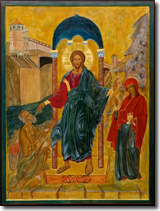
Icon of Christ the Healer

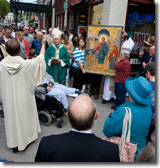
Last summer our parish community welcomed Archbishop John Vlazny of the Archdiocese of Portland in Oregon to bless and dedicate our new icon. The icon of Christ the Healer was written for our parish community that serves people living in poverty in Old Town in Portland. The writer of the icon, Rev. Jon Buffington, incorporated images unique to Portland so that many members of our community could better relate to and pray with the healing Christ offers to every person.

Christ touches a crippled man wearing a backpack sitting in front of the Burnside Bridge. This sacred gesture calms many of our people who sleep under that same bridge. Christ casts out seven demons from Mary Magdalene who holds a jar of perfumed oil. Many of our people suffering from mental health issues take refuge in her beautiful, serene appearance. Many people suffering chronic illness also come weekly to the chapel to be anointed for such unrelenting anguish. A series of roses under Christ’s feet calls to mind the City of Roses, a trademark name for Portland. That same image can be found in our Cathedral just a mile from our parish community.

After the reception of Eucharist, the Archbishop blessed the artist, and called everyone into a silent moment of heartfelt compassion for our parishioners and neighbors who live in dire poverty. The central piece of the dedication was a sung litany which washed over the assembly rousing deep prayer and passion for many people in the assembly.

I offer now this Litany of Blessing so that every community may learn in any time of year to enter more deeply into the healing message of Christ Jesus. This blessing prayer spoke to the particular needs of our parish community. Other parish communities may name their own poverty and suffering in addictions, elder abuse, divorce, or rural unemployment. Every parish community must be truthful and name their experiences in real, honest and authentic prayer.

The assembly responded in song, “Heal us, O God” to each chanted line of the litany. I felt the emotional tug of each statement settling into the hearts of the people. Each line seemed to go deeper into the truth of how we experience life every day in our parish. The bold statements opened our eyes to reality and profound trust in God. I felt a sacred hush under the chant. The prayer touched tender places of compassion and faith for all of us. We seemed humbled by our heartache and even more so by taking the risk of opening our lives to God. We listened, prayed and received the words sincerely in our hearts as we cried out in response.

We lift up our prayer in the healing touch of Christ….
We lift up our community in the healing touch of Christ…

Protect us when we cling to revenge and violence………..
Transform us when hatred overtakes our actions…….
Teach us when we jump to false conclusions…………….

Lead us when we are afraid to follow……..
Inspire us when we fear our own talents…..
Sustain us when we turn from your mercy……

Unite us when we would rather go our separate ways…..
Clarify our thoughts when our thinking becomes destructive….
Bond us together when prejudice tears us apart…..

Create life in our culture of death and destruction…….
Penetrate our stubbornness when self-hatred makes a home in us….
Discover new potential in us when we grasp power and authority…….

Soothe our hearts when illness claims our bodies…..
Rest in us when anxiety penetrates our souls……
Cleanse our consciences when sin overtakes us….

Refresh our hope when we are absorbed in doubt and guilt ….
Wash our feet when we stumble and walk away from love….
Believe is us when we no longer trust in your love….

Forgive us when we do not serve our neighbors….
Provide for us when we loose our employment…
Shelter us when become homeless…..

Recover our lives when addiction and compulsion overpowers us….
Touch us when we cannot bear our pain…..
Cry for us when we grieve those we love…

Weep for us when sorrow blankets our hearts and futures…
Anoint us when our bodies are too weak to pray….
Live in us when we are dead to ourselves….

We lift up our prayer in the healing touch of Christ….
We lift up our community in the healing touch of Christ….

After the litany, the Archbishop prayed the words of blessing for the community and the icon itself. He then sprinkled the icon and the assembly with blessed water. Archbishop Vlazny knelt lovingly on the concrete floor and dipping his thumb into the Oil of the Sick, anointed the four corners of the icon. His humble posture created in me deep concern for all the people we serve and longing for our reliance on God alone.

After the final blessing and dismissal of the Mass, we carried the icon immediately to the outside of our chapel. The entire assembly gathered on the corner of 6th Street and Burnside for the procession around our block to offer Christ to the four winds, for the needs of the entire world. This moment really captured my imagination and the awareness of our assembly. Taking this healing message literally to our neighborhood certainly was a new experience for many visitors and parishioners. Even though we pray at sites of murders as a community and even feed people outside, this was a special way of bringing the message of the Eucharist to a waiting neighborhood in need of love and tenderness.

We huddled silently on the first corner. When people gathered we sang boldly the next texts of the litany. After pausing to allow the prayer to sink into our hearts we then processed along the sidewalk to the next corner and continued the same process on each corner. We sang our truths, anguish and reliance on Christ in the midst of passersby, people pushing their belongings in shopping carts and strangers staring at the large group of us. A few patrons of the local gay bar thought we were condemning gay and lesbian people and drug dealers and several parishioners assured them we were praying for love.

We stand in our streets and offer Christ to the south…..
We pray for immigrants and refugees……
We pray for all people in third-world countries……..

We cry out for the needs of the prisoner, the veteran……
We carry on our shoulders the weight of unemployment….
We ask you to guide our homeless youth and pregnant teenagers….

We carry the cross for people who line up daily for our hospitality center…
We bring Christ to people who line up here for Brother Andre Café…..
We ask you to heal the people who do not trust this community….

We stand in our streets and offer Christ to the east…
We pray for the end of war…
We pray for reconciliation among all faiths and religions…..

We ask healing among agencies serving people experiencing poverty…
We ask healing for the elderly, the crippled and bedridden….
We lift up drug-dealers and pimps who roam our streets…..

We carry the cross to those who cannot help themselves…
We bring Christ to those who feel judged by our faith community….
We ask you to heal the divisions within our neighborhood….

We stand in our streets and offer Christ to the north……
We remember Brother Andre and the people of Canada….
We pray for our Holy Cross institutions of learning…….

We pray for people struggling with sexual identity….
We pray for adequate housing and employment….
We pray for the safety of all women in Old Town….

We pray for reconciliation among neighbors housing the poor….
We pray for all businesses in Old Town……
We long for the unity of believers and the consolation of the oppressed

We stand in our streets and offer Christ to the west….
We pray for navigators of the sea, travelers and sojourners…
We pray for our dead who have traveled to the eternal shore….

We pray for all people suffering mental illness…..
We pray for people living in the sunsets of depression and loneliness.
We pray for all the grieving and lost…..

We pray for patience for a new day of love and concern for people…
We pray for all our neighbors, benefactors and believers….
We wait in joyful hope for the coming of Christ Jesus…….

We offered back to God the healing that comes from God. We gathered as believers who know all too well the pain of life and the unanswered questions of suffering. We took our pain and our faith to the streets. We extended the healing of the Eucharist to the neighborhood and revealed our concerns in public. We blessed the block because we are confident the suffering does not have the last word among us.

After we prayed circling the block, we processed back into the chapel. The artist and some helping hands hung the icon above our Tabernacle. Everyone present burst into applause with sheer emotional release.

Line Dancing

Originally published by Ministry & Liturgy Magazine, December 2009
– PDF version –

On most early mornings I smell cigarette smoke in my bedroom. I smell it not because I smoke or that anyone in the rectory smokes. The hint of cigarettes slowly drifts into my third-story room from the line of people forming below my window. People line up every weekday morning at our urban parish to enter our hospitality center seeking the basics of life. The queue forms in rain or shine, in good economic times or bad, in every liturgical season.

The row of friends and strangers becomes a profound presence of prayer for me even before our hospitality center opens. Low-income neighbors come very early because they have to make decisions about how to spend their day. A young man living outside needs clothing; a single mother wants a laundry voucher so they both wait in our line. A man seeking a job interview steps into a row at another service center to perhaps get one of the few showers available for that day. A stranger in town waits in a different line to get a new identification card because all his belongings were stolen during the night.

Every morning I acknowledge my own lack of patience waiting in lines. I grow angry when I have to wait at a grocery store check-out counter. I feel offended when I have to wait in a restaurant to use a restroom. I have no patience waiting in line to fill my car with gasoline. Every morning in my room and office, the smell of cigarettes and echoes of conversations from below my window remind me of my own stubbornness, small-mindedness and lack of patience.

One of the major differences between when I wait in line and when my friends wait in line is that I will eventually get what I need. I will fill up my car with gas, pay for my groceries and be able to use the restroom in a restaurant. There is no guarantee that people below my window, no matter which line they stand in, will ever get what they need. Our parish can afford only so many laundry vouchers per day, only so many resources for clothing. Our one volunteer can only cut hair of a limited number of people on Wednesdays.

The queue under my window offers a profound reflection especially during the Lenten season. We begin this forty-day retreat with varieties of people in all parishes waiting in line. A cultural mix of people stand in the same procession waiting to be touched, to be given the ash-mark, the sign of the Crucified.

There are as many reasons for coming to Mass on Ash Wednesday as there are people. An immigrant family wants their foreheads to be smeared with ashes because they cling to traditions from the old country. A poor, elderly man believes that if he does not get ashes and dies during the year, he will not go to heaven. An exhausted business man strains to connect again with his childhood. Some gay members feel they can only be part of the sinful fringe of the Church. A neglectful mother feels genuine guilt. An unemployed couple has grown scrupulous and Ash Wednesday continues to make them feel unworthy. For some people suffering abuse, Ash Wednesday is one of the only days a year that they are physically touched in a positive way. Some believers want to keep all the rules, some want to be reminded they are still sinners. Most people want to be found in the love that God has for them.

No matter the reasons we all wait in line to be marked with the Sign of the Cross, every parish must welcome every person. No parish assembly can take for granted that people ache for new life and the security of belonging in the Church. We must not judge people whose reasons for being in the Church seem out of place, too liberal, too conservative or not authentic. We cannot judge folks who come to our parishes only once a year just to receive ashes. We must not shun people who sneak in the doors after Mass on Ash Wednesday and want someone to mark their foreheads.

The queue for the sacred ash mark should remind all ministers that we accept people struggling with mental health, regretful pasts, overwhelming poverty, infidelity, and insincerity. The line dancing down the aisles of our churches to begin the Lenten season teaches us that people have made real decisions to be there, to show up once again to be claimed by Christ’s death and resurrection within the Church.

Remember you are dust and to dust you shall return.

Testing the Waters

Originally published by Ministry & Liturgy Magazine, December 2009
– PDF version –

I was shocked at the results of my eighth-grade aptitude test. I thought for sure when I sat through the exam that it would easily reveal my future career. I figured my entire life would be outlined in this simple assessment completed even before high school. Instead, when I received the results, I knew my future was not going to be so easily defined. The test revealed only one area of real strength in the 90th percentile range, everything else was in the 20-30th percentile range. The graph revealed that “agriculture” was my strong point and that my identity would rest on these skills.

I glance way back to the eighth grade because I now have perspective on God’s grace and sense of humor. Life is not as cut and dried as I hoped as a child. I could never have predicted my life’s tests, sacrifices and wrong turns or the beauty of experiences and relationships. The irony of my life now is that I live on a concrete farm in an urban parish in downtown Portland, Oregon. I minister in an environment where there is no grass, no potted flowers, no home-grown spices, and no garden vegetables and not even visible soil. It is also the place where my faith is put to the test and where my life is open for surprise.

This test goes well beyond my eighth-grade exam. Each day brings new demands beyond my abilities. People here are embedded in fear about how to survive the unfortunate circumstances of their lives. They live with the hard lessons of economic pitfalls, horrible addictions and the blame that their homelessness is their entire fault. There is no time here for pretense or false piety. There are no black and white answers to issues of poverty. We have no patience in this setting for power struggles and stodgy clericalism. The soil here for ministry takes many years to plow. Reaping is in God’s hands alone.

The real test for me centers on my ability to let go of my preconceived notions of my strengths, weaknesses and even my ability to trust God. Here, God calls me beyond my imagining, leaving me clinging only to the everyday seeds of trust, fidelity and gratitude. My real life test is to live the life reflected in love of the sacraments and my commitment to the poor.

Working among the poor has tested my faith completely. Several years ago I had the idea of offering a day of retreat for people preparing for initiation from around the Archdiocese. I wanted people who are searching for identity within the Church to discover even for a few hours what I have found here. I wanted people to learn about God’s fidelity among people who have less than themselves. So for the past half-dozen years our parish has hosted this five-hour Lenten retreat at the Downtown Chapel.

The Elect and Candidates, sponsors and team members are offered the opportunity to assemble in our urban setting where ministry puts us all to the test. The purpose of the retreat is to expose everyone’s vulnerability in prayer. This emptiness or loneliness in God allows us to serve those who are physically poor. Our neighborhood in return then shows everyone on the retreat that we are all the same; we all need God no matter how much money, power or possessions we own.

Many of the Elect from other parishes are not exposed to how the Church responds to people on the margins of society. They have not yet experienced the social Gospel and have not been taught the lived history of social justice within the Archdiocese. I discover that people want to test out whether or not the Church is practicing what it preaches.

I begin the retreat asking people about their experiences of prayer. Many faces go blank because they fear they will give a “wrong” answer. I ask them not to test them, but to find some bedrock of truth to explore our relationship with God. After a few minutes of surface answers and polite conversations we get down to the real issues of life. A sponsor finally opens up about how difficult prayer can be when guilt suffocates her. A young candidate from the suburbs whispers that surrender is most difficult because of her addictive and controlling behaviors. A mother reveals that her prayer is still about the grief she carries because of her miscarriage. One man acknowledges his experience in prayer as, “Fits and starts.” A young woman struggles in her prayer to listen. An elderly woman admits her “Restlessness.” And an admitted addict speaks of prayer as “Only love.”

I struggle to authentically articulate how the poor teach me to pray. If I am honest about my own life, I know how I push God away and then complain that I do not belong within the boundaries of God’s fidelity. I hear every day from people who have next to nothing in life. However, they reach out to touch even the hem of Christ’s garment because that is so often their last possession.

To demonstrate this I ask someone in the group to “play” God. I usually ask a woman to stand up and I introduce her to the group as God. God who is all love, not just “sort of like love”, but all love stands with open arms. I walk to the other side of the room, face against the wall and yell out how we all live in our own power leading to addictive behaviors, isolation, and false authority. “God” calls my name and I slowly turn into the direction of love, finally being reconciled into the loving embrace of God who accepts me and brings me home.

I learn this honesty in new ways from people who suffer mental illness, severe loneliness and even from people who suffer unimaginable abuse. I speak as openly as I can about my own inability to be honest in my quiet moments with Jesus. My challenge in silence is to pray the truth of my life and not try to reach God from the emotional masks and even sin I hide behind.

I try to get across to our visitors that if we are going to serve authentically, we must pray with genuine hearts. We cannot serve thinking we have solutions to other people’s problems. We cannot be convincing if we have not first found ourselves in the embrace of God. Otherwise we become just a church of, “Do-gooders” instead of people who are compelled by God to serve others in the world.

My colleague from another parish, Deacon Brett Edmonson, fashions the vulnerability that has been raised in conversation into a model of prayer. He takes these seeds of honesty and opens people’s lives in the model of prayer called, “Lectio Divina.” This process of slowly reading the Scriptures offers people an opportunity to sink soul-deep into the consolation of the Holy Spirit within the Scriptures. The loneliness and fear that rises up from the discussions rests in the Holy texts, not to resolve the fear, but to allow God to receive it.

These contemplative frameworks for prayer suggest to people that our complications and worries are lived and supported in the mystery of God’s love for us. I watch people’s attentive facial expressions as they realize their prayer comes from their vulnerability. They seem to relax into God’s care when they confront these tender life issues. They rest in a new silence that seems full of insight when people make the connections to their own poverty.

These genuine discussions and silent moments seem to relieve the anxiety people had initially about coming to this urban area in the first place. Their eyes light up when their own questions of life are acknowledged and their fears are spoken openly. This creates a new place in the hearts of all the participants now to leave the confines of the parish building and go into the streets to tour our neighborhood.

Members of our staff lead the participants in small groups from our parish lobby into the streets to discuss the issues of our neighbors. Since our parish does not have any free-standing homes in our boundaries, we speak about the struggles people face within the single room occupancy hotels. We tell stories of people dealing with exploding numbers of bedbugs, over-priced rooms, lack of insurance, minimal health care and drug-induced violence. I tell stories of engineers, contractors and workers cutting corners in their work because the building they were building was to house the poor. People are introduced to the nightclub adjacent to the parish that plays music until 6:00am on weekends and are told of how the sound reverberates in my bedroom.

We walk with a new awareness of what the poor face every day and the issues so many people want to ignore. We stop in front of several non-profit organizations, similar to praying a public Stations of the Cross. We pause, tell stories and pray for the care the agencies provide. Slowly our friends on retreat realize the complexity of life for people who are homeless, addicted and mentally ill. Our participants speak of how they have been so blind to people around them and how their families still cultivate fear about poor people.

I explain on our pilgrimage that even one issue would be enough to speak about for our retreat. If we just focused on homeless women, the stories would be vast about the lack of shelters and care for women. We could spend days speaking about the horrific issues of domestic violence and how the women roam the neighborhood at night so not to be raped. We could spend the rest of the day speaking about the women who sit at night around the perimeter of our chapel building hoping to be safe.

When the groups end the pilgrimage they walk back into our building to debrief their new experiences in the chapel. There is a new silence, a hush of observations and insights that fill the space. Some bear the weight of the test with tears, with a new desire to volunteer, and a new realization that suffering must be surfaced in every parish community. One woman shared that her grandmother was homeless and that the walk around the neighborhood was extremely exhausting and painful. All along the way, reminders of her relative’s struggles pierced her conscience and pulled at her heart. She felt so much guilt because she could never fix her grandmother’s pain.

We close our day with ritual prayer. I speak to them about showing up with every emotion, tension, sin, heartbreak and joy to the Easter Vigil. I invite them to “show up” to the feast of the Sacraments, not only physically, but with every aspect of their lives. Then the Holy Spirit will heal what needs healing and open for them a new path of fidelity and love. They will be tested beyond their abilities, loved further than they can imagine, and called to serve in ways they least expect. We end our day with the Elect and Candidates standing around the altar and the sponsors and team surrounding them. We chant this litany of blessing for all people who will be initiated into the Easter Sacraments.

Response: Bless us, O Lord
In our waiting for love,
In our longing for integrity,
In our searching for hope,
In our striving to belong,
In our wanting to serve,
In our bridging the rich and poor,
In our working for peace,
In our serving the outcast and forgotten,
In our befriending the destitute,
In our speaking words of healing,
In our embracing the sick and marginalized,
In our walking with the tired and lonely,
In our committing our lives to others,
In our standing in truth and fidelity,
In our hearing the cries of the oppressed,
In our asking for forgiveness,
In our hungering for the Eucharist,
In our believing in the Word,
In our claiming your prophetic message,
In our calling to live Gospel justice,
In our daring to speak the truth,
In our living in community,
In our reconciling with our enemies,
In our renewing our Baptismal promises,
In our hoping to be saved,
In our calling to die and rise in Christ,
In our following the guidance of the Holy Spirit,
In our relying on God alone,
In our remembering of saints, prophets, martyrs and guides,
In our resting in your loving Kingdom,

Every Lent after the retreat I escort people to the red doors of our chapel to say goodbye. I believe God is continuing to test me through my fear and loneliness by planting seeds of new relationships. I stand in the doorway grateful for new people believing in love and listening to the Baptismal call to serve within the Church in ways we all least expect.

Sock Exchange

Originally published by Celebrate! Magazine, November – December 2009
– PDF version –

Preaching on Christmas Eve frustrates me. I never know how to reach the exhausted, “perfect mother” struggling to bring her newborn baby to Mass because her in-laws insist. The tired father drenched with worry over paying for the family’s gifts strains to hear the evening Gospel. The single relatives back from college often feel most alone on Christmas Eve. The aging parents grieve the loss of Christmas’ past and the recent death of their only daughter. Some people scurry into the church building at the last minute feeling their place is only on the margins of the community anyway.

Christmas evokes mostly tears of loss for me as I look behind people’s smiles and sugar-induced enthusiasm. Behind the red scarves and new neckties lies the reality of people often forcing their way into happiness and love. On Christmas Eve real life comes to the surface when we least expect. I uncovered this authentic life several years ago when I tried a different approach to preaching during the holy Eve of Christmas.

Before Mass, I wrapped three items as gifts to be opened during the homily. I carried the three gifts in a colorful shopping bag and explained I had just received these gifts and wanted to open them at Mass on Christmas Eve. I ripped open the first gift with wide-eyed enthusiasm. My childlike approach revealed a new teddy bear. I reminisced about our sacred memories as children and the holy bonds of family. I spoke softly that Christmas also conjures up memories of grief, loss and unhappiness with many people we love. The grace of Christmas heals the past and makes room for Christ to be born even in our brokenness and sadness.

The second gift revealed a bag of candy. I preached the sweetness of God’s covenant of love even in times of war and uncertainty. After I spoke about each of these first two gifts, I gave each gift to a different stranger sitting in the pews. What you receive as a gift, give as a gift.

I tore off the wrapping paper from the third gift which revealed a pair of nylon socks. The assembly laughed as my face fell and I muttered about getting such an ordinary gift. I told the assembly that the Incarnation demands a lot of work on our part. I explained that Christ was born on earth to reveal the divine and human dignity of all people. I held up the dark socks and begged them to serve people who long for such dignity. The socks called people to action to serve others who go without adequate clothing, food, shelter, purpose and relationships. Walking in the footsteps of the Crucified demands a life commitment for all believers. I handed the pair of black dress socks to a stranger, a stocky, older man sitting at the end of a crowded pew. His rugged features, deep wrinkles and sparkling eyes revealed a man who had obviously made his living working with his hands with diligence and care.

The Advent Gospels prepare us for this holy night. Our hearts cannot weary while we wait for the face of Christ. Anxieties must not catch us by surprise like a trap. Great signs and wonders will tell the story of redemption. After Mass I introduced myself to the working class, kindly man and his wife. She had suddenly begun to feel ill after everyone had left the church. The three of us sat in the pew for a few minutes until her heart felt better and she felt strong enough to leave.

Beware that your hearts do not become drowsy in waiting for the Lord. I was seeing before me a woman making crooked ways straight, waiting for Christ’s promise to be fulfilled. I saw in her eyes the readiness to see the salvation of God. Her heart was preparing to be birthed into eternal Light. I felt drawn to this couple. I knew I had given this man the socks for a reason. I could already feel in our first encounter that our relationship was only just beginning.

A few days later I received a phone call from the gentleman who received the socks. His wife was very ill and in the hospital. I raced over to the hospital’s Intensive Care Unit to find her entire family at her bedside. She looked up at me and whispered to her husband, “It’s the sock-priest.” A few days later she died in her sleep.

At her funeral, her husband walked into the church to greet me. He pulled up his pant legs and told me that he was wearing his new socks for his wife’s funeral. We hugged each other and we both wept in our newborn friendship. I heard the Prophet John’s words rattling in my heart. If you have extra socks, give them away. Stop hoarding possessions and give them freely to others. I felt deep within my soul the reason for the giving. His grief was now being aided with the parish’s presence. The socks had now become the instrument of healing. He would always remember and grieve over the Christmas his wife died. He would also remember the Christmas Eve the parish reached out to both of them.

Every Christmas and every Easter that followed, the elderly widower wore his black dress socks to Mass. After Mass he made a point of stopping me in the lobby, shaking my hand with one hand and pulling up his pant leg with the other. He greeted me with gratitude and with tears. I looked forward to those holy greetings each year, where kindness and peace embraced. The holy greeting was a reminder for me that God is still coming to earth to save us from ourselves.

I preach now on Christmas Eve with even greater sensitivity to peoples’ stories. I realize the sock exchange with a kind-hearted stranger will never be duplicated. So I strive to break through the cultural wrappings that hide the season’s love. I reach out to tired parents, the bickering relatives, the ill single man or the couple drowning in debt. Now I wait for the gift God gives me, this authentic life, in the apprehensive stranger with cold feet sitting at the end of the crowded pew.

Hand Dipped

Originally published by Ministry & Liturgy Magazine, November 2009
– PDF version –

I reluctantly dip my fingers into our small baptismal font when I enter our chapel before Mass. There are many reasons for my hesitation. The water itself is the first problem. No matter how often we change the blessed water in the porcelain bowl, some people will use it to wash their hands, faces and belongings.

A scum forms along the edges when a mentally ill woman washes her plastic rosary in the font. Another person puts wildflower pedals, grass and dirt in our bowl of life. Rough dirty hands of a homeless man dip into the same waters as the manicured fingernails of the executive secretary from across the street.

The water is not my only hesitation. Some days I am not sure I want to dip my hands into the water because faith is just too difficult. My reluctance to put my fingers in the water is a reminder of my hesitation to open my life to God. I have a deep reservoir of resistance. My resistance accumulates here in our urban chapel because I hear every day the unanswered prayers of people living on the streets. I see firsthand the effects of our culture’s blind attitudes about healthcare. My hands shake with fear as I dip my fingers into the white bowl remembering Jesus’ baptism and realize I am being called to live and serve well beyond my comfort or capability.

I hesitate for a moment going to the font because I also am aware of my own lack of courage. I feel the cool water on my fingers and the sting of guilt on my soul. The water splashes up fear in me about being a priest in such a place of rawness and fragility. On most days I do not feel prepared to enter into relationships with people who challenge me so much.

I also feel the challenge of the Gospels in these new weeks of Ordinary Time. Jesus’ miracle of turning water into wine shows me again that I must turn my reluctance to dip my fingers into baptismal water into real service. The water in our simple font must also be turned into direct care for people who cannot serve themselves. The shallow font is deep with hope for people if I could just get over myself. My wet fingers begin the challenge to ready my heart to sip from the Cup of Salvation.

The Gospel from Luke completely challenges me. I hear Jesus stand up in his place of prayer and declare liberty to captives, sight to the blind and glad tidings to the poor. He has been anointed to say things I experience here every day. If I dip my fingers into a baptismal bowl, does this mean Jesus will cure our addictions and take away the horrific effects of mental illness? I wait with wet fingers and sweat on my brow for the answer.

Jesus’ words always confused people. His prophetic words, healings and miracles stirred up people’s fear. He tells me that no prophet is accepted in his native place. So I rely only on Joseph’s Son to show me what to say to a young woman who sells her body to pay rent for a rat-infested apartment. I wait for Jesus’ words to respond to a young man who sleeps at our door who speaks to me about being sexually abused by family members. There are days that I want to rise up with fury and toss any notion of faith into the Willamette River in downtown Portland. I hear the prophets telling me to be patient as I wash my fingers in our dirty bowl.

I splash water on my body and I also feel the tug of the nets thrown into the Lake of Gennesaret. The disciples were making a living doing what they knew best. They were fisherman just like their ancestors. Jesus challenged them to toss their nets into a deeper place. When their nets were bursting with a catch, he told them not to be afraid. I so wish I could walk with this fearlessness among the deep waters of hypodermic needles, rain-soaked back packs and shopping carts filled with people’s only possessions. I must rely on Jesus who challenges me through our shallow bowl of water that deeper faith will someday wash up in me.

Jesus gathered his friends on dry, level ground and told them that the poor, the hungry, the weeping, and the grieving will all be blessed. He also warned those who were well-satisfied not to expect satisfaction in the Kingdom. I hold on to these Beatitudes. I believe that what Jesus said that day on dry land can be found in our baptismal waters. I splash filmy water on my forehead and shoulders ready to be led into places I least imagine under the sign of the Crucified.


Handwritten Texting

Originally published by Ministry & Liturgy Magazine, October 2009
– PDF version –

I watch people every noontime handwrite their prayers in a book near the entrance of our chapel. Parishioners and strangers pen thoughts, worries, and hopes for a better life on white paper in a simple black three-ring binder. People hope that God will soon respond. They wish that God could text them back.

There are no instructions, icons or lit candles or kneelers or holy cards, but people have come to understand that being present to this black book is an experience of the holy. These pages include a printed prayer for the ministry of our urban chapel and blank spaces to be filled in with personal thoughts and petitions.

This collection of prayers handwritten in Advent especially breaks my heart. There are no quick replies from God. These words on cheap paper, however, change my life. I read the scratchy printing of a mentally ill woman who begs God to release her boyfriend from prison. The flowery penmanship tells the story of an elderly woman praying she will receive money to pay her rent in the single-room occupancy hotel. The tiny print swears at God for giving the author mental illness. Some prayers I read beg for food and others echo a longing for the end of war. In small print one prayer storms heaven asking God to get rid of deep depression. No matter the penmanship or requests, these sacred cries open me up to profound prayer from the tragically lonely voices of people in poverty.

These prayers are written by people who have no voice in the world. Very few people listen to poor people with mental illness. The man sleeping at our front door gets no response from anyone in our society who can foster change. These prayers speak the loudest to our parishioners who work hard to build a community where people are welcomed.

I read the blue-ink prayers, petitions and expressions of anger and realize these prayers are words of prophets. God planted into the throats of the ancient prophets cries to help people remember the poor, the starving and the prisoner. The ancient reformers called people to look again at the needs of ordinary people. These prayers at our doorway call everyone who reads them to cultural reform and honesty.

Zephaniah told his people not to be discouraged, to live without fear and rejoice in God who loves His people. I hear the same from many of our parishioners who live outside and still rejoice in the smallest kindness. Jeremiah spoke out that the Lord shall be of justice and mercy. I hear this cry from friends who reassure me that they are cared for by God even when nights are wet and cold.

John the Baptist pointed his words and life into the direction of God and screamed his concerns to reform and to repent. These written prayers for me act as agents of renewal for our community. They beg us to rely only on God and to act quickly, lovingly and with integrity. These prayers alarm every community to wake up from self-concern, overindulgence, and needless materialism. The prayers of the poor activate my conscience, stir my anger, and show me only God is in charge. I feel all the injustices of the world in these simple prayers.

The prayer texts of the poor also remind me of the sins of the Church. These sins go deeper into communities beyond our small neighborhood. We can no longer ignore people who suffer mental illness or who remain caught in drug addictions. We must speak out of the reality of war when homeless veterans show up to write prayers in our chapel. We have a sacred duty to help men and women who sell their bodies for drug money. Advent calls us to provide shelter, food and hospitality because even the Holy Family was once in need. Our sins are embedded in the prayers of the poor.

I learn from these prayers that Christmas is for the poor. Christmas through its advertising, economic forecasts, and bottom lines so often promotes the notion that love is for only beautiful, thin and wealthy people. The voices of our friends living below the poverty level, in transitional housing or under cardboard huts along the street, must not grow silent in the dark days of Advent.

I read these black-book prayers with hope. They are written so all of us can eavesdrop on personal conversations with God and learn to pray more honestly. These Advent intercessions ignite my faith to work on behalf of people who need the basics of life. I know God responds to each prayer, not through written texts, but through the work of us all.


Sidewalk Soup

Originally published by Ministry & Liturgy Magazine, August 2009
– PDF version –

I learn every day from people on our narrow, urban sidewalk. Many of our low-income neighbors line up in the very early morning to enter our hospitality center to receive clothing and hygiene products. From my third-floor bedroom window I overhear a man arguing about his place in line and another homeless man telling stories about being beaten up during the night. The sounds of the sidewalk echo back to me a simple truth – I cannot eliminate the reasons why people are hungry. Nothing that I plan changes joblessness, increases salaries or offers people adequate health care. Providing suitable housing or employment after prison is out of my bounds. Lessening money mismanagement of people suffering depression or alcoholism is beyond my expertise.

Our parish community nonetheless continues to learn from this simple walkway around our building. Since we have no parking lot or parish garden, no school or separate rectory building, the sidewalk becomes our place of hospitality. On Friday evenings, parishioners and volunteers collaborate from our small urban parish in Portland, Oregon to provide a simple soup meal outside our building. For a couple of hours our sidewalk becomes not just a passage to bars and strip clubs, but a place where people can find friendship and real nourishment. Even though we do not provide long term solutions to poverty, we respond from faith to provide a kind ear, a friendly conversation and a hot meal.

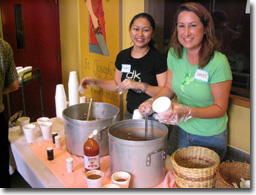
This outdoor meal is truly the work of many people. Parishioners and volunteers prepare a hearty homemade soup and dated packages of pastries arrive from a local grocery store. A parishioner from a produce company delivers boxes of fresh fruit and retirees spread peanut butter on donated bread. Volunteers set up our small chapel lobby with pots of hot water for chocolate and strong coffee. In summer the hot soup is paired with refreshing cold lemonade from large plastic containers. A volunteer sets up a couple of long tables and wipes clean the old plastic tablecloths already used dozens of times.

We serve the feast from the tiny confines of our lobby, the smallest public space in our building. Our guests receive their meal and sit in plastic chairs lined up against the green outside wall. Even in the cold winter rains of Portland, people wait in line for the 7:00pm opening of the red steel doors on the corner of 6th Avenue and West Burnside Street.

Amid the food set-up, the volunteers and guests gather cramped into this small lobby space and narrow sidewalk for many reasons. One reason is the name of the soup line. Our evening hospitality is called the Brother Andre Café, after Blessed Andre Bessette. Andre was a Holy Cross Brother in Montreal, Canadawho died in 1937 with over one million people attending his funeral. He was a man of small stature with an overwhelming dedication to Saint Joseph. Assigned by our religious community to be the Porter at Notre Dame School because of his sickly nature, Brother Andre became a healer. People with crippling diseases traveled for miles to stand in line in order to speak with Brother Andre for just a few minutes. Andre was the first member of our Holy Cross community to be named “Blessed” by Pope John Paul II in 1982.

We carry on the ministry of hospitality Brother Andre showed the Church. Members of the parish welcome friends and strangers with food at our front doors. Our guests may not be healed of illness or infirmity, nor are their crutches and canes left at our door, but strangers are welcomed and our friends are fed, named and appreciated.

This street meal is more than merely a handout. I find profound connections at the bottom of the empty bowls, in the evening interactions. When I first came to the Downtown Chapel, drug dealers stood on our corner convincing people that addiction would be their real food. We pushed the dealers aside. On Friday evenings we present people with an alternative beyond broken needles with friendship and a full soup bowl. This dynamic ministry speaks loudly on our corner as we witness also to onlookers, shoppers and corporate executives strolling by on Friday evenings.

Our narrow sidewalk extends well beyond our own neighborhood. Our ministry of hospitality reaches far into wealthy suburbs and many other parishes. Every week members of different parishes take turns preparing their recipes for soup. The visiting parishes provide some of the volunteers to set up and clean up, to host the evening and to welcome our neighbors. Many volunteers also bring blankets, socks, hygiene products and clothing to be handed out during the weekday hospitality center. I understand more profoundly with every passing week that our narrow sidewalk meanders into the consciences of many people in various parts of the city and beyond.

These volunteers appreciate that our sidewalk soup line becomes a place for people to become known. For many suburban people, these sidewalks are a place of fear and anonymity. Our Brother Andre Café remains a place where the poor have names, faces, life stories, real fears and dimly-lit dreams. The middle-aged soccer mom begins to understand the stories of a young former prostitute living in a single-room occupancy hotel in our neighborhood. As her fear diminishes, the mother relaxes about her children coming to volunteer in our parish. Creating relationships becomes a key source of change, hope and healing for everyone involved.

Our Friday evening outreach is also a place where high school and college students encounter a meaningful mission of the Church. Our parish staff connects with a half-dozen colleges throughout the year. Some undergraduate classes serve food on Fridays and some stay for a week-long plunge in the neighborhood. Nursing students wash people’s feet on Wednesdays. Some high school students meet their volunteer requirements by sorting canned foods for our daily pantry. Others volunteer in our daily hospitality center handing out laundry vouchers to a local Laundromat. They all experience interactions with people who suffer greatly and who live on the margins of our society.

However, nearly all the students go back to their families and schools telling stories of the reality of life. I hear later that they talk about foot fungus, the lack of housing for former prisoners, and the inadequate facilities for homeless women. Our students leave here realizing that the mission of the Church is about people. They admit to me the stereotypes about the poor that their parents and classmates have been passing on to them and their growing realization of the injustice of many aspects of our culture.

Our food-stained sidewalk also helps give direction to the future clerical leadership of the Church. Graduate school seminarians are placed here by the seminary of the Archdiocese of Portland for our Friday night ministry. I lead undergraduate seminarians in a thirteen hour immersion into our work once a year. I watch as the soup begins to break down the notion that the Church is for only the well-educated and well-deserving.

By the end of the academic year the seminarians realize the terrifying issues of people locked in poverty, ill health and sustained unemployment. I watch barriers tumble down and I see that these future clergy gain real insight that ministry involves building real relationships with people. They are stripped of thinking their future priesthood will be about living apart from unemployment, adequate health care and alcohol abuse.. As always, food becomes the vehicle to bring all people together on the same level, the sidewalk becomes a place for equality and authenticity.

Our parish is not the only place that serves food on Friday evenings. In fact I tell new volunteers that food is not the real problem in our neighborhood. The true misfortune, perhaps the real hunger or disease, is loneliness. Social isolation among the homeless and especially people living in the single-room occupancy hotels feeds continuing addiction and crime. People who suffer any form of mental illness may also lack the desire or motivation to remain on medication, to take care of their personal hygiene or to make necessary financial decisions. Loneliness spirals people into further depression. Loneliness creates a path of hopelessness about the future. This isolation also destroys trust, keeping people from reaching out when they are most in need.

However, our volunteers often arrive believing they can change people. They want to solve their situations or zealously promote food or blanket drives. Some become visibly angry that we are not doing more to get people medical help and dental care.Miracles become visible to me when our wealthy volunteers realize that our staff know the names of our guests. Volunteers gradually understand people when they get to know their human stories. Poverty is not easily solved. The issues of mental illness and homelessness are a tangled network of real issues not solvable by any good intentions. Our volunteers who share a bowl of soup realize that if poverty is to be changed, relationships are the key ingredient. This recipe for change starts with broth, onions, carrots, chopped meat, and a warm smile.

The source of these relationships on the streets comes from inside our chapel building. The Eucharistic Table, the center of any faith community, provides the risk to take love beyond the sanctuary. Our community is loved into service. Every day as I celebrate Mass, I break the hosts and pray that grace may sustain everyone present. There is grace enough for everyone because of Christ’s relationship with all believers. God also provides grace which compels us into feeding people who hunger for food, love and a sense of belonging. I realize that God’s love is plentiful if only we can give it away. I ask God every day for the courage to put Eucharist into practice, to take love to the streets of the city and into the households of everyone – even unbelievers.

Even though our parish community serves from God’s love, we still do not have the resources to change policies concerning health care for everyone, adequate housing for the mentally ill and decent employment for veterans. However, I believe that if policies are ever going to change in our cities or for the rural poor, we must first be in relationship with people who are poor. And the source of all these relationships is the sanctuary in all of our churches, the place in which we profess our belief in the Resurrection of Christ Jesus.

Leaving our sanctuaries to minister on street corners is never easy for any worshipping assembly. Entering into the unknown is always risky. Leaving the security of ritual and breaking down even the invisible communion rail takes deep and profound faith. The priorities for every faith community must remain in service to people who suffer. The call of Jesus to wash feet, heal the sick, touch the leper, and encourage the sinner is not a false piety. This call is not for warm-hearted liberals or staunch conservatives, but for us who pattern our lives after Jesus’ passion, death and resurrection. This mission is Christ’s love made flesh, to build community, engage the suffering, and sustain the orphan and widow.

The sanctuary is the place where service and justice are birthed. The sacred liturgy calls us to live beyond the threshold of our comfort, to open doors beyond our ignorance. Our parish community continues to call us into our streets and neighborhood even beyond serving soup. Our community processes to a murder site when violence strikes our neighborhood. We sing a litany that names forms of evil on the sidewalk where the stabbing or shooting occurred. It is the very same litany we sing when we celebrate the Scrutiny Rite for our catechumens. Members of our staff take people on tours to educate volunteers and strangers about the issues of poverty we learn from being in relationship with people inside our chapel walls. The sanctuary and streets are both places of conversion and hope.

I realize sharing soup and stories on the streets does not solve every aspect of people’s suffering. Our staff did not have the insurance or medical care to keep Jane from dying on our streets from gangrene. Our parish cannot solve Jim’s problems of severe mental illness which keeps him in the same clothes for months without showering. We cannot clean people’s teeth or offer a root canal. We cannot fix the ongoing problem of bedbugs in the single room occupancy hotels.

The sidewalk outside our chapel building is more than a corridor to the neighborhood. The concrete path is an extension of the Eucharist itself. The food we share gives us hope when everything else fails. The soup served from the cold streets unites lonely people on Friday evenings and changes priorities of volunteers. The common walkway leads right back to the sanctuary when we are all exhausted from our efforts and need to be fed again with real sustaining food, the Body and Blood of Christ Jesus.