Tuesday of the Tenth Week in Ordinary Time 2020: MT 5:13-16, Homily

Version 3

CLICK HERE to listen to today’s homily

Gospel MT 5:13-16

Jesus said to his disciples:
“You are the salt of the earth.
But if salt loses its taste, with what can it be seasoned?
It is no longer good for anything
but to be thrown out and trampled underfoot.
You are the light of the world.
A city set on a mountain cannot be hidden.
Nor do they light a lamp and then put it under a bushel basket;
it is set on a lampstand,
where it gives light to all in the house.
Just so, your light must shine before others,
that they may see your good deeds
and glorify your heavenly Father.”

Monday of the Tenth Week in Ordinary Time 2020: MT 5:1-12, Homily

cq+tmvcsSBqkmpQ8Uu+K0g_thumb_1b20

CLICK HERE TO listen to today’s homily

GospelMT 5:1-12

When Jesus saw the crowds, he went up the mountain,
and after he had sat down, his disciples came to him.
He began to teach them, saying:

“Blessed are the poor in spirit,
for theirs is the Kingdom of heaven.
Blessed are they who mourn,
for they will be comforted.
Blessed are the meek,
for they will inherit the land.
Blessed are they who hunger and thirst for righteousness,
for they will be satisfied.
Blessed are the merciful,
for they will be shown mercy.
Blessed are the clean of heart,
for they will see God.
Blessed are the peacemakers,
for they will be called children of God.
Blessed are they who are persecuted for the sake of righteousness,
for theirs is the Kingdom of heaven.
Blessed are you when they insult you and persecute you
and utter every kind of evil against you falsely because of me.
Rejoice and be glad,
for your reward will be great in heaven.
Thus they persecuted the prophets who were before you.”

The Solemnity of the Most Holy Trinity 2020: JN 3:16-18, Homily, Prayers of the Faithful

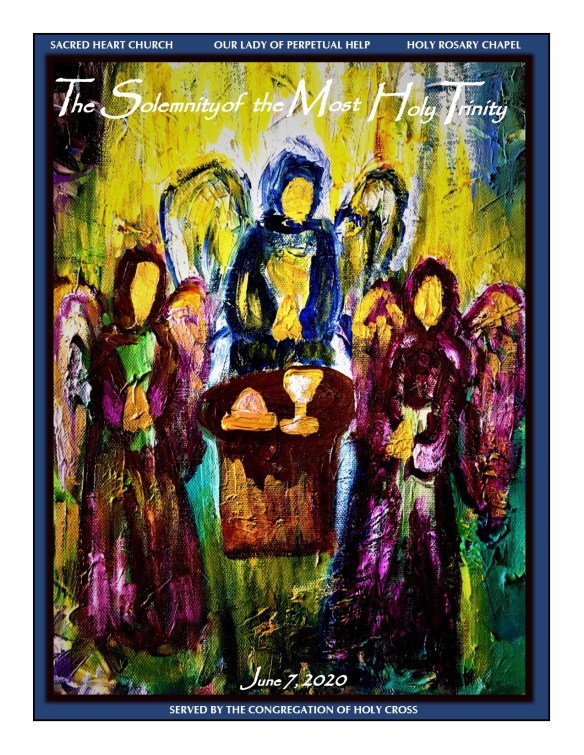
June 7, 2020 Bulletin Cover

CLICK HERE to listen to today’s homily

Gospel JN 3:16-18

God so loved the world that he gave his only Son,
so that everyone who believes in him might not perish
but might have eternal life.
For God did not send his Son into the world to condemn the world,
but that the world might be saved through him.
Whoever believes in him will not be condemned,
but whoever does not believe has already been condemned,
because he has not believed in the name of the only Son of God


Prayers of the Faithful

For our Universal Church, that we may live from the depths of the Trinity offering hope, consolation and peace to all humanity.

We pray to the Lord.

For the destitute, that we may reach out and support those who struggle the most and who need the basics of life.

We pray to the Lord.

For people we harm, that we make work toward reconciliation and peace especially along racial divides.

We pray to the Lord.

For harmony among us, that we may mend our ways and encourage one another in the unity of the Trinity.

We pray to the Lord.

For our sick and grieving, that in the midst of illness and disease, we may seek consolation in the love of God.

We pray to the Lord.

For our beloved dead, that we may offer their lives for all eternity into the rich life of heaven. In this Mass…

We pray to the Lord.


The Solemnity of the Most Holy Trinity 2020: Cover Art, Columm

June 7, 2020 Bulletin Cover

Dear Followers of Jesus,

As we (normally) enter the church building, we dip our fingers into the baptismal water. We fling water over our bodies, marking them in the name of the Father, and of the Son and of the Holy Spirit. We often do this gesture without thinking, our hands not quite reaching our forehead, chest and shoulders.

We may continue this gesture before mealtime prayer or when we tuck our children into bed or begin praying the Rosary. This gesture has been handed down to us for generations. Making the Sign of the Cross on our bodies unites us with God and to one another. This Christian witness comes from our baptism.

On this Solemnity of The Most Holy Trinity, we celebrate the union of the Father, and of the Son, and of the Holy Spirit. This mystery seems so otherworldly and out of our reach. However, at the essence of this celebration, lies the deep communion of God. This profound unity of the Trinity teaches us how to become people of God on the earth.

We are called to live in unity on earth. This unity reflects our heavenly home. We are living in fragile times. We are experiencing the killing of minorities, abuse of power, cultural unrest, and disunity. Violence rises when some of our voices are not heard, when the unity of humanity is threatened.

As Christians, we are challenged to enter the chaos. What we have to offer is a voice that needs to be heard by all sides, by all people, by all generations. What we have to offer the world is a voice of continuity that all human beings share the same value, no matter our race, no matter our political backgrounds, no matter our economic status.

Our voices of unity fall upon deaf ears when we are not living our lives with integrity. We easily fall into the trap of thinking that God must be on our side because we have power, authority, wealth, respect, and of course we follow all cultural rules and obligations. Faith is not about privilege. Faith is not about power or living our lives apart from the world. Faith is meant for us to dig deeply into our human condition and lift up those most in need of healing and wholeness, dignity and respect.

We are called as believers to live with humility. We need to learn how to be citizens in our culture that invite people together, not shun them, or make fun of the lowly, or cast blame upon people who we think are different. It is so easy to blame the weak for anything we do not want to take responsibility for. So often, we want to dominate life and cultural because of skin color and language, because of educational background, and ethnic history.

We are called to gather people into unity, just a God lives. The Trinity gives us a template as how to live even in these uneasy times. Three Persons in One, this is the model for us even here on earth. We are challenged to listen to people who feel they have no voice. We are challenged to explore ways to speak a language of peace no matter who we are or how we live. We are challenged by faith to end violence, racial divides and most of all to continue to discover our common humanity. We are one in God, just as God longs to be in relationship with God’s people.

Throughout our centuries, we have used flimsy images of the Trinity. The triangle or the shamrock has been held up to express the image of unity. The real image of The Most Holy Trinity is when we face divisions and allow God to heal them. The Trinity is revealed when we lift up the poor, settle our disputes, and give the oppressed freedom in our day and in our time. “Peace” is the manifestation of God in our midst.

“For God did not send his Son into the world to condemn the world, but that the world might be saved through him.” JN 3

 God give you peace,

Fr. Ron
Saturday of the Ninth Week in Ordinary Time 2020: MK 12:38-44, Homily

Version 2

CLICK HERE TO LISTEN to today’s homily

Gospel MK 12:38-44

In the course of his teaching Jesus said,
“Beware of the scribes, who like to go around in long robes
and accept greetings in the marketplaces,
seats of honor in synagogues,
and places of honor at banquets.
They devour the houses of widows and, as a pretext,
recite lengthy prayers.
They will receive a very severe condemnation.”

He sat down opposite the treasury
and observed how the crowd put money into the treasury.
Many rich people put in large sums.
A poor widow also came and put in two small coins worth a few cents.
Calling his disciples to himself, he said to them,
“Amen, I say to you, this poor widow put in more
than all the other contributors to the treasury.
For they have all contributed from their surplus wealth,
but she, from her poverty, has contributed all she had,
her whole livelihood.”


Memorial of Saint Boniface, Bishop and Martyr 2020: MK 12:35-37, Homily

Version 2

CLICK HERE TO listen to today’s homily

Gospel MK 12:35-37

As Jesus was teaching in the temple area he said,
“How do the scribes claim that the Christ is the son of David?
David himself, inspired by the Holy Spirit, said:
The Lord said to my lord,
‘Sit at my right hand
until I place your enemies under your feet.’
David himself calls him ‘lord’;
so how is he his son?”
The great crowd heard this with delight.


Thursday of the Ninth Week in Ordinary Time 2020: MK 12:28-34, Homily, Hesburgh

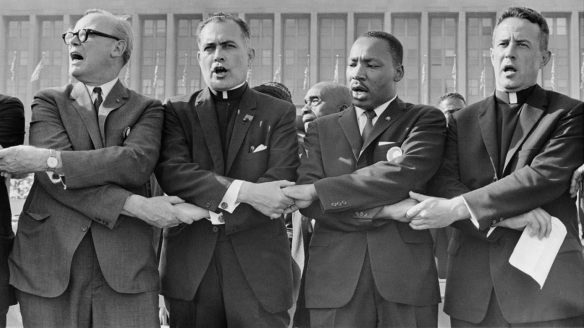
theodore-hesburgh-mlk

Fr. Hesburgh, CSC and Martin Luther King, Chicago, June 1964

Click here to read more about Hesburgh chairing the Civil Rights Commission 

Click here to read an article from Notre Dame’s recent prayer service for justice

CLICK here to listen to today’s reflection

Gospel MK 12:28-34

One of the scribes came to Jesus and asked him,
“Which is the first of all the commandments?”
Jesus replied, “The first is this:
Hear, O Israel!
The Lord our God is Lord alone!
You shall love the Lord your God with all your heart,
with all your soul, with all your mind,
and with all your strength.
The second is this:
You shall love your neighbor as yourself.

There is no other commandment greater than these.”
The scribe said to him, “Well said, teacher.
You are right in saying,
He is One and there is no other than he.
And to love him with all your heart,
with all your understanding,
with all your strength,
and to love your neighbor as yourself

is worth more than all burnt offerings and sacrifices.”
And when Jesus saw that he answered with understanding,
he said to him, “You are not far from the Kingdom of God.”
And no one dared to ask him any more questions.


My dear followers of Jesus,

I grew up just minutes from the University of Notre Dame. During my high school days, I watched Fr. Theodore Hesburgh, CSC on the local news speak about the issues of the world. I watched him as chair of the Civil Rights Commission, as President of Notre Dame, and as a priest, speak about justice, racism, poverty and hunger. The message I received from the television was that the Church was not a building, but a way of life that brings hope in Jesus Christ to a hurting world.

What I saw on television in the late 1960’s and early 1970’s in that small town revealed to me that ministry and life itself was meant to lift people up, not to put them down. I saw a local priest as a world citizen bring hope to many while I watched in awe on a small screen. He counseled five different popes and other world leaders all while remaining in his position at Notre Dame for thirty-five years.

In my own priesthood, I have spent many years among people marginalized by society. In my days in downtown Portland, I worked among people who never got a break in life. A very high percentage of the men who came to our hospitality center were sexually abused as children and nearly all of the women. Many people started drinking alcohol when they were seven or eight years old. Many of our people suffered from mental illness because of early trauma and years living outside. No person there could afford going to a doctor, a clinic or the emergency room.

Everyone who came to our parish carried the weight of other people’s put downs and negative attitudes. They were blamed for restaurants in the neighborhood closing because they had no place to sleep but in doorways. Other churches blamed people in poverty for violence and sexual abuse of children, so the church-school down the street built higher fences. The people surviving poverty were blamed for not pulling themselves up by their own bootstraps. The only problem was that none of them could afford boots.

I learned to listen to people who on the surface were different from myself. The more I leaned into their stories, the more similar we became. They thought I was different too. We had to meet on a ground of hope, on the soil of common humanity. Skin color, ethnic origin, family histories and the number of years in school, were stories told in order to get to know people.

I learned much more from folks in those years than I can ever articulate. I learned much about my own skin color and how privileged I am in every aspect of how I view the world. I learned that my vast education is meaningless unless I use wisdom to listen. I learned that my prayer to an invisible God is also meaningless unless I learn every day how to live for other people. I learned that my solitude as a priest is a waste of time unless I enter into deep relationship with people who teach me how to long for God.

I have spent years working on my conversion toward empathy among people who survive without power in our culture. I am deaf to so much around me because I am not hungry. I am housed and given respect. I am still learning how to love when other people’s experience is one of pain, hardship, poverty and grief. I am still learning to walk with people who teach me how to live beyond the confines of my own sheltered past.

Today is the memorial service for George Floyd. Many people will stand in silence across the globe. We will hold his life and his anguish in the silence. We will hold the systemic racism of our culture in the silence. We will hold his loved ones and his lost dreams in the silence. We will hold all black men who have been murdered in the silence. We will also hold in the silence our longing for peace. We will hold God’s love for all people in the silence. We will hold our own corruption, negative attitudes and arrogance in the silence. In the silence we will feel something more than our own ability to breathe.

Today, in the silence, I will recall the images on the small screen from years ago that all people are part of God’s plan. In the silence, I will hear the voices of people who struggle to breathe while still on earth and those who now live with God forever. I will beg God to teach me how to love with my own heart, mind, soul, skin color, and conscience. I will ask God to teach me how to love Him, and to love my neighbor as myself. I will rest in the love of God, the Kingdom here on earth.

God give you peace.


Memorial of Saint Charles Lwanga and Companions, Martyrs 2020: MK 12:18-27, Homily

Version 3


CLICK here to listen to today’s homily

Gospel MK 12:18-27

Some Sadducees, who say there is no resurrection,
came to Jesus and put this question to him, saying,
“Teacher, Moses wrote for us,
If someone’s brother dies, leaving a wife but no child,
his brother must take the wife
and raise up descendants for his brother.

Now there were seven brothers.
The first married a woman and died, leaving no descendants.
So the second brother married her and died, leaving no descendants,
and the third likewise.
And the seven left no descendants.
Last of all the woman also died.
At the resurrection when they arise whose wife will she be?
For all seven had been married to her.”
Jesus said to them, “Are you not misled
because you do not know the Scriptures or the power of God?
When they rise from the dead,
they neither marry nor are given in marriage,
but they are like the angels in heaven.
As for the dead being raised,
have you not read in the Book of Moses,
in the passage about the bush, how God told him,
I am the God of Abraham, the God of Isaac,
and the God of Jacob?

He is not God of the dead but of the living.
You are greatly misled.”


Tuesday of the Ninth Week in Ordinary Time 2020: MK 12:13-17, Homily

fullsizeoutput_1e88

CLICK HERE to listen to today’s homily

Gospel MK 12:13-17

Some Pharisees and Herodians were sent
to Jesus to ensnare him in his speech.
They came and said to him,
“Teacher, we know that you are a truthful man
and that you are not concerned with anyone’s opinion.
You do not regard a person’s status
but teach the way of God in accordance with the truth.
Is it lawful to pay the census tax to Caesar or not?
Should we pay or should we not pay?”
Knowing their hypocrisy he said to them,
“Why are you testing me?
Bring me a denarius to look at.”
They brought one to him and he said to them,
“Whose image and inscription is this?”
They replied to him, “Caesar’s.”
So Jesus said to them,
“Repay to Caesar what belongs to Caesar
and to God what belongs to God.”
They were utterly amazed at him.

Memorial of the Blessed Virgin Mary, Mother of the Church 2020: JN 19: 25-34, Homily, Art

IMG_1327

Mother of the Church: Painting by: Ronald Raab, CSC 2020

CLICK HERE to listen to today’s homily


Gospel JN 19:25-34

Standing by the cross of Jesus were his mother
and his mother’s sister, Mary the wife of Clopas,
and Mary of Magdala.
When Jesus saw his mother and the disciple there whom he loved,
he said to his mother, “Woman, behold, your son.”
Then he said to the disciple,
“Behold, your mother.”
And from that hour the disciple took her into his home.
After this, aware that everything was now finished,
in order that the Scripture might be fulfilled,
Jesus said, “I thirst.”
There was a vessel filled with common wine.
So they put a sponge soaked in wine on a sprig of hyssop
and put it up to his mouth.
When Jesus had taken the wine, he said,
“It is finished.”
And bowing his head, he handed over the spirit.

Now since it was preparation day,
in order that the bodies might not remain on the cross on the sabbath,
for the sabbath day of that week was a solemn one,
the Jews asked Pilate that their legs be broken
and they be taken down.
So the soldiers came and broke the legs of the first
and then of the other one who was crucified with Jesus.
But when they came to Jesus and saw that he was already dead,
they did not break his legs,
but one soldier thrust his lance into his side,
and immediately Blood and water flowed out.