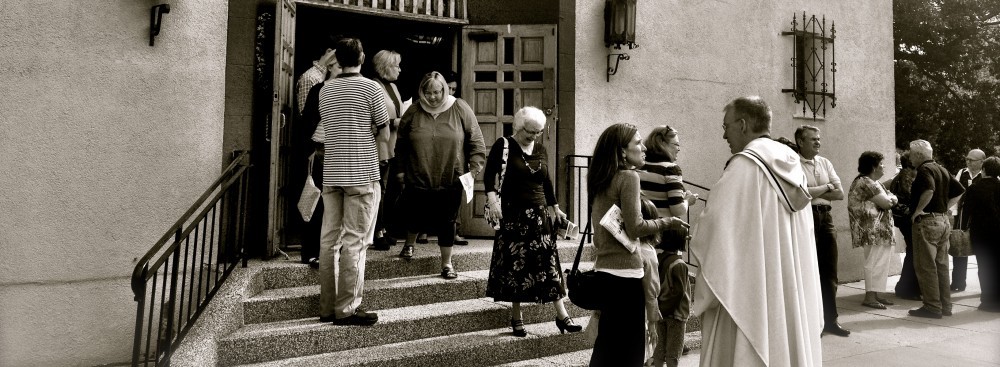
Twenty-Third Sunday in Ordinary Time 2021: Bulletin Art, Column

Dear Believers,

In Mark 7:31-37, we pray this day with the deaf man who was healed by Jesus. Jesus took him away from the crowd, put his fingers in the man’s ears, spat, touched his tongue and looked to heaven and asked the Father to open his ears, his voice, and his soul. 

Jesus declared, “Ephphatha!” which means, “Be opened!”

In Mark’s gospel, Jesus tells the man not to tell anyone about the healing. This is a device in Mark’s text to move the reader along to the end of the story. We still listen to him. We still long to have Jesus touch us and to open us to his healing presence, discovering the beauty and tenderness of his presence. In our emotional shutdowns, we long to be open. 

Jesus’ declaration, his prayer of “Be opened!” has echoed through the centuries. It lands in our ears, in our deafness. Jesus’ touch of love is for us. In the sacraments of baptism, reconciliation, and Eucharist, Jesus continues to show us the way of being opened to the gifts of the Holy Spirit. Jesus desires to heal us no matter what, no matter our sins, our divisions, our heartaches, our past hurts, or hesitations, or even our resistance. 

Be opened. This is in fact, a command of Jesus. It came from his very mouth. I know I need to listen to these two words that invite me into relationship with him. I feel this command in my body. I feel it as I walk on the earth and lift my soul to heaven. I feel it as I encounter people who are bowed down from fear, exclusion, ill health, and turmoil. I feel it as I listen to other people’s pain and know that I can never fully understand the pain of another person. Yet, I am being called repeatedly to be open to the gift of the Holy Spirit and the surprise of how people journey through the sacrifices they make for family and community. 

Be opened. This line is sacramental. It connects us to the freedom of our baptismal life in Christ. It connects us again to the beauty of the Eucharist, where we find eternal life in the center of our daily lives here on earth. As I ponder this simple line, it may very well be a summation of the Christian life. These two words lead us to the glory of Christ’s presence in our encounter with him in our personal prayer and in our communities of faith reaching out to live the mission of the Church on earth. It is a call and a challenge. It demands a physicality of ears, souls, and hearts. It is also a mission and a way of being with other people.  

Be opened. Most of all, these two words call us to be in Christ. We cannot live the Christian life without a relationship with Jesus Christ. No matter how hard we try, we cannot produce mercy, tenderness, and compassion without the source of love in our hearts. We will close. We will shutter our hearts. We will look down to the dusty earth only. We will judge others harshly. We will reiterate the name enemy. We will put people in boxes. We will live in exclusion and think others are out to get us. Shut down. Close. Limit. Condemn. These will be the outcomes when we do not take these two words to heart. 

Be opened. Jesus’ words to us also lead us to truth. We will speak clearly. We will speak the truth that God gives us. Our hearts, our ears, our mouths, our senses will become God’s instruments on earth to liberate ourselves and one another. This is the power of God’s grace in our lives. Again, we do not forgive or liberate our own lives. When we experience and know his touch, we are set free. All things are possible in Christ. Then, we will be able to hear the voice of Jesus, to sense his presence, to understand his life and ultimately to see his face even here on earth. 

Be open. Be open. I want to hear. I want to speak clearly. This is a deep and passionate prayer. This may become the simplest of prayers for you and me this week. I hope you can feel this command in your soul. The Church needs us to hear, to speak, and to love. 

They were exceedingly astonished, and they said, “He has done all things well. He makes the deaf hear and the mute speak.” 

God give you peace,

Fr. Ron Raab, CSC, Pastor

First year seminarians 1974: Saint Joseph Hall at Notre Dame

A former classmate recently sent me this photo. Nineteen of us began our discernment in Holy Cross in 1974. A couple of men attended Holy Cross College, most of us began as freshmen at Notre Dame, a few others were sophomores or juniors.  I was the only one to be ordained a Holy Cross priest out of this group.

As far as I know, four of these men have died. Neil, third in front row, died at the Pentagon on September 11, 2001. Mark, fourth in front row, was ordained a priest in Buffalo, and died almost ten years ago. One man died of AIDS in the 1980’s and another died of cancer way too young.

Most of these men left after a year or two of formation. I have kept up with only four or five since. God scattered us across the globe. We look more like inmates than classmates in this unflattering photo. However, we all desired good things.

I hardly recognize myself in this photo after 47 years. I am second in second row. However, I remember this day like yesterday. I pray for these men, no matter where they are today, who wanted their lives to matter, to count, in service of others. I would love to hear the stories.

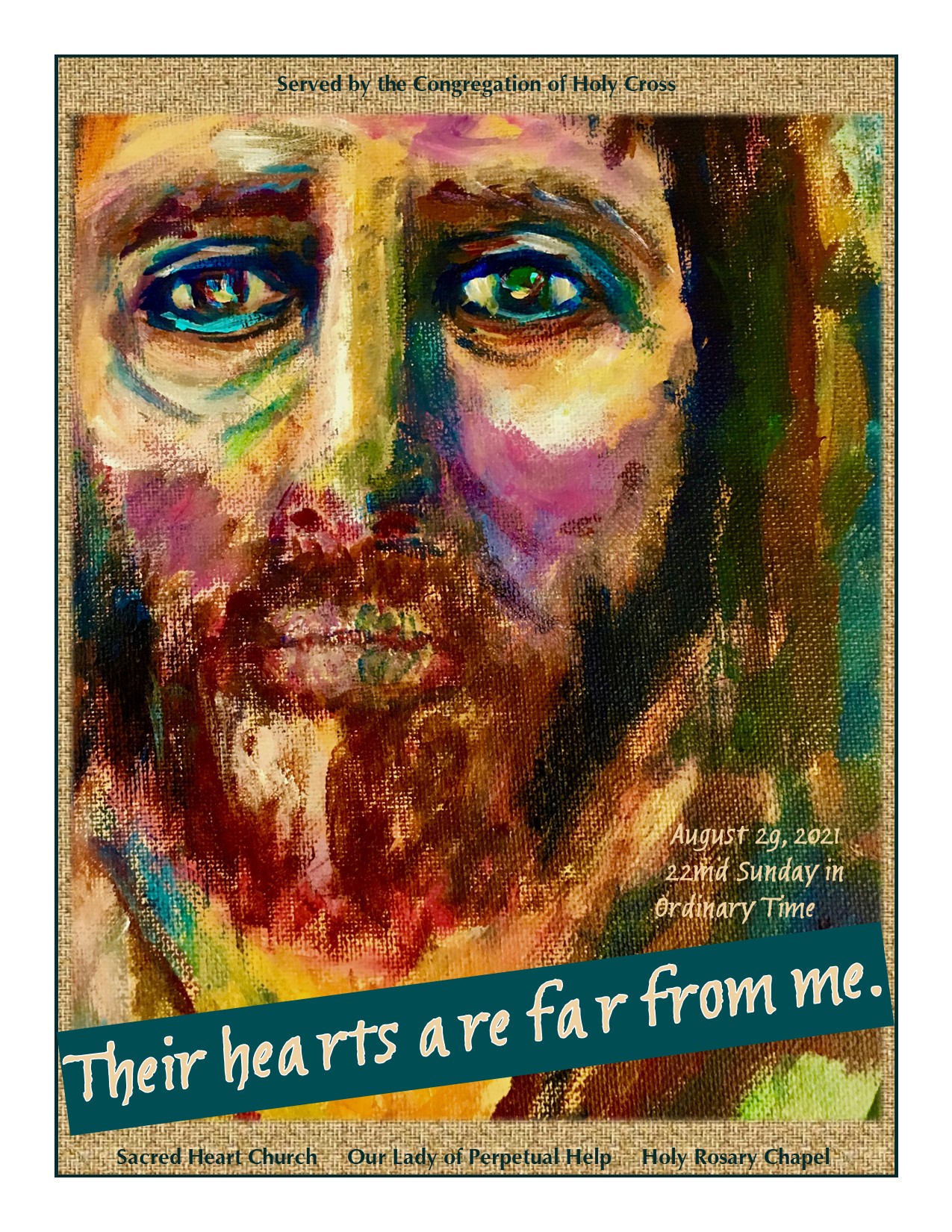
Twenty-Second Sunday in Ordinary Time 2021: Bulletin Cover Art, Column

Dear Followers of Jesus,

We listen to Mark 7:1-8, 14-15, 21-23 in today’s Mass. This text invites us to look within to see how we live and how we follow Jesus. The externals of life do not defile. What comes from within, defiles. This is an incredibly challenging text because religion can easily just be lived externally. We can keep rules, but never be changed by the rule. We can learn formulas and rituals, but never take them to heart. We can read the gospel, but never change our actions or the way we relate to God or one another.  

Faith must touch the heart. Living our lives in Christ Jesus is not a rule, but a relationship with him. Reading the gospels are not just a piety, but a way of life that is extremely challenging. One of the most challenging things in my priesthood is to reveal to people that faith must be lived from the inside out. There are no rules that will make us Christian unless we have the heartfelt desire to live what we teach, to practice what we preach, and to become what we believe. Living life, all of it, from the heart, is a practice that takes us into genuine conversion. This is the gift of Christ Jesus in our lives. This is the belief that must sink in our daily actions, our conscience, our ways of life and how we see the world. 

I am often tempted to keep Jesus at arm’s length. It is easier to see his words only on a page and never have the courage to incorporate them into my life. It is easier to waste my time on living on the surface of life and not to invite my Savior into my heart. It is easier to spout out what others should do and close the door on him to my actions. It is easier to learn about Jesus, and then refuse to know him! It is easier to read books about prayer, but never pray! It is easier to memorize Psalm 23 about the Shepherd, but never know the Shepherd in the intimacy of my heart. 

Ongoing conversion in the Church is not a matter of externals. When we live from only external realities, faith is sure to dry up. Faith must cost us something. The cross is not just a piece of wood; it is an action, a deep source of conversion and change, and most people find it difficult to be inconvenienced by any hardship. Taking faith seriously means real change of lifestyle. It means reflecting seriously on how we view our neighbor. It means we put our lives on the line for the poor, the handicapped, the hopeless and the depressed. When we can view faith from the heart, we can live in Christ and the possibilities of life are endless. Christ can use us to speak boldly about love, compassion, and peace, and not just speak about these things as issues, but to live out these commands in our daily lives. Faith makes a difference if we let it make a difference within us. 

One of the obstacles today is that we have a phone in our hand for most of the day. Though we possess great benefits at our fingertips, there are also many obstacles to living our true selves. We learn things about people instantly. There is no time to think for ourselves, to sort through the consequences of gossip, ongoing hateful opinions of people, and the flinging of gossip across the nation. Living a life where the heart speaks truth is covered over by our addiction to instant gratification, loneliness, and thinking that other people hold the truth more than it resides with our human souls. These externals are harmful to us, to our relationship with Jesus Christ, and our faith communities. We must be able to sit alone and ponder life, to pray through issues and the consequences of our actions, to befriend silence and deep prayer, all of which if taken seriously and in faith, can change us all for the good. Life truly lived from the heart opens up eternal life in Christ Jesus, all for his glory and for the benefit of the world. 

Hear me, all of you, and understand. Nothing that enters one from the outside can defile that person; but the things that come out from within are what defile…”

God give you peace,

Fr. Ron Raab, CSC, Pastor
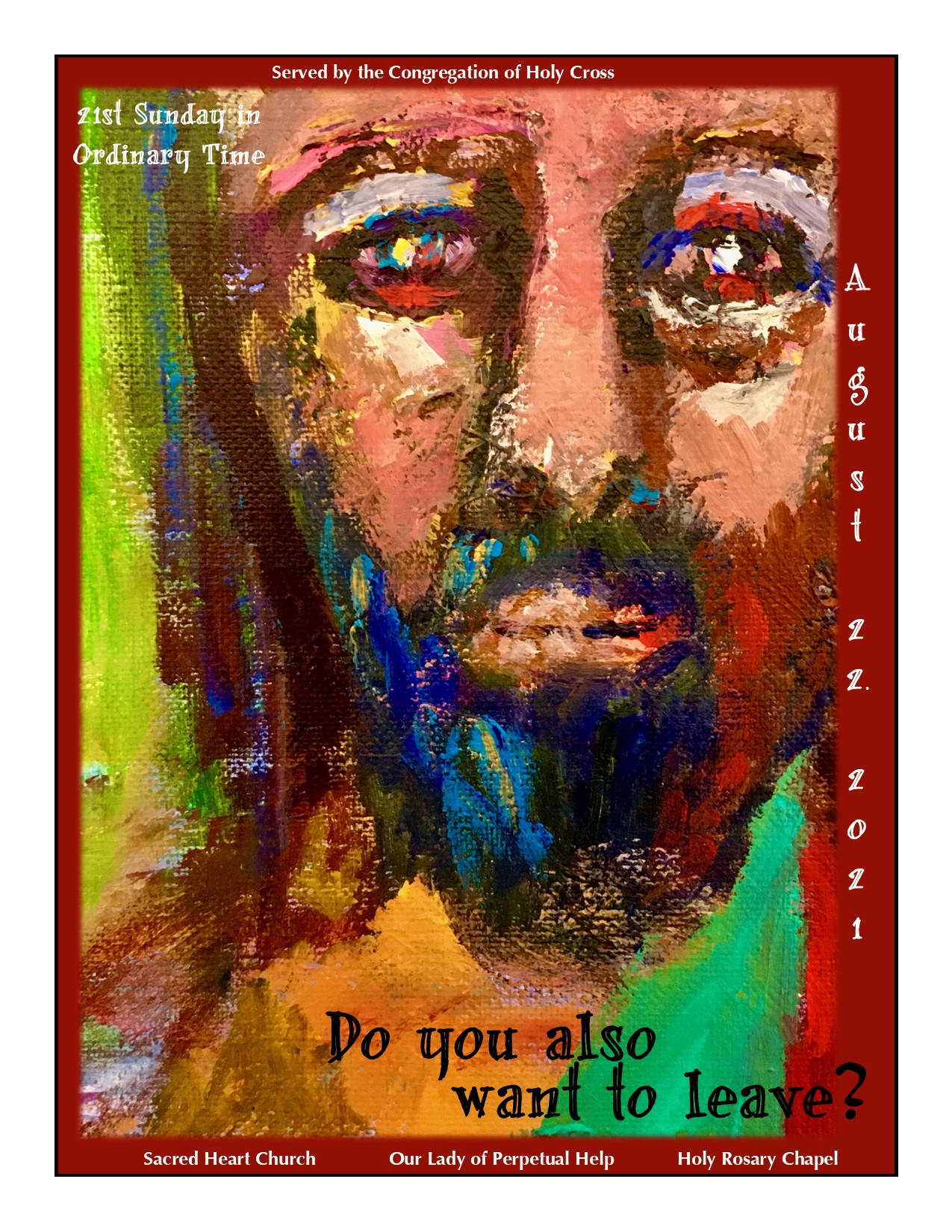
Twenty-First Sunday in Ordinary Time 2021: Column, Art

Dear Believers in the Christ,

In John 6:60-69, we hear Jesus say to his disciples, “Do you also want to leave?” Jesus understands that his words and commands will not be accepted by everyone. Not all people will be able to listen with a soft heart or act with his loving power. It seems every day we all must make decisions in our lives about what we believe. Will we entrust our lives to God’s goodness and love, or will we work in this world with only our bloated egos? Will our thoughts and actions be at the center of life, or will we believe that God has a plan for us, even when life is pretty darn complicated? 

We live in complicated times. Mass shootings are weekly occurrences. Mental health issues among teens and older citizens seem out of control. Divisions among racial lines, among people with money and power and those with little of each. Control in politics and the cursing of people in the opposite party seem to be considered normal today. It seems that we have already answered Jesus in so many ways; perhaps we have already left him. 

In this text Peter answers Jesus with another question, “Master, to whom shall we go? You have the words of eternal life.” Peter asks Jesus this question because he has seen with his own eyes the beauty of his relationship with Jesus. He understands his deep human concern for people and Peter has also captured insight about his divine life. Peter has taken the words of Jesus seriously because he knows in his heart that Jesus is the Word-made-flesh. 

There are many things that have shattered our rhythms of life in these past two years. We are all still trying to recover from job loss, discovering how to educate our children, and grieving the loss of loved ones who have died in the pandemic. We are all tempted to abandon God who promises to be with us. However, if we settle into our pain, we know that God’s love and purpose in our lives is the only thing that will set us on the path of community, friendship, support, and encouragement. 

Some of Jesus’ followers left him. Not everyone today takes faith seriously. Yet, we must take the Eucharist and the scriptures to heart if we are to live with genuine hope. We must live the mystery we celebrate on Sunday. It is not enough for us to just show up at Mass or at our family dinner tables once a week. Our lives are calling out for sincere connection. We must believe that Jesus is in our fear, in our questions about our future, in our inability to calm our restless teens. Here are some things to consider:

1. Admit our restlessness: In our spiritual lives, we take this text seriously. We must admit to Jesus that life is difficult. Assess your life in faith. Tell the truth.

2. Admit we cannot fix our fear: We need something greater than ourselves to survive and for life to flourish. Are we willing to do the work of reflecting on our fear? Or do we just let fear continue to stifle us because it is what we have always known?

3. Admit we need love: Only love will change things. Violence will not change things. Divisions and rage will not change things. Can we decide to turn to love beyond our fear? Can we allow God to love us into the new life we seek?

4. Admit our surrender in God:  If we are to grow and mature as human beings, we must surrender to life beyond our anger, our rage, and our addictions. If we are to raise our families to be vibrant contributors to life and the world, then love and hope become central and vital. “Where else shall we go?”

5. Admit we are instruments of hope:  If we make our lives available for God, then we learn God uses us for the common good and that is healing, assurance, community, and peace. We become what we seek only in Christ Jesus. 

Life is easily bruised. We may blame others for our pain. In Jesus Christ we become instruments of justice, of peace, and gain the courage and conviction to stay with him. We do so because, like Peter, we have seen and witnessed incredible things. 

God give you peace,

Fr. Ron Raab, CSC

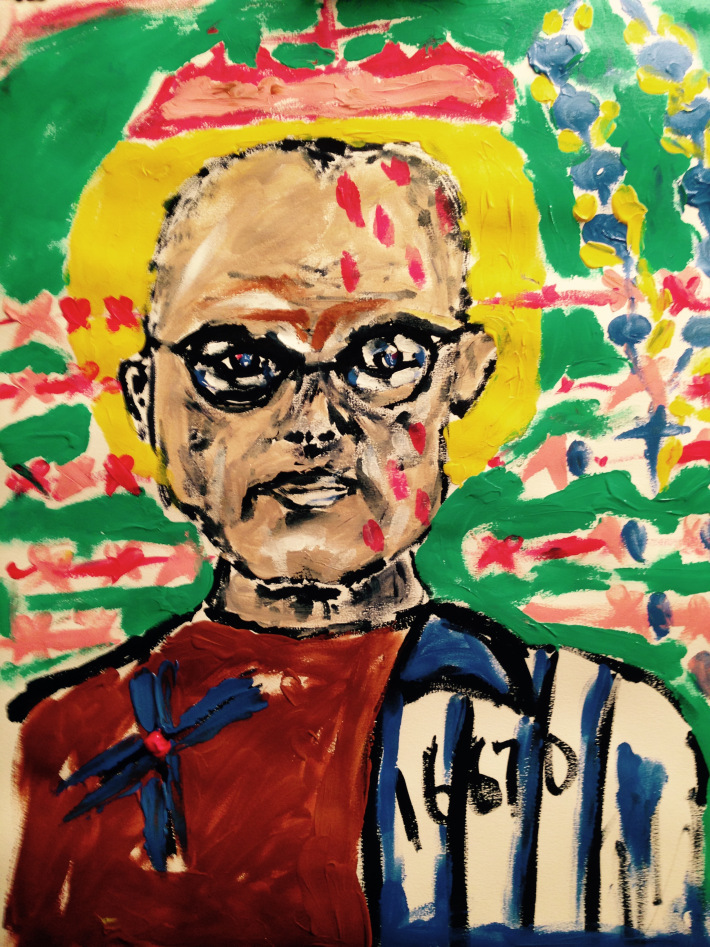
Maximillian Kolbe 2019

Maximilian Kolbe, pray for us.

Ronald Patrick Raab, C.S.C.'s avatarBroken But Not Divided

kolbe-2.jpg Saint Maximillian Kolbe: Painting by: Ronald Raab, CSC(This painting and reflection is from 2015)

Saint Maximilian Kolbe, Priest and Martyr, 1894-1941

This is a crude finger painting. It is meant to be incomplete and simple because there is no easy way to interpret this man’s faith, life and death. This Polish Franciscan priest died in Auschwitz on this day in 1941.

Crown: The red crown was given to him in a vision when he was 12 years old. He had a vision of Mary who presented him with two crowns, one white that would become his reward in heaven, then a red crown, representing his martyrdom. He accepted both crowns from Mary, the Mother of God. 

Mary, the Mother of God: Mary’s appearance to Maximilian gave him purpose in life. Notice how the blue beads of the rosary co-exist and even blend into the barbed wire. I must believe that…

View original post 238 more words