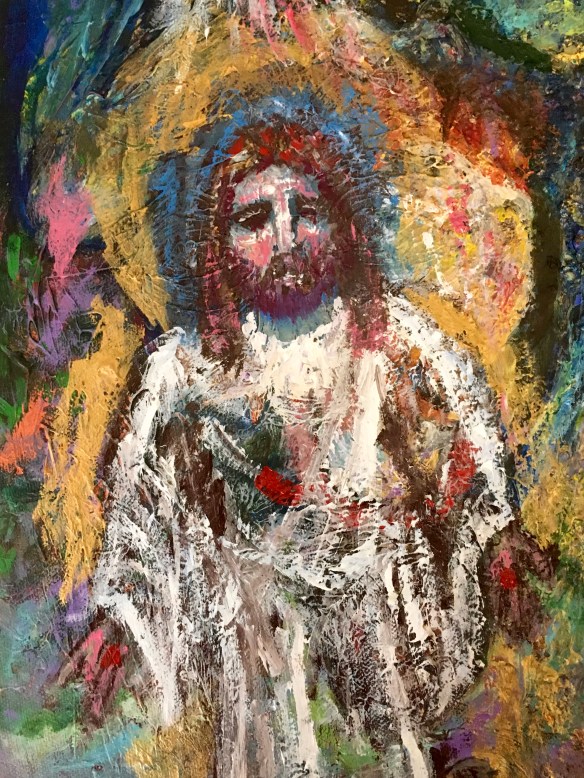
Second Sunday of Easter: Bulletin cover art and column

April 28, 2019 Bulletin Cover

Dear Followers of Jesus,

On this Second Sunday of Easter, we hear the sacred liturgy of John 20:19-31. This gospel is proclaimed in all three liturgical cycles on the Second Sunday of Easter, also know as Divine Mercy Sunday. The gospel invites us into a scene of fear and uncertainty as the disciples are locked in a room after Jesus’ death.

Within their visible fear, Jesus appears in their midst. He offers them peace. This text is rich and profound for our own spiritual lives. Even when fear corrupts our hearts, when it shrouds our perspectives about life and damages our relationships, Jesus comes to us today. The resurrection opens new doors, releases fear and brings peace. We literally stand with the disciples to discover Jesus’ peace.

Jesus then commissions them to go out into the world and offer the forgiveness of his life and resurrection. I can’t imagine how confused the disciples must have been. After all they had been through, Jesus comes to them out of the blue and tells them to get moving beyond their fear and beyond the walls of their locked door.

Thomas was not in the room with them when they experienced such a miracle. A week later, Thomas stands in the presence of Jesus. Thomas takes his finger and places it in the wounds of his hands and places his hand into Jesus’ side. In other words, Thomas probes the mystery of the wounded and redeemed Christ. This is key for us to find the resurrected Christ in our own day. We, too, must probe the mystery of the wounded and redeemed Body of Christ. We do so within the broken, the marginalized, the ill and suffering, the lonely and forgotten.

“My Lord and my God,” proclaims Thomas. His surrender to Jesus’ love and presence is felt well beyond the page where these words are written. This proclamation is felt deep within our souls, especially when we have the courage to seek the Body of Christ in the poor and the abandoned. We know who the resurrected Christ is in this story and we know who we are called to become for we are commissioned as well to be peacemakers, to be people who help others makes sense out of their suffering. All suffering can be redeemed in Christ Jesus, if we have the faith to touch it, to reach out to those who most need love, peace and forgiveness.

The Congregation of Holy Cross celebrates priesthood ordinations on the Saturday after Easter. So our priests preach on this gospel as they celebrate Mass for the first time. I first preached on this gospel 36 years ago. This is my favorite text. I have spent my priesthood probing the mystery of the wounded and redeemed Body of Christ in our world. When I see and touch the pain of others and even within my own life, I find the peace, love and forgiveness of the Resurrection. This is not just a pious notion. This is the reality of not only priesthood but also what we are all called to seek, the resurrection of Christ Jesus. May mercy open doors for us and may we touch the miracles of new life.

Blessings,

Fr. Ron

Easter Sunday: Bulletin art and column

fullsizeoutput_1673.jpeg

Easter Sunday: Painting by Ronald Raab, CSC

READ FULL bulletin here

Dear Believers in the Christ,

On this Easter morning, I am delighted and grateful for your presence at Sacred Heart Church, Our Lady of Perpetual Help and Holy Rosary Chapel. I extend to you a heartfelt Easter blessing as we break through death and into the new life of Christ Jesus.

We proclaim John 20:1-19 this morning. Jesus’ resurrection rings through to our souls. This gospel helps us enter into the scene of the unexpected. Mary Magdalene, Peter and John find the tomb of Jesus empty. Imagine them going to the tomb and not finding Jesus. They must have felt helpless and afraid.

The emptiness of the tomb requires much spiritual reflection. Mary Magdalene peered into emptiness. We can all imagine how fearful she was at that moment. Emptiness is where she realized that something new was happening. Emptiness still shocks us in our daily reality.

Ponder emptiness for a moment. A person who is ill or who has disabilities is often seen as not being whole. There is “emptiness” in our perspective that the person does not live up to being a complete or whole person. When a person is jobless, we may think of the person as not being fully present in our society. Even when we have unscheduled time, we may fear the emptiness and not know what to do, so we fill our lives with many things that do not matter.

Emptiness for Mary Magdalene is really the place where new insights and strengths were revealed. She found her life and voice emptied out by people’s perception of her. She was female, a person with no formal or cultural power. She had little credibility since she was healed of seven demons. She was always socially scarred. She testified to emptiness. Imagine what people must have thought of her testimony, yet in the end people believed her.

I think emptiness still baffles us. We tend to fill a void when we are faced with emptiness in our personal lives, in our prayer and in our spiritual journey. Emptiness is often a place of fear. Interestingly, emptiness is also a place of conversion, new life and freedom. When we surrender to emptiness within our hearts, within our spiritual desire for love, God will fill us up as He did on Easter day. Mary found a deep spiritual wonder and hope from God when the physical tomb presented her with emptiness.

Jesus’ Resurrection means that a new imagination is possible when emptiness happens in our lives. Easter reveals a new imagination in how we live. If Christianity is to survive in our culture, then we are to reimage how we pray and how we work for justice. Christianity cannot be complacent or lethargic. Following Jesus is more than a strict adherence to rules or to be obsessed about the past. A new imagination means we are to rely on the Holy Spirit in the nitty-gritty issues of our lives. We are to take to heart the love of God and live in creative and beautiful ways. Lent has emptied out our perspectives in order to view the beauty of new life at Easter.

I want to continue to create our communities in such imagination. I am grateful for our restored Sacred Heart Church. This is our first Easter back into our renovated building. I see the resurrection in the beauty of our renovation, how we serve one another and all the ways in which we break the mold in our churches. I pray that we can continue what we have started; trusting in the One who began this all.

Easter Blessings,

Fr. Ron

Holy Thursday 2019

Version 5

Holy Thursday 2019

In John 13:1-15, Jesus gives the disciples the heart of his mission. He shows them that they must learn how to receive his love by allowing him to wash their feet. This very human and tender act shows us still that we must allow Jesus to love us and to teach us how to serve other people in the messiness and confusion of life.

I always find it fascinating that in John’s account on Holy Thursday, he does not mention the Eucharist. This is the gospel of deep theological reflection and we would expect high interpretation of what the bread and wine becoming his Body and Blood would mean for us. John’s gospel does not even mention bread and wine. Instead, foot washing becomes a deeply moving and compassionate act, an act of his Real Presence. The meaning of this gesture is broad and even in our day and time; the holy action becomes a rich source of reflection.

What does it mean for us to wash feet from Jesus’ command? We learn to care for an infant and to wash his or hers body out of love. We learn to wash the body of a grandparent or spouse who is ill or dying, surely with love and tenderness. We wipe the nose of our kindergartener on his first day of school from the love we have for him in his nervousness. We bathe our teen with cancer. We care for people in nursing homes and hospitals, in daycare centers and in our own homes.

Jesus asks of us to step out of our patterns of comfort and familiarity. He asks of us to bend down to serve those who are trapped by our prejudice. He asks of us to go another mile for our children who are trafficked. He begs us to reach out to people whose disease we think comes from their weakness, like drug and alcohol addiction. He invites us with profound tenderness to wash feet of people we do not know or even people we do not get along with or people who have hurt us. He asks of us to cleanse the feet and heal the lives of prisoners and orphans, of widows and people marginalized by economics, race and language.

Foot washing is healing. It invites us into communion not separation. We cannot blame people for their dirty feet or the situations in which they find themselves. We cannot judge or bind. We are called to wash the immigrant and the elderly, the baby addicted to cocaine. We are challenged to wash the feet of our enemy. We are asked to walk in the shoes of a stranger, even when they do not have socks or shoes. Jesus invites us to wash when we would rather shun, to wash and dry when we would rather judge or condemn.

On Holy Thursday, we celebrate the Real Presence of Jesus at Eucharist and we remember him on the night before he died. This Real Presence is also demonstrated in the action of foot washing. This profound and tender act coming from Jesus is sacrament for us. His action binds us to love and this love calls for us to give love and service to other people.

Holy Thursday links Eucharist and justice, prayer and service. In this ancient Mass, I find my home this night.

Questions to consider:

How do you receive the love Jesus has for you? Can you accept his actions of tenderness toward you, his willingness to wash your feet with mercy and forgiveness?

Whose feet is Jesus asking you to wash? Whom is he asking you to forgive?

What does Holy Thursday mean for you? Can you sit with its many layers of meanings and find a home in Jesus actions of Eucharist and service?

How would you articulate the link of prayer and service in the Mass of the Lord’s Supper?


Wednesday of Holy Week 2019

Version 5

Wednesday of Holy Week 2019

Today’s gospel, Matthew 26:14-25, reveals much of our human condition. Judas betrays Jesus with a few silver coins. This betrayal brings Jesus closer to his cross and death. This moment for Judas is raw and exposing, even carving him a place in history with this one act toward his friend Jesus.

In our human condition, sin settles into us with a sure fit. We stumble over ourselves with words of hurt toward other people and viewing others only in light of blame and jealously. Even our betrayal of love and connection becomes a story that we tell ourselves over the real story of how love itself brings us to friendship and harmony. So often in our lives hatred and bitterness are the things we remember and hold on to rather than the real connections of love, hope and fidelity.

Our sin against others is real. Yet, the real story of Jesus’ involvement with our hearts is that we also make a home for his love to settle into our hearts. How easy it is for us to forget this truth. Love changes us only when we invite Jesus into our lives to change the stories we tell ourselves about our darkness and lies.

As we move toward the Triduum, we bring with us the stories of our lives into the great story of Jesus’ passion and death, his resurrection. We bring everything to him, leaving nothing astray. We offer the darkness within our hearts, the stories we carry of our loneliness and pain. We offer again to him, the times we have severed such love because of our ego, our sin, our heartaches, our loneliness and especially our fear.

Jesus heals every aspect of our lives, every single aspect. All we need is to cooperate with his fidelity toward us. He will melt away all the betrayal within our hearts, all the hopelessness we carry about the future, all the pain that colors our hearts dark and dreary.

Jesus becomes for us the full measure of reconciliation in the Easter event.


Questions to consider:

How have you severed relationships that used to provide life and hope for you?

Have you betrayed people in the past?

How have others betrayed you?

Are you willing to change your story about these friendships today?

Can you bring healing to them with Jesus’ help?

What is the sin that you hold on to in your life?

Can you allow Jesus’ forgiveness to become greater than your sin?


Tuesday of Holy Week 2019

Version 5

Tuesday of Holy Week 2019

In today’s gospel, John 13: 21-33: 36-38, we listen to Jesus tell his disciples that Judas will betray him and Peter will deny him. Also in the scene John, the Beloved Disciple, rests his head on Jesus’ chest during the meal.

We all hold within our human hearts the duality of betrayal and love. We experience both with people we love. We have betrayed our loved ones. We have experienced such betrayal from someone we love. Our hearts have an amazing capacity to love and shun.

In this Holy Week, we all are invited to examine our human hearts to sift through the sin, the doubt, the denial, the rage, the anger, the injustice as well as our ability to love. Holy Week invites us into the truth, the truth that we may not always want to admit.

As we ponder the gift of the gospel today, I invite you to consider your divided heart as a place of radical love and unbelievable denial. We all hold this tension of being human. In this place, God beckons us into new and amazing life. The great healer of our souls waits for us with abundant grace and mercy.

Many people wish to cover up such divisions. We hold tightly to the rigidity of our denial and never want to admit that our hearts have the capacity to hold such turmoil. We tend to justify our negative thoughts against a thoughtless boss. We hold revenge toward to a spouse or an adult child. We may think that a negative choice of a child reflects on our lives and we hold anger. Jesus invites us to explore what we carry within, the dark and the light.

Today, this day within Holy Week is worth the effort and time to examine the multiple layers of our attitudes, our approaches to others, and our verbal blame to others, our misfortunes, and our inability to accept responsibility for our actions. Our hearts are restless in this week until we realize that only Jesus offers us the truth, wisdom and love that we are looking for in our lives.

Questions to consider:

How have you betrayed people you love?

How have others betrayed you?

Are you willing to find forgiveness within your own heart?

What relationships or images within today’s gospel speak to you?

For what denials in your life do you need Jesus’ forgiveness?

How can you hold within your heart the tension of love and denial?

How does Jesus begin to set you free from such tensions and insecurities?


Monday of Holy Week 2019

Version 5

Monday of Holy Week 2019

 John 12:1-11 offers us a scene of surrender and tenderness as Mary anoints the feet of Jesus with costly perfumed oil made from genuine aromatic nard. Mary dries his feet with her hair.

This image is so multi-layered with meaning. Judas, who will betray Jesus, baulks at such an action because Judas surrenders to money and greed and not to the person of Jesus. Money wins for him. Jesus says that her action of anointing is leading us all to his burial. This image also leads us to Jesus’ action of washing feet on the night before he died.

This action of Mary, the tenderness of anointing feet with expensive oil, is ultimately a gift of sheer surrender to the gift of who Jesus is not only for her but also for us all these centuries later. She shows us how to surrender our lives to such a mystery, how to allow love to show us the way to Jesus. Mary helps us know whom Jesus is and how to give our lives to his passion, death and resurrection.

Surrendering to Jesus is a life-long journey. We so prefer to live feeling we are in complete control of our lives, to know that our answers are correct, our lives are safe and that we live knowing we are at the center of the world. Surrendering to the mystery of faith invites us into a life of deep prayer, of profound letting go of the image of ourselves we cling to. Surrendering to God, to the mystery of love, offers us a home in the mercy and love only God has for us.

Many people in recovery from any addiction understand this surrender. Entering into powerlessness is very countercultural. We are educated to live enclosed within our own egos, our own interpretation of life and to live under the false power of our own self-sufficiency. To live a genuine life of service, of love of neighbor and learning to walk in the shoes of people who suffer requires of us surrender to the love and life God has for us. Surrender to God invites us into unity and not separation, to love not hate, to communion and not self-sufficiency.

This gospel story invites us into the story of real love in this Holy Week. Mary’s action helps us know that we are on the journey to offering our complete lives to Christ Jesus. This story of Jesus is not a story that is separate from our own lives. We must live the same surrender that Jesus lived out in the core of our faith, dying to our selves and living in the bountiful grace and beauty of Jesus’ redeeming love.

Questions to consider:

What does surrender to God mean to you?

How have you experienced such a mystery in your prayer and life?

What do you resist in this Holy Week? What are you being asked to let go of?

Who is Jesus for you?

The first reading today challenges us to realize God liberates us from the slavery of our selves. How do you pray with this text today? How can you realize this liberation of your own heart?

Isaiah says:

I have grasped you by the hand;
I formed you, and set you
as a covenant of the people,
a light for the nations,
To open the eyes of the blind,
to bring out prisoners from confinement,
and from the dungeon, those who live in darkness.