On the Margins: John 2:13-25

Fr_Ron_and_KBVM_reading[1]

On the Margins from Mater Dei Radio, Portland, OR

Third Sunday of Lent, March 4, 2018

LISTEN NOW: CLICK HERE

Gospel JN 2:13-25

Since the Passover of the Jews was near,
Jesus went up to Jerusalem.
He found in the temple area those who sold oxen, sheep, and doves,
as well as the money changers seated there.
He made a whip out of cords
and drove them all out of the temple area, with the sheep and oxen,
and spilled the coins of the money changers
and overturned their tables,
and to those who sold doves he said,
“Take these out of here,
and stop making my Father’s house a marketplace.”
His disciples recalled the words of Scripture,
Zeal for your house will consume me.
At this the Jews answered and said to him,
“What sign can you show us for doing this?”
Jesus answered and said to them,
“Destroy this temple and in three days I will raise it up.”
The Jews said,
“This temple has been under construction for forty-six years,
and you will raise it up in three days?”
But he was speaking about the temple of his body.
Therefore, when he was raised from the dead,
his disciples remembered that he had said this,
and they came to believe the Scripture
and the word Jesus had spoken.While he was in Jerusalem for the feast of Passover,
many began to believe in his name
when they saw the signs he was doing.
But Jesus would not trust himself to them because he knew them all,
and did not need anyone to testify about human nature.
He himself understood it well.
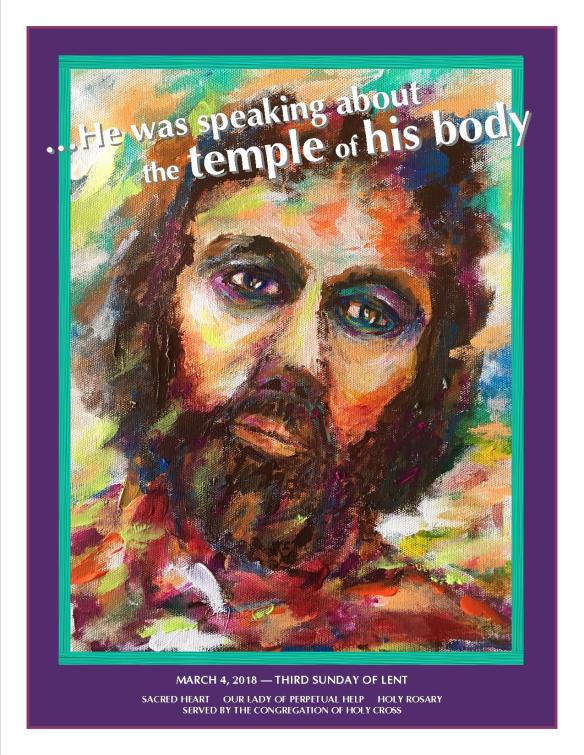
 

Third Sunday of Lent: Bulletin cover art and column


March 4

Painting by: Ronald Raab, CSC

Dear Followers of Jesus,

In our first scripture reading today (Exodus 20), God proclaims to us, “I am a jealous God.” This statement is more than a statement; rather these words are an invitation for us even in our generation to make God the center of our lives and loves. The text outlines the Ten Commandments. However, the text is more than suggesting we live by external rules and obligations. This scripture invites us into a deep and profound intimacy with God.

Our gospel today also proclaims such an intimacy when Jesus is upset with how people are treating the Temple area. He is trying to tell them He is the source of love, the new temple. His body will become the new temple, all that is our hearts’ desire. His own action of passion, death and resurrection will show us the way to the Father. He tosses out the abuse he sees when we get caught up in the trap that faith is a commodity and we objectify our faith.

In these Lenten days, we capture a glimpse that God desires the best for us. We are invited on a journey where all the obstacles in life need to be removed from our hearts so that our hearts have a clear and direct path to Christ Jesus. Our sin and division, our lack of peace, our fighting and anger, are all objects Jesus desires to toss out of the temple of His body so that we can find the peace, forgiveness and mercy that is available to us. Our home is in the heart of Christ Jesus and we are invited to live our lives with such hope to other people.

We must be careful that our faith is lived from the call of Christ Jesus and not determined by our political or social persuasions. In the center of violence and chaos, we must remember that God calls us into his nature that is peace and harmony. In the midst of unrest and a lack of forgiveness on our streets and at our breakfast tables, we must remain clear that is not God’s nature. God’s integrity challenges us into heartfelt forgiveness and hope. This is not passive faith. Faith for us is profoundly a challenge of humility and this only happens with a great deal of self-reflection and prayer.

Living lives that keep God at our center is not an easy Lent. However, through our faith comes an entirely new way of viewing the world and all of our relationships. God desires our complete and trusting hearts, our ways of thinking and acting in our world. God desires our total hearts to rest in Him, for He is a jealous God. Let nothing stand in the way of this notion during our Lenten days.

How is God calling you to give every aspect of your life, every moment of violence and every sin, to Him during this Lenten journey?

Peace to you,

Fr. Ron


Genesis 22 and Mark 9: “What if I find the courage to follow you?”

IMG_0468

“What if I find the courage to follow you up the steep mountain

Will I be able to see your face differently

Or will I stumble

Over my own sinfulness or pride or

Will you challenge me

To sacrifice my own son or

Will my own flesh be enough

To satisfy your longing

For me

Or will I be able to have an open ear to hear the story of my ancestors

Or will I be deaf to all the ways you want to speak to me and

Will I be able to stand in a cloud with the ancient ones

Who have taught me so much to listen carefully

To your voice

Or will I collapse along the way overwhelmed from the weight of the world today

That ignores such challenges and deaf to such calls

And will the mountains of gun violence and losing our children

Be enough sacrifice as you tested Abraham

In our schools and in our malls

Or is it enough to journey along desert lands

In our world to discover the shortage of water and melting glaciers

And journey into the oceans and see the plastics that wildlife choke on

Or how do you want my journey to be even when it is within my own house

At my breakfast table when my children

Do not want to speak to me

Is that desert enough

Or a high enough mountain to climb

When their silence becomes such walls

And their addictions are more rugged and taller than any mountain

Or how should I climb up to you in this Lenten journey

And will I be able to listen to your consoling voice

Or treasure the glory of your light and

Will I find you

And me

Together in new shadows

Giving me the courage and the forgiveness

I need to simply ask

The question

What if I find the courage to follow you?”

On the Margins: Mark 9:2-10

Fr_Ron_and_KBVM_reading[1]

On the Margins from Mater Dei Radio, Portland, OR

Second Sunday of Lent, February 25, 2018

LISTEN NOW: CLICK HERE

Gospel MK 9:2-10

Jesus took Peter, James, and John
and led them up a high mountain apart by themselves.
And he was transfigured before them,
and his clothes became dazzling white,
such as no fuller on earth could bleach them.
Then Elijah appeared to them along with Moses,
and they were conversing with Jesus.
Then Peter said to Jesus in reply,
“Rabbi, it is good that we are here!
Let us make three tents:
one for you, one for Moses, and one for Elijah.”
He hardly knew what to say, they were so terrified.
Then a cloud came, casting a shadow over them;
from the cloud came a voice,
“This is my beloved Son. Listen to him.”
Suddenly, looking around, they no longer saw anyone
but Jesus alone with them.As they were coming down from the mountain,
he charged them not to relate what they had seen to anyone,
except when the Son of Man had risen from the dead.
So they kept the matter to themselves,
questioning what rising from the dead meant.

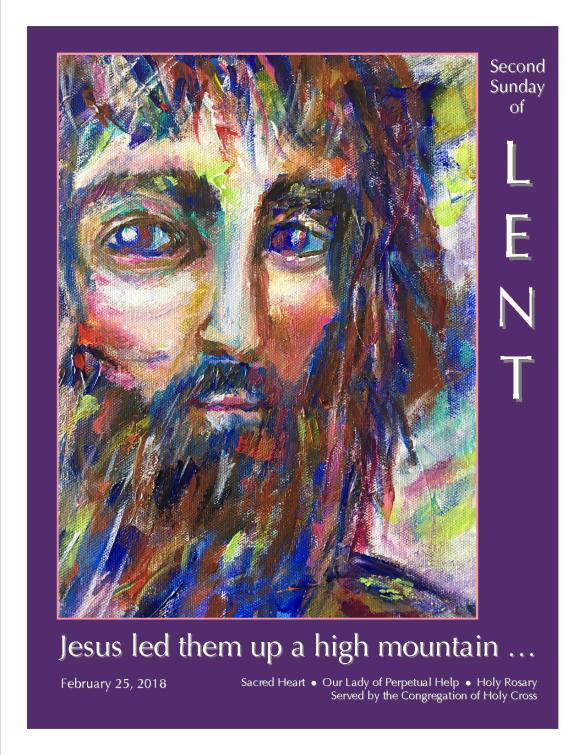
Second Sunday of Lent: My cover art and column

Feb. 25, 2018 Bulletin Cover

Dear Followers of Jesus,

On this Second Sunday of Lent, we follow Jesus and a few of the disciples up a mountain. Unbelievable things come to light. Jesus is transfigured. They listen to their ancestors, Moses and Elijah. The voice of the Father speaks to them from a cloud, “This is my beloved Son, listen to him.”

Jesus beckons us to the hilltop to listen as well. If we have the courage to follow Jesus in this Lenten season, then we shall certainly learn to view our lives differently and our world will be transfigured. The mountain experience gives the disciples a new viewpoint. We need that new perspective on so many issues and concerns in our world today.

We need a new perspective on faith. Our hearts ache to view our image of God, not as a violent judge or hater of us, but of a loving Father who desires our hearts more than we can imagine. We long for a new perspective on our children, their sustaining love within healthy relationships. We need a new perspective on mental health. We need to see poverty differently and how it effects imprisonment, joblessness and violent behavior of so many young people. We need to view drugs and alcohol differently as we constantly see the effects of alcohol among our families. We need a more comprehensive view of violence, the role of guns, the turmoil of abuse and the consequences of multiple addictions in our society. Most of all, we need a new perspective on how fear controls so many aspects of our lives.

We are called during the Lenten season to make a choice for life, the call to support the wellbeing and welfare of all people. Climbing the mountain for a new perspective means that once our eyes are open to the person of Jesus, we must examine the ways we think we have all the answers to life. We easily delude ourselves. We are challenged to discover how hate needs to blend into love, how our negligence needs to be a call to serve, how apathy must turn us toward love and creativity, how our negativity must turn into our praise to God in worship and love.

Life is way too short to live in fear. Faith beckons us on to the mountain. One of the great lessons we learn in the Transfiguration is that we are already connected to God. We don’t have to prove ourselves or condemn others to get the Father’s attention. I pray that we can enter into this passage with an open heart and let go of our stories that tell us that our sins keep us from God. This has enormous consequences, because if we live thinking we are apart from God, then it is easy to finger point to others and believe that others must be separated from God and the Church as well.

Peace,

Fr. Ron

On the Margins: Mark 1:12-15

Fr_Ron_and_KBVM_reading[1]

On the Margins from Mater Dei Radio, Portland, OR

First Sunday of Lent, February 18, 2018

LISTEN NOW: CLICK HERE

Gospel MK 1:12-15

The Spirit drove Jesus out into the desert,
and he remained in the desert for forty days,
tempted by Satan.
He was among wild beasts,
and the angels ministered to him.

After John had been arrested,
Jesus came to Galilee proclaiming the gospel of God:
“This is the time of fulfillment.
The kingdom of God is at hand.
Repent, and believe in the gospel.”

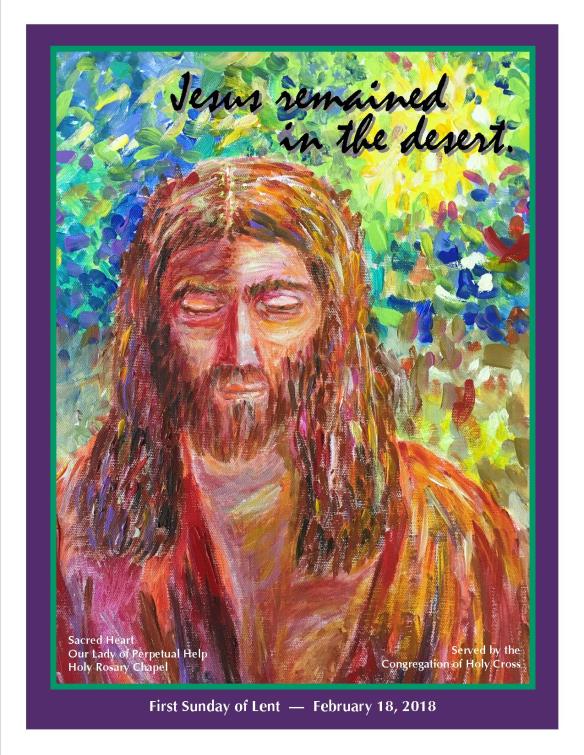
First Sunday of Lent: My cover art and column

Feb. 18, 2018 Bulletin Cover

“Jesus in the desert” Cover painting by: Ronald Patrick Raab, CSC

Dear Followers of Jesus,

Our hearts easily become restless. On some days, our hearts have a mind of their own. We become distant from our true loves, estranged from our commitments, second-guessing our vows and full of blame and anger toward the world that hurts so much. When our hearts become as strangers to us, we call this place an inner desert.

This is the wasteland that Jesus entered into to begin the Lenten journey. His forty-day survival guide suggests to us that we overcome temptations, rely on the Holy Spirit and repent of our past wrongs and sins and more solidly stand on a new ground of faith. This ground is not the shifting sand of complacency, the hot desert of sinful assertions or the rocky road to injustice. This true ground of our redemption lies in the life of Jesus touching our inner lives where our hearts meet daily life.

Lent is a trap. We might think that if we give up something God will enjoy us more. Don’t live in such a blank wilderness. Lent does not flourish because we may give up chocolate. The terrain of Lent is our entry into the deep patterns of our hearts where we know that lust possessions our attentions, where hatred and insecurity becomes a home in us, where prejudice and sin toward our neighbors is the path we have been following. Lent is a time in which we break open old patterns of hate, infidelity and harsh judgments toward people.

Lent means, “springtime.” Lent is a time in which we follow the path of Jesus more intentionally. Lent is a time of self reflection, which is such a stranger to so many people. Lent is a time of deeper prayer and reliance on God. Lent is a time in which we live the Paschal Mystery more completely. This means that we actually live the pattern of Jesus’ passion, death and resurrection.

Lent is a time we face the darkness of our doubt so we can learn to live in the Light of Christ. We face the facts in Lent that we struggle to love our children or the people who migrate to our nation. We let go in Lent our sense of entitlement, thinking that we deserve more than other people who struggle to make ends meet. We learn something in Lent about what unhealthy power is and learn how to lift up powerless people in our world. We feed, love, support and lift up because Jesus broke bread, washed feet and dismissed the devil. Lent is a movement toward profound compassion and hope. Lent, after all, is a journey in and through love.

Here are some questions to consider this week:

What are the inner deserts you face this year in Lent? Grief? Loss? Hopelessness?

What are the ways God may be calling you to trust more or love more wonderfully in Lent?

As you examine your life, how do you see the emerging patterns of Jesus’ passion, death and resurrection?

Blessings to you,

Fr. Ron


On the Margins: Mark 1:40-45

Fr_Ron_and_KBVM_reading[1]

On the Margins from Mater Dei Radio in Portland, OR

Sixth Sunday in Ordinary Time

February 11, 2018


LISTEN NOW: CLICK HERE


Gospel  MK 1:40-45

A leper came to Jesus and kneeling down begged him and said,
“If you wish, you can make me clean.”
Moved with pity, he stretched out his hand,
touched him, and said to him,
“I do will it. Be made clean.”
The leprosy left him immediately, and he was made clean.
Then, warning him sternly, he dismissed him at once.

He said to him, “See that you tell no one anything,
but go, show yourself to the priest
and offer for your cleansing what Moses prescribed;
that will be proof for them.”

The man went away and began to publicize the whole matter.
He spread the report abroad
so that it was impossible for Jesus to enter a town openly.
He remained outside in deserted places,
and people kept coming to him from everywhere.


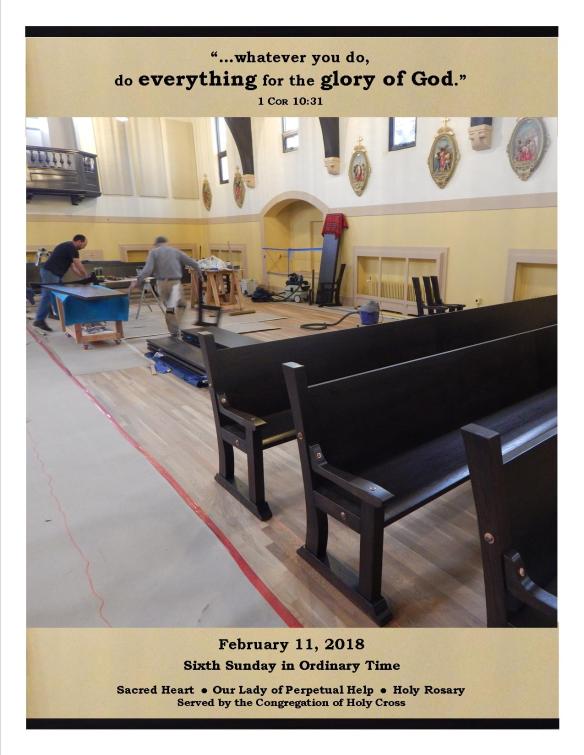
Sixth Sunday in Ordinary Time: Cover and my column

Feb. 11, 2018 Bulletin Cover

Dear Believers in Miracles,

Today’s gospel invites us to see life from the point of view of the leper. We may squirm at such a thought and wonder about the wisdom of such a reflection. The leper is not whole. His body is diseased, but how other people treat him is the real leprosy in the story. Lepers in those days were cast apart from loved ones. They were treated as if their disease came from evil. They did not socialize with family or interact with any aspect of civil life.

Jesus breaks the boundaries of such lies. This is His true healing in the story. The leper reaches deep into his pain and isolation and comes to the conclusion that Jesus is there to heal him. I pray that each of us could have such a conviction. Our task is first to know and understand our pain. Only then can we truly understand how we make lepers out of other people.

There are many forms of leprosy today. Migrants are considered by many to carry such distinction. Gay and lesbian people carry such branding by many. People with drug addiction or people who have never held a job are often treated with such disdain. People from the opposite political party live under this name. Still in this day, people born with skin color different from our own are labeled and given only certain recognitions.

I suffered from severe acne when I was young. A dermatologist treated me for eight years. He told me that I was the worst case he had ever treated. I took antibiotics for all those years. The doctor even gave me x-ray treatments as a last measure to cure me. The treatment didn’t change much. He told me that if the treatments didn’t work, he would call me a leper. I knew he was kidding, but the name hurt more than the treatments.

Acne was very socially condemning for me. In fact, while in college seminary, I was told that if I didn’t do something about it, I would not be ordained. Hard to imagine now, but somehow I managed to walk around such a threat.

Sometimes, we never know how people feel marginalized. Sometimes, leprosy is invisible and secretive. People react in acts of self-mutilation and suicide. People abuse their children who are different. People shun, persecute and ignore others. Some are dismissed from their jobs or never given a chance. Some are homeless or their bodies are damaged from wars. Some are born with disabilities. Not just a result of physical appearance, even gossip creates lepers.

Leprosy becomes an opportunity to love when we finally realize that people are people. Our negative reactions to people who are different from our selves, stem from our fear— simply fear.

Healing happens only when we when finally realize that Jesus desires wholeness, hope and integrity for all people. The reason Jesus became flesh is to heal those whose bodies are shunned, alone and frightened. Leprosy is an opportunity for love for us all.

Peace,

Fr. Ron