On the Margins: Luke 17: 11-19

fr_ron_and_kbvm_readingBW

On the Margins from Mater Dei Radio, Portland, OR

Twenty-Eighth Sunday in Ordinary Time, October 9, 2016

Luke 17:11-19

This week’s edition does not have the usual opening and closing due

to technical difficulities

LISTEN NOW: CLICK HERE

The leper comes back to give thanks to Jesus. The leper is marginalized. The ill are given new life in Jesus. God heals us no matter how broken we are. The touch of Jesus is all we need.

Saint Francis of Assisi, Memorial

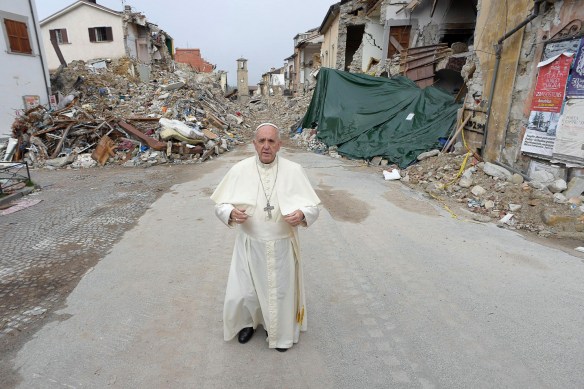
italypopequake-59d16

CLICK HERE TO READ THE ARTICLE FROM THE WASHINGTON POST ABOUT POPE FRANCIS

CLICK HERE TO READ ABOUT SAINT FRANCIS OF ASSISI 

Gracious God, today we remember Saint Francis of Assisi who stood among the rubble of the Church so many years ago. Through his simplicity and prayer, he brought the Church to a new awareness of your Son, Jesus the Christ and our place among people of the earth. He restored dignity to our relationship with nature and brought hope again to people destitute and forgotten. Today we see Pope Francis, named for Francis of Assisi, standing among the rubble, among the ruins of a city. We are reminded of all the ways the Church needs re-formation as well. Give us all courage to help people in need, to offer food to the starving, homes to people lost among the fray and give us courage to pray on behalf of others to restore the world in our relationship with one another. Give dignity and joy to all who believe this day. Give us courage to stand among the ruins and bring hope to those in need of your love. Through the intercession of Francis of Assisi, give courage to our Church this day in the name of Jesus the Christ. Amen

Luke 17:5-10, “The Mustard Seed”


img_1432

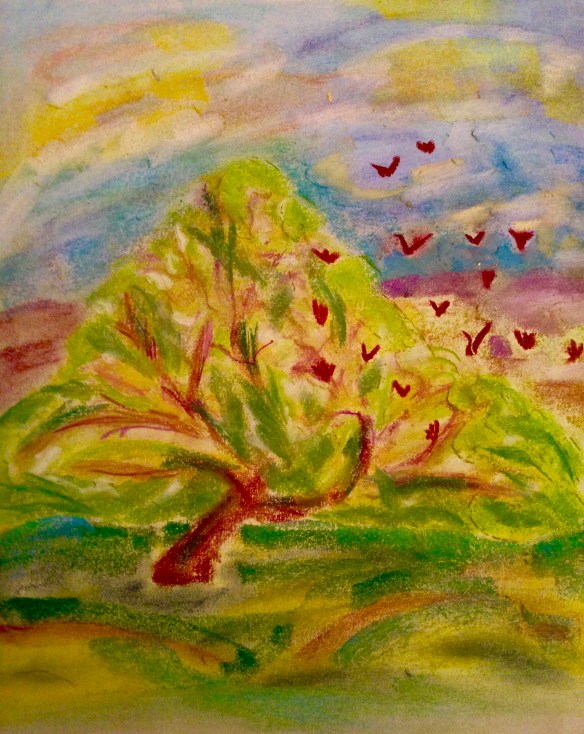
“The Mustard Seed” Sketch: Ronald Raab, CSC

Gospel Luke 17:5-10: Twenty-Seventh Sunday in Ordinary Time

The apostles said to the Lord, “Increase our faith.” The Lord replied, “If you have the faith the size of a mustard seed, you would say to this mulberry tree, “Be uprooted and planted in the sea,” and it would obey you.

“Who among you would say to your servant who has just come in from the plowing or tending sheep in the field, ‘Come here immediately and take your place at table? Would he not rather say to him, ‘Prepare something for me to eat. Put on your apron and wait on me while I eat and drink. You may eat and drink when I am finished’? Is he grateful to that servant because he did what was commanded? So should it be with you. When you have done all you have been commanded, say, ‘We are unprofitable servants; we have done what we were obliged to do.'”

Life is beautiful. The seed of who we are is unique for each one of us. Yet, the core of who we are is our relationship with God. Faith is not something to be increased, it is not a commodity. What needs to be increased is our awareness of God’s fidelity. Faith is a treasure of relying on God for our total lives. This humility changes our lives. We are servants of this seed. We glory in the God who calls us into uniqueness, love and service toward others and toward the Seed-Giver, the God who loves us.

How is God calling you to recognize your true gifts, your ability to use your voice and talents in the world?

How is the seed of faith changing your perceptions of who you are and your life of serving others?

What is God asking of you? Do you believe in this call even though it may seem impossible?

On the Margins: Luke 17: 5-10

fr_ron_and_kbvm_readingBW

On the Margins from Mater Dei Radio, Portland, OR

October 2, 2016

The Twenty- Seventh Sunday in Ordinary Time

Luke 17: 5-10

(THIS WEEK’S EPISODE DOES NOT HAVE THE USUAL OPENING AND CLOSING BECAUSE OF TECHNICAL DIFFICULTIES)

LISTEN NOW: CLICK HERE

Faith is not a commodity but a relationship. This relationship is with the person of Jesus. The disciples wanted to be on stable ground. They wanted to make sure that they belonged to the Father’s love. Mustard seeds grow to the largest of all trees.


Luke 16:19-31 “Wise Relationship”

img_1423

“Wise Relationship” Pastel: Ronald Raab, CSC

GospelLK 16:19-31

Jesus said to the Pharisees:
“There was a rich man who dressed in purple garments and fine linen
and dined sumptuously each day.
And lying at his door was a poor man named Lazarus, covered with sores,
who would gladly have eaten his fill of the scraps
that fell from the rich man’s table.
Dogs even used to come and lick his sores.
When the poor man died,
he was carried away by angels to the bosom of Abraham.
The rich man also died and was buried,
and from the netherworld, where he was in torment,
he raised his eyes and saw Abraham far off
and Lazarus at his side.
And he cried out, ‘Father Abraham, have pity on me.
Send Lazarus to dip the tip of his finger in water and cool my tongue,
for I am suffering torment in these flames.’
Abraham replied,
‘My child, remember that you received
what was good during your lifetime
while Lazarus likewise received what was bad;
but now he is comforted here, whereas you are tormented.
Moreover, between us and you a great chasm is established
to prevent anyone from crossing who might wish to go
from our side to yours or from your side to ours.’
He said, ‘Then I beg you, father,
send him to my father’s house, for I have five brothers,
so that he may warn them,
lest they too come to this place of torment.’
But Abraham replied, ‘They have Moses and the prophets.
Let them listen to them.’
He said, ‘Oh no, father Abraham,
but if someone from the dead goes to them, they will repent.’
Then Abraham said, ‘If they will not listen to Moses and the prophets,
neither will they be persuaded if someone should rise from the dead.’”


I am searching for wisdom. I bet you are as well. Not a wisdom about how to make more cash or even the wisdom a parent longs for in order to survive a child’s autism. The wisdom I refer to is a knowing, an integrity, a wisdom that comes from the depths of our being. This wisdom search is an itch that is hard to scratch. This search makes us sweaty in the middle of the night and throws cold water on us in the hardships of our day.

Many of us identify with the rich man in purple who is blind to the beggar in the doorway of his own home. Some of us believe that Lazarus tells our stories of loss, despair and uncertainty about today and we identify with his plight. The truth is that our lives are both characters in Luke’s gospel, a combination of wealth and poverty. We are rich and blind. We are poor and hungry. This combination once we admit it, is the real road to faith and wisdom. We know the identity of the poor man, his name is Lazarus. The rich man in this story is nameless. Who is rich and who is poor?

We live in a divided world. Of haves. And have nots. We sorta like it that way. We want to know the names of the good guys and the identities the bad guys. We want to be on the winning team. The Church today even plays into that division more than ever. We want clarity. Some bishops are good and some not. One Pope is more Catholic than the other. Some preachers are orthodox and others are inept. We want to know the rules we really need to follow and yet we ignore the sure message of Christ in the scriptures. Some parishioners are worth our attention while the homeless family living in a car is shunned by us. In fact we even blame people for being poor in the first place. This thinking leads us to more division within our own lives and in our communities.

This gospel challenges us to go deeper into our search for integrity of faith. We can admit our own richness of thought and gifts. We also, in prayer, can express our own poverty. Our lives are the amazing combination of poverty and wealth.

Cultivating change is never easy. We are a delightful combination of both/and. Our goal in life is to live in community that acknowledges such tension, where the opposites come together in integrity and faith. We are all poor in spirit and rich in the gifts of love, faith and gratitude. We need both sides in order to survive this complex thing we call life.

The wise relationship we seek is acknowledging the humble poverty of not knowing all the answers and yet the rich and vast exploration of our gifts in the world. Wisdom cannot be shrunk down into quick answers and sound bites. We need to breathe into the mystery of our lives and settle into the great awareness that we are loved by God and that our time on earth is short and beautiful.

Today, these two familiar characters in the gospel deserve our complete attention. Why? Because they both represent us, the people of God who ache for wisdom and new life in Christ Jesus. Ponder the image of the rich man that I sketched yesterday. Or is he the poor man, Lazarus? Perhaps he is both.
Eccl 1:2-11 Vanity of vanities

august-15-16

Reading 1 Eccl 1:2-11

Vanity of vanities, says Qoheleth,
vanity of vanities! All things are vanity!
What profit has man from all the labor
which he toils at under the sun?
One generation passes and another comes,
but the world forever stays.
The sun rises and the sun goes down;
then it presses on to the place where it rises.
Blowing now toward the south, then toward the north,
the wind turns again and again, resuming its rounds.
All rivers go to the sea,
yet never does the sea become full.
To the place where they go,
the rivers keep on going.
All speech is labored;
there is nothing one can say.
The eye is not satisfied with seeing
nor is the ear satisfied with hearing.

What has been, that will be;
what has been done, that will be done.
Nothing is new under the sun.
Even the thing of which we say, “See, this is new!”
has already existed in the ages that preceded us.
There is no remembrance of the men of old;
nor of those to come will there be any remembrance
among those who come after them.

Prayer: (Ronald Raab, CSC)
Lord God, my eyes are never satisfied with what is and my ears wait for more. Forever do I see and hear the refrain from your heart that I cannot be in control or fashion life into my own ways. Allow me to feel the sun of a new day. Radiant from within my heart your love, kindness and gentleness. Open my eyes and ears. Help me appreciate all that has been and to be grateful for all that will be. I stand in awe of you with a deep, refreshed breath of peace. Amen

Saint Matthew, Feast 2016


img_1421

“Saint Matthew” Painting: Ronald Raab, CSC

Painting: My illustration of Saint Matthew includes some of the classic images usually associated with Matthew and his role in the Church as an Apostle. First, the three coins on the left side illustrate Matthew’s old life, his livelihood. He was a tax collector and because of this profession, he was marginalized by the community. He was not trustworthy in the eyes of the people. The coins become an image of how Jesus uses our weakness or sin or past offenses to show that conversion and change is possible. The three coins also show us the value of his new call, the three images of God, the Father, Son and Holy Spirit. Second, the wing on the right side refers to the classic symbol of the winged man or angel from Revelation that guided the hand of Matthew. In all the early paintings or images of Matthew, this winged creature is present. Third, notice the gospel book itself. I illustrated it as looking more like tablets, which are associated with Moses and his role in the ten commandments. Matthew’s gospel is viewed by scholars to show how Jesus is the new Moses which is best demonstrated in Matthew’s Beatitudes. These Beatitudes are the new teaching of the law. Jesus becomes the teacher, the new way of living and viewing our relationship with God, the new invitation of Jesus’ mercy and forgiveness.

Today’s gospel:

Matthew: 9:9-13

As Jesus passed by, he saw a man named Matthew sitting at the customs post. He said to him, “Follow me.” And he got up and followed him. While he was at table in his house, many tax collectors and sinners came and sat with Jesus and his disciples. The Pharisees saw this and said to his disciple, ” Why does your teacher eat with tax collectors and sinners?” He heard this and said, “Those who are well do not need a physician, but the sick do. Go and learn the meaning of the words, I desire mercy, not sacrifice. I did not come to call the righteous but sinners.”

Reflection questions:

How is Jesus calling you from an old way of life?

What do you need to let go of or change to put your call into practice?

What does following Jesus mean for you?

How is the Holy Spirit writing a gospel of hope and love within your heart, your actions?

Proverbs: 21:1-6,10-13: Opening eyes and ears

img_1422

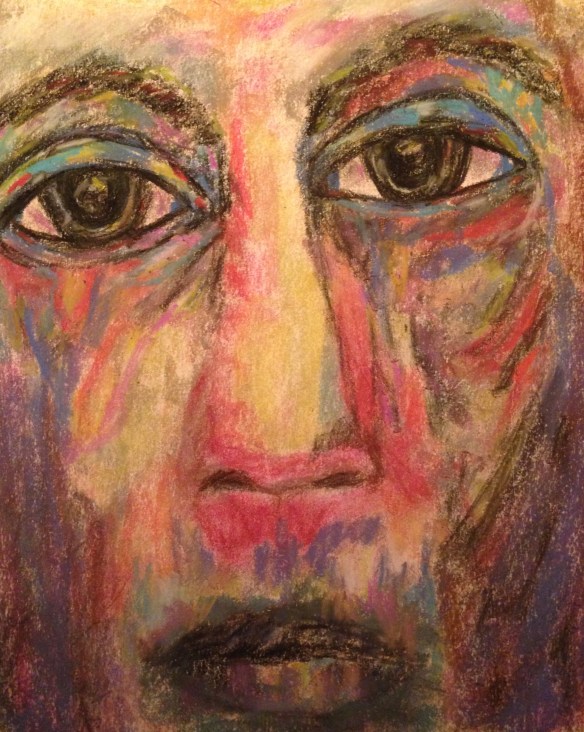
“The emerging self” Painting: Ronald Raab, CSC

Reading 1 Prv 21:1-6, 10-13

Like a stream is the king’s heart in the hand of the LORD;
wherever it pleases him, he directs it.

All the ways of a man may be right in his own eyes,
but it is the LORD who proves hearts.

To do what is right and just
is more acceptable to the LORD than sacrifice.

Haughty eyes and a proud heart–
the tillage of the wicked is sin.

The plans of the diligent are sure of profit,
but all rash haste leads certainly to poverty.

Whoever makes a fortune by a lying tongue
is chasing a bubble over deadly snares.

The soul of the wicked man desires evil;
his neighbor finds no pity in his eyes.

When the arrogant man is punished, the simple are the wiser;
when the wise man is instructed, he gains knowledge.

The just man appraises the house of the wicked:
there is one who brings down the wicked to ruin.

He who shuts his ear to the cry of the poor
will himself also call and not be heard.


Reflection:

“…He who shuts his ear to the cry of the poor
will himself also call and not be heard.”

We know the old refrain that once our consciousness is raised to a new level it is hard to lower it again. This is the reality of both our prayer and our service. Once we feel the tenderness of God’s mercy, then we see mercy in every relationship and act in our world.

This painting is meant to show the self that comes to life as we listen to God and listen to our neighbor. We are not fully developed people of prayer and action. There is always more to become. We rest in the assurance that God has more in store for us. When we open our ears and eyes, the beauty of God’s call becomes the action that the Holy Spirit wants of us. We emerge from darkness, sin and division, hatred and violence, to the beauty and light, hope and wonder of our relationship with God challenging us to live in the world.

Our prayer is not just for ourselves, our own benefit or our own salvation. Our prayer is meant to change our hearts to make them more of a home for God’s love and tenderness. This tenderness rests in God’s hands and is the source and fruit of our service to other people.

Our prayer and service are never separate realities. We cannot lower our awareness to make them separate, apart from love of God and others.