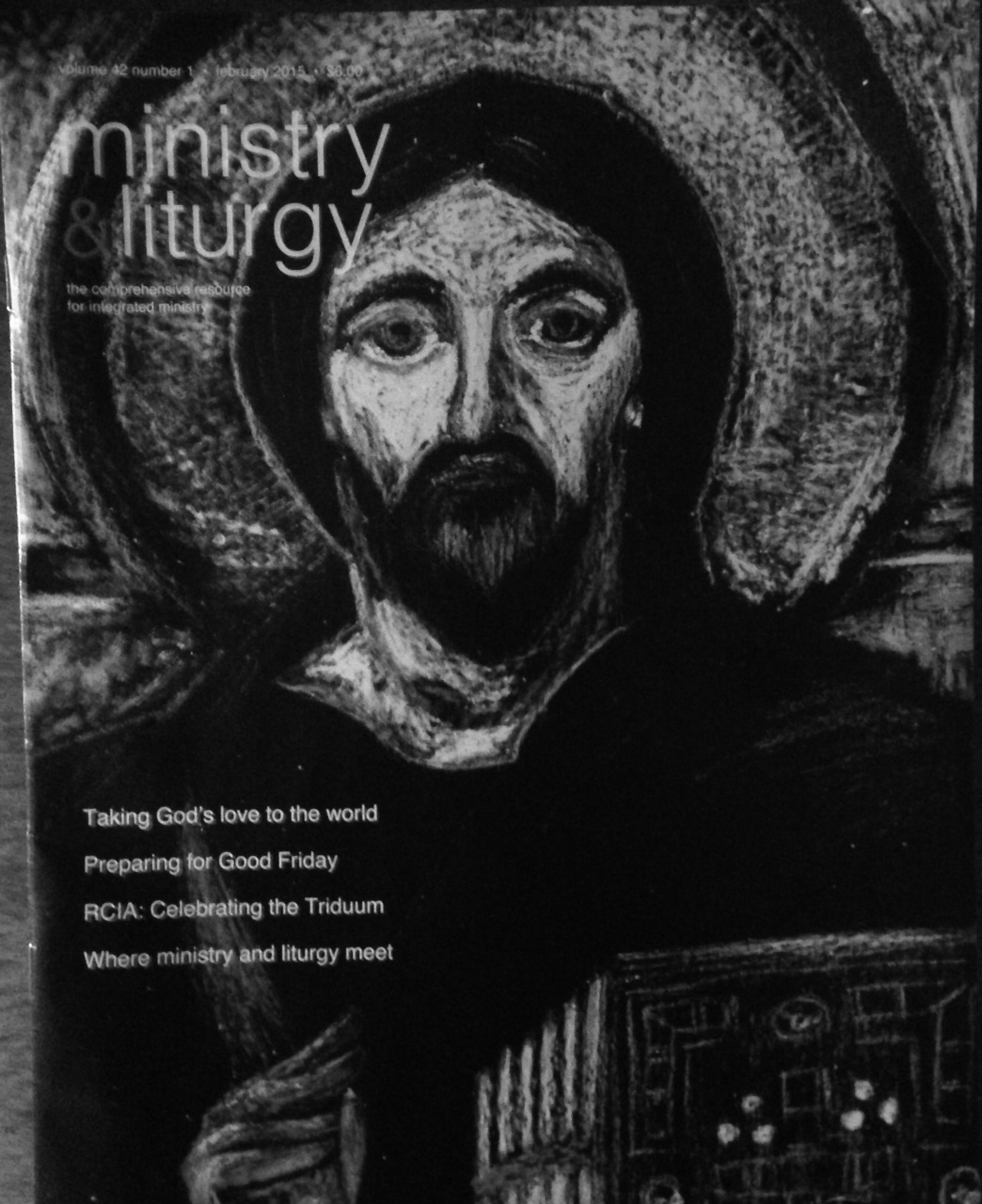
Bread and Concrete: Where Ministry and Liturgy Meet, Ministry and Liturgy Magazine, March 2015

(This is the second in a year-long series published in Ministry and Liturgy Magazine, March 2015 issue. I am grateful for Ada Simpson, editor who made the decision that these reflections from my years at the Downtown Chapel in Portland should see the light of day in Ministry and Liturgy magazine.)

Processions on Concrete

“Jesus himself drew near and walked with them,

but their eyes were prevented from recognizing him.” Luke 24 Continue reading →

On The Margins – Mark 1: 40-45

fr_ron_and_kbvm_readingBWListen to  “On the Margins”. This broadcast comes from KBVM 88.3, Catholic Broadcasting Northwest. Jesus’ presence with the lepers restores all relationships. Leprosy was thought to be evil, people lived away from the community. He does the same with our lives, our brokenness, our shame. “If you wish, you can make me clean.” He restores us to new life.   Sixth Sunday in Ordinary Time, February 15, 2015.


Listen now: [audio https://dl.dropboxusercontent.com/u/75239779/On%20The%20Margins/On%20The%20Margins%20Feb%2015%202015.mp3]

Stream live On The Margins on KBVM 88.3FM on Saturdays at 8am and Sundays at 8am.

First International Day of Prayer and Awareness Against Human Trafficking

Pope Francis is asking us to pray today for people who are victims of human trafficking across the globe. Here is a link to an article about the press conference this week. 

Also, here is a link for more information in Colorado.

“On the occasion of this first day of prayer and reflection, all dioceses, parishes, associations, families and individuals are invited to reflect and pray in order to cast light on this crime, as indicated by the theme of the initiative. In addition, prayer vigils will be held in different countries, culminating in the Angelus prayer in St. Peter’s Square on 8 February.

On the day, the faithful are invited to recite the following prayer”:

“O God, when we hear of children and adults

deceived and taken to unknown places for

purposes of sexual exploitation, forced labour, and

organ ‘harvesting’, our hearts are saddened and

our spirits angry that their dignity and rights are

ignored through threats, lies, and force.

We cry out against the evil practice of this modern

slavery, and pray with St. Bakhita for it to end.

Give us wisdom and courage to reach out and

stand with those whose bodies, hearts and spirits

have been so wounded, so that together we may

make real your promises to fill these sisters and

brothers with a love that is tender and good.

Send the exploiters away empty-handed to be

converted from this wickedness, and help us all to

claim the freedom that is your gift to your

children. Amen”.

On The Margins – Mark 1:29-39

fr_ron_and_kbvm_readingBWListen to  “On the Margins”. This broadcast comes from KBVM 88.3, Catholic Broadcasting Northwest. Jesus reaches out to those who are sick. He touches their illness, he reaches out to Simon’s mother-in-law. Jesus cures, he brings a new right order of hope and healing.  Fifth Sunday in Ordinary Time, February 8, 2015.

Listen now: [audio https://dl.dropboxusercontent.com/u/75239779/On%20The%20Margins/On%20The%20Margins%20Feb%208%202015.mp3]

Stream live On The Margins on KBVM 88.3FM on Saturdays at 8am and Sundays at 8am.

Ministry and Liturgy Magazine: February 2015

( This article is from my regular column, Bridge Work, in Ministry and Liturgy Magazine for the February 2015 issue. I posted the feature article a couple of weeks ago from this same issue)

FullSizeRender (72)

Washing the church

Pope Francis challenged all liturgists during his first Triduum at the Vatican. Not only did he wash the feet of people in prison but also of a Muslim woman. He not only wanted to take the liturgical gesture into the world but he also did not celebrate the Holy Thursday Evening Mass of the Lord’s Supper inside Saint Peter’s Basilica.

The shock waves have grown stronger in these past few years. Pope Francis touches deformed people. He caresses the tight bodies of diseased children. He cups his hand around the face of a crying father. He wipes the tears from the cheeks of a grandmother with his fingertips.

Pope Francis creates havoc for liturgists that are tied to rubrics alone. He sends shock waves among his nervous security guards when he steps out of his car but more importantly among anxious bishops that are to follow his example. Pope Francis is expanding our notions of ritual itself, how the Mass is celebrated and lived in our time and in our cultures across the globe.

I relish Pope Francis’ example even though I cannot keep up with him. I remember last Holy Thursday as I bent down to wash people’s feet in the aisles of our church. I prayed for him and his example to me. I still need to bend down further to wash the feet of the unexpected immigrant, the fragile cancer patient and the lost teenager.

I recognized that evening the faces that belonged to the feet I just washed. I had already celebrated four funerals of loved ones from the twelve people I just bent down toward. I recognized the faces of those who grieve most especially that year and the faces that were still shocked that we would ask them to have their feet washed in the first place.

The Washing of the Feet is a daringly dangerous ritual. The ritual is designed to disengage us from comfort and security. I realize that the dirty feet of other people bring me to surrender my own life. I bent down to our people last year knowing that I cannot solve their grief nor can I solve their problems of job loss, fixed incomes or the fact that their grandchildren no longer believe the church is worthwhile or important. The ritual is as much for me as it is for them because I know my sheer dependence on Jesus whom I trust will still bend down so low as to wash my feet and wipe the unrelenting tears from my own cheeks. The Washing of the Feet exhausts me since I do not have the power to heal all the broken lives or mend their relationships. I find my doubt so clearly in the scum that is left in the bottom of the bowl on Holy Thursday evening.

All liturgical ministers must uncover the meaning of these Triduum rituals for themselves. Musicians must put down their horns and their stringed instruments, close the lids on their keyboards and flee the church to discover again why they are creating music for our rituals. Musicians cannot escape the pastoral needs of people in hospitals or soup lines.

Liturgical planners must connect the pitcher and bowel that is used on Holy Thursday to their prayer and conversations about how people use bedpans for the elderly or how parents have to care for their children who vomit in the nighttime. These rituals are profoundly related. Liturgical items and physical objects must be tied to real life, not just rubric.

Deacons must again see their service at the altar during the Triduum as a gift and not as a privilege. They must discover for themselves the Good News and not keep it bottled up for safekeeping inside the church. They must see in the eyes of the dying person in a hospital the reason to proclaim the gospel of good news at the ambo.

Pastors also need to find again the reason for these rituals. Pastors need to put worry aside about this year’s budget. We must make sure we sit in a chair in a soup kitchen to hear stories of hope from people without homes and shed the notions of security that we want to build our parishes upon.

The Washing of the Feet is a yearly ritual that must speak loudly to our people and even more clearly to those of us in liturgical ministry. Do not short-change this ritual. Do not substitute hand washing. Do not think this ritual is meaningless to our younger generation. This ritual is designed to change us all, to challenge the notions about people we serve and people whom we outright neglect. This ritual helps us realize our own selfishness as liturgists. This liturgical act shows us that the real meaning of ritual is how we live our daily lives.

On Holy Thursday, I will shower before Mass and I will pray that the ritual of the Washing of the Feet will cleanse my soul again. I will continue to pray for Pope Francis who is washing the Church in ways we still cannot imagine. This is our faith, our faith in the real presence of Christ Jesus.


On The Margins – Mark 1: 21-28

fr_ron_and_kbvm_readingBWListen to  “On the Margins”. This broadcast comes from KBVM 88.3, Catholic Broadcasting Northwest. Jesus’ authority is offered today in his teaching. This man with an unclean spirit is presented to Jesus. Jesus heals him with his authority from the Father. Even the unclear spirit recognizes Jesus..  Fourth Sunday in Ordinary Time, February 1, 2015.

Listen now: [audio https://dl.dropboxusercontent.com/u/75239779/On%20The%20Margins/On%20The%20Margins%20Feb%201%202015.mp3]

Stream live On The Margins on KBVM 88.3FM on Saturdays at 8am and Sundays at 8am.

On The Margins – Mark 1:14-20

fr_ron_and_kbvm_readingBWListen to  “On the Margins”. This broadcast comes from KBVM 88.3, Catholic Broadcasting Northwest. Jesus begins calling his disciples to begin his mission. How did the disciples just leave everything and follow him? We leave the positive and the negative things behind to follow Christ Jesus.  Third Sunday in Ordinary Time, January 25, 2015.

Listen now: [audio https://dl.dropboxusercontent.com/u/75239779/On%20The%20Margins/On%20The%20Margins%20Jan%2025%202015.mp3]

Stream live On The Margins on KBVM 88.3FM on Saturdays at 8am and Sundays at 8am.

John Allyn Melloh, SM, teacher and mentor

John Melloh, SM

John Melloh, SM

Fr. John Allyn Melloh, of the Society of Mary, (Marianists) died on December 30/31 in Florida while visiting his family. John was 71.

John was my homiletics teacher. He also taught us how to celebrate all of the sacraments. John taught me in six classes in both the Masters of Divinity program and Masters in Liturgical Studies program at the University of Notre Dame. I learned a great deal from John but more importantly I still carry those insights with me into every homily and into many pastoral situations even after more than thirty-five years.

Continue reading →

On The Margins – John 1:35-42

fr_ron_and_kbvm_readingBWListen to  “On the Margins”. This broadcast comes from KBVM 88.3, Catholic Broadcasting Northwest. People are now seeing for themselves the person of Christ. This revelation, The Lamb of God, is among them. Then Jesus remains some of the disciples. We are named as Christians, those who follow Christ. Second Sunday in Ordinary Time, January 18, 2015.

Listen now: [audio https://dl.dropboxusercontent.com/u/75239779/On%20The%20Margins/On%20The%20Margins%20Jan%2018%202015.mp3]

Stream live On The Margins on KBVM 88.3FM on Saturdays at 8am and Sundays at 8am.

Opinion from Colorado Springs Gazette

A couple of weeks ago, the outdoor nativity was vandalized at Our Lady of Perpetual Help Church in Manitou Springs. The Gazette reported the incident. Today, the Opinion column referred to my response in the original newspaper report. Click here to read today’s Opinion column. (The text is also below)

Desecrate something sacred to Islam — even joke about the religion — and a retaliatory beheading, bombing or mass shooting may ensue. Dead cartoonists are only the latest reminder

Desecrate something dear to Christians, and the victims will pray for the perpetrator and offer support.

For evidence, look to the latest local hate crime. A person or group recently desecrated four characters from the Nativity scene outside Our Lady of Perpetual Help Catholic Church in Manitou Springs. Characters in the display, including baby Jesus, were broken into bits. It is the second attack on local Catholic property in six weeks, after a statue of the Virgin Mary outside St. Andrew Kim Korean Catholic Church in Colorado Springs was vandalized repeatedly in October and November and destroyed on Thanksgiving.

The Manitou desecration included an upside-down cross painted on Mary, mother of Jesus, sending a powerful anti-Catholic message.

The priceless broken objects were created 20 years ago by Manitou artists Tina Riesterer and her husband, Ken. They modeled the characters after locals — including a handful of other well-known Manitou artists — who dressed in elaborate costumes and stood for hours while the couple hand-painted each figure.

Given the magnitude of the loss — and the extraordinary indignity committed against sacred objects — one might expect righteous anger from the victims. They are hurt, to be sure. But they do not seek vengeance.

“I am more concerned about the people who are hurting enough to do that,” said the Rev. Ronald Raab, pastor of Our Lady of Perpetual Help. “I realize this time of year brings out a lot of pain, loneliness and frustration, and people want to lash out maybe because they’re not heard or accepted by the church. If people ever wanted to talk about their pain, I’m certainly available to speak with them.”

He would probably pay their bills and feed them, too. Pope John Paul II visited Mehmet Ali Agca in prison, forgiving the man for trying to assassinate him. Agca placed flowers on the pope’s grave 30 years later.

Britain’s Prime Minister David Cameron insists Christians are the most persecuted religious group, slaughtered and tortured daily for their beliefs. In his book “The Global War on Christians,” CNN correspondent John Allen illustrates how Christianity is “indisputably” the most persecuted religion. Supporting similar observations in his book “Christianophobia,” British author Rupert Shortt laments a “liberal blind spot” that makes Western politicians obtuse to persecution of Christians while being “very very sensitive to the perceived sufferings and complaints of Muslims.”

Few are more critical of Christians than atheist Bill Maher, but even he gets it. In September, Maher rebuked PBS anchor Charlie Rose for comparing Christianity to Islam.

“Vast numbers of Christians do not believe that if you leave the Christian religion you should be killed for it,” Maher said. “Vast numbers of Christians do not treat women as second-class citizens. Vast numbers of Christians do not believe if you draw a picture of Jesus Christ you should get killed for it.”

We know lots of domestic Muslims who love their neighbors and lead lives of charity and peace. But Maher cited a Pew poll of Egyptians that shows 82 percent favor stoning as punishment for adultery; 80 percent favor death for those who abandon Islam. Another survey found 61 percent of British Muslims think homosexuality should be punished as a crime. So, no, Christians and Muslims are not similar when viewed in a global context.

It is touching to see the contrast in a local priest’s compassionate response to a desecration on his lawn. But our cops and prosecutors are not men of the cloth. Treat this as a hate crime, hunt down a suspect and prosecute with vigor.
Continue reading →