On The Margins – Matthew 28:16-20

“The naming of God is more than an external name. The name of God also leads us to an experience of Divine love, mercy and hope. The Solemnity of the Most Holy Trinity: Sunday June 3, 2012 ”

Listen now: [audio http://dl.dropbox.com/u/75239779/On%20The%20Margins/20120603-On-The-Margins.mp3]
Stream live On The Margins on KBVM 88.3FM on Saturdays at 7am and Sundays at 8am.

Hearts and Hope

Originally published by Ministry & Liturgy Magazine, June 2012
– PDF version –

The Twenty-Second Sunday in Ordinary Time:
God of might, giver of every good gift, put into our hearts the love of your name, so that, by deepening our sense of reverence, you may nurture in us what is good and, by your watchful care, keep safe what you have nurtured. Through our Lord Jesus Christ, your Son, who lives and reigns with you in the unity of the Holy Spirit, one God, for ever and ever.
 
The Thirtieth Sunday in Ordinary Time:
Almighty ever-living God, increase our faith, hope and charity, and make us love what you command, so that we may merit what you promise. Through our Lord Jesus Christ, your Son, who lives and reigns with you in the unity of the Holy Spirit, one God, forever and ever.
 

I hear from many people who believe they are responsible for fixing the pain that resides in their hearts. I listen to many women in particular who feel it is up to them to heal the pain of past abuse all by themselves. They cannot allow God or anyone else to enter such tender spaces of the heart. I converse with people who blame themselves for being abused in the past that results in blaming themselves for every negative aspect of their lives in the present. Discovering God’s love is far from their awareness or desire. Their instinct is to constantly feel bad about life and all their relationships.

My experience reveals many people do not feel good about themselves nor do they believe that God could love them. My heart aches for people who cling to such pain. Discovering God’s love or even the notion that God could be anything more than condemnation and judgment is very common in people who face issues of poverty and emotional illnesses.

This opening prayer for the Twenty-second Sunday in Ordinary Time is an invitation to discover a desire for God within us all. This desire is so distant and abstract to so many people because all they know from the Church and from their relationships are put-downs and harshness. This prayer to desire a reverence for God’s name is a place of profound prayer and a place that is very foreign to many people.

This prayer also asks God to nurture what is good within us and to keep safe what is good and holy in our lives. This text deserves prayerful attention by liturgy planners and preachers. A well-planned and honest homily on discovering God’s love and name within our hearts is greatly appreciated even by people who resist this love. This prayer could also become a rich source of catechesis for liturgical prayer as well as private prayer. This collect is not a throwaway text but needs to continue to be translated into real life especially to people who have trouble accepting God’s care for them.

Every worshipping community needs to put flesh on how love is lived in the world. The one aspect of faith that I see missing in so many worshipping communities is the real love of God. Our overly intellectual approach to the Church and to God results in living out rules and obligations but seldom results in healing lives and hearts. No person can give what he or she does not have. So our communities cannot be called into faith, hope and charity without first discovering a deep, passionate love of God for their own lives.

The collect for the Thirtieth Sunday in Ordinary Time asks God for the courage to live out this love in the real world. Faith, hope and love become the rich and real aspects of discovering a genuine relationship with God. Living out charity as well as justice becomes nothing but ego and self-importance if it does not first have the foundation of God’s fidelity and love. I witness this nearly every day in our hospitality center. Many volunteers want to serve people in poverty in order to feel better about their own lives. So many people want to serve people surviving issues of mental illness and homelessness but want nothing to do with the faith dimensions of the Church. Some people want to serve and ignore prayer while others pray and ignore service. Theses prayers help bridge this gap if they are prayed and discussed with honesty and integrity.

I pray this prayer realizing that we all merit what has been given to us in Christ Jesus. We do not have to serve our way into salvation. God’s love and salvation for us is a true and free gift. We all value that gift in varying ways in our lives even when we cannot fully express our desire for God. The gift of the Paschal Mystery is the source of genuine love for all who think they must earn their salvation and God’s love for them. This love is manifest every time we gather for Eucharist and begin our prayer in faith, hope and love. We are all worthy of this love.

I pray daily for people who still think they must solve their own pain. My heart aches for people who believe that they are unworthy of God’s love. My quiet hours are spent in silent prayer for people who have never discovered God’s love because of the human pain that is held tightly in their hearts. This is the place in which our communities must pray together and speak the truth out loud. I wait for the day in which every heart discovers the love that will set us all free.

Summoning Us To Glory

Originally published by Celebrate! Magazine, Summer 2012
– PDF version –

PREFACE I OF THE SUNDAYS IN ORDINARY TIME
It is truly right and just, our duty and our salvation,always and everywhere to give you thanks, Lord, holy Father, almighty and eternal God, through Christ our Lord.
 
For through his Paschal Mystery, he accomplished the marvellous deed, by which he has freed us from the yoke of sin and death, summoning us to the glory of being now calleda chosen race, a royal priesthood, a holy nation, a people for your own possession, to proclaim everywhere your mighty works,for you have called us out of darknessinto your own wonderful light…
                    
PREFACE II OF THE SUNDAYS IN ORDINARY TIME
… For out of compassion for the waywardness that is ours, he humbled himself and was born of the Virgin;by the passion of the Cross he freed us from unending death,and by rising from the dead he gave us life eternal. And so, with Angels and Archangels, with Thrones and Dominions, and with all the hosts and Powers of heaven, we sing the hymn of your glory,as without end we acclaim:   
 

I stand praying the preface on humble ground. This is the earth on which Christ emptied himself of heavenly affections. I stand on common soil with Jesus who bent down to write in the sand words of forgiveness for an adulterer. This is the soil that he mixed with saliva to heal the blind and the ill. This is the earth in which chaos, wars and violence still rage as we live his command for peace. On this ground, Jesus sacrificed his life, his ministry and teaching on a cross between two thieves. This is the ground, the sacred earth in which Christ rose from the dead after three days in the dark cave that held his body.

This ground of sacred prayer is anything but ordinary. These prefaces during Ordinary Time are not throwaway prayers. They are not meant to be prayed out loud only while people fumble with kneelers, change positions, calm children and ready themselves for the consecration of the bread and wine. These prayers reveal the vulnerability of people who beg God for healing as we all try to make sense out of our lives. These prayers summarize the mystery we celebrate even far from the altar table, as God possesses us. Mighty works are revealed in our humility during Ordinary Time.

I pray these texts often feeling awkward and out of place. I have not always felt emotionally comfortable standing on the earth. I have often felt unworthy to stand in the position behind the altar because I have been reluctant to claim my place among God’s chosen. I have spent years in therapy healing the past, in spiritual direction claiming the Spirit in the present, allowing my spirit and body a place on the planet. I pray these prayers walking on the earth, ministering among the marginalized, discovering my own life and God’s love within me.

As a priest and human being, I know I must continue to claim my faith among this holy nation of believers. I hear so often from other priests that they are burned out from always proclaiming the Paschal Mystery.  So many ordained men never really believe the reality of love and forgiveness within their own lives.  I listen to clergy beaten down by age, restlessness and severe loneliness.

Many years ago as a younger priest, I facilitated a retreat for clergy. I heard volumes of anger from priests about their positions behind the altar as leaders of parishes and larger institutions. They were exhausted from proclaiming, preaching and teaching about faith because so many priests in that group had not experienced God’s consolation and love. They were so angry amidst God’s people and the larger institution of the Church. They wept with me in private conversations and among one another about not finding meaning standing alone at the altar table.

I remember one priest screaming at me that there must be something more than the passion, death and resurrection of Jesus. He asked me to find some other method of teaching, pattern of healing or philosophy of life to speak about. I wept with him as he cried on my shoulder. I tried to comfort him with only what I had come to realize even as a young priest, that I find a place on the earth only in the healing love of Jesus, the Christ. I felt the darkness of his life on my shoulder and in my heart. I stood with him as if I were at the altar table, offering his life to God. I cannot predict outcomes or change people or even heal them. I can only remind people that we are all among God’s possessions being lifted from yokes of burden. We live even among the shadows of the healing light of Christ’s presence.

I still muster the courage to stand on the opposite side of the altar from people. The longer I pray there, the deeper my commitment is to people who are searching for something more in their lives. The preface of the Eucharistic Prayer invites every person into a dialogue of life. This dialogue goes well beyond simple words no matter the translation. This dialogue back and forth between priest and people is about the deepest aspects of our lives.

I recently met a twenty-something young man who has just been released from prison. During his incarceration because of selling drugs, he found God. He spoke with me in a soft voice in the dimly lit chapel before Mass. He told me he just spent the weekend exploring a vocation as a priest and a monk. He also told me that he has yet to be baptized. He is confident that God is calling him to be ordained.

I saw deep within his brown eyes, the desire to be healed of his heroin addiction. His sad eyes told me that perhaps moving out of the last pew to the other side of the altar would take his pain away. Perhaps being a priest would release him from his wayward ways. He longs for God to free him from the yoke of sin, addiction and heartache. I wanted to remind him that waywardness and heartache does not disappear once you get to the other side of the altar. I longed to tell him that God is in his present darkness and the light will lead him one step at a time.

Perhaps the heroin addict and the priest should change places on some days. The addict needs to constantly offer his pain up to God in order to survive another day. The priest needs to be honest about his suffering and come to need God more than anything in order to survive another day. This is the real dialogue the preface suggests. We are a chosen people who need God. We are a royal priesthood that constantly offers up our pain and suffering to God so we will all be healed. Every person on the earth is God’s possession.

Every worshipping community needs to explore this sacred dialogue. The people and the priest, the daily suffering and the daily offering to God becomes the flow of the Paschal Mystery. I have yet to imagine another place to go for meaning when a homeless mother comes and says that suicide seems to be the only answer. I do not know where else to turn when a young man is struck by a car days before his graduation. We do not know where to place our trust when a young mother offers up her newborn child in death. We turn in any worshipping community to the Lord who invites our hearts to rest and be freed from the yoke of pain, suffering and grief.

I admit that priests will have to get used to many of the prayers of the new translation of the Mass. However, many priests will also have to take stock of their life of prayer, their ability to discover God’s consolation for their lives and receive the people in real dialogue of faith. These texts from Ordinary Time will take time to settle into the hearts of priests and people. The faith behind the words will continue to show us Christ’s love and compassion for us all.

God still has compassion for our waywardness. We turn to God in the dialogues of war and destruction and his call for nonviolence. We turn to God’s compassion when we blame people living in depression and other forms of mental illness for their disease. We turn to God to feed people who are starving especially for love. We turn to God in this sacred dialogue when priests do not believe and when addicts grasp newborn faith.

I am deeply grateful for my position at the altar to articulate our communal praise to God. Even the heavens ring with praise for what is loved on the holy soil of earth. Thankfulness and gratitude form the church in prayer when our dialogue of life and faith begins at the Table of the Lord. God emptied himself of heavenly form and walked among us. He still feeds us in our humility and welcomes us in our waywardness.           

As I pray these various forms of the preface behind the altar, I plant my feet safely on the earth. Here on the rich soil of our earthly home I have come to know my place among people who live on the daily bread of hope. I stand behind an altar lifting up to God my fearful heart and lifting up the lives of people who desperately need God for human survival. We are all given a share in the richness of Christ’s resurrection so we will all find our footing in the Kingdom of Heaven.  Our gratitude is without end. 
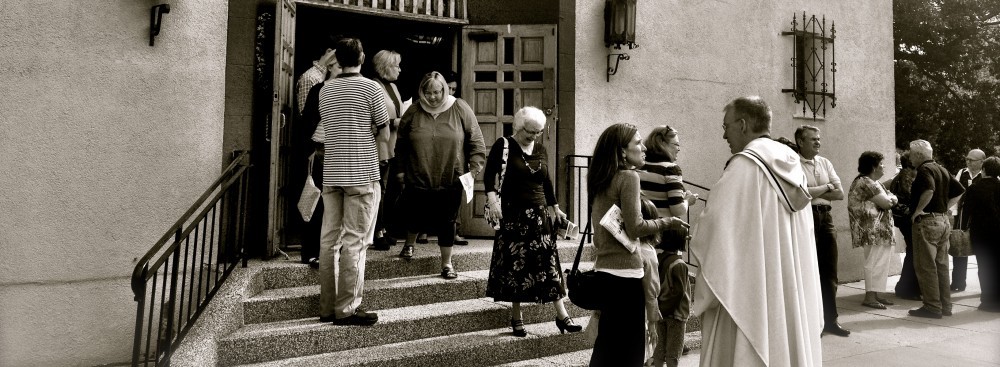
We remember Al Michael

I wrote this reflection for the bulletin cover last weekend. We celebrated Al’s life and death yesterday, Thursday May 31 at 12:05pm. Fr. Dick Berg, former pastor presided and preached. Al lived a simple life in the heart of this community, totally dependent on the people and the resources in our parish.

Al and Mary Ellen (2004)

Dear Friends,

Al Michael has died. Many of you will remember Al because he sat on the west side of the chapel near the organ during nearly every Mass. He was tall, quiet and struggled with his eyesight. He was soft spoken and walked with a walker. Even though he has been away from our community for these past few years, I want to remember him and celebrate his life of prayer and service.

Al lived in our building for over thirty years. His residence was on the second floor that is now Andy Noethe’s office. He ate only the leftovers from the kitchen. He was never given a stipend or any money from the parish community. I arrived in 2002 and about a year later, he suffered a mild stroke and then made his residence at the MacDonald Residence.

Al had been a seminarian in his youth. He lived his entire adult life serving the Downtown Chapel. He lived among the marginalized even when fatigue, age and ill health got the best of him. He was devoted to the mission of this community, especially dedicating himself to prayer and janitorial work in the building.

I remember Al’s presence in the mornings. Al prayed the rosary and his devotions around 5:00am in the sacristy. He wore a red stocking cap because the mornings were cool. He sat in the sacristy with the light on the Tabernacle praying through the door. He did so because he did not want to wear his cap in the chapel.  He was a man of complete routine, ritual and never varied from his formulas. I admired what I saw as I would pass him in the early morning to head out to walk by the river.

His morning routine also included collecting the trash in the building. He would wheel a red two-wheeled cart beginning at 6:00am. He came up to our kitchen to collect the trash and garbage from the evening meal. He would empty the can into a larger one. The juices would run on the floor and the leftover fluids would collect in the bottom of the trashcan. We tried to convince him that it was all right to use a fresh, plastic liner. He would not consider such a luxury. He repeated his trip after lunch and at the end of the day.  He was very proud of his work here.

Former pastor and Jesuit priest, Peter Byrne noted, “ Al was like a character out of a Dickens novel, slightly eccentric, observant and wary of those in power and perceptive of their misuse of power.  He was well read and erudite and quite cultured in his own way.”

I want to express my deep appreciation to Katherine Wilson. She is the member of our parish that cared for him during all these years. She cared for Al when he had his strokes and had to make his home apart from our parish building. Katherine has dedicated years of her life caring and loving Al. We should all express our appreciation to Katherine.

Most of us only knew Al in his later years. I hear that he had been an athlete and a vigorous voice for prayer and service among people living in poverty. God, receive Al into your Kingdom. Provide him room at the feast with his red cap and old sweater.

On The Margins – John 20:19-23

“Pentecost invites us into the fidelity of the Spirit. On this day we ask for what we need, for all that the world needs. Who knows what may happen! Who knows how God is waiting to heal us, to nourish us.” Pentecost Sunday, May 27, 2012

Listen now: [audio http://dl.dropbox.com/u/75239779/On%20The%20Margins/20120527-on-the-margins.mp3]
Stream live On The Margins on KBVM 88.3FM on Saturdays at 7am and Sundays at 8am.

On The Margins – Mark 16:15-20

“On this feast of Ascension, we stand not looking up, but we are even more attentive to the world around us. We are people entrusted with the miracles of healing and hope for the world.” The Ascension of the Lord, Sunday May 20, 2012

Listen now: [audio http://dl.dropbox.com/u/75239779/On%20The%20Margins/20120520-on-the-margins.mp3]
Stream live On The Margins on KBVM 88.3FM on Saturdays at 7am and Sundays at 8am.

On The Margins – John 15:9-17

“We remain in God’s love by our fidelity. We are friends, not slaves, we are a people of hope in the fidelity of God’s faithfulness. We are invited into the beauty, the hope of loving one another for the sake of the Kingdom” Sixth Sunday of Easter, May 13, 2012

Listen now:
Stream live On The Margins on KBVM 88.3FM on Saturdays at 7am and Sundays at 8am.

On The Margins – John 15:1-8

“We build this church based on this loving vine. The Divine remains in us and we remain in God. The fruit that we produce is the continuation of the vine. God’s work in our world can only be done through people. It is up to us to make sure we are proclaiming and professing and living this Gospel.”

Listen now:
Stream live On The Margins on KBVM 88.3FM on Saturdays at 7am and Sundays at 8am.

Path and Purpose

Originally published by Ministry & Liturgy Magazine, May 2012
– PDF version –

15th Sunday in Ordinary Time –
O God, who show the light of your truth to those who go astray, so that they may return to the right path, give all who for the faith they profess are accounted Christians the grace to reject whatever is contrary to the name of Christ and to strive after all that does it honor. Through our Lord Jesus Christ, your Son, who lives and reigns with you in the unity of the Holy Spirit, one God, for ever and ever.
 
21st Sunday in Ordinary Time –
O God, who cause the minds of the faithful to unite in a single purpose, grant your people to love what you command and to desire what you promise, that, amid the uncertainties of this world, our hearts may be fixed on that place where true gladness is found. Through our Lord Iesus Christ, your Son, who lives and reigns with you in the unity of the Holy Spirit, one God, for ever and ever.
 

I know the path to Christ is often convoluted and winding. The new translation of this particular prayer for the 15th Sunday in Ordinary Time zigzags and twists us even more along the path to Christ Jesus. I fear that aspects of this prayer may be misinterpreted. This opening prayer runs the risk of creating judgment from the assembly toward other people I who may be struggling with their place in life and within the church.

I usually cringe when I hear from someone that a person has ’’gone astray.” That phrase for me implies judgment of someone’s life, and rarely do people know the real story of any other person’s journey. The path to the Crucified means entering into personal suffering, which no other person should judge or condemn.

I learn through my years of ministry not to judge people who leave the church or who struggle with faith. In fact, I usually learn the most from people who sit in the dirnly lit last pews of any church or others who take a break from going to church until they sort out the issues of life. I learn from people who face tragedies such as a stillbirth and who fall deeply into depression and cannot commit to believing in God. I am in awe of people who struggle through a family suicide that takes them on a journey of nonbelief, even for many years. In so many cases, people judge others for the action of not participating in Christian community without realizing the pain that has settled into their hearts.

This prayer invites us to consider the correct path to Christ. The real path leads to the way of the Crucified. Suffering in life is never easy and creates paths that are treacherous and foreboding. Faith is awakened when we all invite God into our suffering. Many people cannot find their way beyond this blind curve. When suffering overtakes them, they may turn to alcohol, drugs, and destructive behavior. This is when the path really becomes steep, with unknown outcomes. I learn in our fragile community to remove the blame from my interactions. I cannot blame people in the confessional for the ways in which they deal with mental disorders or past abuse. I do not blame people in any conversation for the outcome of their lives. People need to take full responsibility for their actions; however, I do not add to their burden by blaming them for their pain. This opening prayer is a bumpy road for me.

I desire more than ever for people to find their way to Christ. This is the only path to real joy and purpose in life. The goal for every parish community is to invite people into desiring God. This is the message of the collect of the 21st Sunday in Ordinary Time. I weep when people cannot desire God, who can heal them. The pain of divorce, suicide, drugs, and mental illness often ‘strips people of the basic desire for God. We cannot blame people for their suffering, but we can teach people how to pray in deeper ways. Every community must help remove the obstacles people face in order to truly desire God in their lives. God is here to heal and reconcile, no matter our suffering, no matter who we are in the world.

Every worshiping community needs to take these opening prayers to heart. We need to invite people into experiences of setting our hearts on the love God has promised for every person. We need to give action to our conviction of love. This means getting our hands dirty and learning how the issues of justice challenge us. We need to be in relationship with people who live outside, others who may never be released from prison or people who suffer severe mental illness. We need to understand the family issues of the immigrant. We need to interact with our neighbors in nursing homes and care for babies born addicted to drugs, as well as for the mothers who birthed them. We all need to fix our hearts on the place of God’s love for people, so we may all find true joy and hope in his world.

Answering the challenge of these collects takes time and faith. Every parish community needs to risk stepping beyond their gossip and judgment of people. Every parish needs to find new ways of inviting people — in every form of prayer — into a deeper hunger for God in the Eucharist. Prayer and service lead us on the exact path of Christ Jesus. Experiencing the place of true gladness within our parishes is the mission for us all.

Solemnity and Slavery

Originally published by Ministry & Liturgy Magazine, April 2012
– PDF version –

The Solemnity of the Most Holy Trinity:
God our Father, who by sending into the world the Word of truth and the Spirit of sanctification made known to the human race your wondrous mystery, grant us, we pray, that in professing the truth faith, we may acknowledge the Trinity of eternal glory and adore your Unity, powerful in majesty. Through our Lord Jesus Christ, your Son, who lives and reigns with you in the unity of the Holy Spirit, one God, for ever and ever.
 
Fourteenth Sunday in Ordinary Time:
O God, who in the abasement of your Son have raised up a fallen world, fill your faithful with holy joy, for on those you have rescued from slavery to sin you bestow eternal gladness. Through our Lord Jesus Christ, your Son, who lives and reigns with you in the unity of the Holy Spirit, one God, for ever and ever.


Many people in our neighborhood suffer from social isolation. For many people suffering mental illness, loneliness distorts their reality even more than disease. For some people loneliness even kills. People living in the bug-infested single-room occupancy hotels often die alone. Prostitutes roam our urban corner looking for people who cannot live another night with their loneliness. Drug dealers are always nearby to numb the pain of our neighbors or to satisfy lonely youth attending a blaring concert in the nightclub across the street.

Our staff struggles to create community from such loneliness beginning with the liturgy itself. I pray this opening prayer on the Solemnity of the Trinity aware that most people do not feel welcomed into the relationship of Father, Son and Holy Spirit. The iconic relationship of our God does not easily model how many people in severe poverty are to live. This takes time and relationships are fragile. Welcoming people into communion, into unity, is so counter to what most people experience on the streets. On the violent streets life is all about self-protection, not giving oneself over to another person or institution, or even to God.

Loneliness is often translated into reluctance to believe in God. I witness this reluctance in the sanctuary and the confessional. I pray with people’s reluctance in my alone time and in moments of prayer with groups of people. This reluctance comes to the surface because people do not feel worthy of God. Many people hold their reluctance as adults because God was forced on them as children or because they were shamed into going to church.

This collect outlines the reason for our gathering at the Eucharist. God has made known to the human race the truth and love of Jesus the Christ and the grace of the Holy Spirit. In our baptism we acknowledge the true faith of the Paschal Mystery. We are invited into that sharing of life prompted by God who continues to create within us love, mercy and kindness. This collect is an invitation to begin Eucharist breaking through the loneliness so many people face. These words of prayer must somehow crack through the shame so many people in the pews face about being in relationship with God.

The collect of the Mass is a prism is which we bring people into viewing the nature of God in the continuing celebration of the Eucharist. The prayer also invites people into the covenant relationship with God that is made known among us in our various parishes, our neighborhoods and our world. The Trinity invites people to rest in the loving relationship of God, not because the relationship and God are perfect but because God is still here for the weary, the lonely and the shamed.

I pray the collect on the Fourteenth Sunday of Ordinary Time reminded of the continuing mission of Christ. Jesus was born into a world in need. He gave up his heavenly presence with a new humility on earth. This action of Christ is not over. Christ did not only abase himself for a fallen world of the past, but Christ is still reaching down to bring life and love to us in every day and age. This is genuine joy for all people in all ages, the presence that somehow we need to translate into the depths of people’s lives. This is the Church of mercy and not judgment, of love and not condemnation, of hope and not loneliness.

These collects come to life in every parish when we reach out first of all to people who live in isolation and fear. This takes real courage. This outreach to people well beyond the sanctuary steps takes genuine faith modeled on Christ who humbled himself in the first place. We must reach out to the concrete sidewalks of the city and concrete floors of jails and prisons. We must be willing to abandon our complacency for the rich reward of being in relationship with people who cannot live with their loneliness another day. Every parish community must be willing to abandon their judgment of people and accept people into the pews who are different and who are hurting. This is the perfect model of Trinity life.

The translation of these collects in the new Roman Missal does not stop in our new books or familiar pews. The translation of the Trinity continues in our neighborhoods among people who feel they cannot survive their lives. People who have been shunned by our communities become the place where these ancient Latin texts meet the streets. The translation of these collects into genuine community is a reflection of our God made flesh, so we may live in eternal gladness.