Street Prayer for the Murdered – Litany

Revised Pentecost 2009

Response: SAVE US O GOD

From the brutality of murder and violence…..
From the hardship of poverty and loss…..
From the addiction of drugs and alcohol….

From the fear of isolation and hardship….
From the evil of war and hatred……….
From the corruption of sin and darkness….

From the terror of gunshots and stabbings…
From the suffering of illness and disease…..
From the coldness of loneliness and self-pity…

From the bitterness of homelessness and empty pockets…
From the need of prostitution and pornography….
From the snare of mental illness and all discrimination..

From the desperation of pride and jealousy….
From the silence of apathy and neglect….
From the wounds of sexual molestation and abuse…

From the deserts of ignorance and suffering…
From the arrogance of racism and greed…
From the burden of grief and despair…

From the torture of broken promises and empty commitments…
From the doubt of selfishness and insecurities…..
From the web of egoism and self-centeredness….
From the outrage of revenge and the death penalty…

From the seduction of materialism and gossip…
From the sin of gluttony and avarice……
From the cloud of sexism and ageism ….
From the trap of cynicism and lack of forgiveness….

And from all evil….
And from all evil….
And from all evil……

A Beautiful Supper

Originally published by Ministry & Liturgy Magazine, April 2009
– PDF version –

All too often, I stuff myself with junk food. The sweet or salty fatty fare tastes so good at the time when I think I want to fill the void of hunger. I am always aware that I am trying to fill up more than my body’s desire for nutrition. I am really hiding my feelings of wanting to be connected, loved, and accepted in the world. Food can often play tricks on me, making me feel I am in charge of my own life. Stuffing my body can also mask my feelings of not belonging in the world.

I understand this feeling of emptiness every day working among the poor. I am engaged with people who believe they do not belong in the church because they fill up the void in their lives with multiple sexual partners or by shooting up drugs or constantly acting out in anger and violence. Beneath the surface of all of our anxiety is a deep, profound craving to belong to God and to the gift of being fully alive.

Priscilla deepened my understanding of the real food God offers to all of us. Priscilla always sat in the front pew during Sunday Mass because of her fading eyesight. Even though her eyes could not go the distance, Priscilla perceived more at the Eucharist than most of us. I noticed her
feisty, fiery, youthful self hidden in her aging body. She always looked forward to her seat in the church because her family lived in another state and her health kept her home most of the week. Priscilla’s vision was anchored on the action of sharing our common story in Scripture and praying the Eucharist.

Every Sunday after Mass, Priscilla would hobble up to me, stare into my eyes, and say with loving confidence, “Thank you, Father, for the beautiful supper!” Her words always adjusted my perspective back on the real meaning of my own hunger.

Priscilla was deeply connected to the Eucharist because of her poverty, illness, and loneliness. Her piety was not nostalgic, rigid, or maudlin. She admitted her hunger and she believed God would feed her. She better understood God’s care for people because she spent years rolling up her sleeves to feed people on our Portland streets. She got her hands sticky spreading peanut butter and jelly on white bread. She stained her soul with involvement by remembering people’s names and welcoming the poor in our soup line.

Priscilla’s words of gratitude teach me about the solemnity of the Body and Blood of Christ as we continue to pray in these months of Ordinary Time. We celebrate in all of our parishes the sacrament that feeds our deepest hungers. We name the reality that all of us starve for the life God has for us. However, this solemnity cannot become reduced to a rigid or static notion of the real presence of Christ. Priscilla showed me again that Christ reveals his presence in relationship to people and to honest hunger.

Some parishes may be tempted to celebrate this solemnity by focusing on adoration of the Blessed Sacrament. When this becomes the only focus in our parish celebrations, adoring the eucharistic bread at a distance becomes more important than the action of the celebration of the Liturgy. People may perceive that the Eucharist we kneel in front of is better, holier, and even more present than the Eucharist celebrated every day in parish life.

The lives of the poor show me that the action of the Eucharist calls us all into service and love. The presence of Christ must remain rooted in what Christ actually did on earth. He gathered people who were hungry and multiplied loaves and fish and had full baskets left over. He fed people in ways they could least imagine, not only with bread and fish but by curing diseases, expelling demons, and even raising the dead. On the night of his death he stooped down and washed his friends’ feet at the same meal in which he told his apostles to remember him when they break bread and share the cup.

Priscilla died this past year. Every day as I stand at the altar and hold the Eucharist in my hand, I remember her gratitude to God for real and authentic suppers. I look past her empty seat to other people in the pews starving for love and longing for relationship. I feel a deep, satisfying fullness of tasting God’s presence as we all approach the beautiful supper of the Lamb.

A Reading from the Prophet Bonnie

Originally published by U.S. Catholic, December 2008
– PDF version – Online version –

God’s messengers are often just as surprising as the words they bear.

Advent always opens me up. Just when I think I am in control of my life and ministry, I am confronted by the challenges of a new liturgical year. The prophets get under my skin. The gospels splash my soul to surprise and awaken me.

Never has Advent shaken my priorities as the year Bonnie camped out in front of the red doors at our urban parish. Our small chapel in Old Town, Portland, Oregon serves our low-income neighbors, our homeless friends, and people just getting on their feet after prison. Just before Thanksgiving Bonnie wheeled a shopping cart to the front door filled with her stolen treasures: picture frames and toys, extra sweaters and fake flowers.

Bonnie signed up for our hospitality center on her first morning in search of new clothing and a warm breakfast. Her boundless energy disturbed everyone’s routine in the small basement room. Suddenly our entire staff, volunteers, and the room full of guests awakened to her forceful presence. We panicked as she stuffed food into her pockets, paperback novels under her jacket, and rolls of toilet paper in her plastic bag.

Bonnie’s kleptomania unnerved the staff, her penetrating voice disturbed many of our shy guests, and her wiry presence evoked fear in me. Bonnie began her Advent journey by disturbing our entire operation.

She prayed during Mass on her first day with a voice that could stop a train, screaming out every liturgical response at the right time but with a dozen extra words. She threw off the rhythm of our common prayer so completely that the entire congregation stopped speaking. People erupted with complaints and tried to quiet her. Bonnie persisted with her prayer.

Many of us were left confused and bewildered in those first few days with Bonnie. She stirred up resentment among our neighbors, angered many parishioners, and even blocked people from entering our front door.

But I also began to notice something shift inside me. Slowly I opened my eyes to see her differently. I began to hear the message of Jesus in Mark’s gospel: “Be watchful! Be alert!” Bonnie shook me out of my own sleepiness toward people who suffer beyond my imagining. I started to interpret her disturbing actions and screeching voice as our Advent wake-up call, a real prophet in our midst.

She challenged our professional ideals regarding how we deal with crisis and how we try to keep order as we serve the poor. As the voice crying out in the desert, she echoed the words of Isaiah and John the Baptist to get our acts together and let go of our control. Bonnie was not going to let us get too comfortable thinking we were in charge of our lives or even of the parish. Once we all began to see her as a gift to us, she started to change our experience both of her and of the Advent season.

One day during Mass I heard Bonnie screaming outside the chapel. She was trying to stop people from stealing her things. When Bonnie started screaming, I saw one of our parishioners leap out of the pew to go outside. There was something about her scream that day that was raw and primal.

I felt deep sadness rise up in me. Bonnie was communicating to us that many things in our society are not right. Her haunting scream reminded me of all the ancient prophets who tried to get the attention of people to reform their lives and society. I heard in her scream the challenge to wake up and realize that addicts need shelter and sobriety, people need adequate housing, and the mentally ill need affordable medications. I felt in her scream the poverty of the world.

Bonnie also changed my perceptions of her loud responses at Mass. In the very predictable patterns of common prayer, I understood by her piercing voice that those who are marginalized by poverty or mental illness need to be heard. Mass could no longer be prayed on autopilot. We had to think about what, how, and why we were praying the liturgy. She made us think about our responses to the Word that was proclaimed. She halted us in the middle of blindly reciting the Creed. Like the biblical prophets before her, she was teaching us how to pray and live with new awareness and intention.

Bonnie still reminds me that most of the suffering around us remains hidden and secret. She helps me realize we all must take on the prophet’s role when disease, poverty, loneliness, and financial instability grab hold of our communities. People who suffer silently need the voices of the rest of us to speak up for the abandoned and neglected. The Advent season calls for courage and conviction to make faith real, inviting, truthful. Advent is a time to go deeper into our human condition, beyond the surface of relating to one another from our financial status or educational backgrounds or the styles of clothing we wear.

One day Bonnie approached a woman named Sally, who was born with one arm shorter than the other. Bonnie walked up to Sally and said, “Don’t worry about that arm, honey. When Jesus comes back, he will fix that right up for you!” Bonnie really believes in Emmanuel, God-with-us. She even voiced God’s consolation and joy announced in the prophet Isaiah: “Comfort, give comfort to my people, says your God.”

I thank God for our prophet Bonnie. Even though she washed her glazed donuts in our baptismal font, collected our hymnals in her shopping cart, and took hundreds of our plastic rosaries to wear around her neck, we all recognized that she carried Christ into our midst. She unstuck my notion that Advent is about the purple polyester fabric in the sanctuary or the flattened, artificial greens with faded, purple ribbons posing as the circle of life. She helped me break open the lie that Christmas is for the rich and well-deserving. God desires to be in relationship with all of God’s beloved.

Before Bonnie left our parish, she knelt down in front of the crèche on Christmas Eve. Several parishioners feared her kleptomania as she approached the newborn king. Instead, poised in prayer, she placed a clean, meticulously folded purple blanket in the small stable. It was her cleanest blanket, her source of warmth on the cold Portland streets.

I never realized I would find the birth of Jesus in the center of mental illness, homelessness, and my own insecurity. God gave us the gift of hope years ago in a small stable and continues to grace us with real human beings who teach us that faith is about relationship. I wait patiently for Advent this year to see if our prophetic sister returns. I wait for love again to awaken me.

About My Father’s Business

Originally published by Ministry & Liturgy Magazine, November 2008
– PDF version –
My father died alone in a hospital room four days after suffering a series of strokes.  Earlier that evening my family and I gathered around his bed before heading out to dinner. I told him that his two living sisters granted their permission for him to die. He never made any major life decision without the approval of at least one of his five sisters. I told him that my brother and I could manage life from here. We all told him of our love. I thanked him for being my dad.  Dad had accomplished his goals, he battled Parkinson’s disease for years, he was tired and he was ready to let go.

As we prayed around his bed on that cold December evening, he remained barely conscious. Dad responded to our presence, forming his lips into a silent, “thank you.”

I treasure his sacred last words to us. His farewell gift of gratitude has formed and changed me in these past years. I now see more clearly my own life as a man and as a priest. I inherited on that cold night a gift of gratitude and I will spend the rest of my life interpreting that gift in all I do and accomplish in the world. I look back now from that moment of gratitude to listen again to his other words throughout his lifetime. His words and phrases now open me up, challenge me, and create in me a place of strength and love. I believe Dad’s phrases which he often spoke in life also speak now to other ministers in the church who strive to live the same message of gratitude and encouragement.

My parents owned and operated a grocery store for forty-five years. My only brother managed the business after his military service. I worked reluctantly during summers stocking shelves with canned goods and bagging groceries for familiar customers. Dad’s business was his school of life. Through this small, neighborhood business, he learned how to be a man, how to relate to the world, and how to face the struggles within himself.

His familiar phrases, his one-liners, motivated all of us who worked long hours to make ends meet. His words were his mantras, like refrains to the morning psalms. The older I become the clearer Dad’s words ring true especially in the context of my pastoral ministry. I hear his phrases differently now because I heard him admit his gratitude.  I first heard his words as an awkward teenager unmotivated to be working in the family business, and didn’t understand their significance at the time.

Dad woke up each morning with more ideas than he could ever implement. Morning was the time to paint new signs on white butcher paper for the latest sale items. He prepared a dozen varieties of homemade sausage. He organized, made lists, and swept floors before employees arrived. His first phrase that I remember from childhood was, “Get it done early.”

He prepared for his day because he respected his customers and he wanted to offer them his best work. He felt every morning his life’s call, his mission and purpose in the world. He knew personal hunger as a child and he really respected food and its purpose in family life.

This explains why I pray at 4:00am, write essays before dawn and decorate the church before breakfast. I unveil every morning my own call to be a man of integrity and hope for other people. The early morning hours strip away pretense and they help me discover my mission from God. I confront my own demons and the uncertainty of my priesthood before I see the sun. I strive in the new day to be grateful for everything.

We could all learn from Dad’s business that our ministry depends largely on our preparation and reflection. We need better preparation from all of us who serve in the church. Being prepared is also costly. It takes time away from family, self-care and often from relaxation. However, “get it done early” for us may mean that we sit in the early hours and encounter God in the daily Scriptures. It calls us to confront our sin and mistakes. Being prepared for us means that we sort out before dawn the real reasons we stay in the church working, loving and serving people with often very little thanks for those pre-dawn efforts. This is the hidden life of the minister. Being prepared is to accept our call from God to get His work done on earth.

My father butchered meat for a living. He mastered huge meat-cutting saws, sharp cleavers, and wrapping up meat packages with white paper and string. With blood on his apron and sawdust on his shoes, he mastered the tools of his trade. However, in an instant he could wipe his dress shoes clean, whip off his apron, roll down his sleeves of his starched white shirt and be prepared to meet people or discuss products with salesmen. He expected the rest of us to be ready for customers. He would yell to us stock boys, “We need help up front!” This meant we were to drop what we are doing because we were needed to bag groceries at the cash register or help an elderly woman to her car.

This phrase always yanks me out of my solitude and stubbornness and reminds me of my authentic call to be in relationship with people who need God. I often hear Dad’s words when I see priests hiding in the sacristy before Sunday mass. When I witness ushers, greeters or other hospitality ministers telling jokes to each other or reminiscing about former pastors, I hear Dad’s plea to make sure people are greeted and acknowledged. I feel his dissatisfaction when people entering the church doors have questions about how to plan for marriage or simply want to know the locations of the restrooms, and they remain ignored.

“We need help up front,” is a radical call for contemplation by all ministers. Being with people is the reason the church exists. This grace-filled act is faith lived in the moment. Each person deserves our attention because God calls us all into prayerful action. People entering our church doors depend on us believing in something more than our self-centered piety in which some people belong and others feel ignored.

The family-run business often overwhelmed my father. Worry often got the best of him. He did not possess all the answers to how to make ends meet or the best way to advertise or what products to put on sale. When he realized he could not control the outcome of his day or when he grew tired of worrying about something in the future he would say to the rest of us, “We’ll cross that bridge when we get to it.”

I find in this statement profound love and honesty. I, too, get caught up in many ideas and worries about my ministry and what it could become.  What I miss so often is ordinary life, people and their needs sitting in front of me. I cross one bridge at a time when an elderly man needs medications or when a woman needs diapers for her infant or when the addict needs to talk to someone right now.

The poor teach me the sacredness of Dad’s words. I learn to take each day of grace as it comes. I ground myself in daily life, one person and one need at a time. I make sure I am not living ahead of reality, not feeding on tomorrow’s bread. People who search for one meal at a time or ask for a clean blanket to make it through the night teach me all over again to deal with life as it comes, one bridge at a time. I realize in Dad’s statement that I cannot control life or peoples’ reactions either. I depend on God to help me make appropriate decisions.  I wait like everyone else for God’s initiative and presence.

Dad made financial mistakes. He cut his losses and moved on. He fretted much about making the correct choices and he stressed over people who were difficult to please. His worry became more evident when his Parkinson’s became more obvious to us. When he was exhausted from his worry, he would utter, “That’s the way it goes.”

Even hearing the exasperation in these words, I never took this phrase as Dad giving in to despair. I heard it then from a man who recognized with clarity his limitations. Now I hear it in the truth of adulthood myself. I say it under my breath when I feel my dreams slip away. I scream it to God when I know members of my religious community or parish do not understand me or my new ideas. This mantra becomes for me a new reliance on God, a trust when all else fails. Dad’s phrase speaks relief when my plans crash or it gives me courage when I finally understand I was wrong in the first place.

Many of us compulsively complain that we are never heard or understood in the church. Our energy runs out as we blame everyone when life does not work out from our plans. We blame everyone, including bishops, parish councils, the poor, consumerism, and even school parents, for much that goes awry in parish life. I hold on now to Dad’s words because I am confident it was his phrases and what remained underneath those phrases that brought him to his gracious thanks. I do not want to miss out on that gratitude. I want more than ever to appreciate life, to find it deep in my soul, and to let my gifts speak as they will. That’s the way it goes, when love finds a home in us.

Dad’s phrases race around in my heart daily, too many to speak about here. It was through his phrases that I learned to be a stock boy in a small grocery store. Now I hear them as a seasoned adult, a man searching for authentic priesthood, yet still my father’s youngest son. I learn from his mistakes. I put my own spin on antique phrases. I wallow some days in my own regret. I take chances and dream dreams and I believe that God never abandons us.

My parents and my brother liquidated the family business in 1991. Dad was never the same as his Parkinson’s disease, cancer and his pride took a great toll on his health, his mind and his perspective. He remained faithful to his many simple sentences, verbal reminders of his working days where his dreams once stood.

I preached my father’s funeral having received his words of thanks before he died. His gratitude helped to ease my pain. His phrases, the Gospel and my words seemed to all intermingle in my mind. I anticipated that day for many years, but nothing really prepared me. It was also on that day that I became a man, his grown son. I felt noble, taking the rein of life. I felt my priesthood standing in fire, a moment of purification, a place of passage.

At the end of the Eucharist, during the Final Commendation, I slowly pulled out from underneath my alb Dad’s white butcher’s apron. I held it up and my mother and brother sobbed. Everyone recognized it as his garment of service. They all remembered the baptismal white apron he wore behind the meat counter. I laid the garment on his casket and we prayed our goodbyes. My father’s business prepared me for my Father’s business, the two intertwined. Now I pass on in my adult priesthood what I learned as a youth and I long for the gift of my father’s gratitude, my earthly inheritance.
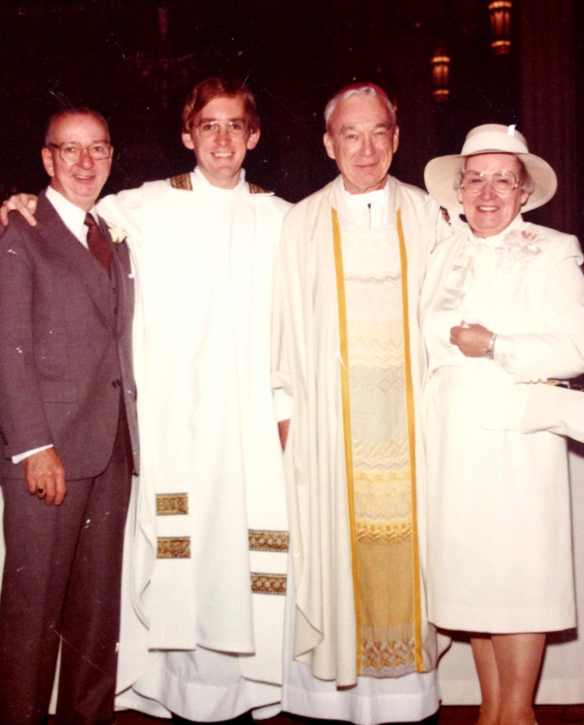
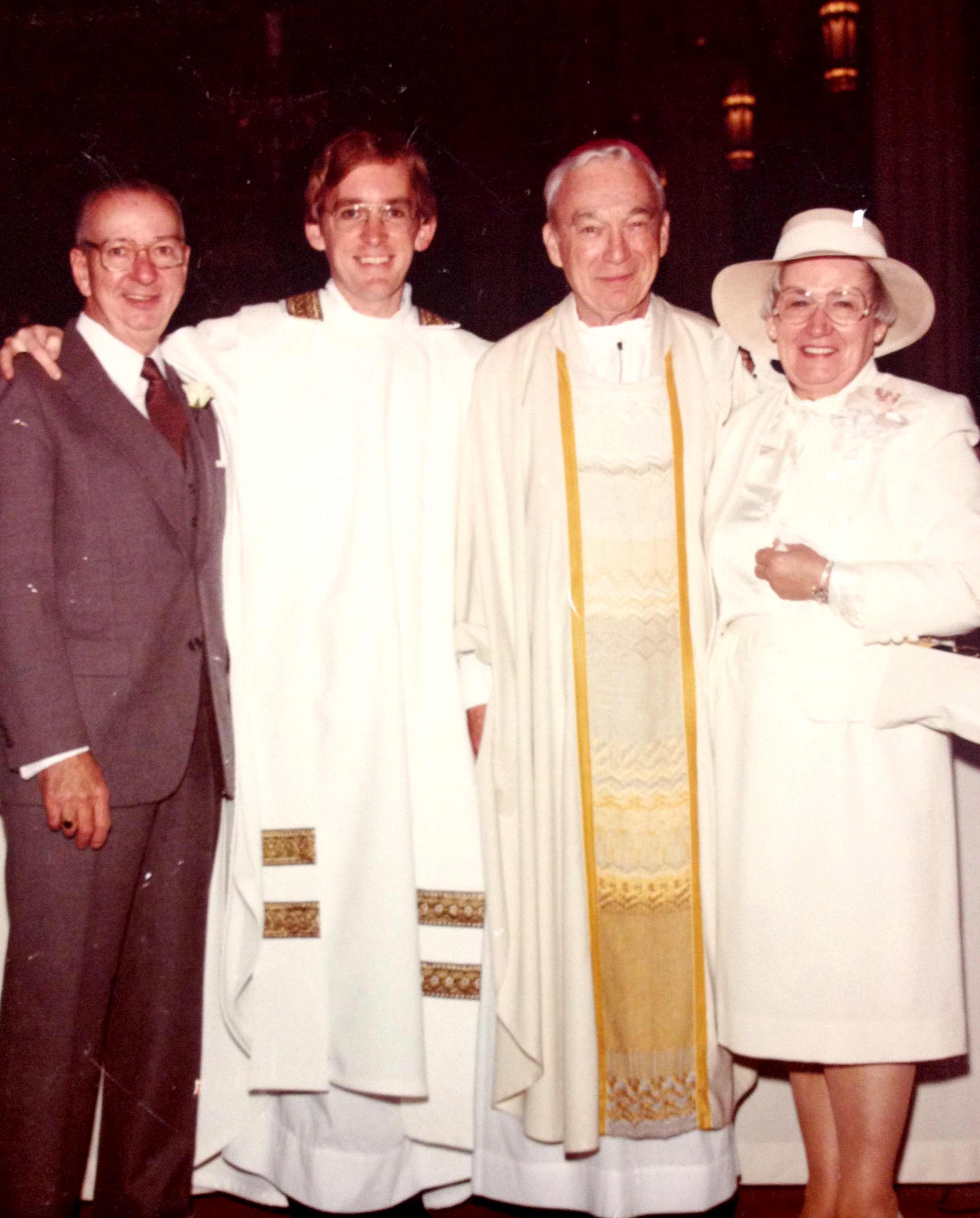
Albert John Raab, Jr. (1920-2000), Ronald Patrick Raab, C.S.C., Bishop William McManus, Rosemary Raab
Saving Face

Originally published by Ministry & Liturgy Magazine, October 2008
– PDF version –

I grieve my father’s face in Advent. He died one December in the cold Midwestern days. His mother also died years before in the same Advent month. I remember his expressions becoming frozen not from the weather outside but from the numbing effects of Parkinson’s disease. I cringe at the memory of his furrowed brow from his disappointments and regrets in his old age. His old-man face haunts my memory because his disease creased his spirit and shrunk his perspective on a life of hard work and dedication to his family.

My Advent heirloom can not escape my father’s long years of blank stares and the generational grief that has formed the life of my brother and me. Every year these days before Christmas remind me that I do not wait for a baby to be born in a manger. I long instead for a new expression on my own face that reflects God’s intervention in me now that I am not a lost child, not an heir of only loss and failure.

Every year before Christmas, I view similar faces in our urban parish that reflect subsurface suffering and losses that extend from parents to children. Many people who make their home outside often hide their longing to be connected to their past. To begin to unveil the stories behind some of the faces in our daily hospitality center, a parishioner initiated one late autumn the “Portrait Project”.

Our parish staff called upon a professional photographer and his students to sit with our guests and capture their faces on camera. When the day came to shoot the photos, some people cleaned up, and others asked if a friend could join them in the frame. Some women dabbed on makeup which so changed them I could hardly recognize their worn expressions. People felt excitement wearing grins and smiles because we wanted to capture their features, their present story. Their entire bodies lit up standing opposite a lens for the first time in years.

The finished photographs arrived back at the parish in the dark shadows of Advent. I viewed each face with a tender respect. The paper icons revealed the dignity and emotional energy of each person. Personalities jumped out from the 5 X 7 portraits, each face glowing off the golden background. From what was previously a group of wet, darkly clothed, anonymous poor who line up every day at our church door, I now see individual people. Their faces teach me to see them for who they are, with individual histories, with stories of suffering and being lost, stories that are not so different from my own as I might have thought before.

All the labels I put on others peeled away as I held that stack of portraits. I realized the variety of violent names and tags I put on other people. These human faces unmasked my own fear when I squeeze others into categories such as uneducated, smelly, or lazy. I saw in my heart the fear that keeps others at bay to attempt to protect myself from being in relationship with the real world, with people beyond my own history and comfort.

Advent reveals the faces of our ancestors because Jesus’ birth confirmed the dignity of the human condition. Our preparation for Christmas invites us to explore within our communities how we view the people around us. These four weeks stir our hearts for the God who lives behind each human face, underneath our expressions of unworthiness, fear, and loss.

When the photographs were distributed, volunteers wrote letters dictated by those who had had their portraits taken, provided Christmas cards, and addressed envelopes so people could send a loved one this very personal gift. One volunteer received this dictation, “Please forgive the wreckage I left behind. Someday I hope to come home.”

I believe if we are all honest in this Advent season, this sentiment may very well be ours. We stumble around our own conscience unable to fully believe that the Christ who once was human still heals and forgives. The Savior still is being born among all of us who need him the most. Without this faith, we will never see the true dignity of other people and never realize our own true home.

When I step out from behind my mask of success and authority, Advent reveals in me the hidden face of God. This grace opens me to a new power greater than myself and calls me to forgiveness, love and hope. The liturgies of Advent shake all of us out of our slumber and wake us to recognize the gift of people around us and our ancestors before us. My brow relaxes, my expressions become free, when finally I experience God’s saving face.


Triumph of the Holy Cross

Sung Response: “Redeem us, O God”

We lift up our lives through the Holy Cross of Christ ……. Redeem us, O God
We lift up our sorrow through the Holy Cross of Christ……

Protect us when we cling to revenge and violence………..
Transform us when hatred overtakes our actions…….
Teach us when we jump to false conclusions…………….

Lead us when we are afraid to follow……..
Inspire us when we fear our own talents…..
Sustain us when we turn from your mercy……

Unite us when we would rather go our separate ways…..
Clarify our thoughts when our thinking becomes negative and destructive….
Bond us together when prejudice tears us apart…..

Create life in our culture of death and destruction…….
Penetrate our stubbornness when self-hatred makes a home in us….
Discover new potential in us when we grasp power and authority…….

Sooth our hearts when illness claims our bodies…..
Rest in us when anxiety penetrates our souls……
Cleanse our consciences when sin overtakes us….

Refresh our hope when we are absorbed in doubt and guilt ….
Wash our feet when we stumble and walk away from love….
Believe is us when we no longer trust in your love….

Forgive us when we do not serve our neighbors….
Provide for us when we loose our employment…
Shelter us when become homeless…..

Recover our lives when addiction and compulsion overpowers us….
Touch us when we cannot bear our pain…..
Cry for us when we grieve those we love…

Weep for us when sorrow blankets our hearts and futures…
Anoint us when our bodies are too weak to pray….
Live in us when we are dead to ourselves….

We lift up all people through the Holy Cross of Christ….
We kneel in gratitude through the Holy Cross of Christ….
Through the Holy Cross of Christ ……..

The Yellow Pages

Originally published by Ministry & Liturgy Magazine, September 2008
– PDF version –

I proclaim the Gospel during Mass holding on to the lectionary for dear life. My right thumb presses tightly along the lower corner of the page while my left hand glides along the sentences yet to be read. I caress the written words because I understand my life depends on how I interpret those words which I yank out of my throat. After twenty-five years of Gospel proclamation, through translations changes and varied lectionaries, I ponder the yellowing marks on the corners of the pages left by my greasy prints.

My soiled fingers also leave the pages of my Liturgy of the Hours book brittle with shades of yellow decay. They tell the tale that I have been faithful to the same book since the fall of 1976. Those same marks tell the story that I am more faithful to Morning Prayer than to Evening Prayer. I pray more often at the beginning of the week rather than at the end. The dirty-yellow marks on the edges of the thin pages reveal the direction of my past faithfulness. They also reveal my end-of-the-week infidelity.

With little detective work even the sacramentary traces my path of prayer. Those same greasy-yellow marks creep onto even the newest books. Our parish sacramentary, however, tells a tale of years of true-to-life prayer because the cover is being held together by white masking tape. Inevitable wine spills mark the red and black texts with a few bread crumbs hiding in the folds of the pages. Many prayers have come from the written rubrics from this book evoking responses from the faithful listeners in the pews.

Now that I have some years of experience leading communities in prayer, I realize that a liturgical spirituality may be revealed in the ordinary, tangible articles of how we pray in any community. The commonplace artifacts of liturgy speak honestly and boldly, beyond the script set out for me in graduate school or the seminary, more profound than liturgical workshops and much more interesting than discussions on prayer being “liturgically correct.”

I form liturgical ministers by teaching them to act with this same sense of intentionality. I instruct them to caress the sacred texts with fidelity and love. Lectors hold on to the lectionary because they understand now after years of proclaiming the holy Word to our needy assembly, that we all need God. The readers grasp the edges of the sacred book because on some days many of us forget that God loves us. They learn that the written words in a book become something more than a history lesson. The lectors become instruments of God’s intentional love for all His people.

These readers in our worship may also get lost in the swirl of life’s indignities. When lectors lose hope, they proclaim the Word anyway. They hold tight to the holy words even on days when they do not believe they can manage life or believe in something more than themselves. They grasp the lectionary tightly because they never know how much other people need to hear the Word of freedom and healing.

My heart aches for the elderly woman grasping the written text with arthritic fingers because she remains so tired of caring for her husband with Parkinson’s disease. She cannot lift him out of bed and she barely has the strength to lift the holy book up to her fading eye sight. On those days she proclaims the Word in the hope that someday she may believe in God’s love again.

One day Bonnie stormed into the sacristy before Mass disheveled and frantic. Her puffy eye lids told me she had been crying and not sleeping. She screamed out at me that she could not take her daughter’s drinking anymore. She threw off her coat and complained that she was tired of always rescuing her daughter after late night drinking binges. Bonnie could not handle her verbal abuse and the effects on the family. Quickly before Mass started, I tried to suggest that her entire family needed help. I could not calm her. I forgot that Bonnie was scheduled to be the first lector for the Eucharist. Bonnie walked up to the ambo after the opening prayer, held on to the lectionary with both hands and proclaimed from Isaiah, “Can a mother forget her infant, be without tenderness for the child of her womb? Even should she forget, I will never forget you.”

On that day, Bonnie left her finger prints on the Scriptures and most of her worry as well. The Scriptures in turn marked her soul. These moments reveal to me that God’s presence in the Eucharist is real and sustaining. Her proclamation of the Word also showed me that seeds of faith are nurtured and brought to fruition by God alone. Our role is simply to be present to life honestly, lovingly and understanding that we cannot force faith on anyone. On that day I grasped the Gospel book with intentional gratitude, leaving on its white pages the prints of my pride and deep concern for Bonnie and her family.

Our extraordinary Eucharistic Ministers also carry with them this ministry of intentionality. They hold the Cup of Salvation with a firm grasp that understands their fragile place in life. Even on days when life erodes their self-esteem and purpose they stand on the holy ground of our worshipping community as if they owned the place. The ministers stand solidly on the earth, breathing deeply, and realizing God is using them for His purpose. The noticeable prints on the communion cups tell me the story of our minister’s grasp for dear life, especially on the days when they do not believe in God’s presence within their pain.

Jane holds the goblet, the miracle of Christ’s real presence, in her hands with great intention because she is allergic to alcohol. Even though she does not receive the Eucharist from that vessel, she holds on tightly to the fact that she must offer the cup of freedom to other people. She stands intentionally on this place of level ground where all people are equally treated. Jane looks into the eyes of each person who approaches her and invests her prayer in people she knows by name. Jane prays especially for people who remain bashful or timid or feel unworthy to look at her in the eyes. She prays through her addiction and into the hearts of strangers who need God in ways that are beyond her imagining. Jane prays at the sight of every lipstick mark on the purificator and every fingerprint left on the sacred cup. She realizes she holds the source of love to many who feel they do not belong in the church, those who cannot forgive themselves and for those who wait to believe again someday. She waits for the day when we are all in communion with one another.

Our ritual books reveal the marks of many other profound moments of prayer. There are a few pages dusted with black marks from my thumb from Ash Wednesday after dabbing burned palms on people’s faces. I leave the dark splotches on the pages because they remind me of the fragile lives behind the greasy foreheads that long for change. These people let go of previous conclusions about sin, division and heartache. Those black-grey ashes under my nails remind me that I will join the club of heaven with all past believers when my body becomes dust.

Every week in our urban parish we celebrate the Anointing of the Sick after the noon Eucharist because so many people long for courage. I pray for healing as I ponder the oil spots left on my chasuble or the sacred oil spills on the maroon carpet in the chapel. In those greasy sights I still see my friends who suffer from mental illness or are recovering from strokes and congestive heart failure. I pray focusing on the crusty oil dried on the glass container that stores the oil during the week. The container waits again for our friends who line up in a row so to be touched with sacred oil blessed by the Bishop. I celebrate every week wearing garments spotted from past encounters of this loving sacrament and touching the foreheads in their need of Christ today.

Even the pages from the ritual book of the Rite of Funerals are warped from blessed water. The crinkly pages from the opening of the funeral mass remind me of all the times I sprinkled baptismal water on the caskets of loved ones and strangers. The texts of this ritual book are blurred from the drops of water and tears that have flooded the opening rituals of bringing dead bodies through the church doors for the last time The pages connect me to people’s lives and the hope I will be sprinkled with new life when my body enters the church door for the last time. These old, worn, faded pages celebrate for me so many lives and teach me again to let go of everything I want to cling to that is not God.

I observe the pen-marked pages of the ritual book from the Rite of Christian Initiation of Adults which remind me of all the new followers of Christ. I celebrate my twenty-five years of starting ritual fires in parking lots and on street corners. I remember these years of blessing fresh water in bowls and fonts. I pray again in memory of drenching people with this holy water and ruining their hairstyles. The dark marks on the pages remind me of the sacred chrism which connects all believers from around the world. I wait for the day when our connection to human community gives way to the true unity in our places in heaven. In God’s Kingdom we will not have to worry about our hairstyles or regret our roles in the community or fret about the correct rubrics of our worship.

I believe we must ponder the finite, ordinary aspects of our prayer to find the God of infinite love and mercy. Every aspect of the liturgy must lead us into two directions, first to people’s hearts and then ultimately to the unbelievable mystery of God. Our community worship must shed light on the here-and-now and our future with God. If people or God are missing then our prayer becomes disengaged and meaningless.

As I look back over my years of ministry, I see that the ordinary and even the trite aspects of our common worship help make our prayer honest. This is one of the first fruits of living an intentional life, being honest with God. I see His mercy in the sweat stained purple stole hanging over the chair in the confessional. I understand courage pondering the tattered edges of our chapel’s carpeting. The fringe reminds me of my friends who pray in wheelchairs that get caught along the frayed corners.

When I am transferred from this parish I will leave behind the stains, tears, and smeared pages of all our ritual books. The books will outlive my stay and they will remind others that we all prayed here with gusto and grace. I am not sure the second grader stepping on the kitchen stool to read the Scriptures at Mass will notice yet the greasy marks on the pages. The confirmation student may not even be aware of the oil spilled on the ritual book. On First Communion day the children may not be aware that the adults are holding on to the chalices for dear life. They will in time, when God settles into their lives, find grace in the ordinary, connecting their real lives to fingerprints on the chalices and the smeared, yellowing pages of the lectionary.

When the Sun Shines on the Crystal Again

Originally published by Ministry & Liturgy Magazine, September 2008
– PDF version –

The autumn sun burns most deeply into my room. Every year the hours of daylight shorten but the rays of sunlight lengthen to stretch beyond the windowsill to the crystal vase on my bookshelf. My mother passed down the crystal heirloom to me when my grandmother died. The first arms of this light bring back fond memories of my grandmother and now my parents as well. I see my past more clearly every year when the crystal seduces the sun.

The soft light so often surprises me because I always forget it will appear again.  When I finally settle into the memories, the late autumn light also brings the darkness of my loneliness and the reminder of the rapid pace of my adult life.

I first noticed the friendship of the sun and the crystal when my spiritual mentor, Richard, told me he had AIDS. He sat at the piano bathed in this light and for the first time could not play Mozart because of his dizziness. This light cracked open a new experience for me of delicate conversations with a dear friend who was dismantling his relationships, discovering a soulful and physical dying. The devastating news wore in me a new place of vulnerability and fear.

A year after sitting at the silent piano, he died. I preached his funeral in autumn after sunset. The roles of friendship reversed that final year. I mentored Richard through extreme physical suffering and letting go of all life. Now every year, I begin to fear the earthly change of cold air, shorter days, and the autumn memories of all the dead. I frolic in reminiscences like a lost child in a pile of fallen leaves. I feel the cold regrets and pray through the emptiness.

This autumn ritual catches me off guard. Yet, my body senses every year the deep experiences of all the loss in my life. No one autumn contains all my fear. No one crystal vase receives every regret or memory. Grief lives within the confines of our earthly life forever. The human heart calls for this flow of ritual, the current of memories, and the natural course of sorrow to find healing.

Every parish community in autumn must prepare people to feel their grief and connect their memories to faith. There is no way around death. We must find new ways to ritualize what is most common, the fear of loss. We must sort out ways to help people ritualize within in their own families and circles of friends the grief that keeps us numb to new ways of relating to people.

Death keeps every community honest. However, we must risk telling the truth about life. Naming real issues and celebrating loss breaks through much of the narcissism and pretense that strangles most communities of faith. This truth cuts into our natural instincts of thinking that money, power, education and fear create community.

These are the days to create this awareness of loss. Gather grief counselors, professional spiritual directors and liturgists from your assembly to facilitate discussions for parish staffs and liturgy committees on death and grieving. When we build a network of openness and honesty about what is most important, a new vital energy emerges to help people deal with sudden grief, sustained depression and the release of anger.

Create forums where the Gospels ignite genuine discussions in preparation for homilies during the months ending the liturgical year. Connect elderly people in the parish and school parents by creating opportunities to pray in silence for the dead. Instruct school age children to write follow-up letters to grieving families a month after losing a loved one in death. Suggest that volunteering among the poor is a way for every family member to memorialize a loved one. Create an opportunity in the church lobby for parishioners to write down not only names of the dead but how they grieve them at home and with family members. Organize discussions and name rituals for home reminders that grief needs to be ritualized within everyday experiences.

Ritualizing our grief comes in the everyday awareness of living life. Members of our communities need the assurance that they are not alone in the simple ways grief becomes articulated and lived. We need to live an honest life to lovingly grieve other people’s death. I wait for this autumn, when I will be reminded of those I love in death, when the sun shines on the crystal again.