First Sunday of Lent, March 6, 2022: Cover Art, Column on Luke 4:1-13

Dear Followers of the Christ,

On this First Sunday of Lent, this passage from Luke 4:1-13 brings us into the desert, an image of these forty days of Lent. In this text, Jesus is confronted by the devil. He battles temptations for food, for power, and for safety. Jesus overrides all temptations. No evil is greater than the redemptive love of Christ Jesus. He is the reason we are entering into such a journey in the first place. 

During the Lenten season, we come closer to our identity in Christ. Jesus washes away our sins, doubts, and failures. We enter more deeply into prayer, fasting, and almsgiving to revitalize our faith and to sustain our commitments in the Church. However, these go far deeper than obligation. Prayer, fasting, and almsgiving reveal our ultimate surrender to the dying and rising of Jesus Christ. 

How do we enter more deeply into prayer this Lent? The Church invites us to renew our devotional life in Lent. We may pray the Stations of the Cross to understand the deep pattern of letting go and receiving, the death and resurrection of Christ Jesus. We may receive the Sacrament of Reconciliation with more intention or frequency. In Lent, we learn self-reflection and the consequences of our actions. We may also read the scriptures more frequently, reflect with people in a group, or attend daily Mass. We may pray with greater intention with our families at home at mealtime or at bedtime. 

However, Lent reveals the deeper reasons for prayer. We learn a profounder, more beautiful reliance on God. We learn more about our sin, our failures, and the walls that keep us from intimacy with God. Prayer gets us to the truth, both in our hearts and in our actions. Prayer also offers us the truth of God’s mercy, love, and redemption. Lent is not a time to slash our self-esteem or to think we are not worthy of God. Lent, in fact, is just the opposite. It is a time to reflect on our humility. Lent reveals the life that is really ours, to be more open to intimacy, love, and forgiveness. Lent is not a season to make us feel unworthy of God, rather it is a vehicle to deeper intimacy with the Divine. The core of our Christian lives is to discover Jesus Christ, and to commit our lives once again to the pattern of redemption with his passion, death, and resurrection. We are one in the Paschal Mystery. 

There is nothing that keeps us from God’s love, nothing at all. Prayer in Lent is meant to lead us into a deeper silence and awareness that forgiveness and mercy are real and forever gifts from God. We don’t change God’s mind in Lent. We allow God to change our hearts for the good in Lent. I invite you to spend time in silence and prayer during Lent. Be aware of God in your heart. Learn to settle into God’s love and do not be afraid. Prayer invites us into relationship with Jesus, an intimacy that is the core of life. 

Lent leads well beyond the desert. Lent leads us into the joy of belonging to Christ’s resurrection. Death gives way to life. This is our deep joy and profound place within the Church. We belong to God through baptism. Lent is a time to renew our baptismal call and commitment so that the Church may thrive. In the Lenten season we renew our lives in Christ, and we do so to serve the needs of the world. The beauty of Lent is ultimately about the wonder, joy, and salvation of the entire world. Baptism is not just about our salvation, but it is a vehicle for renewal, love, and service to all humanity. We shall rejoice at Easter within our personal and common prayer. Life in the desert gives way to forgiveness and peace in this beautiful and glorious world. 

God give you peace,

Fr. Ron Raab, CSC Pastor
Conference at the University of Notre Dame: Accountability, Healing and Trust 2022

I am a panelist for this conference on sexual abuse. On Friday morning, I will speak with two other preachers on, “Preaching in and for a Wounded Community.” Here is more information about the conference:

Conversations in Theology, Psychology, and Law for the Life of the Church

March 3–5, 2022 

University of Notre Dame
McKenna Hall Conference Center

This conference will explore practical strategies to increase accountability, promote healing, and rebuild trust in the life of the Catholic Church in the aftermath of the clergy sexual abuse crisis. Its focus will be on the needs of local parishes, their leaders and staff, including educators in Catholic schools. The conference will also explore the intersection of parish life and the formation of ordained and lay ecclesial ministers in seminaries, dioceses, and Catholic universities. Scholars of theology, psychology and law will present recent research on these issues in conversation with those working in ministerial settings who have developed approaches and practical programs to address the needs of Catholic parishioners, students, and Church leaders during these challenging times. 

CLICK here for more information

I wrote this to prepare my own heart for my talk and presence at this conference:

Creed for Preaching Among the Traumatized                              

I believe Jesus born in a cave, cries for us

In the darkest places of human anguish

I believe the Holy Infant welcomes childhood wounds

Where truth is illumined, and cooing is soothed

I believe the Holy Family fled their land to protect

Our trafficked children who feel uncomfortable standing on earth

I believe Jesus confronted evil under the hot sun and

Still crushes evil in our deserts of being unloved

I believe Jesus drenched in the Jordan rises with hope

For us drowning in rivers of self-blame

I believe Jesus reached for the hand of Simon’s mother-in-law

To reconcile families tormented by emotional disease

I believe Jesus touches our eyes to

Wipe away generational tears of unlived lives

I believe Jesus heals the leper because

No pain in us is untouchable

I believe Jesus circled men holding accusing stones

To heal the weight of emotional and sexual abuse

I believe Mary wept at Jesus’ cross

To teach us to stand among forbidden suffering of loved ones

I believe the Disciples carried Jesus’ body

Burying our abuse in a cave of hope

I believe Mary Magdalene’s testimony finds a home

In vulnerable hearts that ache for tenderness and truth

I believe Thomas who touched Jesus’ nail marks

Gives us permission to expose our wounds to one another

Eighth Sunday in Ordinary Time 2022: Cover, Reflection on Luke 6-39-34

Dear Followers of Jesus,

Luke 6:39-45 invites us into deep self-reflection. We are to ask ourselves about our own blindness as we try to lead others. We are to take note of the wooden beam in our eyes as we struggle with the splinter in our brother’s eye. We are to ask ourselves whether we are a good tree bearing good fruit or a rotten tree bearing rotten fruit.

Luke’s gospel reveals a path of deep conversion. We must find this grace in our hearts. The spiritual journey must include self-reflection and honest prayer. We cannot use prayer to make us look good to others. Prayer is not a vehicle to put other people down. Religion is not a club we join. Prayer calls us into love. It changes us.

We come to rely solely on the mercy of the Father when prayer becomes a way of life. The human heart is where real transformation happens. In other words, religion is a way of seeing God and humanity. We must learn to see the world with justice, love, and compassion. We must first look at how we are blind to our own actions.  

Today’s gospel challenges us to reflect on our spiritual blindness. We can easily point out the defects of other people. Jesus challenges us first to look at our own motivations, sinfulness, and insecurities. We must face our own lives with honesty. Learning to truly see ourselves is the work of a lifetime. We must be honest about how life has hurt us, our disappointments, and our failures. Jesus calls us into love so that we experience it in our own darkness. When the path of life is illumined in the light of Christ, then we can learn to see other people more clearly. The plank in our own eye must be removed before seeing others as God sees them. 

We begin the Lenten season this week. Today’s gospel is a beautiful start to this season when we take time for self-examination. We all ache to be people of integrity. We all want to cultivate goodness in our hearts so to become a tree that bears good fruit. This gospel invites us into becoming people who first know the healthy love of God within us. Then only after understanding what truly gives us life, we then can pass this love to others. 

The tree in this gospel leads us to exploring the Cross of Christ. The Tree of Life is the place where real fruit is grown. We learn to die to ourselves in the same pattern of our Savior. We die to self so to rise into full bloom in his life on earth. Each of us shall bear good fruit when we are immersed in the beauty of God’s love and mercy on this earth. 

A good person out of the store of goodness in his heart produces good…

God give you peace,

Fr. Ron

Seventh Sunday in Ordinary Time 2022: Cover, Column on Luke 6: 27-38

Dear Followers of Jesus,

Luke 6:27-38 offers us a line-by-line script on how to live faith. If you remember the gospel last week, Luke tells us that God’s love brings us together on equal ground. This is a place where we can look each other in the eyes and live in the possibility of harmony. The common ground of God’s grace is a great reminder as we listen to this gospel for today’s Mass.

This gospel passage offers us a line-by-line way to live on this common ground. In other words, each statement of Jesus attempts to break down the obstacles we have toward others. For example, the gospel says love your enemies, bless those who curse you, give to another your tunic, do to others as you would have them do to you. All these requests of Jesus teach us to rely on his grace. We stand on solid ground when we finally realize our faith must teach us a new way of being in the world. We are to live on the ground of faith and mercy, bringing with us a life that welcomes even our enemies. This is difficult at best. This gospel reminds us that all these things can be a way to deeper faith if we allow them a place in our hearts. 

The gospel goes on to invite us to live God’s mercy in the world. We are to stop judging others. We are to stop condemning. We are called to forgive. These are a few of the core issues Luke has for his community that teaches them how to live faithfully. Living out these requests also teaches the community that something new will happen. Grace will flood their lives. Acceptance, abundance, and all good things will flow into the lap of those who are willing to surrender to God and to live in faith. 

Even though we are to live without the expectation of repayment, Jesus offers us the notion that not all good deeds will be lost. The Father will offer an abundance of hope for all people. In other words, the good that we do helps create the common ground for wellbeing, compassion, and forgiveness manifested in each person’s life on earth. The ground will be firm in faith when we break down the obstacles of life that keep us apart.

As we move through these first weeks of Ordinary Time, the gospels offer us a glimpse of what Jesus can do for us, and his authority on the earth. When we learn to love ourselves and our neighbors, we continue his journey to explore his authority in our very lives, in our activities, and in our interactions with other people. 

Soon we will enter the Lenten Season. This gospel may be a good blueprint for us to find our way to break down walls that keep us apart. It may be for us a good place to start thinking about how we live forgiveness, generosity, kindness, and justice in our lives. This gospel is a place for genuine conversion and change when we believe the ground on which we stand, even with our enemies, is a place of surrender and profound grace. 

“For the measure with which you measure will in return be measured out to you.”

God give you peace,

Fr. Ron Raab, CSC, Pastor

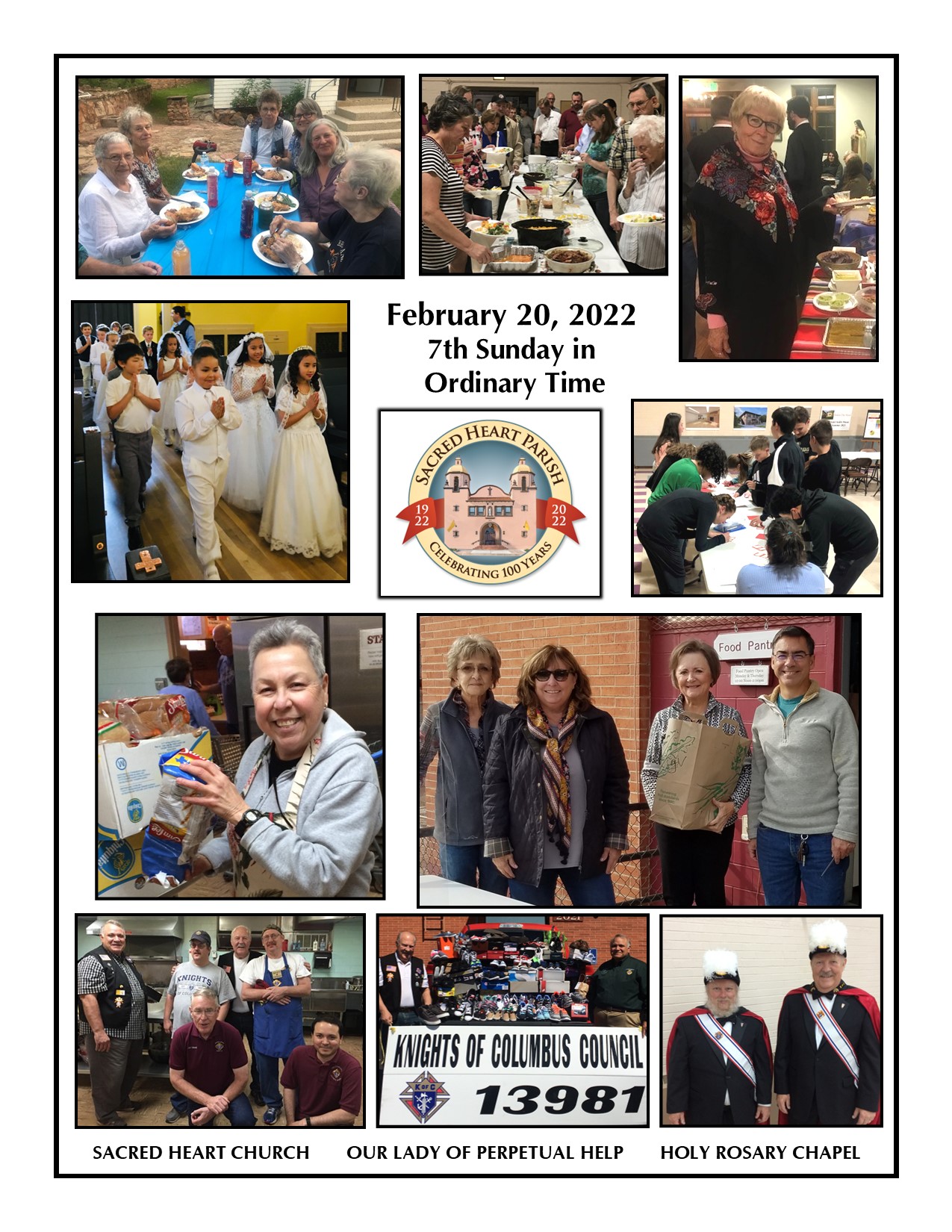
Sixth Sunday in Ordinary Time 2022: Cover, Column on Luke 6: 17, 20-26

Dear Followers of Jesus, 

In Luke 6: 17, 20-26 we pray with Luke’s version of the Beatitudes. Luke’s desire for the poor to know the promises of Jesus is clear in his interpretation. In the opening sentence we learn so much about how Jesus is portrayed in this gospel. I think the opening sentence is really all we need to know.

The opening sentence of today’s gospel is, “Jesus came down with the twelve and stood on a stretch of level ground with a great crowd of his disciples and a large number of the people from all of Judea and Jerusalem and the coastal region of Tyre and Sidon.”

So, Jesus gathers the twelve on level ground. This is quite the contrast to Matthew’s version of the Beatitudes where Jesus is on a hillside speaking to a vast crowd. In this text, Luke desires that Jesus comes to the people with his presence and message. Jesus desires to see people on an equal footing where there is no power or prestige. The setting for the message that Jesus gives begins on level ground where people can understand that Jesus is also there for them. There is no false power, no inequality, no submissive response since Jesus and his words are authentic and true. The ground is equal love. The ground is stable, real, and genuine. The words of the Divine are offered on solid ground for each hearer. Jesus also places his twelve among others, such as the large number of people from various nations. The words of Jesus have equal weight for every nation and people. His message becomes a message for the world. 

The words of Jesus have equal weight for all people. Jesus then lifts the poor to an equal ground with other people. “Blessed are you for the Kingdom of God is yours.” This simple sentence is the essence of Luke’s gospel. Luke desires to lift every person brought down by poverty, prejudice, insecurity, ill-health, misfortune, and emotional disease to the promise of an eternal heaven. The Kingdom that is usually seen above people or in the next life is now available to the least, to outcasts and sinners, and to the poor of every nation and tribe. The rich with money, prestige, advantage, education, or anything that is plentiful, will also have to know that they stand on the same ground as people who need many earthly things to survive. On level ground we see the face of Jesus and look into the eyes of our neighbors with love and fidelity. 

There is an equality in the Kingdom. I have come to know this in my own life and ministry. In fact, the greatest teachers in my priesthood have been folks who know they need something greater than themselves. My teachers have been people who understand how to surrender to God, to know God from the depths of the human heart since they have been so bruised in life. I have spent years finding my grounding on the earth among people who teach me how to stand in the gifts God gives me and every person in every nation and time. The surefootedness of this gospel setting is the place where we all can find new life in the Kingdom of Heaven revealed directly here on earth in the person of Jesus Christ. 

Rejoice and leap for joy on that day!

God give you peace,

Fr. Ron Raab, CSC, Pastor

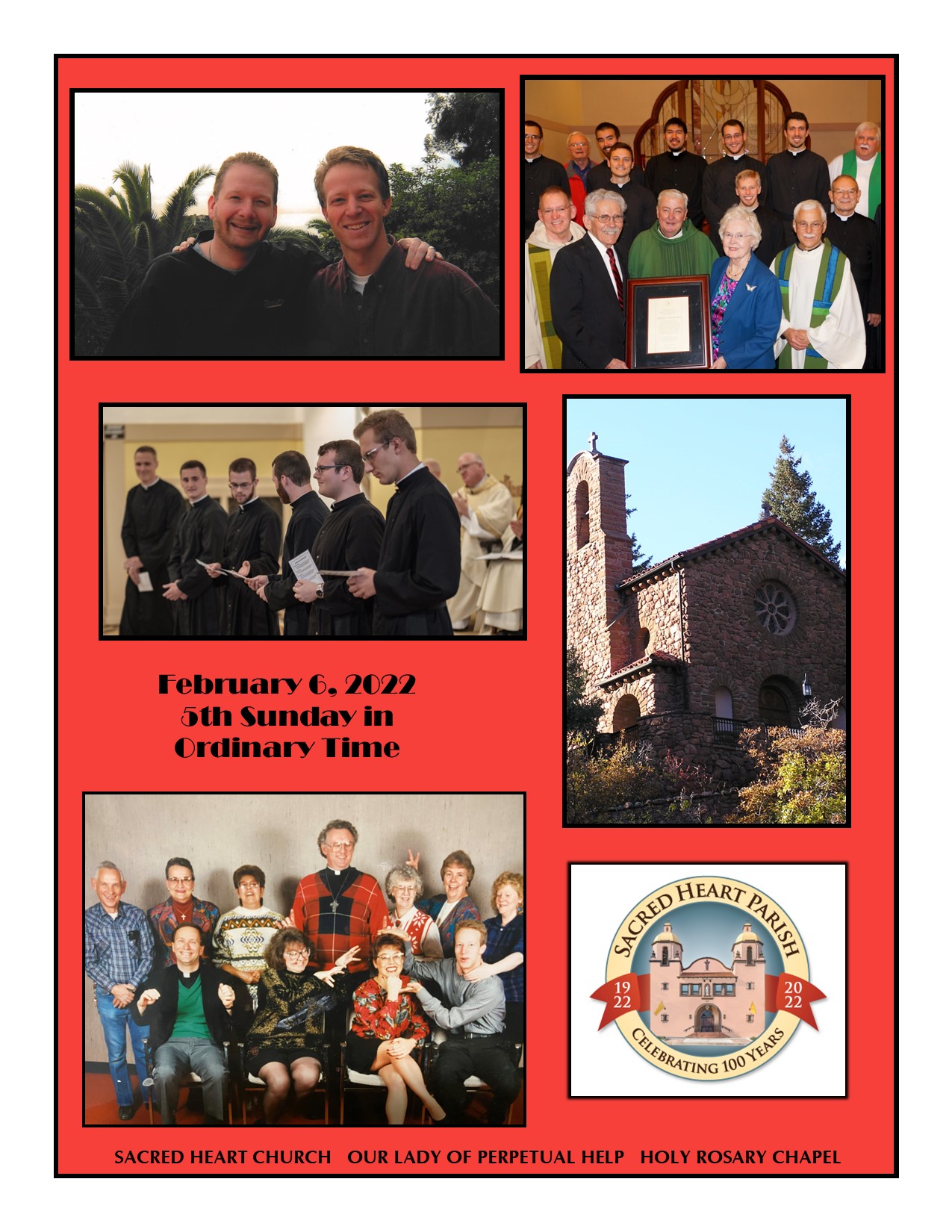
Fifth Sunday in Ordinary Time 2022: Cover and Column on Luke 5:1-11

Dear Followers of Jesus,

Luke 5:1-11 is a text with deep meaning and power for even our day. Jesus is among a crowd that is pressing in on him. Jesus took advantage of an empty boat so that he could teach the crowd with some perspective. He taught the word of God from the boat. The boat already becomes a place of hope. On the insecurity of the water, Jesus reassures Simon and others that he is a rock, a place of safety and a place of trust. 

Jesus meets Simon directly in his place of work, on the water that yields a living for Simon and his family. On the boat, Simon knows well the workplace. He understands the ins and outs of being a fisherman. He knows intuitively where the fish are and where they are not. Simon is in charge on these waters. Simon knows how to fish and how to sustain the work to make money for his family and their survival. 

After Jesus’ teaching, Jesus tells Simon to put his net into deep water and lower the nets for a catch. Now, you can just see Simon’s exhausted face. Simon must have been really frustrated because Jesus was invading his territory. I can just see Simon rolling his eyes at Jesus. He knows the water and the fish. He is exhausted and just wants to call it a day. Instead, something inside Simon knows that Jesus has a message for him. I want to know how the Holy Spirit worked in him at that moment. What convinced him to listen to Jesus and not his own tired body and rather deflated spirit? Somehow, a light went on in Simon. He decided to listen to Jesus and so he cast the net into deeper water.

Then a visible miracle appeared. The net was full of fish. Simon’s eyes must have been as big as saucers. Listening to Jesus worked out! Simon could hardly pull his big catch of fish into the boat. Simon called other fishermen for help. The boat was so loaded, it was in danger of sinking. Simon fed on the beauty of his trust in Jesus. He surrendered to the beauty of Jesus’ request, and it worked out.  

So, I wonder what we can learn from this simple scene? In the center of our lives, we know our routines, how to make a living, how to sort out our day, our time, and our work. We are often tired, exhausted, and spent from being in charge and working our way into another day’s routine. Can we learn what Simon learned? Can we trust our lives to Jesus no matter how we want to control our lives and our work? We even want to control our lives of faith. We want to make sure Jesus is a sure thing before we are willing to cast a net or a job or a career in his direction. 

This simple scene teaches us to surrender to God. We, too, must learn to listen. We must learn to trust Jesus. We must learn to let go of our preconceived notions about life and just toss our nets into deeper water. This is where Jesus’ abundance is. This is where Jesus’ love is… in letting go of our control, our pride, and our predicted outcomes. 

Simon will become Peter. He will be the Rock. He will be given the Keys to the Kingdom. In this simple work-a-day scene, we see Simon trusting the voice that is inside of him… the voice of Jesus who challenges us beyond our imagining. Simon will be given even more responsibilities. He will be catching greater things than fish. 

God give you peace,

Fr. Ron Raab, CSC, Pastor

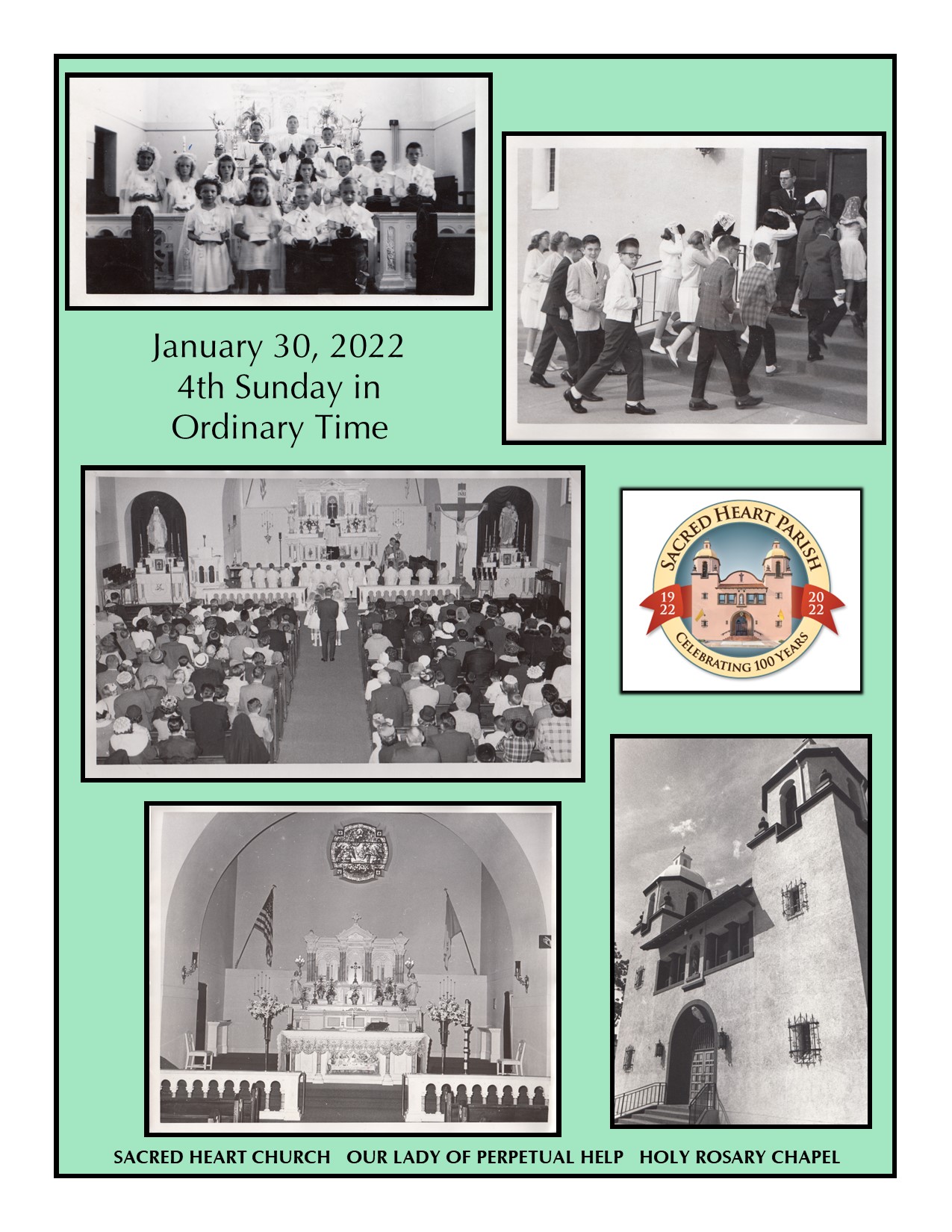
Fourth Sunday in Ordinary Time 2022: Bulletin Column on Luke 4:21-30, Cover

Dear Followers of Jesus,

We read Luke 4:21-30 in today’s liturgy. This text is a continuation from last Sunday. It invites us into the place where Jesus is establishing his spiritual authority. It took more than just words for him to demonstrate to his people that he was truly from the Father. Luke places him in the synagogue reading from the scriptures. 

This text points out that, “all who heard Jesus were amazed at the gracious words that came from his mouth.” This sentence is worth much reflection. Already, Jesus possesses in his body, in his rich voice, the authority of the Father’s love for the world. He was part of the Trinity that revealed his relationship with the Father and the Holy Spirit at his baptism. 

Here, Jesus feels grounded in the love that will compel him to service, to healing the sick, and to opening people’s hearts. Here, his feet are planted firmly on the ground of tradition, on the earth, on the shoulders of the prophets before him. Here, he will enter the mystery of the people around him, the blind, the lame, the weak, the hopeless. Here, he is steeped in the scriptures, readied for what will come, even death on a cross. 

In the opening weeks in Ordinary Time, each of the gospels tells us of the stories that open the door to the rich authority he has in the past that opens new paths for the future. It is the same in our era. Jesus establishes his authority from the Incarnation by healing our souls, calling us deeper in the richness of his mercy, and allowing us to view the hope for other people’s lives. It is important for us to realize that when we gather at Eucharist, we are not there to get what we want. We gather and pray so that the authority of God is realized within us, that God’s activity is stimulated in our empty hearts, in our prayers for people in need and our vision of how life could be in God. Our hearts bear the mystery of his authority when we get out of our own way and surrender our pride and our ego to his holy and rich name. 

When prayer opens us to the mystery of Christ, we then are amazed like those who first heard him. If we pray only to get something for ourselves, we will be disappointed. Prayer is not a commodity. It is not something that we check off our spiritual list to get to heaven. Prayer is not about our authority, our initiative or our doing; it is only God’s grace within us. Prayer is not something we do, but something that is opened in us by God. Our lives in God are simply amazing if we can get out of our own way, out of the way of our control and authority.

We also hear a text from 1 Corinthians 13:4-13 in this week’s liturgy. This text explains the mystery of love. It is also a blueprint for prayer: Love is patient and kind, not inflated or pompous. It bears all things. It endures all things. This sacred scripture helps explain the mystery of Jesus’ presence in our lives and a call to deep prayer. Love is the reason for our prayer, not obligation. Love is the purpose of our surrender to God, not our earthly need. Love is the reason for Jesus’ authority in our lives. In love, we stand among our ancestors who were amazed at the gracious words that came from his mouth.

God give you peace,

Fr. Ron Raab, CSC, Pastor

Out of Our Minds with Love, Published from Give Us This Day, January 2022

Reflection for January 22, 2022

Out of Our Minds with Love

Open our hearts, O Lord, to listen to the words of your Son.

Jesus challenges us. We may easily think Jesus is out of his mind when he asks us to forgive our neighbor, to unite in racial justice, and to behold the beauty of every life. He overwhelms us when he reveals to us that life is not ours to control.

I have never held an infant, my own flesh and blood, on my chest, two hearts beating as one. I can only imagine such intimacy, such tenderness. However, I have held the stranger dying from wounds inflicted by an enemy. I have listened to a mother attempting to explain the pain of losing a child. I have helped a mentally ill, homeless man who would not stay clothed in winter months. I have listened to a father who lost his child in addiction. I have waited with parents who ached for a word about a son who was trafficked for sex.

As believers, we wait and work and pray for laws and opinions to change concerning abortion. People may think we are out of our minds. This imitation of Jesus must be our life. In the meantime, we show the world around us that we mean it, that we are converted by our understanding of what life is and what it can be.

The Incarnation is our hope. Living in the human body is redemptive because Jesus died and rose for us all. Every breath of every person is holy, and we cannot control outcomes or our future even though others may think otherwise.

Open our hearts, O Lord, to listen.

Fr. Ronald Raab

Ronald Patrick Raab, CSC, is pastor of Sacred Heart Parish in Colorado Springs. Learn more at http://www.ronaldraab.com.

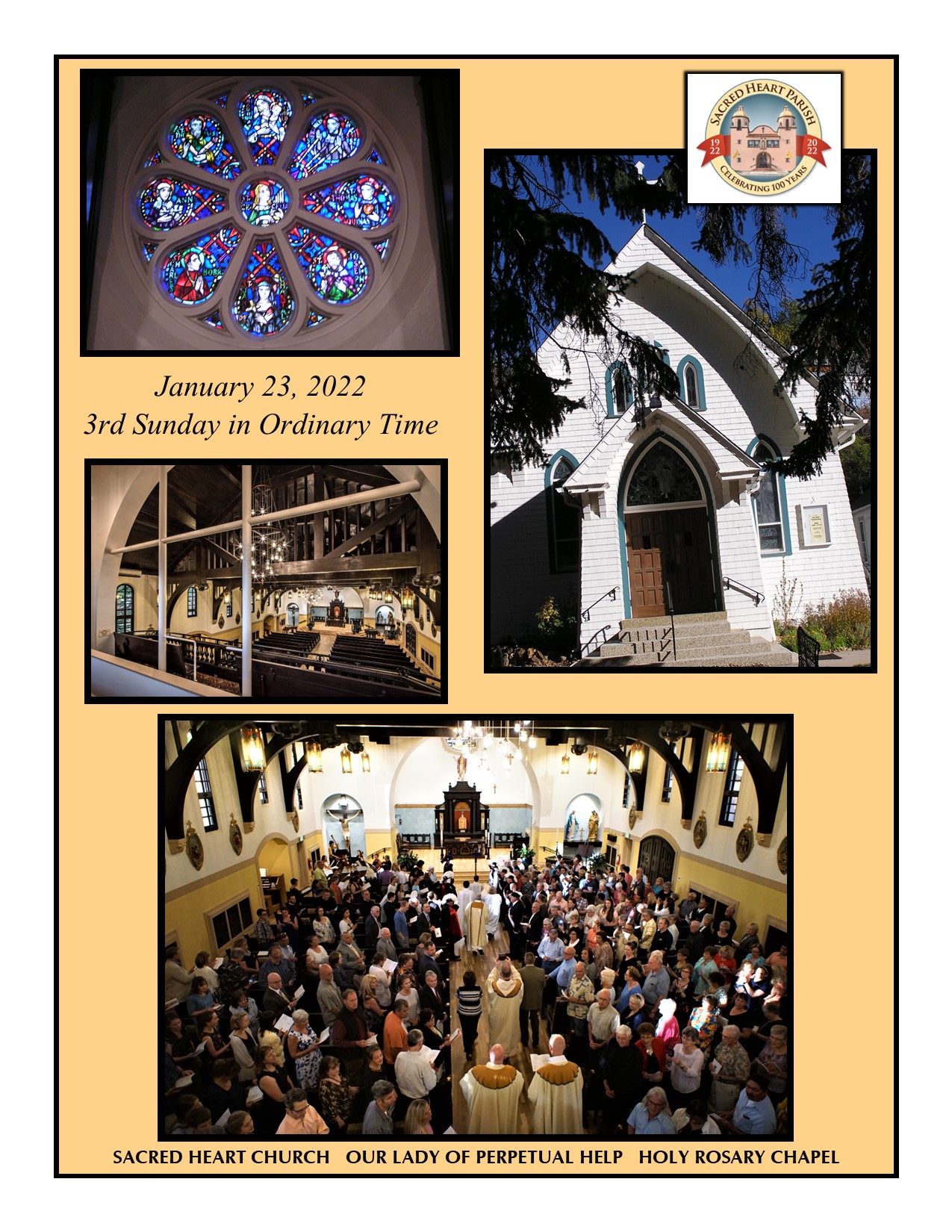
Third Sunday in Ordinary Time 2022, Reflection on Luke 1:1-4; 4:14-21

Dear Believers, 

Today we hear the beginning of the gospel Luke 1:1-4; 4:14-21. We hear from eyewitnesses of the stories of Jesus, our ancestors in faith. In the beginning of Luke’s commentary, Jesus goes back to his homeland and back into the synagogue to pray and to read on the Sabbath. 

The scroll from Isaiah from which Jesus reads is, “The Spirit of the Lord is upon me, because he has anointed me to bring glad tidings to the poor. He has sent me to proclaim liberty to captives and recovery of sight to the blind, to let the oppressed go free, and to proclaim a year acceptable to the Lord.”

Imagine this scene for those who first saw Jesus and heard his voice in the synagogue. They had no idea what was to come, how he would embody those words, how he would become the message in his death and resurrection. Imagine how their hearts must have burned with hope and longing for the coming of the Messiah. In his eyes, they saw hope manifest. 

Of course, the gospel is written many years after the events of Jesus’ ministry and life. So, the gospel sets up what is to come in the story. Jesus becomes this promise. He is the Anointed One. He is the freedom we have all longed for in our lives.

In the opening weeks of a new church year, perhaps we can learn to listen to the scriptures in a new way. In the Mass, when the gospel is proclaimed, it becomes the Real Presence of Jesus. This Real Presence forms us as individuals and as a church community. It is so important to our lives of faith that we listen to the Word. The Liturgical Year and the gospel proclamation at each Mass both teach us how to live in the world and how to become hungry for God, how to need God and how to serve our neighbor. 

I ask you to consider reading the gospels and all the scriptures before Mass. We can’t understand the gospel from only hearing it at Mass. We must become familiar with the images, the stories, the characters, the overall arch of the story of Jesus’ passion, death, and resurrection, to enter more fully into the Mass. The Real Presence of Jesus in the Mass is in the gospel proclamation, in the elements of bread and wine which becomes his Body and Blood, and in the lives of the baptized people in the pews. Read the stories, open the scriptures, and enter the scene of how the characters interact. After all, we become what we celebrate at Mass; we become the Body of Christ on earth. 

The scriptures help us understand the person of Jesus Christ. I always use the example of the Good Shepherd. We can memorize Psalm 23. However, we need to have a relationship with the Shepherd. There is a difference in memorizing a story and fully knowing the Shepherd in our lives. We can hear the gospel, but it will make no difference until we know the person of Jesus Christ. 

As we begin hearing the Gospel of Luke in the opening Sundays of Ordinary Time, we also know that Luke is writing for his community that is poor. He desires to lift them up in the story of Jesus. He desires healing for their lives. In this context, the opening scene of Luke’s Gospel is so important. We too, come to Mass not just for our own benefit, but to pray for the world, the poor, the prisoner, the hungry, those whose lives are the result of unjust systems. 

We should all take to heart the closing line of today’s gospel, “Today, this Scripture passage is fulfilled in your hearing.”

God give you peace,

Fr. Ron Raab, CSC, Pastor