Foot Crossing

Originally published by Ministry & Liturgy Magazine, March 2011
– PDF version –

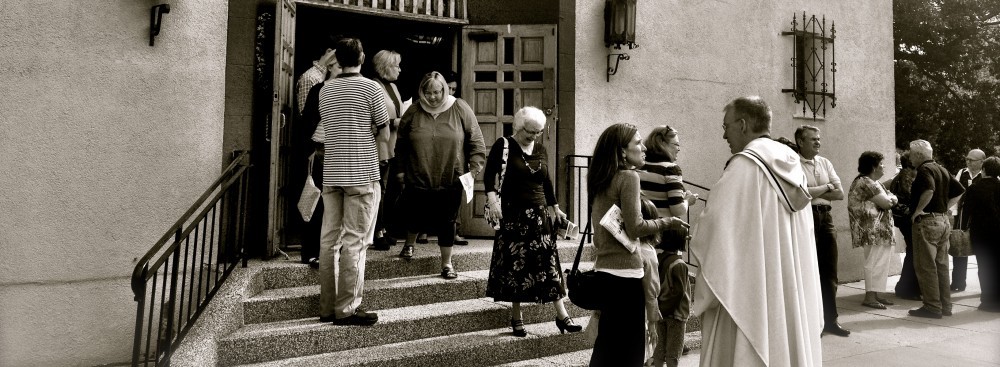
Every weekday morning, more than 100 pairs of tired feet cross the threshold of our parish building. A newly homeless couple trying to find resources for survival stands on their weary, calloused feet, waiting to enter our hospitality center. A man drenched from the morning rain and reeking from alcohol limps into the familiar lobby, hoping to get a dry pair of socks and a jacket. A heavy Vietnam War veteran wearing an unbuttoned shirt and feathers tied to his long hair waits for a new pair of shoes to fit his swollen, infected feet.

People’s feet tell the stories of homelessness and disease. Some of our guests carry within them deep secrets of how they landed on hard times. Others may be silent about their past physical traumas or how they have abused drugs. They may even try to hide their need for food, companionship, or a new pair of underwear. Our volunteers and staff understand that people often do not want to admit their vulnerability. However, people cannot hide their homelessness, illnesses, and defenselessness when our nurses and volunteers deal with people’s sore, filthy feet.
Foot care ministry
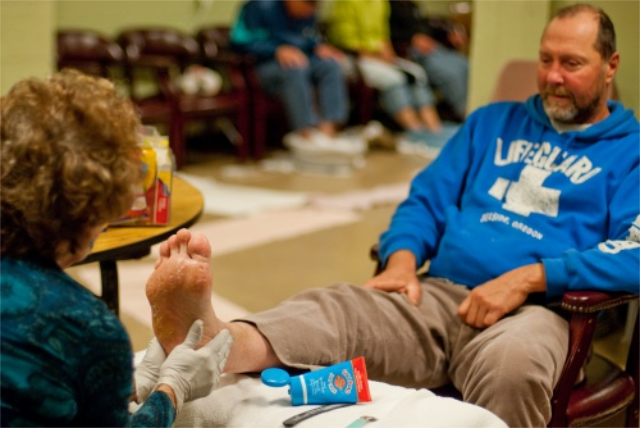
Every Wednesday in our hospitality center at the Downtown Chapel Roman Catholic Parish in Portland, Oregon, the staff and volunteers provide foot care. This once-a-week offering affords people an opportunity to make sure their feet are given proper medical treatment. This ministry began not with the notion of medical assessment and management but with the ancient tradition of foot washing and welcome.

Roy contacted us nearly a decade ago from a suburban parish. He inquired about offering sessions on centering prayer for people surviving poverty. Roy told our staff that he had already facilitated groups in local jails and also various groups of people living with HIV/ AIDS. He wanted to pass on what he himself had discovered in his own life: the deep and abundant love of God. Roy quietly spoke his own story to our staff of his years of wretched anger and hatred toward family members. He told us that his hardened, heated life had been transformed with prayer. Roy assured us that God was still healing his relationships with his wife and children. He was also the foster father of more than a dozen at-risk children. So the members of the staff agreed to his request for offering a time of contemplative prayer among people who live outside and who suffer the many issues of poverty.

After several months of facilitating group prayer, Roy came back to our parish staff with another request. He and his wife longed to discover why Jesus washed his disciples’ feet. Roy said to our staff, “1 know that Jesus ate with his disciples everyday, but on the night before he died, he ate with them one more time and then washed his friends’ feet.” He said with an intense desire, “1 have to find out what that means.”

Thus Roy and his wife began our foot ministry. They welcomed people into a small room with gentle conversation and intentional hospitality. The couple was shy and intimidated at first as they provided soothing salts to soak putrid feet. They trimmed long, yellow toenails and provided clean white socks that they had purchased themselves. While they stooped before people with aching feet, they internally prayed for each person. Our foot ministry was born of a man who admitted to both his selfishness and to his life’s being completely transformed by personal prayer.

After several months of washing rank and sore feet, the couple came back to speak to our staff. The holy couple explained that they glimpsed a reason why Jesus washed his disciples’ feet. Roy quietly said to us, “I believe Jesus washed the feet of his beloved so to see their faces at a different angle, in a new light, in the intimacy of genuine humility.” Roy and his wife continued their service in their own lives by receiving two more foster children into their home. When the couple left our foot ministry, our parish nurse continued it. Today, Sharon and other volunteer nurses, student nurses, and other volunteers receive people on Wednesday mornings. Now the focus is not only to bathe people’s feet but also to provide more medical assistance.

Sharon provides soothing Epsom salts, healing lotions, and creams. The nurses look for deep infections and open wounds that will not heal. They know when to send our guests to a doctor or an emergency room. The volunteers fill plastic bins with hot water and sudsy healing salts. They invite people to soak their feet, and the volunteers enter into people’s lives through the stories of their feet. Sharon and others listen to the words people share and become attuned to their hope that someday homelessness, poverty, and addictions may also be soothed and cured. They wipe each toe with bleached towels, and each foot is examined and dried. They teach our guests how to care for their feet when disease and infection are present because of diabetes. They cut curly long nails and wipe scaly skin with care and concern. The nurses deliberately dress each foot with new white sweat socks.

We provide our foot ministry as an extension of our morning hospitality center because feet are the main source of transportation for many people living outside. Most of our guests cannot afford appropriate health care, and in most cases health care is not accessible to people living on the streets. We also provide this basic foot care because people live in the reality of Portland’s rain and cool weather all year long. Every day, people’s feet are not just damp but squishy wet. People come to us with prune~likeskin and yellow, tough nails. The rank smell of feet permeates our entire bUilding and lingers long into the day. People expose their secrets by crossing our parish threshold and offering theideet to be cared for by our volunteers.

Our volunteers and nurses enter into the mystery of Holy Thursday’s Mandatum every Wednesday morning. This ministry extends the mission of Jesus from the ancient liturgy of the Triduum. The Gospel of John reminds us that our foot ministry is not just a reenactment of the past but a vital ministry in our generation. The ritual gesture is neither fake nor meaningless in our community. Our foot ministry puts into daily action the call of Jesus to become people of hospitality, to enter into the mystery of people’s stories. Our foot care volunteers show us that intimacy happens when we see people’s faces from the perspective of love and service. People’s feet tell us stories, especially when we listen to them from the angle of looking up into their weathered, beautiful faces.
Holy Thursday foot washing
The liturgy of Holy Thursday invites people in every parish into the role of hospitality. The act of washing feet is still a sacred form of worship. Some parishes are quick to replace the foot washing on Holy Thursday with hand washing or shoe shining. These replacements seldom work; they do not bear the weight of the intimate act of exposing dirty feet to the community. Those other acts do not reveal vulnerability or suggest that people actually need God or the community for survival in daily life. Naked feet expose the Body of Christ in real need on Holy Thursday.

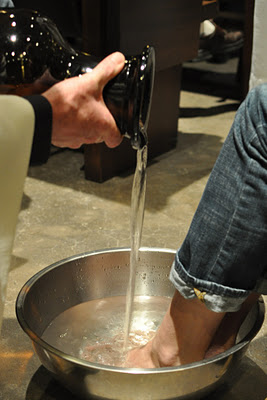
Entering into the mystery of the Mandatum on Holy Thursday evening invites every person into the earthy, human need for Christ’s redeeming love. Our parish sets up chairs in our three aisles before the liturgy begins. After the Gospel and homily, the people designated for “foot washing go to their preassigned chairs and remove their shoes and socks. Every person who attends this Mass should see naked feet. People should be able to enter into the action of this rite. The presider and servers process around the chapel to hold, wash, and wipe the human foot. The feet of our people are seldom beautiful, and their nails rarely (if ever) receive a pedicure. The smell of sour feet needs to be part of the rite – not perfumed, perfect feet.

The Mandatuin tells the story of every worshiping community and reveals how each one listens to the Gospel during the entire year. The stories of vulnerability told in naked feet connect to the ways the parish serves people. The foot washing is linked to a young mother wiping the bottom of her infant after a bout of diarrhea. Foot washing connects to the middle-aged man who washes the aging body of his father after he has suffered a stroke. A mother holds the forehead of a grade-school-age daughter vomiting in the toilet. A wife washes the blood off her husband after surgery. A husband cleans up food from his wife’s body after feeding her stomach through a tube. The Mandatum on Holy Thursday connects the human vulnerability we all face in caring for those we love with the public ritual of the church.

Foot washing on Holy Thursday reminds every parish community that we begin each ministry from Jesus’s call to prayer and service. Many parish communities resist entering into such filthy concerns, but we are all called to enter local hospitals with prayer and willingness to be changed by the suffering of our friends and neighbors. We are challenged dUring the Triduum to get our own feet wet from sweat by building a home or painting a garage. We must walk the extra mile to support fundraising efforts for breast cancer or AIDS. On Holy Thursday, we are reminded that we do all of those things because of the intimate love of Jesus, who offered his life for each person.

I recently asked Gwen, one of our regular foot washing volunteers,to articulate how this ministry has changed her. I wish everyone could see her in action, using few words as she carries tubs of sloshing water in our basement to prepare for our guests. She washes and bleachestowels, wipes up floors, and invites people to experience foot washing. These actions go well beyond her words. She said to me, “I appreciate the trust our guests develop in our abilities as well as limitations to provide for what they need.” She also added, “The community helps me to maintain an attitude of grateful living, to not take things for granted, and to do what I am able.” Gwen does so much without the notice of so many. Gwen can also be seen on Holy Thursday serving the Eucharist or reading the Scriptures.

Gwen’s daily actions guide our Triduum. Her actions, along with those of all of our volunteers, speak the reality of John’s Gospel. She and the many nurses and volunteers live the Mandatum every week. The connection of prayer and service is lived on Wednesday mornings in our parish basement. I do not have to look very far to preach the Gospel on Holy Thursday. The feet that cross our threshold each day are signs of the crucified Savior. Their smell reminds me always to walk with people who suffer.
Food For Friday

Originally published by Ministry & Liturgy Magazine, February 2011
– PDF version –

I crave the Eucharist on Good Friday. Perhaps my hunger is most pronounced then because Good Friday is the only day of the year in which the celebration of the Eucharist does not take place. Nevertheless, my hunger grows strong. I intellectually realize that the Body of Christ is distributed on this sacred day consecrated from the Evening Mass of the Lord’s Supper on Holy Thursday. Even with that knowledge, my hunger pains cry out. These liturgical arguments do not take the longing away from my soul. Nothing really soothes my hunger on Good Friday.

I experience great hunger on Good Friday because I pray with people who feed only on their loneliness and suffering on most other days of the year. People stream into our chapel at high noon on Good Friday. Some cross the line from the business world to the world of poverty by simply walking across Burnside Street. Some people stroll into the chapel after spending the morning in our Hospitality Center seeking clothing, a new backpack or clean pair of underwear, or just to be acknowledged by name. Some people stroll in recalling childhood memories of kissing the cross, inhaling bellowing incense and humming long Latin chants. Still others are curious about what Catholics do on Good Friday since Jesus stays on the cross all year long in our sanctuaries.

No matter the curiosity of some people or the memory of others, there remains a collective hunger for God. For so many people the hunger is bone deep because they are crushed by relationships of abuse. Many of our worshippers hate themselves for how their lives have turned out from serving in wars or selling their bodies for drugs. The collective hunger in our worshipping assembly settles into our common songs and liturgical responses. People remain emotionally empty and are looking for a way out of the circumstances that have brought them down. We are all hungry for God’s love and compassion on the day when we remember the death of Christ Jesus.

Several years ago our staff tried to address this common hunger in a different way during the Good Friday liturgy. We looked to a common item that we distribute each day that comforts people, yet a reminder of hunger itself – a bag of food. On most weekdays, our community distributes food bags to people living in single-room occupancy hotels. These single rooms are no larger than a parking space. People need food to get by because the monthly rent remains outrageously high. So our community offers bags of canned goods and items that can be warmed on a small hot plate.

These food bags are a reminder of poverty itself. They speak volumes about our inability to feed people’s needs. We only offer them a few cans and packages to survive a long month of high rent and skyrocketing food prices. The presence of these brown bags reminds people of their own hunger as they also symbolize our help for them.The bags tell the stories of severe loneliness that eats away at those whose lives are so tenuous. Living alone in a bug-infested, noisy room destroys one’s dignity. The bags of food become a sign of hope even in the midst of poverty and loneliness, of hunger and broken dreams.

We stationed members of our staff carrying bags of food on each side of the cross as people came forward to reverence the cross. We then invited people to also touch the bag, to pray for our starving neighbors and the millions of starving people around the world. Since so many people count on our bags of food this was a simple reminder that the Cross of Christ is lived here on this block amidst great hunger. Many visitors ignored the invitation; some did not get the connection to Christ’s presence. However, for many people the Cross of Christ and the bag of food became the source of real and substantial nourishment.

I realize this gesture would not work for every worshipping assembly. I know it may even confuse many people. However, I keep trying to discover ways that people in poverty can find their home in any of our worshiping communities. I am at a loss to feed people’s unfathomable and lasting pain. This is Good Friday. Only God can restore people’s lives and feed their deepest needs. This is the place in which I learn to trust God. The Cross of Christ is the place for real, rich and sustaining food even though I remain so hungry on Good Friday.


Lenten Rhythm

Originally published by Ministry & Liturgy Magazine, December 2010
– PDF version –

Several years ago I sat around the kitchen table in the rectory with a friend discussing our upcoming Lenten discipline. My friend taught Scripture at a Catholic university and she had been received into the Catholic Church the previous Easter. She challenged me to look at Lent differently. We stumbled on an image of Lent being a delicate dance, a relationship with God who longs to offer us healing and love.

Our discussions led us into this unique dance of partners that Lent offers us, sacrifice and grace, sin and forgiveness, contrition and change, suffering and love. We discussed our need to understand the Scriptures differently than in previous years. We realized that we needed to go beyond taking the gospels for granted, beyond our automatic responses and our usual patterns of praying and living them.

We then tripped over the idea to actually take a few dance lessons for our Lenten offering. Somehow I agreed to sign up for Tango, the most complicated dance of all. All of a sudden I found myself in a downtown dance studio just after Ash Wednesday. The instructor assumed we were a couple and just could not quite figure our motives for pursuing dance since neither of us was at all a natural.

We laughed more than we danced, we tripped over our feet more than we felt the rhythm of the music and we embarrassed ourselves during the three weeks of lessons. Real dance is more complicated than we thought, the footwork, the balance and the emotions. Our insights and discouragements led us back to the Lenten gospels to examine the relationships that are crucial in this season.

Jesus encounters a delicate relationship with the temptations of the devil. The two tango with the scriptures and God who promises support even when we dash our feet against a stone. We partake in this sacred dance when our two left feet deal with our sin against helping people who cannot stand up for themselves or feed their children. In Lent our relationships with overeating, drug use and extramarital affairs stop us in our tracks. Our convictions must speak louder than the din of anger, rage and neglect. Lent must be centered on the real pain of our people, the disillusionment of our spirits and the temptations of our emotions.

Lent calls us to get a new perspective on our lives. This perspective is not from a high mountaintop, but an inner awareness that a new vision is possible even for the most stubborn among us. Fear is the culprit we must all deal with in Lent. Dancing with fear can lead us to self-absorption, lack of love and empty relationships. Taking fear by the hand can lead us all into the love that God has for even the most callused or confused partner.

The woman of Samaria danced around her past in the presence of Jesus. He knew her heart and the real person behind the water jar and the fear. He named her real thirst, gave her hope to drink and sent her on her way to set others free. This marvelous dance at the well at noontime still shows us that Christ is in relationship with sinners, doubters and outcasts. This holy dance is for everyone. Christ opens up faith to be about people, not certainty, correct rubric or dancing the tightrope of politics.

Jesus still spits on the ground making clay with saliva in order for us all to see. We are still blind to teenagers having sex in schools, adults shooting heroin in movie theaters and gangs murdering our elderly grandparents. We still do not think people suffering homelessness are our sisters and brothers nor do we really see that children need food in an era of severe obesity. The Lenten dance takes us by the heart, puts spittle on our ears and courage in our souls.

We also realize we cannot dance in the dark. Jesus finally goes to his friend Lazarus and teases him out of the grave. Lazarus slowly moved his body in a divine dance, being released from the burial clothes and the bonds of death. We too, shake ourselves from even the fear of death in order to live a new life in Christ. We wake up to life when the bandages of fear are slowly unraveled in faith, hope and love.

Lent beckons the soul in a dance of new life. We discover our faith again in the radical rhythms of Christ’s death and resurrection. These gospels of the Lenten season take us by the hand and form in us authentic life.

This is the beginning of conversion for us no matter where we worship. Even though my friend and I did not master the Tango, I entered that year more deeply into the invitation that God takes the lead of every aspect of my life. The task for us all is to keep dancing in the love God offers each person no matter our stumbling, no matter our falling and no matter our lack of rhythm.


Blessing of the Doors

Response: “Bless us, O God”

This blessing takes place on the First Sunday of Advent at the 10:00am Mass. Father Ron welcomes people at the beginning of the liturgy and then invites everyone into the lobby of the building. Father Ron will invite everyone to silence then he will sing the litany.

For the homeless, seeking shelter, we pray…
For the forgotten, believing in companionship, we pray…
For the mentally ill, longing to be understood, we pray…
For the abused, hoping for a safe environment, we pray…
For the angry, expressing trust in community, we pray…
For the hungry, knowing God satisfies, we pray…
For the suffering, struggling to find compassion, we pray …
For the dirty, searching for acceptance, we pray …

For the new born and catechumens, walking toward the waters of baptism, we pray…
For the hungry of heart, desiring Holy Eucharist, we pray…
For the restless, hearing God in Scripture, we pray…
For the weak, discovering the Holy Spirit in Confirmation, we pray…
For the ill, touching God’s strength in Anointing of the Sick, we pray…
For the sinful, believing in the power of reconciliation, we pray….
For the lost, finding their place at God’s table, we pray…
For the marginalized, resting in a new home of peace…
For those asking for marriage, believing in God’s covenant, we pray…
For the dead, entering the doors for the last time, we pray…

For all the staff, volunteers and parish community entering the doors in faith and service, we pray…
For people afraid to enter…
For those peering into our windows…
For those urinating on our doors….
For those selling drugs at our doors…
For those prostituting themselves…
For those we ignore…
For those we can not help or console…
For those who sleep at our doors…
For those entrusted to God alone…

And for all God’s people…

(After the litany is sung, the presider will sum up the prayer with the collect.)

Let us pray:

God of our longing and source of life,
In these Advent days,
We wait to be awakened to your presence among us.

Help us welcome the lost and faithful.
Give us courage to hear the voices of fear.
Welcome the hungry to your table.

Bless these doors of entrance to our community.
May these doors remind us of our journey to the gates of heaven.
May these doors teach us how to welcome the lost on earth.

Bless these doors and open your salvation to your people.
We ask blessings in the name of the Father, the Son and the Holy Spirit.

Amen

(The presider will then bless the doors with holy water. After that gesture of prayer Father Ron will invite everyone to go back into the chapel to begin the opening hymn. The presider goes to the back of the center aisle and processes as the usual start of Mass.)

Advent: A Housing Project

Originally published by Celebrate! Magazine, November 2010
– PDF version –

My parents decided to sell our family home in Edwardsburg, Michigan the year after I was ordained a priest. Even though I had not lived in the cozy house for ten years prior to that decision, the news of my parents’ move devastated me. I was an adult having made decisions about my future, but my past seemed to be slipping out from under me. This charming white, renovated home sitting on the edge of Garver Lake was not just a commodity; it felt as if it were at the core of my identity.

I did not realize the emotional power of this piece of land and the house with the open view to the lakefront until I visited my parents just before they sold our home. I walked into the familiar setting to see cardboard boxes being filled with family heirlooms, everyday items and simple gifts I had given them. I saw antiques that my mother and I purchased at flea-markets through the years being carefully stored in bubble-wrap. The setting in which I felt safe, comfortable and protected from the world was being torn up and being sold to strangers.

I felt so alone walking through once-familiar rooms. I strolled through the home one last time before saying goodbye to my past and my parents. I ambled out of the house being stripped of so much of what I thought was important. Part of my angst was that I was being transferred for the first time as a new priest to a different state in the western part of the country. Not only could I not visit my old house, I would be living even further from my folks.

I stood on the driveway looking back at the house and wept like a baby. My mother held me and I felt my father’s arm on my back. This moment was a clear transition into adulthood. There was no going back on my decisions or my parents’ choices. At that moment I was a lost child, a homeless adult.

I remember my fear on the driveway especially during another transition into a new liturgical year. I hear the gospel writer Luke tell us again that people were speaking of the temple adorned with costly stones and votive offerings. Jesus explains that a day will come when there will not be one stone left on another at the temple site. I can imagine the fear people felt hearing these words. The temple was a place of security, community and faith. The panic of change overwhelmed many believers. Saying goodbye to my family home that last day crushed many stones in my memory of what I thought was secure.

As Advent unleashes its prophets’ voices, I hear Jesus spearheading the end of time. He commands our wakefulness. He cuts our ties on earth telling us that two men will be out in a field, one will be taken and one will be left. Two women grinding at the mill will be separated, one taken and one left. If the master of the house would have known when the thief was coming, he could have saved the home from robbery.

Panic must have been written on their foreheads and fear inscribed in their hearts. The one who was to come, the Messiah, first separates us from people we love. I still sleep with one eye open remembering the day that Jesus invited me to let go of the home of my youth.

John the Baptist insists that good fruit must be born in us from our change of hearts. This conversion remains costly as we try to adjust our attitudes about our human priorities and cling to God alone. The Advent wake-up call challenges even the most dedicated believer and the most sophisticated parish assembly to let go of earthly ties of safety and familiarity. This challenge for every individual and community comes at the time of year when we prefer to focus on our cultural nests of financial security, family relationships, warm memories and stable futures.

As I got into the car at my parents’ old house after saying goodbye, I wondered why I was really leaving. I questioned God’s plan for me to move, to live a vocation that would always separate me from my family and my past. I hear again in Advent the reasons for my growing up.

John the Baptist’s followers see that Jesus is healing the sick, getting the lame back on their feet and cleansing the lepers of all disease. They witnessed deaf people hearing and friends being raised from the dead. Jesus also preached news that the poor should always be housed in our concern and love.

I left the security of my childhood home to find my real shelter in God. Finding my life in God enables me to provide a home for others. Now I experience the need for people suffering poverty to always have good news preached to them. I see in other adults the devastation of childhood abuse and the deep grooves of generational poverty and loss. I let go of my childish ways to teach the illiterate, welcome the outcast and befriend the sinner.

Advent calls every worshipping community into adulthood.Our faith cannot remain in cozy corners of sentimentality or in rooms locked in the past. Our common faith is not a dusty antique packed away in our history. God calls our generation to open our eyes to people suffering mental illness and those who make their homes on the streets. We must show our children the real reasons why the Church exists. Advent calls us again to step into the unknown, to cling to God and to embrace people living on our cultural margins.

I celebrate now the gift of being an adult and leaving my hometown so many years ago. I still miss my deceased parents every day and I hold tight to the support they instilled in me as I left home.

As we enter into a new year of grace, some memories still stick to the pavement of our family’s former home. However, now as an adult I do not weep for my loss but instead grieve for people who have never known the security of love, self-worth and family integrity. I now understand my real home in Christ Jesus. He was born humbly on earth so we will know our relationship with heaven. Now I minister among God’s fragile who teach me to wait for a new earth where everyone will find our true home in Christ Jesus.

Advent Alarm

Originally published by Ministry & Liturgy Magazine, October 2010
– PDF version –

I wake up every morning to the sound of a dozen or more people talking as they line up around our parish building. Some people are still sleeping in the shelter of the inset near our front door. Others pack up quickly to claim a place in line for our morning hospitality center. Still others will sleep off the cheep booze from the night before.

Waking up to this reality wears me down, especially during the Advent season. Sleeping in a heavenly peace seems like such a dream. This reality seems more like nightmares for people carving out a warm place to be safe under mounds of damp cardboard. Others go weeks without slumber because of drug overuse. Other people sleep all day long due to deep depression. A few people sleep at our door with no blankets, no possessions, no cardboard box or coat or hat, just the concrete for a pillow.

The issues of sleep and waking up create real problems for our parish community. Every morning members of our staff come to work and nudge people out of sleep who are blocking the entrance to the building’s door. During the noon Eucharist when our offices are closed, other people obstruct the exit trying to catch a quick nap. Some people fall asleep in our pews during the noontime Mass – especially the corporate executives.

Advent is the time for people in every parish community to wake up to the reality that surrounds us all. Stay awake! This command in Matthew’s Gospel challenges us to wake up to our timidity toward people’s needs. Advent instills in our communities the deep passion for why Jesus came into the world in the first place. We need to get off our common couches and do something about how people are living in the world.

Advent calls us to claim the dignity of all people. We do this by waking up to the real paradoxes of our day. In this time of year when we overeat, we are called to acknowledge the billion people in the world starving for basic bread. In this time of buying, accumulating, fussing over the correct gifts, Advent scriptures should claim a new awareness of our possessions no matter in which community we live.

No believer wears camel hair and feasts on locusts anymore, but the Sunday gospels need to capture our imaginations about whether or not people have decent clothing. We need more than ever in a downward economy to rouse new attitudes about how we care for elderly people or the mentally ill person who needs a community in which to rest. As members of any worshipping community, we need to find new ways to welcome our homosexual children back from college, our cousin who lost everything gambling on the Internet and our uncle who walked out of his marriage. We all need to come to grips with our real possessions, our relatives and friends.

The Advent Gospels proclaimed in every parish shake us up to see that the lame walk, lepers become cleansed, the deaf hear and the poor have good news proclaimed to them. This is the time to rouse communities from the sleep of apathy and complacency. We need to preach about the needs of people living in poverty even though other people do not want to hear about it. We need now to invite our children into real and dedicated service so that they can witness the parish community doing something worthwhile. We need to invest not only in people who cannot make ends meet, but also in our children who are walking away from our worshipping communities.

Waking up is never easy, but the issue of our sleepy attitudes is the core of the Advent season. We open ourselves to real people because Christ became flesh and invested himself humbly in our human world. He took on the humility of flesh so that we could see all people as divinely loved.

A couple of Christmas’ ago a strong-willed, homeless woman, Bonnie, blocked our only doorway during Christmas Eve Mass. She piled up blankets and carts in a matter of minutes by our red doors. She opened containers of food and invited street people to join her. She smoked a few cigarettes and spoke loudly to passersby. She prepared a place to sleep while members of the parish sang carols and broke bread and shared the cup and proclaimed that Christ is born for people.

I walked out into the lobby as Mass ended and could not believe my eyes. No one could exit the chapel. I scurried to persuade her to move her belongings. Some parishioners helped her move her camp to the side of the building. Knowing Bonnie and seeing her bright eyes, I am convinced she held us captive in the chapel so we could wake up to the meaning of the Incarnation, the Body of Christ in our real world.

The Spirit’s Note

Originally published by Ministry & Liturgy Magazine, March 2010
– PDF version –

When I lived in Southern California, I walked every week along the promenade between Santa Monica and Venice Beach. The famous beach pathway is not only well-known for its sunshine and beautiful sand, but for all the colorful people who make their living selling unique items. Many people will also offer their small or individual talents in exchange for a money offering. Some people who are homeless ask for a donation of coins or paper money dropped in a bucket or hat or tossed on a blanket.

One Friday morning as I was making the return trip to Santa Monica, I noticed a homeless man blowing on a trumpet with a small, rusty coffee can at his feet. He caught my attention because his trumpet looked as if it had been run over by a truck. The smashed instrument looked unplayable at best. However, my fascination became centered on the fact that he was playing just one musical note. I stopped in my tracks and watched him play for awhile. I could not believe my eyes or ears. After listening to his one note concert for a few minutes, I moved on along the path back to my car.

After walking about a half-mile away from the horn player, I stopped cold. All of a sudden something dawned on me. I said out loud on the path, “Now I get it! It was not that he was playing just one note on his trumpet, the man had the courage to play his note!” I am not sure what the people around me must have thought when they heard me talking to myself. However, the new insight sent me racing back to the one-note gentleman to put some money into his rusty container. Unfortunately, he disappeared before I could make a donation to his flat trumpet.

As I look back to my experience on the beach that day, I hold this man’s courage firmly in my heart. He was so humbled by his communication with his trumpet, yet he was fearless in offering to the world what only he could offer. This note speaks to me now of our upcoming celebration of Pentecost.

On Pentecost Sunday, we will proclaim from 1 Corinthians, “To each individual the manifestation of the Spirit is given for some benefit.” This is manifest in my friend’s trumpet playing. The cumbersome note grasped my attention. It was not a note from a wealthy person, or an educated musician, a cleric or a teacher. This sound of belief and even longing came from a homeless man struggling for a dime in the hot sun.

Because I heard this man’s trumpet, I only imagine how many people I have ignored before him. His dire poverty struck me. I catch myself judging people for expressing themselves, or discounting their voice because of their background, their financial status or their lack of formal education. His humble poverty changed me and my belief about how the Holy Spirit changes me.

At Pentecost we must reconsider the people crying out to us who long for our attention, who beg to be heard, understood and accepted. We must welcome the teenager lost in the foster care system, the elderly suburban woman being abused or the manic housewife caught in addiction. If we believe that the Spirit is not dead, then we must be able to hear the Spirit in the lives of people we have ignored, shunned or have turned a deaf ear.

Many parish communities are paralyzed with fear faced with people in poverty. We have built fences around our schools, locked our church doors and protected our parish gatherings from strangers. We are called again this Pentecost to break free of our fear to welcome the lost, the smelly, the ragtag and the neighbor next door. Pentecost is not a past experience; it is an explosive grace capturing the hearts of people today, in our time and generation.

The Spirit still blows the hinges off our doors, still knocks us off our pedestals, still whips the wind out of our preconceptions and heals our hurtful judgments of one another. The celebration of Pentecost must create the Church from the lives of those who are waiting for a new dignity of life, for those who long to be accepted and for those who cannot wait to pray with us.

The golden age of the Spirit does not exist. We must not believe that a certain time in history is more infused with grace than another. We cannot get stuck in our parish communities believing that the Spirit was more present when we had the cute pastor, or when we had stricter rules, or when priests wore cassocks, or when we wore tie-die.

The gift of Pentecost costs us our thinking that we are in charge, that life will be better without the stranger or that our false security will bring us peace. Pentecost reminds us all as individuals and worshipping assemblies that our lives are a mystery and we are made lovingly in each note of the Spirit’s love.


Almost White Garments

Originally published by Ministry & Liturgy Magazine, February 2010
– PDF version –

I relish a moment of quiet in the chapel early on Easter morning. Every year at the Downtown Chapel I sneak downstairs, flick the switch of a single altar light and sit on the sanctuary steps. I relax in this sacred space as I have done in various other places in the 27 years of my priesthood. I savor the prayer and excitement, the longing and grieving, and the memories and peace of the Triduum. Every year the Triduum captures the real life of every parish, and I try to soak up the lingering hope of people who believe in the dying and rising of Christ Jesus.

Last Easter morning I tried to recall the names and faces of our friends who courageously extended their feet to be washed on Holy Thursday. I captured again the longing on those faces that ache for Jesus to truly wash them of suffering, poverty and loss. I remembered the fresh smell of the bleached towels. I heard again the gentle music, the soft singing. I felt again the anxiety of some people worried about publicly exposing their imperfect feet. The naked feet reminded me again of the sinners and outcasts who ache to be called among His followers. These memories help me realize one more time that everyone longs to be cared for and acknowledged as followers of the Christ who still washes us clean.

I remembered the folks who processed down the chapel aisle to kiss the cross on Good Friday. Some people from our hospitality center reverenced the cross for the first time. Other people who live on the margins of society hoped that this gesture could spark healing for them and for the Church. Still others sought out the wood because it has been a deeply significant ritual all the way from their childhood. Last year I sensed my own fear of death as I remembered an elderly woman who hobbled up to the cross. She died just a few short weeks later.

I also held up to the Divine my memories of celebrating the Easter Vigil. I smelled the Chrism now mingled among the bright aroma of the white lilies. I pondered the wax from the peoples’ candles now on the carpeting. I remembered the new fire capturing excitement on the faces of the Elect and the Word of God echoing our ancient history in our small chapel. I remembered the joyful faces of people renewing their baptismal commitments. The deep joy of new life echoed back to me on the quiet step.

My reminiscence ended abruptly last Easter morning with a knock on the chapel door. Julie, a volunteer and parishioner, arrived in the rain with a load of clothing donated from her coworkers. As I opened the door she said that a young man she encountered down the block really needed help. We invited him through the lobby doors. He was in his early twenties and told us he was just passing through town. He stood in front of us wearing jeans, a T-shirt and filthy, wet white socks. He explained that while he had slept in a doorway all of his possessions were stolen, even his shoes. He begged us for at least a pair of socks and any kind of shoes.

Julie and I escorted him into our men’s clothing pantry, a small dark space in our basement. I assisted him in sorting out some options for shoes. Julie ran upstairs to acquire a new pair of white sweat socks. His name was Chris, and the smell of booze covered him as he sat down on a bench to try on his new shoes. We chatted as he peeled off the soaking wet, filthy-grey socks from one foot then the other. His face lit up as he slowly put on his new socks and tried on a couple of pairs of shoes to find the right size. The donated canvas shoes fit him perfectly.

Julie and I engaged Chris in conversation as he relaxed on the bench enjoying the warmth of his new socks and shoes. He was alone, seeking a job, lost in alcohol, running from family issues and not sure he would stay in Portland long. He thanked us over and over again, for the new white socks and the shoes that felt even better than the boots he had been wearing.

As we were leaving the men’s pantry, Chris picked up his old white socks and tossed them to the side of the room into a small waste basket. I saw the gesture in slow motion, this young man tossing the white garments off to the side. I slowed down and took a second look at the socks in the trash can. I turned off the lights to the small windowless room, acknowledged his smile, closed the door and gave thanks for the Easter morning memory.


Line Dancing

Originally published by Ministry & Liturgy Magazine, December 2009
– PDF version –

On most early mornings I smell cigarette smoke in my bedroom. I smell it not because I smoke or that anyone in the rectory smokes. The hint of cigarettes slowly drifts into my third-story room from the line of people forming below my window. People line up every weekday morning at our urban parish to enter our hospitality center seeking the basics of life. The queue forms in rain or shine, in good economic times or bad, in every liturgical season.

The row of friends and strangers becomes a profound presence of prayer for me even before our hospitality center opens. Low-income neighbors come very early because they have to make decisions about how to spend their day. A young man living outside needs clothing; a single mother wants a laundry voucher so they both wait in our line. A man seeking a job interview steps into a row at another service center to perhaps get one of the few showers available for that day. A stranger in town waits in a different line to get a new identification card because all his belongings were stolen during the night.

Every morning I acknowledge my own lack of patience waiting in lines. I grow angry when I have to wait at a grocery store check-out counter. I feel offended when I have to wait in a restaurant to use a restroom. I have no patience waiting in line to fill my car with gasoline. Every morning in my room and office, the smell of cigarettes and echoes of conversations from below my window remind me of my own stubbornness, small-mindedness and lack of patience.

One of the major differences between when I wait in line and when my friends wait in line is that I will eventually get what I need. I will fill up my car with gas, pay for my groceries and be able to use the restroom in a restaurant. There is no guarantee that people below my window, no matter which line they stand in, will ever get what they need. Our parish can afford only so many laundry vouchers per day, only so many resources for clothing. Our one volunteer can only cut hair of a limited number of people on Wednesdays.

The queue under my window offers a profound reflection especially during the Lenten season. We begin this forty-day retreat with varieties of people in all parishes waiting in line. A cultural mix of people stand in the same procession waiting to be touched, to be given the ash-mark, the sign of the Crucified.

There are as many reasons for coming to Mass on Ash Wednesday as there are people. An immigrant family wants their foreheads to be smeared with ashes because they cling to traditions from the old country. A poor, elderly man believes that if he does not get ashes and dies during the year, he will not go to heaven. An exhausted business man strains to connect again with his childhood. Some gay members feel they can only be part of the sinful fringe of the Church. A neglectful mother feels genuine guilt. An unemployed couple has grown scrupulous and Ash Wednesday continues to make them feel unworthy. For some people suffering abuse, Ash Wednesday is one of the only days a year that they are physically touched in a positive way. Some believers want to keep all the rules, some want to be reminded they are still sinners. Most people want to be found in the love that God has for them.

No matter the reasons we all wait in line to be marked with the Sign of the Cross, every parish must welcome every person. No parish assembly can take for granted that people ache for new life and the security of belonging in the Church. We must not judge people whose reasons for being in the Church seem out of place, too liberal, too conservative or not authentic. We cannot judge folks who come to our parishes only once a year just to receive ashes. We must not shun people who sneak in the doors after Mass on Ash Wednesday and want someone to mark their foreheads.

The queue for the sacred ash mark should remind all ministers that we accept people struggling with mental health, regretful pasts, overwhelming poverty, infidelity, and insincerity. The line dancing down the aisles of our churches to begin the Lenten season teaches us that people have made real decisions to be there, to show up once again to be claimed by Christ’s death and resurrection within the Church.

Remember you are dust and to dust you shall return.

Testing the Waters

Originally published by Ministry & Liturgy Magazine, December 2009
– PDF version –

I was shocked at the results of my eighth-grade aptitude test. I thought for sure when I sat through the exam that it would easily reveal my future career. I figured my entire life would be outlined in this simple assessment completed even before high school. Instead, when I received the results, I knew my future was not going to be so easily defined. The test revealed only one area of real strength in the 90th percentile range, everything else was in the 20-30th percentile range. The graph revealed that “agriculture” was my strong point and that my identity would rest on these skills.

I glance way back to the eighth grade because I now have perspective on God’s grace and sense of humor. Life is not as cut and dried as I hoped as a child. I could never have predicted my life’s tests, sacrifices and wrong turns or the beauty of experiences and relationships. The irony of my life now is that I live on a concrete farm in an urban parish in downtown Portland, Oregon. I minister in an environment where there is no grass, no potted flowers, no home-grown spices, and no garden vegetables and not even visible soil. It is also the place where my faith is put to the test and where my life is open for surprise.

This test goes well beyond my eighth-grade exam. Each day brings new demands beyond my abilities. People here are embedded in fear about how to survive the unfortunate circumstances of their lives. They live with the hard lessons of economic pitfalls, horrible addictions and the blame that their homelessness is their entire fault. There is no time here for pretense or false piety. There are no black and white answers to issues of poverty. We have no patience in this setting for power struggles and stodgy clericalism. The soil here for ministry takes many years to plow. Reaping is in God’s hands alone.

The real test for me centers on my ability to let go of my preconceived notions of my strengths, weaknesses and even my ability to trust God. Here, God calls me beyond my imagining, leaving me clinging only to the everyday seeds of trust, fidelity and gratitude. My real life test is to live the life reflected in love of the sacraments and my commitment to the poor.

Working among the poor has tested my faith completely. Several years ago I had the idea of offering a day of retreat for people preparing for initiation from around the Archdiocese. I wanted people who are searching for identity within the Church to discover even for a few hours what I have found here. I wanted people to learn about God’s fidelity among people who have less than themselves. So for the past half-dozen years our parish has hosted this five-hour Lenten retreat at the Downtown Chapel.

The Elect and Candidates, sponsors and team members are offered the opportunity to assemble in our urban setting where ministry puts us all to the test. The purpose of the retreat is to expose everyone’s vulnerability in prayer. This emptiness or loneliness in God allows us to serve those who are physically poor. Our neighborhood in return then shows everyone on the retreat that we are all the same; we all need God no matter how much money, power or possessions we own.

Many of the Elect from other parishes are not exposed to how the Church responds to people on the margins of society. They have not yet experienced the social Gospel and have not been taught the lived history of social justice within the Archdiocese. I discover that people want to test out whether or not the Church is practicing what it preaches.

I begin the retreat asking people about their experiences of prayer. Many faces go blank because they fear they will give a “wrong” answer. I ask them not to test them, but to find some bedrock of truth to explore our relationship with God. After a few minutes of surface answers and polite conversations we get down to the real issues of life. A sponsor finally opens up about how difficult prayer can be when guilt suffocates her. A young candidate from the suburbs whispers that surrender is most difficult because of her addictive and controlling behaviors. A mother reveals that her prayer is still about the grief she carries because of her miscarriage. One man acknowledges his experience in prayer as, “Fits and starts.” A young woman struggles in her prayer to listen. An elderly woman admits her “Restlessness.” And an admitted addict speaks of prayer as “Only love.”

I struggle to authentically articulate how the poor teach me to pray. If I am honest about my own life, I know how I push God away and then complain that I do not belong within the boundaries of God’s fidelity. I hear every day from people who have next to nothing in life. However, they reach out to touch even the hem of Christ’s garment because that is so often their last possession.

To demonstrate this I ask someone in the group to “play” God. I usually ask a woman to stand up and I introduce her to the group as God. God who is all love, not just “sort of like love”, but all love stands with open arms. I walk to the other side of the room, face against the wall and yell out how we all live in our own power leading to addictive behaviors, isolation, and false authority. “God” calls my name and I slowly turn into the direction of love, finally being reconciled into the loving embrace of God who accepts me and brings me home.

I learn this honesty in new ways from people who suffer mental illness, severe loneliness and even from people who suffer unimaginable abuse. I speak as openly as I can about my own inability to be honest in my quiet moments with Jesus. My challenge in silence is to pray the truth of my life and not try to reach God from the emotional masks and even sin I hide behind.

I try to get across to our visitors that if we are going to serve authentically, we must pray with genuine hearts. We cannot serve thinking we have solutions to other people’s problems. We cannot be convincing if we have not first found ourselves in the embrace of God. Otherwise we become just a church of, “Do-gooders” instead of people who are compelled by God to serve others in the world.

My colleague from another parish, Deacon Brett Edmonson, fashions the vulnerability that has been raised in conversation into a model of prayer. He takes these seeds of honesty and opens people’s lives in the model of prayer called, “Lectio Divina.” This process of slowly reading the Scriptures offers people an opportunity to sink soul-deep into the consolation of the Holy Spirit within the Scriptures. The loneliness and fear that rises up from the discussions rests in the Holy texts, not to resolve the fear, but to allow God to receive it.

These contemplative frameworks for prayer suggest to people that our complications and worries are lived and supported in the mystery of God’s love for us. I watch people’s attentive facial expressions as they realize their prayer comes from their vulnerability. They seem to relax into God’s care when they confront these tender life issues. They rest in a new silence that seems full of insight when people make the connections to their own poverty.

These genuine discussions and silent moments seem to relieve the anxiety people had initially about coming to this urban area in the first place. Their eyes light up when their own questions of life are acknowledged and their fears are spoken openly. This creates a new place in the hearts of all the participants now to leave the confines of the parish building and go into the streets to tour our neighborhood.

Members of our staff lead the participants in small groups from our parish lobby into the streets to discuss the issues of our neighbors. Since our parish does not have any free-standing homes in our boundaries, we speak about the struggles people face within the single room occupancy hotels. We tell stories of people dealing with exploding numbers of bedbugs, over-priced rooms, lack of insurance, minimal health care and drug-induced violence. I tell stories of engineers, contractors and workers cutting corners in their work because the building they were building was to house the poor. People are introduced to the nightclub adjacent to the parish that plays music until 6:00am on weekends and are told of how the sound reverberates in my bedroom.

We walk with a new awareness of what the poor face every day and the issues so many people want to ignore. We stop in front of several non-profit organizations, similar to praying a public Stations of the Cross. We pause, tell stories and pray for the care the agencies provide. Slowly our friends on retreat realize the complexity of life for people who are homeless, addicted and mentally ill. Our participants speak of how they have been so blind to people around them and how their families still cultivate fear about poor people.

I explain on our pilgrimage that even one issue would be enough to speak about for our retreat. If we just focused on homeless women, the stories would be vast about the lack of shelters and care for women. We could spend days speaking about the horrific issues of domestic violence and how the women roam the neighborhood at night so not to be raped. We could spend the rest of the day speaking about the women who sit at night around the perimeter of our chapel building hoping to be safe.

When the groups end the pilgrimage they walk back into our building to debrief their new experiences in the chapel. There is a new silence, a hush of observations and insights that fill the space. Some bear the weight of the test with tears, with a new desire to volunteer, and a new realization that suffering must be surfaced in every parish community. One woman shared that her grandmother was homeless and that the walk around the neighborhood was extremely exhausting and painful. All along the way, reminders of her relative’s struggles pierced her conscience and pulled at her heart. She felt so much guilt because she could never fix her grandmother’s pain.

We close our day with ritual prayer. I speak to them about showing up with every emotion, tension, sin, heartbreak and joy to the Easter Vigil. I invite them to “show up” to the feast of the Sacraments, not only physically, but with every aspect of their lives. Then the Holy Spirit will heal what needs healing and open for them a new path of fidelity and love. They will be tested beyond their abilities, loved further than they can imagine, and called to serve in ways they least expect. We end our day with the Elect and Candidates standing around the altar and the sponsors and team surrounding them. We chant this litany of blessing for all people who will be initiated into the Easter Sacraments.

Response: Bless us, O Lord
In our waiting for love,
In our longing for integrity,
In our searching for hope,
In our striving to belong,
In our wanting to serve,
In our bridging the rich and poor,
In our working for peace,
In our serving the outcast and forgotten,
In our befriending the destitute,
In our speaking words of healing,
In our embracing the sick and marginalized,
In our walking with the tired and lonely,
In our committing our lives to others,
In our standing in truth and fidelity,
In our hearing the cries of the oppressed,
In our asking for forgiveness,
In our hungering for the Eucharist,
In our believing in the Word,
In our claiming your prophetic message,
In our calling to live Gospel justice,
In our daring to speak the truth,
In our living in community,
In our reconciling with our enemies,
In our renewing our Baptismal promises,
In our hoping to be saved,
In our calling to die and rise in Christ,
In our following the guidance of the Holy Spirit,
In our relying on God alone,
In our remembering of saints, prophets, martyrs and guides,
In our resting in your loving Kingdom,

Every Lent after the retreat I escort people to the red doors of our chapel to say goodbye. I believe God is continuing to test me through my fear and loneliness by planting seeds of new relationships. I stand in the doorway grateful for new people believing in love and listening to the Baptismal call to serve within the Church in ways we all least expect.