Sock Exchange

Originally published by Celebrate! Magazine, November – December 2009
– PDF version –

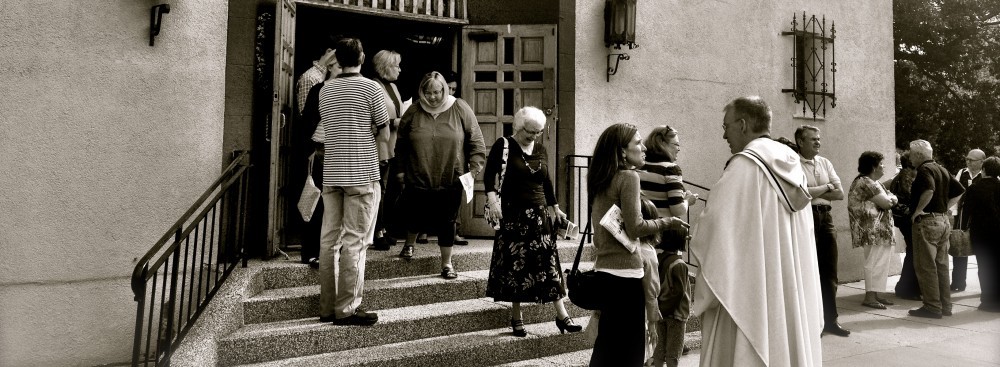
Preaching on Christmas Eve frustrates me. I never know how to reach the exhausted, “perfect mother” struggling to bring her newborn baby to Mass because her in-laws insist. The tired father drenched with worry over paying for the family’s gifts strains to hear the evening Gospel. The single relatives back from college often feel most alone on Christmas Eve. The aging parents grieve the loss of Christmas’ past and the recent death of their only daughter. Some people scurry into the church building at the last minute feeling their place is only on the margins of the community anyway.

Christmas evokes mostly tears of loss for me as I look behind people’s smiles and sugar-induced enthusiasm. Behind the red scarves and new neckties lies the reality of people often forcing their way into happiness and love. On Christmas Eve real life comes to the surface when we least expect. I uncovered this authentic life several years ago when I tried a different approach to preaching during the holy Eve of Christmas.

Before Mass, I wrapped three items as gifts to be opened during the homily. I carried the three gifts in a colorful shopping bag and explained I had just received these gifts and wanted to open them at Mass on Christmas Eve. I ripped open the first gift with wide-eyed enthusiasm. My childlike approach revealed a new teddy bear. I reminisced about our sacred memories as children and the holy bonds of family. I spoke softly that Christmas also conjures up memories of grief, loss and unhappiness with many people we love. The grace of Christmas heals the past and makes room for Christ to be born even in our brokenness and sadness.

The second gift revealed a bag of candy. I preached the sweetness of God’s covenant of love even in times of war and uncertainty. After I spoke about each of these first two gifts, I gave each gift to a different stranger sitting in the pews. What you receive as a gift, give as a gift.

I tore off the wrapping paper from the third gift which revealed a pair of nylon socks. The assembly laughed as my face fell and I muttered about getting such an ordinary gift. I told the assembly that the Incarnation demands a lot of work on our part. I explained that Christ was born on earth to reveal the divine and human dignity of all people. I held up the dark socks and begged them to serve people who long for such dignity. The socks called people to action to serve others who go without adequate clothing, food, shelter, purpose and relationships. Walking in the footsteps of the Crucified demands a life commitment for all believers. I handed the pair of black dress socks to a stranger, a stocky, older man sitting at the end of a crowded pew. His rugged features, deep wrinkles and sparkling eyes revealed a man who had obviously made his living working with his hands with diligence and care.

The Advent Gospels prepare us for this holy night. Our hearts cannot weary while we wait for the face of Christ. Anxieties must not catch us by surprise like a trap. Great signs and wonders will tell the story of redemption. After Mass I introduced myself to the working class, kindly man and his wife. She had suddenly begun to feel ill after everyone had left the church. The three of us sat in the pew for a few minutes until her heart felt better and she felt strong enough to leave.

Beware that your hearts do not become drowsy in waiting for the Lord. I was seeing before me a woman making crooked ways straight, waiting for Christ’s promise to be fulfilled. I saw in her eyes the readiness to see the salvation of God. Her heart was preparing to be birthed into eternal Light. I felt drawn to this couple. I knew I had given this man the socks for a reason. I could already feel in our first encounter that our relationship was only just beginning.

A few days later I received a phone call from the gentleman who received the socks. His wife was very ill and in the hospital. I raced over to the hospital’s Intensive Care Unit to find her entire family at her bedside. She looked up at me and whispered to her husband, “It’s the sock-priest.” A few days later she died in her sleep.

At her funeral, her husband walked into the church to greet me. He pulled up his pant legs and told me that he was wearing his new socks for his wife’s funeral. We hugged each other and we both wept in our newborn friendship. I heard the Prophet John’s words rattling in my heart. If you have extra socks, give them away. Stop hoarding possessions and give them freely to others. I felt deep within my soul the reason for the giving. His grief was now being aided with the parish’s presence. The socks had now become the instrument of healing. He would always remember and grieve over the Christmas his wife died. He would also remember the Christmas Eve the parish reached out to both of them.

Every Christmas and every Easter that followed, the elderly widower wore his black dress socks to Mass. After Mass he made a point of stopping me in the lobby, shaking my hand with one hand and pulling up his pant leg with the other. He greeted me with gratitude and with tears. I looked forward to those holy greetings each year, where kindness and peace embraced. The holy greeting was a reminder for me that God is still coming to earth to save us from ourselves.

I preach now on Christmas Eve with even greater sensitivity to peoples’ stories. I realize the sock exchange with a kind-hearted stranger will never be duplicated. So I strive to break through the cultural wrappings that hide the season’s love. I reach out to tired parents, the bickering relatives, the ill single man or the couple drowning in debt. Now I wait for the gift God gives me, this authentic life, in the apprehensive stranger with cold feet sitting at the end of the crowded pew.
Handwritten Texting

Originally published by Ministry & Liturgy Magazine, October 2009
– PDF version –

I watch people every noontime handwrite their prayers in a book near the entrance of our chapel. Parishioners and strangers pen thoughts, worries, and hopes for a better life on white paper in a simple black three-ring binder. People hope that God will soon respond. They wish that God could text them back.

There are no instructions, icons or lit candles or kneelers or holy cards, but people have come to understand that being present to this black book is an experience of the holy. These pages include a printed prayer for the ministry of our urban chapel and blank spaces to be filled in with personal thoughts and petitions.

This collection of prayers handwritten in Advent especially breaks my heart. There are no quick replies from God. These words on cheap paper, however, change my life. I read the scratchy printing of a mentally ill woman who begs God to release her boyfriend from prison. The flowery penmanship tells the story of an elderly woman praying she will receive money to pay her rent in the single-room occupancy hotel. The tiny print swears at God for giving the author mental illness. Some prayers I read beg for food and others echo a longing for the end of war. In small print one prayer storms heaven asking God to get rid of deep depression. No matter the penmanship or requests, these sacred cries open me up to profound prayer from the tragically lonely voices of people in poverty.

These prayers are written by people who have no voice in the world. Very few people listen to poor people with mental illness. The man sleeping at our front door gets no response from anyone in our society who can foster change. These prayers speak the loudest to our parishioners who work hard to build a community where people are welcomed.

I read the blue-ink prayers, petitions and expressions of anger and realize these prayers are words of prophets. God planted into the throats of the ancient prophets cries to help people remember the poor, the starving and the prisoner. The ancient reformers called people to look again at the needs of ordinary people. These prayers at our doorway call everyone who reads them to cultural reform and honesty.

Zephaniah told his people not to be discouraged, to live without fear and rejoice in God who loves His people. I hear the same from many of our parishioners who live outside and still rejoice in the smallest kindness. Jeremiah spoke out that the Lord shall be of justice and mercy. I hear this cry from friends who reassure me that they are cared for by God even when nights are wet and cold.

John the Baptist pointed his words and life into the direction of God and screamed his concerns to reform and to repent. These written prayers for me act as agents of renewal for our community. They beg us to rely only on God and to act quickly, lovingly and with integrity. These prayers alarm every community to wake up from self-concern, overindulgence, and needless materialism. The prayers of the poor activate my conscience, stir my anger, and show me only God is in charge. I feel all the injustices of the world in these simple prayers.

The prayer texts of the poor also remind me of the sins of the Church. These sins go deeper into communities beyond our small neighborhood. We can no longer ignore people who suffer mental illness or who remain caught in drug addictions. We must speak out of the reality of war when homeless veterans show up to write prayers in our chapel. We have a sacred duty to help men and women who sell their bodies for drug money. Advent calls us to provide shelter, food and hospitality because even the Holy Family was once in need. Our sins are embedded in the prayers of the poor.

I learn from these prayers that Christmas is for the poor. Christmas through its advertising, economic forecasts, and bottom lines so often promotes the notion that love is for only beautiful, thin and wealthy people. The voices of our friends living below the poverty level, in transitional housing or under cardboard huts along the street, must not grow silent in the dark days of Advent.

I read these black-book prayers with hope. They are written so all of us can eavesdrop on personal conversations with God and learn to pray more honestly. These Advent intercessions ignite my faith to work on behalf of people who need the basics of life. I know God responds to each prayer, not through written texts, but through the work of us all.


A Reading from the Prophet Bonnie

Originally published by U.S. Catholic, December 2008
– PDF version – Online version –

God’s messengers are often just as surprising as the words they bear.

Advent always opens me up. Just when I think I am in control of my life and ministry, I am confronted by the challenges of a new liturgical year. The prophets get under my skin. The gospels splash my soul to surprise and awaken me.

Never has Advent shaken my priorities as the year Bonnie camped out in front of the red doors at our urban parish. Our small chapel in Old Town, Portland, Oregon serves our low-income neighbors, our homeless friends, and people just getting on their feet after prison. Just before Thanksgiving Bonnie wheeled a shopping cart to the front door filled with her stolen treasures: picture frames and toys, extra sweaters and fake flowers.

Bonnie signed up for our hospitality center on her first morning in search of new clothing and a warm breakfast. Her boundless energy disturbed everyone’s routine in the small basement room. Suddenly our entire staff, volunteers, and the room full of guests awakened to her forceful presence. We panicked as she stuffed food into her pockets, paperback novels under her jacket, and rolls of toilet paper in her plastic bag.

Bonnie’s kleptomania unnerved the staff, her penetrating voice disturbed many of our shy guests, and her wiry presence evoked fear in me. Bonnie began her Advent journey by disturbing our entire operation.

She prayed during Mass on her first day with a voice that could stop a train, screaming out every liturgical response at the right time but with a dozen extra words. She threw off the rhythm of our common prayer so completely that the entire congregation stopped speaking. People erupted with complaints and tried to quiet her. Bonnie persisted with her prayer.

Many of us were left confused and bewildered in those first few days with Bonnie. She stirred up resentment among our neighbors, angered many parishioners, and even blocked people from entering our front door.

But I also began to notice something shift inside me. Slowly I opened my eyes to see her differently. I began to hear the message of Jesus in Mark’s gospel: “Be watchful! Be alert!” Bonnie shook me out of my own sleepiness toward people who suffer beyond my imagining. I started to interpret her disturbing actions and screeching voice as our Advent wake-up call, a real prophet in our midst.

She challenged our professional ideals regarding how we deal with crisis and how we try to keep order as we serve the poor. As the voice crying out in the desert, she echoed the words of Isaiah and John the Baptist to get our acts together and let go of our control. Bonnie was not going to let us get too comfortable thinking we were in charge of our lives or even of the parish. Once we all began to see her as a gift to us, she started to change our experience both of her and of the Advent season.

One day during Mass I heard Bonnie screaming outside the chapel. She was trying to stop people from stealing her things. When Bonnie started screaming, I saw one of our parishioners leap out of the pew to go outside. There was something about her scream that day that was raw and primal.

I felt deep sadness rise up in me. Bonnie was communicating to us that many things in our society are not right. Her haunting scream reminded me of all the ancient prophets who tried to get the attention of people to reform their lives and society. I heard in her scream the challenge to wake up and realize that addicts need shelter and sobriety, people need adequate housing, and the mentally ill need affordable medications. I felt in her scream the poverty of the world.

Bonnie also changed my perceptions of her loud responses at Mass. In the very predictable patterns of common prayer, I understood by her piercing voice that those who are marginalized by poverty or mental illness need to be heard. Mass could no longer be prayed on autopilot. We had to think about what, how, and why we were praying the liturgy. She made us think about our responses to the Word that was proclaimed. She halted us in the middle of blindly reciting the Creed. Like the biblical prophets before her, she was teaching us how to pray and live with new awareness and intention.

Bonnie still reminds me that most of the suffering around us remains hidden and secret. She helps me realize we all must take on the prophet’s role when disease, poverty, loneliness, and financial instability grab hold of our communities. People who suffer silently need the voices of the rest of us to speak up for the abandoned and neglected. The Advent season calls for courage and conviction to make faith real, inviting, truthful. Advent is a time to go deeper into our human condition, beyond the surface of relating to one another from our financial status or educational backgrounds or the styles of clothing we wear.

One day Bonnie approached a woman named Sally, who was born with one arm shorter than the other. Bonnie walked up to Sally and said, “Don’t worry about that arm, honey. When Jesus comes back, he will fix that right up for you!” Bonnie really believes in Emmanuel, God-with-us. She even voiced God’s consolation and joy announced in the prophet Isaiah: “Comfort, give comfort to my people, says your God.”

I thank God for our prophet Bonnie. Even though she washed her glazed donuts in our baptismal font, collected our hymnals in her shopping cart, and took hundreds of our plastic rosaries to wear around her neck, we all recognized that she carried Christ into our midst. She unstuck my notion that Advent is about the purple polyester fabric in the sanctuary or the flattened, artificial greens with faded, purple ribbons posing as the circle of life. She helped me break open the lie that Christmas is for the rich and well-deserving. God desires to be in relationship with all of God’s beloved.

Before Bonnie left our parish, she knelt down in front of the crèche on Christmas Eve. Several parishioners feared her kleptomania as she approached the newborn king. Instead, poised in prayer, she placed a clean, meticulously folded purple blanket in the small stable. It was her cleanest blanket, her source of warmth on the cold Portland streets.

I never realized I would find the birth of Jesus in the center of mental illness, homelessness, and my own insecurity. God gave us the gift of hope years ago in a small stable and continues to grace us with real human beings who teach us that faith is about relationship. I wait patiently for Advent this year to see if our prophetic sister returns. I wait for love again to awaken me.

Saving Face

Originally published by Ministry & Liturgy Magazine, October 2008
– PDF version –

I grieve my father’s face in Advent. He died one December in the cold Midwestern days. His mother also died years before in the same Advent month. I remember his expressions becoming frozen not from the weather outside but from the numbing effects of Parkinson’s disease. I cringe at the memory of his furrowed brow from his disappointments and regrets in his old age. His old-man face haunts my memory because his disease creased his spirit and shrunk his perspective on a life of hard work and dedication to his family.

My Advent heirloom can not escape my father’s long years of blank stares and the generational grief that has formed the life of my brother and me. Every year these days before Christmas remind me that I do not wait for a baby to be born in a manger. I long instead for a new expression on my own face that reflects God’s intervention in me now that I am not a lost child, not an heir of only loss and failure.

Every year before Christmas, I view similar faces in our urban parish that reflect subsurface suffering and losses that extend from parents to children. Many people who make their home outside often hide their longing to be connected to their past. To begin to unveil the stories behind some of the faces in our daily hospitality center, a parishioner initiated one late autumn the “Portrait Project”.

Our parish staff called upon a professional photographer and his students to sit with our guests and capture their faces on camera. When the day came to shoot the photos, some people cleaned up, and others asked if a friend could join them in the frame. Some women dabbed on makeup which so changed them I could hardly recognize their worn expressions. People felt excitement wearing grins and smiles because we wanted to capture their features, their present story. Their entire bodies lit up standing opposite a lens for the first time in years.

The finished photographs arrived back at the parish in the dark shadows of Advent. I viewed each face with a tender respect. The paper icons revealed the dignity and emotional energy of each person. Personalities jumped out from the 5 X 7 portraits, each face glowing off the golden background. From what was previously a group of wet, darkly clothed, anonymous poor who line up every day at our church door, I now see individual people. Their faces teach me to see them for who they are, with individual histories, with stories of suffering and being lost, stories that are not so different from my own as I might have thought before.

All the labels I put on others peeled away as I held that stack of portraits. I realized the variety of violent names and tags I put on other people. These human faces unmasked my own fear when I squeeze others into categories such as uneducated, smelly, or lazy. I saw in my heart the fear that keeps others at bay to attempt to protect myself from being in relationship with the real world, with people beyond my own history and comfort.

Advent reveals the faces of our ancestors because Jesus’ birth confirmed the dignity of the human condition. Our preparation for Christmas invites us to explore within our communities how we view the people around us. These four weeks stir our hearts for the God who lives behind each human face, underneath our expressions of unworthiness, fear, and loss.

When the photographs were distributed, volunteers wrote letters dictated by those who had had their portraits taken, provided Christmas cards, and addressed envelopes so people could send a loved one this very personal gift. One volunteer received this dictation, “Please forgive the wreckage I left behind. Someday I hope to come home.”

I believe if we are all honest in this Advent season, this sentiment may very well be ours. We stumble around our own conscience unable to fully believe that the Christ who once was human still heals and forgives. The Savior still is being born among all of us who need him the most. Without this faith, we will never see the true dignity of other people and never realize our own true home.

When I step out from behind my mask of success and authority, Advent reveals in me the hidden face of God. This grace opens me to a new power greater than myself and calls me to forgiveness, love and hope. The liturgies of Advent shake all of us out of our slumber and wake us to recognize the gift of people around us and our ancestors before us. My brow relaxes, my expressions become free, when finally I experience God’s saving face.


Palm Sunday Processional Litany

Response: “Redeem Us, O God”

You are the King of Kings….

You are life for the humble…..
You are hope for the poor…
You are salvation for the sinner..

You are home for the transient..
You are healing for the sick..
You are promise for the broken…

You are prophet for the meek..
You are peace for the anxious…
You are food for the starving..

You are love for the lonely…
You are servant for the helpless..
You are encouragement for the lost…

You are sustenance for the starving..
You are rock for the weak…
You are sacrament for the searching…

You are shepherd for the weary..
You are light for the restless…
You are comfort for the abused….

You are direction for the pilgrim….
You are forgiveness for the desperate…
You are truth for the incomplete…

You are rest for the disheartened…
You are spirit for the ill…
You inspiration for the disillusioned…

You are path for the rejected…
You are leader for the disciple..
You are redeemer for the dead…

You are the King of Kings…
You are the King of Kings….