Handwritten Texting

Originally published by Ministry & Liturgy Magazine, October 2009
– PDF version –

I watch people every noontime handwrite their prayers in a book near the entrance of our chapel. Parishioners and strangers pen thoughts, worries, and hopes for a better life on white paper in a simple black three-ring binder. People hope that God will soon respond. They wish that God could text them back.

There are no instructions, icons or lit candles or kneelers or holy cards, but people have come to understand that being present to this black book is an experience of the holy. These pages include a printed prayer for the ministry of our urban chapel and blank spaces to be filled in with personal thoughts and petitions.

This collection of prayers handwritten in Advent especially breaks my heart. There are no quick replies from God. These words on cheap paper, however, change my life. I read the scratchy printing of a mentally ill woman who begs God to release her boyfriend from prison. The flowery penmanship tells the story of an elderly woman praying she will receive money to pay her rent in the single-room occupancy hotel. The tiny print swears at God for giving the author mental illness. Some prayers I read beg for food and others echo a longing for the end of war. In small print one prayer storms heaven asking God to get rid of deep depression. No matter the penmanship or requests, these sacred cries open me up to profound prayer from the tragically lonely voices of people in poverty.

These prayers are written by people who have no voice in the world. Very few people listen to poor people with mental illness. The man sleeping at our front door gets no response from anyone in our society who can foster change. These prayers speak the loudest to our parishioners who work hard to build a community where people are welcomed.

I read the blue-ink prayers, petitions and expressions of anger and realize these prayers are words of prophets. God planted into the throats of the ancient prophets cries to help people remember the poor, the starving and the prisoner. The ancient reformers called people to look again at the needs of ordinary people. These prayers at our doorway call everyone who reads them to cultural reform and honesty.

Zephaniah told his people not to be discouraged, to live without fear and rejoice in God who loves His people. I hear the same from many of our parishioners who live outside and still rejoice in the smallest kindness. Jeremiah spoke out that the Lord shall be of justice and mercy. I hear this cry from friends who reassure me that they are cared for by God even when nights are wet and cold.

John the Baptist pointed his words and life into the direction of God and screamed his concerns to reform and to repent. These written prayers for me act as agents of renewal for our community. They beg us to rely only on God and to act quickly, lovingly and with integrity. These prayers alarm every community to wake up from self-concern, overindulgence, and needless materialism. The prayers of the poor activate my conscience, stir my anger, and show me only God is in charge. I feel all the injustices of the world in these simple prayers.

The prayer texts of the poor also remind me of the sins of the Church. These sins go deeper into communities beyond our small neighborhood. We can no longer ignore people who suffer mental illness or who remain caught in drug addictions. We must speak out of the reality of war when homeless veterans show up to write prayers in our chapel. We have a sacred duty to help men and women who sell their bodies for drug money. Advent calls us to provide shelter, food and hospitality because even the Holy Family was once in need. Our sins are embedded in the prayers of the poor.

I learn from these prayers that Christmas is for the poor. Christmas through its advertising, economic forecasts, and bottom lines so often promotes the notion that love is for only beautiful, thin and wealthy people. The voices of our friends living below the poverty level, in transitional housing or under cardboard huts along the street, must not grow silent in the dark days of Advent.

I read these black-book prayers with hope. They are written so all of us can eavesdrop on personal conversations with God and learn to pray more honestly. These Advent intercessions ignite my faith to work on behalf of people who need the basics of life. I know God responds to each prayer, not through written texts, but through the work of us all.


Sidewalk Soup

Originally published by Ministry & Liturgy Magazine, August 2009
– PDF version –

I learn every day from people on our narrow, urban sidewalk. Many of our low-income neighbors line up in the very early morning to enter our hospitality center to receive clothing and hygiene products. From my third-floor bedroom window I overhear a man arguing about his place in line and another homeless man telling stories about being beaten up during the night. The sounds of the sidewalk echo back to me a simple truth – I cannot eliminate the reasons why people are hungry. Nothing that I plan changes joblessness, increases salaries or offers people adequate health care. Providing suitable housing or employment after prison is out of my bounds. Lessening money mismanagement of people suffering depression or alcoholism is beyond my expertise.

Our parish community nonetheless continues to learn from this simple walkway around our building. Since we have no parking lot or parish garden, no school or separate rectory building, the sidewalk becomes our place of hospitality. On Friday evenings, parishioners and volunteers collaborate from our small urban parish in Portland, Oregon to provide a simple soup meal outside our building. For a couple of hours our sidewalk becomes not just a passage to bars and strip clubs, but a place where people can find friendship and real nourishment. Even though we do not provide long term solutions to poverty, we respond from faith to provide a kind ear, a friendly conversation and a hot meal.

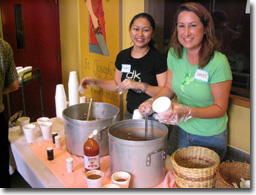
This outdoor meal is truly the work of many people. Parishioners and volunteers prepare a hearty homemade soup and dated packages of pastries arrive from a local grocery store. A parishioner from a produce company delivers boxes of fresh fruit and retirees spread peanut butter on donated bread. Volunteers set up our small chapel lobby with pots of hot water for chocolate and strong coffee. In summer the hot soup is paired with refreshing cold lemonade from large plastic containers. A volunteer sets up a couple of long tables and wipes clean the old plastic tablecloths already used dozens of times.

We serve the feast from the tiny confines of our lobby, the smallest public space in our building. Our guests receive their meal and sit in plastic chairs lined up against the green outside wall. Even in the cold winter rains of Portland, people wait in line for the 7:00pm opening of the red steel doors on the corner of 6th Avenue and West Burnside Street.

Amid the food set-up, the volunteers and guests gather cramped into this small lobby space and narrow sidewalk for many reasons. One reason is the name of the soup line. Our evening hospitality is called the Brother Andre Café, after Blessed Andre Bessette. Andre was a Holy Cross Brother in Montreal, Canadawho died in 1937 with over one million people attending his funeral. He was a man of small stature with an overwhelming dedication to Saint Joseph. Assigned by our religious community to be the Porter at Notre Dame School because of his sickly nature, Brother Andre became a healer. People with crippling diseases traveled for miles to stand in line in order to speak with Brother Andre for just a few minutes. Andre was the first member of our Holy Cross community to be named “Blessed” by Pope John Paul II in 1982.

We carry on the ministry of hospitality Brother Andre showed the Church. Members of the parish welcome friends and strangers with food at our front doors. Our guests may not be healed of illness or infirmity, nor are their crutches and canes left at our door, but strangers are welcomed and our friends are fed, named and appreciated.

This street meal is more than merely a handout. I find profound connections at the bottom of the empty bowls, in the evening interactions. When I first came to the Downtown Chapel, drug dealers stood on our corner convincing people that addiction would be their real food. We pushed the dealers aside. On Friday evenings we present people with an alternative beyond broken needles with friendship and a full soup bowl. This dynamic ministry speaks loudly on our corner as we witness also to onlookers, shoppers and corporate executives strolling by on Friday evenings.

Our narrow sidewalk extends well beyond our own neighborhood. Our ministry of hospitality reaches far into wealthy suburbs and many other parishes. Every week members of different parishes take turns preparing their recipes for soup. The visiting parishes provide some of the volunteers to set up and clean up, to host the evening and to welcome our neighbors. Many volunteers also bring blankets, socks, hygiene products and clothing to be handed out during the weekday hospitality center. I understand more profoundly with every passing week that our narrow sidewalk meanders into the consciences of many people in various parts of the city and beyond.

These volunteers appreciate that our sidewalk soup line becomes a place for people to become known. For many suburban people, these sidewalks are a place of fear and anonymity. Our Brother Andre Café remains a place where the poor have names, faces, life stories, real fears and dimly-lit dreams. The middle-aged soccer mom begins to understand the stories of a young former prostitute living in a single-room occupancy hotel in our neighborhood. As her fear diminishes, the mother relaxes about her children coming to volunteer in our parish. Creating relationships becomes a key source of change, hope and healing for everyone involved.

Our Friday evening outreach is also a place where high school and college students encounter a meaningful mission of the Church. Our parish staff connects with a half-dozen colleges throughout the year. Some undergraduate classes serve food on Fridays and some stay for a week-long plunge in the neighborhood. Nursing students wash people’s feet on Wednesdays. Some high school students meet their volunteer requirements by sorting canned foods for our daily pantry. Others volunteer in our daily hospitality center handing out laundry vouchers to a local Laundromat. They all experience interactions with people who suffer greatly and who live on the margins of our society.

However, nearly all the students go back to their families and schools telling stories of the reality of life. I hear later that they talk about foot fungus, the lack of housing for former prisoners, and the inadequate facilities for homeless women. Our students leave here realizing that the mission of the Church is about people. They admit to me the stereotypes about the poor that their parents and classmates have been passing on to them and their growing realization of the injustice of many aspects of our culture.

Our food-stained sidewalk also helps give direction to the future clerical leadership of the Church. Graduate school seminarians are placed here by the seminary of the Archdiocese of Portland for our Friday night ministry. I lead undergraduate seminarians in a thirteen hour immersion into our work once a year. I watch as the soup begins to break down the notion that the Church is for only the well-educated and well-deserving.

By the end of the academic year the seminarians realize the terrifying issues of people locked in poverty, ill health and sustained unemployment. I watch barriers tumble down and I see that these future clergy gain real insight that ministry involves building real relationships with people. They are stripped of thinking their future priesthood will be about living apart from unemployment, adequate health care and alcohol abuse.. As always, food becomes the vehicle to bring all people together on the same level, the sidewalk becomes a place for equality and authenticity.

Our parish is not the only place that serves food on Friday evenings. In fact I tell new volunteers that food is not the real problem in our neighborhood. The true misfortune, perhaps the real hunger or disease, is loneliness. Social isolation among the homeless and especially people living in the single-room occupancy hotels feeds continuing addiction and crime. People who suffer any form of mental illness may also lack the desire or motivation to remain on medication, to take care of their personal hygiene or to make necessary financial decisions. Loneliness spirals people into further depression. Loneliness creates a path of hopelessness about the future. This isolation also destroys trust, keeping people from reaching out when they are most in need.

However, our volunteers often arrive believing they can change people. They want to solve their situations or zealously promote food or blanket drives. Some become visibly angry that we are not doing more to get people medical help and dental care.Miracles become visible to me when our wealthy volunteers realize that our staff know the names of our guests. Volunteers gradually understand people when they get to know their human stories. Poverty is not easily solved. The issues of mental illness and homelessness are a tangled network of real issues not solvable by any good intentions. Our volunteers who share a bowl of soup realize that if poverty is to be changed, relationships are the key ingredient. This recipe for change starts with broth, onions, carrots, chopped meat, and a warm smile.

The source of these relationships on the streets comes from inside our chapel building. The Eucharistic Table, the center of any faith community, provides the risk to take love beyond the sanctuary. Our community is loved into service. Every day as I celebrate Mass, I break the hosts and pray that grace may sustain everyone present. There is grace enough for everyone because of Christ’s relationship with all believers. God also provides grace which compels us into feeding people who hunger for food, love and a sense of belonging. I realize that God’s love is plentiful if only we can give it away. I ask God every day for the courage to put Eucharist into practice, to take love to the streets of the city and into the households of everyone – even unbelievers.

Even though our parish community serves from God’s love, we still do not have the resources to change policies concerning health care for everyone, adequate housing for the mentally ill and decent employment for veterans. However, I believe that if policies are ever going to change in our cities or for the rural poor, we must first be in relationship with people who are poor. And the source of all these relationships is the sanctuary in all of our churches, the place in which we profess our belief in the Resurrection of Christ Jesus.

Leaving our sanctuaries to minister on street corners is never easy for any worshipping assembly. Entering into the unknown is always risky. Leaving the security of ritual and breaking down even the invisible communion rail takes deep and profound faith. The priorities for every faith community must remain in service to people who suffer. The call of Jesus to wash feet, heal the sick, touch the leper, and encourage the sinner is not a false piety. This call is not for warm-hearted liberals or staunch conservatives, but for us who pattern our lives after Jesus’ passion, death and resurrection. This mission is Christ’s love made flesh, to build community, engage the suffering, and sustain the orphan and widow.

The sanctuary is the place where service and justice are birthed. The sacred liturgy calls us to live beyond the threshold of our comfort, to open doors beyond our ignorance. Our parish community continues to call us into our streets and neighborhood even beyond serving soup. Our community processes to a murder site when violence strikes our neighborhood. We sing a litany that names forms of evil on the sidewalk where the stabbing or shooting occurred. It is the very same litany we sing when we celebrate the Scrutiny Rite for our catechumens. Members of our staff take people on tours to educate volunteers and strangers about the issues of poverty we learn from being in relationship with people inside our chapel walls. The sanctuary and streets are both places of conversion and hope.

I realize sharing soup and stories on the streets does not solve every aspect of people’s suffering. Our staff did not have the insurance or medical care to keep Jane from dying on our streets from gangrene. Our parish cannot solve Jim’s problems of severe mental illness which keeps him in the same clothes for months without showering. We cannot clean people’s teeth or offer a root canal. We cannot fix the ongoing problem of bedbugs in the single room occupancy hotels.

The sidewalk outside our chapel building is more than a corridor to the neighborhood. The concrete path is an extension of the Eucharist itself. The food we share gives us hope when everything else fails. The soup served from the cold streets unites lonely people on Friday evenings and changes priorities of volunteers. The common walkway leads right back to the sanctuary when we are all exhausted from our efforts and need to be fed again with real sustaining food, the Body and Blood of Christ Jesus.

I Just Want to Be Loved

Originally published by CHURCH Magazine, Summer 2009
– PDF version – Online version –

Witnessing the marriages of couples who ground their love in service and community challenges a priest to hear the universal longing for love.

I am still learning how to love. I discover every day the fragility of my own commitment as an ordained priest and vowed member of a religious community. The setting that has begun to open my heart from my self-preoccupation and even self-loathing is living and praying among our culture’s fragile and neglected people. Here, in our urban parish in downtown Portland, Oregon, people show me their raw belief in God. Life in this paradoxical setting strips me of pretense and reveals my obvious fear of relationships. Ministry here teaches me to live the love that is locked up behind my own breakable heart.

Every day I hear people screaming out to be accepted despite their tortuous history of mental illness or their latest relapse into using drugs. Some people cry out in pain because no one has ever stopped to listen to their history of being sexually abused. Others cry out because they were thrown out of their homes as teens for using heroin. The daily battle on the streets has scared many of them from intimacy and distanced most of them from society’s care or concern. However, underneath all the external hardness of sleeping outside or the effects of alcohol or methamphetamines, there is a common ache, a screeching cry from people to be heard, forgiven, and loved.

I literally heard a stranger crying out one cold, rainy morning as I walked across one of the bridges downtown. I spotted a man carrying an umbrella and briefcase and wearing a gray trench coat. I followed him across the river, blinded by the sharp rain. Out of the darkness, a young man straddling the railing of the bridge yelled out to the hurried businessman, “I’m going to jump!” The preoccupied gentleman ignored him. As I walked closer to the unknown voice, the young man shouted out even louder to me, “I’m going to jump!”

His voice pierced the new day, sharp and penetrating. With raw instinct I bent over the drenched youth, grabbed his arm and pulled him off the railing. He pretended to struggle and fight me. He stabilized his body on the earth. His large, dark brown eyes looked right through me and he screamed in my face, “I just want to be loved.”

We walked to safety, and the police told me he had jumped off a bridge a few weeks earlier. He wanted more than just someone’s attention. They also told me he was not sick enough to be admitted to a hospital for more than a couple of days. I left him sitting in a squad car, but his scream still haunts me.

This cry for help resonates deeply within me. I believe that our relationship with God begins with this sacred cry, the ache of the human heart that begs to be nurtured. I hear and absorb this holy scream because society’s poor are more honest about their needs in the world. The hallowed shriek, the deep passion for acceptance, is not an isolated event or one moment of despair. Desiring to be loved and accepted in our culture is a daily occurrence among our sisters and brothers living isolated, fretful, and anguished lives. This cry of the poor does not end among those who fall among the margins of society.

I carry this scream with me in all areas of my ministry, even in contexts where it may seem to some to be unrelated. I remember the cry of the poor especially when a couple approaches me to be married in the church. I am powerless to fix people’s pain and suffering, but I must always educate people about other people who suffer. I begin discussions with those who come seeking marriage in the church with the fact that all people are seeking love. I remind couples of their responsibility to offer their lives not only to each other, but to the world around them. Then I begin to speak about how even the wedding ceremony can speak of their commitment to their families, the disenfranchised, and the turbulent world around them.

I begin with the human desire to be loved because I so often encounter obstacles in the wedding ceremony itself to the real meaning of marriage. Weddings must not be contained in overspending and selfish overindulgence. The authentic ritual is often lost behind the silk foliage and the ideas of a perfect wedding day. Even family relationships are often stretched to their limits and feelings are hurt when customs and expectations get in the way of the tradition of authentic love.

I realize some weddings in many of our parishes are short-circuited by decreasing numbers of clergy, the rules of the local tribunal, and even local parish requirements for hall rentals and floral arrangements. So often the wedding planner replaces the preacher; the etiquette guides speak louder than the gospel; and arguments over bridesmaids’ dresses overshadow relationships with family and friends.

Years of ministry, however, have given me multiple opportunities to celebrate weddings that celebrate the connection and dignity of all people. These rituals have given the couples and their families a new window into living the Christian life. These weddings continue to show me that love is not bound to family only, but that weddings become the sacrament of vocation and service in the world.

Our present culture faces critical times. We live our vocations in days of economic hardships and job loss. Together we face loving in times of war, forgiving in moments of blame, and unity in days of global transition. Our world and culture depend on us as Christians even more to put love into real action.

I was deeply touched when a graduate school classmate and his fiancée asked me to preside at their wedding. Joe (all names are changed) lived and worked among the poor and met his future wife in a soup kitchen. Their commitment toward the poor formed their love for each other. They wanted the church filled with people from the streets. Their desire was that the rituals speak loudly about the reality of their commitment of service.

On the day of their June wedding people flocked to the church. People who had lined up for soup and bread now lined up around the inside of the church because of the overflow crowd. They were there to witness the love of Joe and Mary and celebrate with others in the parish hall afterward. Some family members arrived with fresh manicures and silk gowns; other guests had not showered for weeks. Some people radiated designer perfume, others reeked of stale alcohol breath.

After reading Matthew 25: 31-46, I walked down into the assembly to begin the homily. My eyes fell on the shy poor and the excited family members. I paused and then asked everyone present to take off their right shoe. Without hesitation people reached for their stilettos or sneakers, the shoe that matched the dress or the worn boot found in the shelter.

I then asked them to exchange their shoe with person next to them. I led them through a reflection of walking in other people’s shoes because God came among us and walked in our shoes. I reminded them that this wedding was a celebration of God’s covenant with us as we learn how to love others.

As the vibrant couple came forward to profess their marriage vows, they sat down on the altar step and slowly took off their shoes. They lovingly, patiently washed each other’s feet. The silent echoes of this generous gesture echoed throughout the room, in every heart and mind. The rich symbol and unexpected washing reminded us all of the humility and risk of love, to put others first in the command of Jesus.

This ritual gesture inserted into the rite of marriage nearly stopped my heart. The reconciling foot care showed me that the couple was serious about living the gospel far beyond the celebration in that church. They staked their marriage on that liturgical gesture, and indicated that their vows would include loving those on the fringe of our culture. Washing feet was not a cute ceremonial addition to their wedding, but a statement of commitment far into the future. I witnessed at that moment my own selfishness, the limits I put on my own young vocation. Their naked, wet feet exposed my longing to serve the people who were sitting in those pews. Their vulnerability connected human concerns and authentic prayer and social justice. Their fairy-tale wedding exposed dirty feet, gathered hungry people, and challenged us all to serve beyond our comfort.

Joe and Mary have worked all these years speaking out on behalf of the poor and raising their daughters with radical compassion, simplicity of life, and prophetic teachings. Even though I have not yet met their children, I want someday to tell them how much their parents have educated me, challenged my own ministry, and taught me to remain humble in front of dirty feet.

Steve and Lori hesitated to speak with me about their wedding preparations. They grappled with their wedding liturgy because they did not have money to pay for many of the cultural and family expectations. They both were invested in parish activities and also wanted members of the parish present during their commitment. Together we decided to celebrate their wedding during the regularly scheduled Saturday Vigil mass.

After the homily, I stood at the sanctuary step and said, “Let those who will be married please come forward.” I could hear all the whispers of questions floating among the congregation. From the middle section of the pews, a young couple stood up and moved out of the seats and came forward. The congregation gasped with surprise and anticipation. When I saw Steve and Lori’s faces as they approached the sanctuary, I started to cry. I saw in them the raw commitment to the people of God who formed them in gospel service and justice. They professed their marriage vows with delicate voices. However, the sound of their promises radiated throughout the church. The congregation fell completely silent with only the sounds of tears.

Steve and Lori’s ceremony seared my memory with fondness and the real meaning of weddings. The couple caught the entire congregation off guard with the unexpected celebration. There was no long-term planning or external fuss or frenzy. However, that moment has remained with me because they professed their vows with clarity of intent, with deep faith and authentic passion for the people they served every week.

Steve and Lori’s simple wedding stands out to me amid all the expensive and chaotic weddings I have celebrated. Their understated presence pierced through all the cultural accessories. The action of the ritual revealed their love to me and their willingness to commit themselves to the community. Their unencumbered ceremony still teaches me that love is stronger than money, expectations, and fantasy. Even in our present days of building smaller homes, making every penny count, and caring for more people without health care, sacraments need to be celebrated with more honesty and intentionality.

A young couple married in our small urban chapel asked their guests to bring to their wedding ceremony white socks, different sizes of men’s underwear, and warm blankets. On the day of the wedding the sanctuary was overflowing with large green garbage bags stuffed with everyday needs for our daily hospitality center. This wedding ceremony gives me hope that the cry of love and justice can be heard in the center of the wedding ritual and into the lives of the newlyweds.

In another parish, Dan and Beth were dedicated to serving many in the community. They wanted to make sure people in the parish had a role during the actual wedding ceremony. We based the entrance rite on the rite of welcome from the rite of Christian initiation of adults. The liturgical ministers, attendants, the couple, and I all stood within the threshold of the church. I welcomed them through the main doors and spoke with affection of their love for each other and their special bonds of service within the community. I then turned to the congregation, who faced the church’s entrance, and asked them for their oral support. I asked them if they approved of this bond, if they would support them today and in the future, and if they would pray for them and their desire for children. I also asked the community if they would support them in living out the ministry of the gospel to serve the poor and disenfranchised. The procession music began, we all processed down the long aisle, and the community exploded with applause and shouts of joy.

Dan and Beth’s wedding remains an icon of community participation. The voices of the poor raised the roof with approval and hope. Their ritual opened the possibilities that marriage is also for the Christian community, it can be a source of hope for people who believe they will never find love for themselves. I hear the scream of wanting to be loved every day. I also hear young couples committing their lives to work with the unemployed, the mentally ill, and former prisoners. Marriage is created in community and must speak to the marginalized and neglected.

I recently met a couple volunteering on a Friday evening in our parish soup line. Every week people from other parishes and students from various high schools and colleges gather to make soup and create an evening of hospitality for our low-income neighbors and our homeless friends. The couple told me they were getting married. They shyly whispered that they were to be married in another parish the following day. I immediately spoke up and said I had never met anyone who would volunteer in a soup line the evening before their wedding. They quickly replied, “Well, Father, this is what we want to build our marriage upon. This kind of service and simplicity is the meaning of our marriage.”

The poor teach me to extend my own vocation beyond my pristine prayer, my selfish use of my time, or my limited understanding of community. The former prisoner teaches me to live a generative life beyond the confines of my own doubt. The mentally anguished addict shows me I cannot put off love until the world is perfect. Young couples who connect their love for one another to service among the poor expand my notions that God’s covenant with us is real, vital, and full of hope in this generation.

Every time I sit down with an engaged couple for the first time, I tell the story of my early morning encounter across the bridge. I tell stories of how married love is lived in our community. We plan and prepare, we discuss and reminisce, and we fill out forms and write down schedules. We prepare for the wedding and the marriage; we explore how their married love will grow beyond their own home. On their wedding day, I stabilize my body on the earth witnessing the couple, listening to their sacred vows, and feeling the depths of us all longing to be loved.

Personal Poverty Retreat

Originally published by Ministry & Liturgy Magazine, February 2008
– PDF version –

Our parish church, on Burnside Street in Old Town, downtown Portland, Ore., sits on the border of a great divide. On one side corporate executives scurry one by one to tall, marble buildings, but on our side people dressed in drab colors line the sidewalk in front of our building waiting to enter our red doors for coffee or clean underwear. One day I noticed a woman executive who crossed the forbidden line. She stood on our sidewalk pointing her finger at a man, mentally ill and homeless, who was playing with his grey kitten. Dressed in grey flannel and stiletto heels, she screamed at him not to endanger the cat. After her encounter, she stormed into our lobby, where I was sweeping the floor, and yelled at me, “you have to do something about that man who is hurting that cat!” I assured her I would take care of the situation. After she left the lobby I turned to one member of our parish staff and said, “1 wait for the day when someone comes into our lobby and says, ‘We, together, should do something about that young man who suffers from mental illness and is without housing, employment and friends’.”

This encounter teaches me that we all face different forms of poverty. Dozens of times every day in ministry, I realize poverty is not an abstract reality but reveals itself through our own histories, relationships, and education. We carry poverty in our prejudices or our backpacks, in our cultural expectations or in a shopping cart. We express issues of poverty by the labels we attach to one another, no matter which side of the street we live on.

This interaction between two people dressed in grey also shows me the black and white divide between the rich and poor that continues an ancient tradition. This chasm reminds me every day of Lazarus in the doorway who longed to eat the scraps from the rich man’s table. The segregation calls to mind the journey of Jesus to a Samaritan town to reach out to a woman under the noonday sun. It underlines Jesus’s command to welcome ill strangers, people with handicaps, the former prisoner, and the newly widowed to the feast where all people fit around his open table. This ancient way of dividing the poor and rich teaches me that we have yet to understand the basics of gospel life, in which our lifestyles of fear can be replaced by reaching out to those who need the staples of love and understanding.

Our parish staff searched for ways to educate people living beyond our corner. We wracked our brains to develop a method to move believers beyond their black and white interpretations of life. The staff realized that our ministry among the poor on our side of the street could become a vehicle for real catechesis among those who already have jobs, security, and satisfying relationships. We began to realize that the poor themselves would become the teachers, the authentic catechists. The antidote to unhealthy interactions with poor people begins by learning from those who are suffering, lonely, and drug addicted. Building authentic relationships remains the answer to recognizing the dignity of all life. But the people would first have to be willing to cross the street.

And I needed to examine my own life, priorities, and actions to discover which side of the street I really live on. I needed to grapple with my own need and desire for God, my own personal poverty. I needed to authenticate God’s work in me by stepping out of my fear and comfort in order to serve people suffering physical and emotional poverty.

I found the way to bridge the chasm between faith and service right under my nose. Our daily hospitality center has changed my approach to God more than anything in my years of priesthood. When I spend two hours handing out hygiene products or laundry vouchers and listening to people’s stories, our interactions strip away all the pretense of my human ego and priestly identity. I am the one emotionally naked most days as I realize all the masks, education, and power I stand behind. Mingling in our hospitality center strips away any notion I have that people should be different than they are or that I could possibly have answers for their questions of survival or sobriety. So I invited those who live on the opposite side of the street and beyond to enter into this place of self-stripping.

The parish staff developed from our basic daily ministry an opportunity for others to join us in learning more about prayer and service. Every Friday we work a 13-hour day. We now open up this time once a month so others may join us in an unconventional retreat. We call this day of work and reflection “The Personal Poverty Retreat.” People in small groups muster the courage to cross the dividing line and participate in this day of ministry and sharing.

I gain great courage as I hear people reveal insights and stories during the debriefing sessions following morning hospitality. They understand that the trip across the street was worth the effort as they slowly unravel all their misconceptions about people who are poor, addicted, or lonely. Facing the mentally ill rouses palpable fear in people who are used to having all the answers in life, those who spend their days telling others how to live or what to do. Teachers, bankers, and retired executives often sit confused about how the experience challenges them. I watch in silence as I hear a retired grandfather express guilt over his well-earned possessions. I listen with gratitude as a businessman reveals that he must reinterpret his basic notions of a lifetime of cultural norms, his perceived masculine role in society, and the threats he feels to the American dream. Encountering people who live in poverty becomes real catechesis to the rest of us who think relying on our own power, education, and social status will bring us to God.

After we celebrate the Eucharist at noon, we take the call of the dismissal seriously. We let go of the safety of the sanctuary and enter the streets of the neighborhood where we visit Catholic agencies serving the needs of people living on the streets or in single-room occupancy hotels. I try to resist the notion in myself that this is a poverty safari, a tour of gazing at drug dealers selling their stuff or glaring at the mentally ill person who asks for a handout along the way. This walking tour opens up all our senses, especially for those who are used to passing through this same area in the safety of their car. I see a couple having sex in a doorway, a family creating a cardboard hut near a fence, and a man telling jokes to himself. It is on this tour that people experience the issues of our city trying to eliminate housing for the poor, closing agencies that provide services, and avoiding the needs of the mentally ill people. Amidst the piercing sounds of jackhammers, ambulance sirens, and buses rushing by, we always pray in front of each service agency. This is not a tour about how the church serves the poor but an exploration of people’s consciences to find new ways to learn the needs of others and a new dependency on God who calls us out of ourselves.

The foot-tour raises challenges and exposes consequences about people in poverty, but the two-hour reflection session afterward is where the rubber meets the road. Here we try to ask the startling questions raised by shattered notions of who poor people are and about the God who calls us to do something with our lives. I introduce the session by reading aloud about one of my mentors in Scripture. The Canaanite woman perks us all up after the walk outside, challenging us to shake our fists at Jesus to change his mind about the needs of her daughter. She teaches us to advocate not only for those we love but also for those we just met along the way. This holy woman in Matthew’s Gospel reveals that what we must do to change people’s lives is to storm heaven with our prayer to make sure Jesus is paying attention to his lonely and forgotten.

l am profoundly changed by the challenges people face while sharing in this group setting. One by one people share their real poverty. Suddenly people are making the connections that a recent divorce isa path to God or that the powerlessness they experience with a tormented teenager is the way to a new life of compassion and change. I witness the Spirit softening the anger of a middle-class parent realizing that his years of anger and hatred toward his homeless son need to change. He now understands through the course of the day that he cannot fix his son’s addictions and ‘that he simply needs to love him and offer support. I am amazed at how people let go of so much control and regret, old patterns of life, church, and family. The people on retreat realize that their answers to questions of family, society, and church do not always work for every person, no matter how hard they try to convince people of their correctness. This kind of catechesis does not come from a religious education manual or a tidy parish program but is found in real and honest relationships with those who find themselves on the margins of society and church.

Our evening ends by sharing a meal with other volunteers and then working in our soup line, The Brother Andre Cafe. In our church lobby we encounter people from the neighborhood coming to us not only for food but for an affirmation that their lives count. They come because this is about community, even as broken and tenuous as it is. I try to make the connection with our folks on retreat that this line is an extension of the sanctuary where people feel cared for and welcomed. It is the human and complicated table where people learn that profound hunger brings honest community. This safety of community sometimes is shattered by a man who acts out his mental illness violently or by people just wanting to stir up a fist fight.

I am deeply inspired when people realize Christians are not U do-gooders. People begin to learn that serving under our own power only gets us to burnout and anger. They make the connection that discipleship comes from realizing that we are all loved by God and then we are called into loving others. We do for others what only God can first do for us – that is simply to love. This is the real grace I witness when people come to the conclusion that they do not possess all the answers in life, that finally they need God to do the work only God can accomplish.

I learn from people encountering the needs of the poor that admitting suffering is the road to true community. This admission and conversion is a struggle in every parish community. This is the key to building bridges between people on both sides of the street. This model of retreat convinces me that parishes only need to look to those who are suffering in their midst to begin to understand that people need to be loved as they are and not made over according to our prejudice or ambivalence. Once we admit our own poverty, our own need and desire for God, we can learn to walk together, no matter which side of the street we may live on.

I look forward to the day when we all stand on the same side of the street believing in something more than our fear. We can work together to change these initial instincts into actions of acceptance and service. Participants on our retreat show me that attitudes change when we cross the barriers that separate us from other people’s suffering. Barriers fall through the simple encounters of people as they strip away their black and white differences and share a cup of coffee and a warm bagel.