Holy Oil

Brother Andre Series: Number Four
I cleaned out the cabinets in our parish sacristy last month. I sorted through all the lost-and-found items that had accumulated in a drawer over the past few weeks. I returned several extra glass vases to the florist across the street. I discovered one item at the back of a large cabinet that stopped me in my tracks. At the bottom of an old box, I uncovered a small glass bottle of oil. The unopened bottled had an image of Saint Joseph molded into the glass. A small folded brochure from Saint Joseph’s Oratory protected the antique glass container. I unfolded the yellowing paper and I saw a handwritten date at the top of the page. The date read, “1939,” just two years after Brother Andre’s death.

Brother Andre was assigned as porter for Notre Dame College in Montreal after he professed vows in the Congregation of Holy Cross. People started coming to him because they saw in him an earthy holiness and a desire to be among people who needed help and refuge from their pain. He prayed honestly and intentionally with people, asking them to pray to Saint Joseph as a model of fidelity and hope.

Brother Andre also anointed people’s bodily pain with vegetable oil from a lamp near a statue of Saint Joseph in the chapel. Brother Andre told people to wipe the oil on their wounds as a sign of faith. Andre insisted that Jesus’ disciples used simple things to express their faith in moments of healing, such as mud and water, oil and laying hands in prayer on people in need. Brother Andre’s great devotion to Saint Joseph connected the oil in the lamp to the poverty and suffering of people longing for healing and miracles.

At the Downtown Chapel, we all recognize the need to be present to people seeking healing. People need to be touched in a healthy, prayerful way in the midst of diseases that are not only physical but emotional and social as well. These diseases do not just go away in a measured time nor are they fixed or cured with ease. These matters of suffering remain lifelong struggles of sheer survival.
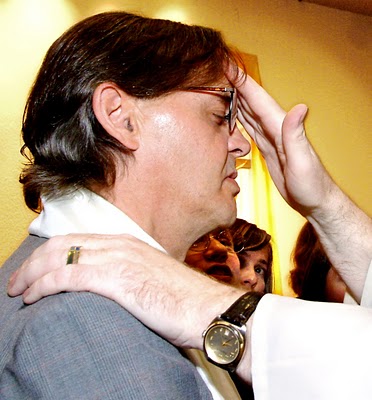
Every Wednesday at the noon Mass, we celebrate the sacrament of Anointing of the Sick near our icon of Christ the Healer. At the 5:00 p.m. Mass on Wednesdays we also celebrate the healing sacrament in particular for people suffering from addictions. On the first weekend of the month at both Masses we also celebrate the sacrament of Anointing of the Sick for people living in poverty, mental and physical illness and various addictions. We pray with the oil blessed on by the Archbishop and the people of God during the Chrism Mass.

I understand Brother Andre’s need for such a tangible item as oil to connect with people’s suffering and the healing of Christ Jesus. We anoint weekly because we know there is little else we can do. We anoint in faith because we do not have solid answers for people living in systems of poverty and generations of mental illness and ongoing addictions to heroin, alcohol, cocaine, sex and food. We anoint people because only God can heal people. Christ is our only hope.

A couple of weeks after discovering the oil in the sacristy, a friend offered me a gift from his recent visit to Saint Joseph’s Oratory in Montreal. I opened the wrapping and accepted a large plastic bottle of Saint Joseph’s oil. Brother Andre has been part of the healing here all along even though I did not know the antique bottle of oil was in our sacristy. Now our prayers for healing will be even more intentional through the intercession of Saint Joseph and the memory of Brother Andre in Christ Jesus our Lord.

Honor

Brother Andre Series: Number Three

Every morning I witness people surviving the ravages of chronic unemployment. Job opportunities may never come along for many of our guests who face severe mental illness and depression. A middle-aged man holds back tears as he explains to our volunteers that his wife left him because he recently lost another job. A young runaway teen stresses about his survival as he explains to me that his foster brother sexually abused him. An elderly man just arrived in town from another city hoping to break his three-year streak of unemployment.

Our staff and volunteers become acutely aware that we cannot change people’s situations or fix the circumstances of others’ lives. There are no quick and easy solutions to long-term joblessness. People come to our parish Hospitality Center worn down from the heartbreak of unemployment and the loss of personal dignity. When people lose their jobs so many also lose their honor for life, self-worth and a sense of personal identity.

I also hear from many friends and neighbors that if homeless people just got jobs they would not need our handouts. Unfortunately, finding meaningful employment is not that easy, especially for people who suffer various forms of mental illness, long-term addictions and years of being homeless. Even after finding employment many people struggle to find the self-respect and courage to persist in their work. Finding work with dignity is an even greater challenge.

From people’s stories of unemployment, I also understand Brother Andre’s honor and devotion to Saint Joseph, the patron saint of all workers. Saint Joseph quietly worked as a simple laborer to support his family, Mary and Jesus. He worked in the shadows of Jesus, being a dedicated father and supporter of the mission of Jesus in the world. Brother Andre lived out Joseph’s dedication to work, realizing that there was no task too small if done for the purpose of being close to Christ Jesus. Andre swept floors, cut hair, ran errands for the sick, and welcomed the stranger. Brother Andre realized that it was not the job that gave him identity, but the fact that simple chores enabled him to constantly pray even while working many hours.

Saint Joseph is also the Patron Saint of Canada, which strongly influenced Brother Andre as a child. The Brothers of the Congregation of Holy Cross also look to Saint Joseph as their patron. Brother Andre continued this devotion to this quiet saint and patron throughout his religious life. The life of Saint Joseph shows us that living simply in the midst of Christ is our real identity. Brother Andre relied on the help of Saint Joseph in every aspect of his life and prayed to Saint Joseph for all people who came to the door of Notre Dame College in Montreal.

Saint Joseph, pray for us. We pray for people unable to provide for themselves. We work being grateful of our abilities no matter our talents or occupations. We pray for the dignity of all who labor and for all who seek employment. We pray for daily bread for all people as we honor Saint Joseph.

Hospitality

Brother Andre Series: Number Two

Every weekday morning at the Downtown Chapel our parish staff and dozens of volunteers open our red steel doors to people longing for companionship and a few essentials for survival. People stream from local shelters and wait in line at the parish for clean socks or money for prescription drugs for their mental illness. A young twenty-something man just released from jail wears flip-flops and needs clothing for protection in the Portland rain. One person waits in line for a yearly haircut. A young woman cuddles her infant hoping to secure a package of diapers in our Hospitality Center.

As I enter into relationship with our volunteers and our daily guests, I realize Brother Andre’s ministry as porter. Because of his own frail nature, the Congregation of Holy Cross was reluctant to welcome him into our religious community. He persisted through prayer and pleaded with the local bishop and superiors in Holy Cross. On August 22, 1872, Andre professed his first vows of poverty, celibacy and obedience. From that day on he was assigned as porter at Notre Dame College in Montreal, Canada. The frail man who was nearly turned away from religious life became the person to welcome the stranger at the door. He persevered in that ministry until 1909.

I learn everyday the core gospel value of hospitality. Welcoming the stranger is messy, stressful and often makes us all uneasy. Opening the door to people with mental illness or drug addiction changes my perspective and my view of people. I give up judging people and I put prejudice aside. Hospitality means entering into real, authentic relationship and discovering the person of Christ in our human condition. I now realize this as Brother Andre longed to be united with Christ through suffering. Hospitality is lived here as we slowly discover the dignity of every human being and come together in faith and non-violence.

I saw hospitality in a new light last month as we welcomed the film crew from Salt + Light Television Productions from Toronto, Canada. They were here witnessing the connection of Brother Andre and ministry among people in poverty in the United States. I witnessed the producer, Mary Rose, seeing something more than the perfect shot for the documentary. She began to discover in conversations that Brother Andre lives here because of his example of welcoming people. She listened to a man express his faith and his story of mental illness. She heard people admit being sexually abused and their longing for lasting adult relationships. As the crew filmed many aspects of our community welcoming all people, I saw a new attitude within them. They were not spectators behind a camera, but people being welcomed and accepted into our community.

Brother Andre’s ministry of hospitality lives among people who live outside or who have lost their jobs. This ministry continues within Holy Cross parishes and within the Universal Church. The sickly man who welcomed the stranger teaches us all to honor the dignity of all people no matter who knocks on our door.

Home

Brother Andre Series: Number One

Last month a film crew from Salt + Light Television Productions from Toronto, Canada filmed aspects of our ministry at the Downtown Chapel. Their cameras rolled for two days here because they are producing a documentary about Brother Andre Bessette, CSC. He will be officially named a saint in the Roman Catholic Church this October 17, 2010.

Brother Andre is very well known throughout Canada for his prayerful intercessions for people suffering from physical, emotional and spiritually pain. He touched thousands of people through his faith and prayer in the early 1900’s. The film crew caught images of our welcoming the homeless, feeding the hungry and washing the feet of the tired. Brother Andre still makes his home among us—the marginalized.

Brother Andre’s healing power still extends well beyond the borders of nations or the confines of generations. Our ministry at the Downtown Chapel continues his care and work in our neighborhood of poverty and suffering. His prayer for our community begins here at our red doors. Many of our neighbors, parishioners and guests remain smothered in violent relationships, overwhelming fear about the future and inconsolable suffering on a daily basis. Brother Andre still makes his home here among us, inviting us through these iconic red doors into a community of prayer and service.

Brother Andre was born (named Alfred) on August 9, 1845 about thirty miles from Montreal. His father died when he was nine years old. He was always sickly and his mother spent much of her attention on him even though she had eleven other children. She could not afford to care for her children so she offered them for adoption. She cared for Alfred until her death just two years after her husband’s death.

Alfred was poor, sickly and orphaned but his faith strengthened him. In the center of so many hardships he turned to Saint Joseph for courage and hope. Alfred made his home in the love of God, the promise of Christ’s healing. After his mother’s death, the illiterate Alfred struggled from job to job trying to support himself at a young age. He was a baker, cobbler and janitor and he tried to make a living across the border of the United States as well.

Alfred felt a deep calling from God to enter a religious community. At the request of his local parish priest, the Congregation of Holy Cross accepted him into formation even though he was so frail. The pastor told members of Holy Cross, “I am sending you a saint.” As Alfred was accepted into the community, he was given the name, “Andre.” Brother Andre finally found a home in God, in religious life and in service to Saint Joseph.

(I begin this series on the weekend of Brother Andre’s birthday. This series will continue weekly throughout October 2010)

Besmeared

Originally published by Ministry & Liturgy Magazine, August 2010
– PDF version –

I cringe when I notice the dirt on the door windows leading into the chapel. Our janitor cleans these windows daily and staff members occasionally wipe them spotless during business hours. However, by Sunday morning, handprints, coffee, food, body grease and makeup keep the windows smeared and dull. I often think that these greasy windows reflect on the staff and our ability to keep our chapel clean and appropriate for people to pray.

As I reflect on the Gospel passages beginning on the 25th Sunday in Ordinary Time until the 29th Sunday in Ordinary time (September 19-October 17), I see through my own ego. I also see through the smears on the windows and some aspects of faith much more clearly. I see the reasons why the greasy, ugly prints show up in the first place. The grunge on the windows speak loudly about our ministry among those who sleep at our doors, the dozens and dozens of people who come to us needing our attention and the basics of life.

Luke’s Gospel reminds me that to be concerned with my own ego is to serve two masters. When the besmeared windows cast a light on our staff, we serve ourselves rather than the people we are called to befriend in the first place. We must not fritter away our property and not squander our accountability of our stewardship. However, the real property and the authentic stewardship are the people who struggle for clothing, food and a warm place to rest on weekday mornings. To see these people clearly is to become trustworthy in small things. Jesus reminds us that we will become children of light when we see through the opaque nature of our mistrust. When I see through my own foibles, insecurities, failures and moments of self-protection, I serve God and not mammon. I see then more clearly even through the dirty windows to the people who are looking back at me.

Another passage in Luke’s Gospel challenges me to see Lazarus at my door. Jesus’ story is also reflecting back to the fact of my physical safety, emotional comfort and abundant resources. Jesus tells the story of the rich man encountering the poor man at his own door. This story retells itself every day at our urban chapel. Not only Lazarus, but Ethel, Joe, Irene, Bill, Big-Feather, Isaac and Beshawn come waiting at our red steel doors. Some of these people sleep at our doors, leave food, press their greasy foreheads to the windows to peer inside and even urinate on our doors. Pet dogs provide companionship to many homeless people but they also leave their waste near the entrance to the chapel.

The parish doors remain dirty all day because of our hospitality, our welcome to the Lord’s Table. My preoccupation with having clean windows remains a deterrent to my place in the bosom of Abraham. The place in the next world is already being prepared for the staff and the people who wait at our doors. This relationship of those on the inside and those on the outside remains important to the salvation of everyone. This Gospel story reminds me again to listen to the one who has already risen from the dead, the one who will provide a place of welcome for everyone in the next world, Christ Jesus.

The apostles want to know for sure how to increase their faith. They think it will be all up to them to finish the race. Instead, Jesus tells them to put on an apron and get to work. There are more people at the door, more food to prepare, more hospitality to provide, more kindness to offer, more clothing to give away. He asks us to be servants of his Word and stewards again of his real property, the people at the door. The call to serve will always be our obligation, our way into the door of heaven.

Jesus also touches lepers and heals them. He breaks down limits, boundaries and borders to get to people in need. Jesus shows us that getting dirty, touching sores and seeking after the afflicted will provide for us a new way of life. He calls us in the meantime to be grateful. Jesus warns us to be careful whom we consider a leper. It might just be people who remain ego centered, caught in the trappings of cultural expectations, preoccupation with appearance, and people who cannot recognize the value of people.

I peer through the besmeared windows of our doors and see the dignity of dirt, the purpose of our community and the need for my own growth. As I invite people into our chapel, I see the light. In the chapel sanctuary itself there are no windows. I cherish the bright light of my relationship with real people.