Unknown's avatar

About Ronald Patrick Raab, C.S.C.

Ronald Raab, C.S.C.,serves as religious superior at Holy Cross House, a medical and retirement home for the Congregation of Holy Cross, Notre Dame, Indiana

Column from parish bulletin: Twentieth Sunday in Ordinary Time

Dear Friends and Parishioners,

Luke’s gospel (12:49-53), challenges us to the core. Just when we think we have a handle on Jesus’ message of working for the Kingdom of God, Jesus shakes us up once again. Jesus says that he has come to set a fire on the earth. He will be the source of division, and he hopes for a great fire to be blazing on the earth.

We know how the truth can divide us. We understand even within our families that life and faith are complicated and the truth may first divide us from one another. Luke is trying to get our attention and remind us of the radical understanding of faith. Faith is very countercultural; faith and the Church are not meant to be static or status quo. We are believers for the long haul and that means we are to put our lives on the line and get with Jesus to continue to push his agenda of faith, integrity, prayer and justice.

True faith does indeed cause turmoil, because most people do not want to change. We tend to think that the Church is meant to sustain the opinions that we already hold. We want the Church just to confirm our lackadaisical attitudes and our own biases and prejudices. Faith, however, causes us to dig deep into the radical notions of how prayer changes our hearts, and allows us to live in a new understanding of forgiveness, compassion and mercy.

As we continue in the Year of Mercy, Pope Francis is also calling for us to live with such fire. Faith is strong and enduring; it cuts deep into our shallow notions of love, hospitality and healing. Jesus wants us to cut our ties with our cynicism, our obtuseness, our coldness toward other people.

Jesus claims this fire within us when we truly give over our lives to faith. For most Christians, we want very much to “control” Jesus—to monitor how he is involved in our parish churches and how mercy and love are distributed. I admit that I see this all the time in the Church. When we resist working for the poor or the needs of our neighbors we are in fact trying to control how the Holy Spirit works. The mercy that Pope Francis is trying to get us to understand is the mercy of a generous, abundant, consoling God. We cannot control mercy and love; we cannot censor or set up rules or communities to govern how God can manage his people. In other words, God is God and we are not.

As we move toward implementing many of the projects and educational opportunities in our strategic plan at Sacred Heart, I hope that a new fire will grab hold of us here in our parish. I cannot be the pastor here without this hope. It has taken my first three years to get things moving—I hope that our parish will continue to move forward, that the Holy Spirit will seize us and bring us continually into a greater trust and love of God.

Some questions to ponder this week:

We are all baptized in Christ. This is the source of the “fire.” What does it mean for you to live out your baptismal commitment to Christ? Where have you grown weak in your prayer and commitment?

Jesus says that division will be apparent in our human relationships. How do you see faith—the Church—being a source of division in your family? How can you pray for harmony and peace? Can you take the risk of genuine faith and the radical lifestyle of Christ Jesus? What are you waiting for?

Blessings,

Fr. Ron

Door Man: St. André Bessette

Today is the birthday of Saint Andre Bessette, August 9. Here is an article from US Catholic Magazine from 2010. Search other articles on my blog.

Ronald Patrick Raab, C.S.C.'s avatarBroken But Not Divided

Originally published by U.S. Catholic, December 2010
– PDF version – Online version –

Brother André Bessette didn’t need fancy degrees to know how to welcome the sick who came to the Holy Cross community. Now, he’s the order of educators’ first saint.

My path to the priesthood, as with all priests in the United States, involved many years of higher education. I earned two degrees from the University of Notre Dame before being ordained a priest in the Congregation of Holy Cross in 1983. Later I received yet another master’s degree from Notre Dame. I learned all the appropriate professional skills. I studied the correct rubrics from scholars of liturgical history. The vision of the Second Vatican Council prepared me for what I thought my work would entail.

The education that truly formed me, however, has been learning to pray through my own suffering and the inconsolable pain…

View original post 677 more words

Column from parish bulletin: Nineteenth Sunday in Ordinary Time

Dear Believers, I had my yearly physical at the doctor’s office this week. Now that I am 60, there were all kinds of new and exciting tests! However, the one thing that is so evident is that I am certainly my parents’ son, even in terms of health and aging. I am the product of my mother and father and the ways I have lived in the world and how I care (or not) for myself even in my physical life and health.

The gospel today from Luke (12:32-48) gets at this same idea for our lives of faith and belief. In both of the parables today, the idea is that we need to look at how we live when the master is away. In other words, we are the product of our lives of faith; we are the lived reality of how we have incorporated faith into our every action. We are called to be vigilant when the master is away the same way we learn to take care of our earthly bodies and even our ideas and self worth.

We cannot live the life of a Christian half-heartedly. We cannot claim to be a follower of Christ Jesus in name only. We are to care for our faith as we do everything else in our family and personal lives. It is a lot of hard work; like exercise and eating well, our daily lives of prayer must be cared for, nourished, and treasured. What we put into this following of Jesus makes us better adults, more loving and wise and forgiving. Children often carry on the traits of their parents, and we are called to do the same after our baptism. We are Children of God. Gospel values and the daily Eucharist form us. We are products of being forgiving, loving people. We are products of Jesus’ passion, death and resurrection. This means that we learn by the example of Jesus, the disciples, and all the saints before us how to work through change, loss and suffering. We are people in faith with hope to bring our world because of our ancestors.

So we live as Jesus taught us, with courage and tenacity. The last line of the parable in today’s gospel is, “Much will be required of the person entrusted with much, and still more will be demanded of the person entrusted with more.” This is an incredibly challenging statement.

I invite you to take some prayer time this week and reflect on your inheritance of faith, love, and mercy. Reflect on what it means for you to live a life of faith passed down from your parents, ancestors, the lived faith of the saints, and, of course, the reality of what Jesus has done for you.

We really do not know when the Master will return. However, we live a life of justice and prayer in the meantime. We value all of life, not just when Jesus is watching us. We live with an eye of faith toward God’s beloved poor and the sick and the dying. We speak out on others’ behalf because we cling to the love and voice of Jesus, not because we are supposed to do such things. We are entrusted with much in life and so we are called to go even more deeply into our faith and into the lives of suffering people. Living a mature life of faith is not easy. There are many distractions. Sometimes we just give up because of our age, because life seems to not really change.

Here are some questions to reflect upon this week: “For where your treasure is, there also will your heart be.” What in your life does this statement from the gospel call you to? What is your treasure? Where is your true heart in the matter of your faith? How does this statement challenge you? How are you to search for your true treasure? How does this statement change your priorities?

Much will be required of the person entrusted with much, and still more will be demanded of the person entrusted with more.” How can you take stock of your life and what you have received from your parents, your teachers, and from Jesus? What does it mean to you to be responsible for your life? How can you better live the values Jesus has given you? How do you use your talents and your goodness for the benefit of others?

Blessings to you,

Ron

Today’s Responsorial: Jer 31:10-13

IMG_1367

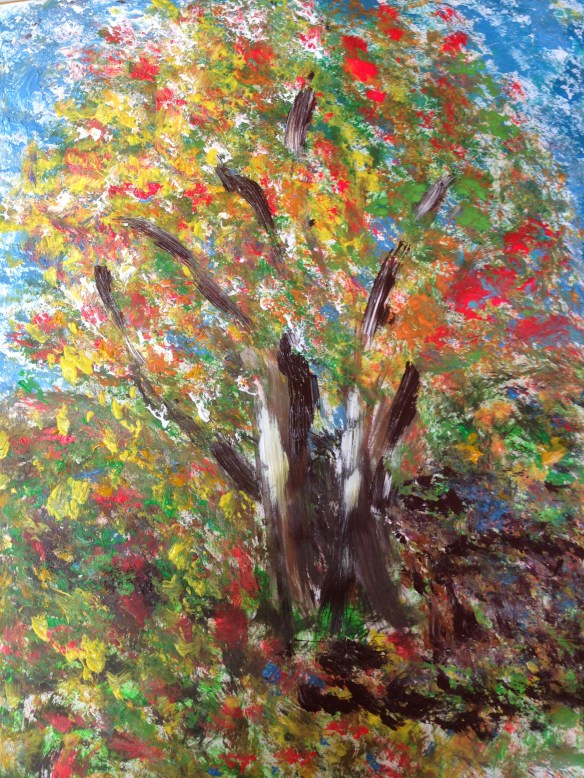
“Then the virgins shall make merry and dance, and young men and old as well.” Painting: Ronald Raab, CSC

Responsorial Psalm Jer 31:10, 11-12ab, 13

R. The Lord will guard us as a shepherd guards his flock.
Then the virgins shall make merry and dance,
and young men and old as well.
I will turn their mourning into joy.
I will console and gladden them after their sorrows.
R. The Lord will guard us as a shepherd guards his flock.

Column from parish bulletin: 18th Sunday in Ordinary Time

Dear Parishioners and Friends,

On Saturday, July 30 at Sacred Heart, we celebrated the First Profession of Vows of six young men in the Congregation of Holy Cross. Thank you for praying for these men who will return to Notre Dame this week for four years of graduate studies. I am grateful to have our Holy Cross novitiate in Cascade and for the novices to join us throughout the year. Our next class of novices will arrive in a couple of weeks.

Also, Fr. Neil Wack, CSC will be preaching here at Sacred Heart this weekend. He served here as associate pastor a number of years ago, and is now our Vocation Director for the US Province of the Congregation of Holy Cross. Welcome, Fr. Neil!

—————

Luke’s gospel (12:13-21) sets our priorities on the Kingdom of Heaven. Jesus said to the crowd, “Take care to guard against all greed, for though one may be rich, one’s life does not consist of possessions.” This passage challenges us in our human priorities and offers us a check and balance for our consciences and how we live our lives.

Luke is always trying to pry our hands and hearts off of greed, mistrust, and the accumulation of possessions. Why does this gospel writer focus on this? He focuses on our earthly possessions and even our human relationships and ties because he understands the value of what Jesus is offering us: the Kingdom of Heaven. Luke, in his community nearly a hundred years after Jesus Christ, believed that he would soon return. Luke wants us to be prepared for Jesus’ Second Coming. Luke does not want anyone left out of the true value of Christ, our place in the Heavenly Kingdom. He does not want you to be left out either.

We live in a very complicated time in history where greed is real. We value having more and saving less. We want to be more prosperous than our parents. We cling to and are even addicted to our technology. Our lives have become much more self-centered even as instant communication with the world has expanded our horizons about the needs of people. Our face time with people, with friends and family, has diminished with our noses in our phones. The world opens up with a click or a password, yet the deep human needs of others often elude us. We need to get our hands dirty in the real needs of people and not just read about those needs on our phones. Our possessions are many, and our ties to greed and having “more” are tight and secure. We need to listen to Jesus.

It is easy to store up stuff. It is not as easy to relate to what Jesus offers. It is easier to cling to possessions than to cling to harmony, forgiveness, love, and kindness. Our attention span is short and Jesus is trying to make a dent in what our hearts desire. He wants to be in relationship with us, but so often we just do not have time for him. We have little patience for how he can change our hearts.

So how can you become rich in what matters to God? This treasure is simply a relationship. Sometimes even religion gets in the way of what Jesus offers us. Most people see faith and religion as a set of rules to keep so they will get to heaven; what religion and faith really offer us is the way to crack open our hearts to look at the love God has for us and how we live that love in the world. The reason why Jesus wants to get our attention through our possessions is so that we can learn to share what we have with other people. Jesus offers us love and calls us to share love in the world and to work diligently for justice. Jesus offers us forgiveness and challenges us to forgive others. Jesus offers us healing and so we are to work among the marginalized and broken to make healing manifest in our world.

Jesus wants us to examine our relationship with our “stuff” so that we can ultimately call Jesus our true possession. Jesus wants us. He desires our pain and ambiguities. He wants to live fully in our priorities so that we can bring him to other people.

Here are some questions to consider this week:

How might Jesus be calling you into a new priority of prayer and service?

What stands in your way in moving toward a deeper relationship with Jesus?

Is it possible for you to put limits on frivolous activities and use your time for self-reflection, prayer, and putting yourself in the shoes of people who suffer or who possess less than you?

Is it possible for you to value prayer as a way to create real and radical change in your life? Can you move away from using prayer as a means to validate your own prejudice, hatred and self-absorption? Can you move away from using prayer as a way to always be correct and to validate your own way of thinking?

Can you find some peace this week and rest in prayer and gratitude?


Blessings,

Ron