Unknown's avatar

About Ronald Patrick Raab, C.S.C.

Ronald Raab, C.S.C.,serves as religious superior at Holy Cross House, a medical and retirement home for the Congregation of Holy Cross, Notre Dame, Indiana

Lent 2016: Fr. Bill Carmody

w620-1c54df34a1ffc618a7d52482b0af5064 2

Fr. Bill Carmody 

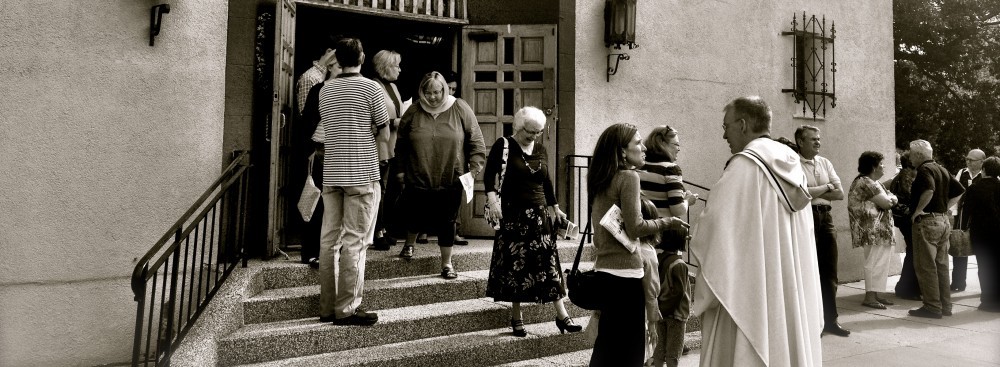
As I read the scriptures today, I am thinking of Fr. Bill Carmody of the Diocese of Colorado Springs who died yesterday. He suffered greatly with cancer and even Bishop Sheridan last evening on the news did not know he was so close to death. He was first an amazing priest, always on the side of his people. Bill was a community leader and motivator, inspiring people to examine their thoughts and actions toward the dedication that every life matters. Every life matters, even the unborn.

I met Bill when I arrived at Sacred Heart in 2013. At any meeting of the diocese in which we both attended, he always affirmed me in my interest and work with people on the margins of the Church and society. He felt marginalized from many other priests because of the gospel call to affirm life. He was inspired to keep moving, to keep preaching and to keep loving people. His words comforted me as a new priest serving in the diocese. I will miss him because he understood his priesthood in ways I can only admire. Yesterday and today, I pray for Bill and his people.

Click here for an article on Bill’s death.

From today’s gospel:

“…Rather, whoever wishes to be great among you shall be your servant; whoever wishes to be first among you shall be your slave. Just so, the Son of Man did not come to be served but to serve and to give his life as a ransom for many.” Matthew 20:17-28

Lent 2016: A life of integrity

IMG_0992

“The frenzy of life”

Reading 1 Is 1:10, 16-20

Hear the word of the LORD,
princes of Sodom!
Listen to the instruction of our God,
people of Gomorrah!

Wash yourselves clean!
Put away your misdeeds from before my eyes;
cease doing evil; learn to do good.
Make justice your aim: redress the wronged,
hear the orphan’s plea, defend the widow.

Come now, let us set things right,
says the LORD:
Though your sins be like scarlet,
they may become white as snow;
Though they be crimson red,
they may become white as wool.
If you are willing, and obey,
you shall eat the good things of the land;
But if you refuse and resist,
the sword shall consume you:
for the mouth of the LORD has spoken!

I recently spent some time with a man who was finally coming to terms with his past. His life was a frenzy of lies, guilt, sin and shame. His body shook as he began to unfold the circumstances of his past. His eyes were fuzzy with the lack of integrity and watery from finally facing his lack of responsibility of his past. Today, we listen to Isaiah to put our misdeeds before our eyes, to look again at the needs of people including the orphan and the widow.
Lent invites us into a life of integrity. It is a time to see our real life as it is, to focus our faces on the love God has for us. We all live in frenzy of activity and we can see the guilt on our faces.
Come and rest in the mercy of God, the healing and quieting balm of love.

Lent 2016: The Chair of St.Peter, the Apostle

IMG_0922_2

Sketch: Saint Peter, Ronald Raab, CSC 2016

…Jesus said them, “But who do you say that I am?” Simon Peter said in reply, “You are the Christ, the Son of the living God.”

Sometimes I wonder how Peter knew those words to say back to Jesus, how he really understood what he was saying. I had a conversation the other day with a twentysomething man who was telling me about his grandfather. He said that faith for his grandfather was just a natural thing. He told me that his grandfather “just knew” God and that he prayed every day with the surety and conviction of a saint. The grandson wants that for himself, that same conviction and peace. Yet, he has a scientific mind, a rational approach to the world and to God and does not see such faith as possible for him, at least not now.

I told him that his conviction will most likely come later in life, when his life circumstances change him, when he does not always get his way, when suffering makes a home in him, when he finally realizes that life does not always turn out as planned.

After all, Peter denied Jesus three times and he was always fumbling around in Jesus’ presence to make himself look good. Only after Peter suffered did he really understand the glorious keys that were handed to him.

Here are some questions for you in this Lenten season:

How do you understand Jesus in this Lenten journey? Are you afraid of him because you think he will judge you or are you drawn to him because of the love he has for you even when you stumble and fall?

How do you view Peter in today’s gospel and as the recipient of the Keys to the Kingdom? How can you and your faith help the Church today become a more credible witness to people who suffer, to those who really need God and to the marginalized?

Parish bulletin column for February 21, 2016

Column for February 21, 2016

mercy man 3

“Longing for Mercy” Finger Painting by Ronald Raab, CSC


Dear Followers of Jesus,


Last Sunday we followed the Spirit into the desert. This week, Luke’s gospel (9:28b-36) takes us on a journey to a mountaintop on this Second Sunday of Lent. Jesus is transfigured, with bright light reflecting in the eyes of his disciples.


This is the scene of the Transfiguration, where Jesus becomes dazzling white and the voice of the Father comes from a cloud. We understand along with those disciples that Jesus truly is the Son of God. In earshot of the Father’s voice, we know we are in the right place.


This mountain shows us the person of Jesus. We see him as he really is. We take a deep breath and realize the beauty of our following Jesus in this Lenten season. We follow him well beyond this scene and ultimately to another mountain called Calvary, where he will be nailed to a cross.


In this Year of Mercy, Jesus may be leading you to a new perspective on your life just as he led the disciples up a mountain. He wants you to know that you belong in His love. He wants you to see that your journey is really a path toward love if you can see it. Jesus desires that you to live every moment in his presence.


When we see our lives centered in His name, we see our pain, our suffering transfigured in love. Our suffering is a path toward love and Jesus stands in front of us in dazzling white ready to transfigure our doubt, our abuse, our loneliness, our fear, our hardships, our addictions into his goodness and love.


This gospel calls us to change our perspectives on our lives. Many people come to church wanting to hear what they already know, the rules of the Church so that they know where they stand with God and who will be in or out of that love. This mountain tells us that there is more to learn, that we must be open to the light and peace of God’s mercy.


Conversion to Christ is ongoing. There is more to learn every time we gather for Eucharist. I know so many of us want to cling to the fact that we are worthless or sinful or have no good within our hearts. Many of us feel that we do not live up to God’s love, that we are worthless in His eyes. Jesus wants change. He wants us to stop putting ourselves down, to stop using language that decreases our self-worth. Jesus wants us to stop thinking that we do not belong to him, that we are worthless in his sight. This mountain is meant for our transfiguration, for us to become dazzling white, loving and sure-footed on the ground of love.


Jesus also draws us into becoming a compassionate people. We have a long way to go to be compassionate with just ourselves. The Lenten journey is about a whole-hearted change in how we see ourselves, other people and especially God. There is much in our lives that needs to be converted, to be changed and to be mended so that we can become a truly compassionate people.


Here are some questions to reflect upon this week from Luke’s gospel text:


How can you learn in this Lenten season to see Jesus with greater clarity? How can you see him with love in his eyes? How can you learn to listen to him with forgiveness on his lips?


What does it mean for you to follow Jesus in this Lenten Season? Where is he leading you? Might Jesus be leading you to let go of the past or perhaps to let go of the false blame you carry about the circumstances of your life? Are you willing to follow him in prayer and meditation?


How is God calling you to become more compassionate and to live with less fear? What does it mean for you to listen to a stranger or to walk in another person’s shoes? How would you define compassion?


How is Jesus inviting you into prayer beyond ritual or formula or rote expressions? How do you rest in Him on the mountain?


In the mercy of God,


Fr. Ron


On the Margins: Luke 9:28b-36

fr_ron_and_kbvm_readingBW

On the Margins: From Mater Dei Radio, Portland, OR

CLICK HERE FOR AUDIO

Second Sunday of Lent: Luke 9:28b-36 Today, we follow Jesus up a mountain for a change of perspective. We see Jesus differently and ourselves. We stand with our ancestors in the faith through our baptism. In the bright light of Jesus’ face, let us see our own lives and the healing we long for, the mercy that we seek in faith.

Psalm 130: “Lord hear my voice”

FullSizeRender 2

Responsorial Psalm PS 130:1-2, 3-4, 5-7a, 7bc-8

R. (3) If you, O Lord, mark iniquities, who can stand?
Out of the depths I cry to you, O LORD;
LORD, hear my voice!
Let your ears be attentive
to my voice in supplication.
R. If you, O Lord, mark iniquities, who can stand?
If you, O LORD, mark iniquities,
LORD, who can stand?
But with you is forgiveness,
that you may be revered.
R. If you, O Lord, mark iniquities, who can stand?
I trust in the LORD;
my soul trusts in his word.
My soul waits for the LORD
more than sentinels wait for the dawn.
Let Israel wait for the LORD.
R. If you, O Lord, mark iniquities, who can stand?
For with the LORD is kindness
and with him is plenteous redemption;
And he will redeem Israel
from all their iniquities.
R. If you, O Lord, mark iniquities, who can stand?
My heart aches for you, O God. In the nighttime, my unsettled soul roams for love. My voice waits to lash out and my anger is unleashed in the darkness. My voice waits to express the violence of my poverty, my infidelity, my ill health, my mistakes, my misfortunes, and my discomfort in my skin.
Turn toward me as I wait for you. No other can calm me. No other can hold me in the night to comfort my fear. In the dawn, draw near to my cry and may I feel your breath of compassion and mercy. Be kind and consoling to me, the one who cries for new life and freedom. 
I trust you, O Lord and may my mouth give you praise. In your mercy, I pray and I wait. May I speak of your love as morning dawns. Amen 
(Prayer and Finger Painting by: Ronald Raab, CSC)

In this Year of Mercy: Beauty as compassion

IMG_1112

In this Year of Mercy, I realize that beauty is an act of mercy and compassion. This finger painting reminds me of the flower arrangements I created from “hand-me-down” flowers in Portland, Oregon. Even though the flowers in this painting neither live or die, they too, lead us to sense the beauty of God’s love and presence in creativity.

When I served at Saint Andre Bessette Church, I would walk over to Geranium Lake Flowers every Saturday morning. Kim, the owner of the business, would hand me a few flowers to take back to the chapel. Sometimes those flowers were left from wedding or party arrangements that she had been working on for the weekend. A few times, I even sorted through the shop’s trashcans for various greens and branches to create a weekly arrangement.

The simple floral arrangement stood in front of the crucifix that hung on the purple wall of the sanctuary. People who were surviving the gloom and darkness of poverty looked forward to seeing something beautiful. I discovered that flowers were a visible act of mercy.

Here is a non-published excerpt from “Bread and Concrete: Connecting Eucharist and Service.” Most of this book was published this past year in Ministry and Liturgy Magazine. In this Lenten season, we see the beauty of dying and rising. The flowers in our sanctuary captured that message in our small chapel in Portland, Oregon. Here, I reflect on the beauty of faith and the simplicity of death and resurrection.


…I learn from many people who suffer that hospitality is also important in our chapel. I create a clean, simple and tidy environment not only because of liturgical norms or rules, but because people need to be welcomed into a safe place to unburden their lives. On the other side of our chapel walls, the streets are brutal, loud and tormenting. I learn from recovering addicts how important it is for them to see the altar cloth that is carefully ironed and to ponder an unfussy bouquet of fresh flowers that highlight the simple crucifix.

     People long to see something that is beautiful and alive, something that reveals to them that people care about ritual prayer and the people who pray. People ache to feel that God’s beauty is still for them. They want even for just a moment, to feel that life is safe, loving and calming so they can go out of our building and bear the weight of addictions, mental illness and so much turmoil.

            I hear from heroin addicts that their recovery is painful, erratic and frightening. Jean tells me that she aches to see the freshly pressed cloth on the altar because everything else in her life is so chaotic, messy, unpleasant and out of her control. She lives in squalor every day of her life. Jean tells me that she normally treats herself so poorly that she wants to pray in an environment that is intentionally simple and elegant. She spent her life abusing her body and all her relationships.

Jean does not expect that our chapel should be expensive or opulent, she just means clean and simple, the best we have to offer God. Jean expresses that the kind and gentle environment, the simplicity and the elegance of the sanctuary gives her hope that her life could one day become a simple vessel for God.

She told me recently that she understands that the flowers near the cross will die this week. However, for just a moment, for a split-second she wants to absorb the eternal beauty of the living, gorgeous arrangement. Even our weekly flowers are hand-me-downs. My friend Kim owns a flower shop across the street from the parish. Each Saturday she offers me flowers that she would normally throw away at the end of the workweek. I create something with whatever she gives me. Sometimes I even retrieve branches and flowers from her dumpster. No matter what she has available to offer, the flowers create a focus under the light that shines on the wooden crucifix hanging off-center in the sanctuary.  

           Another woman who suffers from emotional instability speaks to me often of the importance of having a space, a real prayer environment that is emotionally secure and inviting. She tells me that her life is so filled with emotional disarray, that to come and pray in an environment that is pleasing to the eye, simple and direct, honest and innocent is so important for her healing and daily prayer. She tells me nearly every day that these patterns of beauty in our chapel help her feel normal and that her life counts in the community…


The Corporal Work of Mercy: To bury the dead

mercy man 3

Click here for audio from Mater Dei Radio

Session Seven:

This is Fr. Ron Raab, host of On the Margins, with a moment of mercy


The Corporal Work of Mercy: To bury the dead


We are called to treat each person with dignity until they are one with Christ Jesus. Burying the dead is an act of mercy since we live in the belief of Jesus’ passion, death and resurrection. Standing at the gravesite of a loved one recalls the dignity of each person and our yearning for our home in heaven.


In our parish community, we attend to the funerals of about forty people during a year. Every family grieves differently and every family’s relationship with their loved one is different.


Some family members do not want the Church to be involved in the funeral. Others depend on faith to get through the pain. Standing at the gravesite is always a graced moment for me, lifting up in prayer the person who has died and standing close to the family who struggle in grief. Death usually teaches us all how to live in the present, how to love in the moment and how to forgive the past.


Mary, the Mother of Jesus received the body of Jesus from the cross. Mary and some of the disciples buried the body of Jesus. When a loved one dies, we all wait at the tomb for the resurrection of Jesus, for our place among the saints in heaven.


Discover more at ronaldraab.com

Please know of my pray for you in this Year of Mercy