
On the Margins: From Mater Dei Radio, Portland, OR
Sixth Sunday of Easter: John 14:23-29
Let us not be afraid and rely on the Holy Spirit that gives us hope and satisfaction.

On the Margins: From Mater Dei Radio, Portland, OR
Sixth Sunday of Easter: John 14:23-29
Let us not be afraid and rely on the Holy Spirit that gives us hope and satisfaction.
The blog post that I published after the movie “Spotlight” received Best Picture from the Academy Awards was reprinted in the Catholic Herald from the Diocese of Colorado Springs.
CLICK HERE TO READ THE ARTICLE
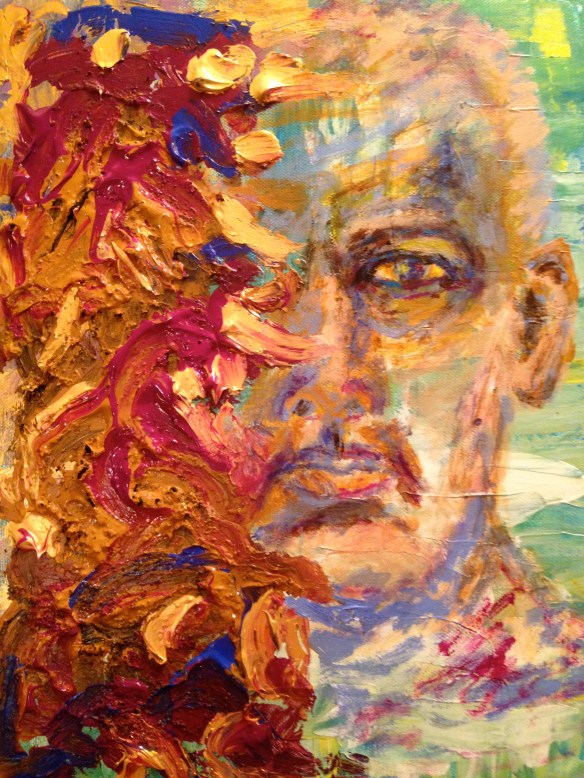
“The Emergence of Love” Painting: Ronald Raab, CSC
The Emergence of Love
Today’s gospel (John 13: 31- 33a, 34-35) gives us another chance to reflect on God’s love for us. We grow in love when God’s love is shared with other people. We change from darkness to light, from hatred to love.
We remember the Last Supper today when Jesus invites us to wash feet and remember him with bread and wine.
We remember from the Lenten season the Pharisees standing around the adulterous woman and we know that we remain a church and a society of stone throwers.
We remember the Prodigal Son coming home and his father running to great him on the path. We remain a people who only stubbornly forgive.
The Book of Revelation reminds us that the old order will pass and something new will happen.
Our lives emerge in love in the Easter Season. Jesus’ resurrection invites us into something new where love is real. Forgiveness takes time. Washing the feet of people is ongoing. Sharing love never ends.
We emerge from bigotry, hatred, violence, despair, from stone throwing and a lack of forgiveness, and loneliness only in the love of Christ Jesus.

Fifth Sunday of Easter: John 13:31-33a, 34-35
On the Margins from Mater Dei Radio, Portland, OR
In these Easter days, we are called to put love into practice. Love that comes from Jesus’ passion, death and resurrection, love that come from our hearts being converted to the needs of our world. Let us love fully, with open hearts.

“Tender Shepherd” Ronald Raab, CSC
Column from parish bulletin on Good Shepherd Sunday
Dear Followers of the Risen Christ,
Jesus chases us. He pursues us because we already belong to his love and kindness. Jesus wants the best for us because he has already suffered and died for our lives. Our salvation is not our making. Salvation is a pure gift. He looks kindly upon us, not to judge but to offer us a life that his filled with hope, mercy and forgiveness.
This Sunday’s gospel (John 10:27-30) reveals to us again the love of the Good Shepherd. The Fourth Sunday of Easter is traditionally known as “Good Shepherd” Sunday. This image to express the foundation of God’s care for us is a perfect and profound image for the new life that is offered us in Easter.
When I was at Notre Dame for the Holy Cross pastors’ meetings, I went to the Morris Inn for breakfast before leaving to come back to Colorado. There was gathering of new students and parents. So as I sat down at a table to be served my meal, I noticed a father and son across from me. The father’s back faced me but the son’s posture toward his father was in full view for me. I could witness every expression of the son’s face. The son leaned into his father’s presence. The son could not take his eyes off his father. The son spoke to his dad without blinking, he spoke with confidence and fidelity. The son was speaking German to his dad but it did not matter what language he was speaking. His posture and attitude conveyed everything to me.
I admit that I never spoke to my father in such a loving and convicted way. My eyes would have diverted with uncertainty and shame. I suspect that is the experience of most people. This young man’s posture toward his father and toward life will forever be in my heart because this is the posture of real prayer. We need the firm conviction that the father wants the best for us and desires us to thrive.
Are you able in this Easter Season to look Jesus and the Father in the eyes? Are you able to receive the tenderness of Jesus? I hope you will be able through the gift of Easter to feel good enough about your relationship with God to not have your eyes cast down in dread or shame or regret. I hope you will be able to directly come to Jesus to tell him what you need and to be grateful for the opportunity to look him in the eyes.
I have heard so many times recently that people have given up on God. They do so because judgment of the Church is their only experience of faith or community. They give up on God’s searching for them because they are divorced and remarried or because their son or daughter is married to a same-sex partner. They may have given up on the face of Jesus because the faces of people in the pews are harsh and unwelcoming. Their eyes are cast down from the love of God because other people have told them they are not worthy to receive communion or to find a home within the Church.
This gospel and image of the Good Shepherd is at the heart of the Year of Mercy. We need to find ways in which people will understand the love God has for them whether or not their lives are hindered from the rules of belonging in the communion line. We cannot give up on people nor condemn them or judge them. We must seek people out and be kind to them and help them gaze upon the eyes of Jesus and the Father. We cannot let labels completely identify people.
As I mentioned last week at all the Sunday Masses at Sacred Heart, we are working with a consultant from Orlando to look at a plan for our three parishes. We hired an architect last year to design plans for our buildings. Marilyn Blanchette is now helping us focus our future on who we will be and our witness in faith. This work is time consuming and difficult but should provide great outcomes for our future. I will be letting you know more about these plans as the weeks go by. We have also talked about how communication is such a problem and that very few people will read these sentences in the parish bulletin. However, we are forging ahead to provide a future for this community many parishioners input and the words of our consultants.
This coming week the priests of the Diocese of Colorado Springs will be in Breckinridge for meetings. Please pray for us. Our Holy Cross priests from our novitiate will be presiding at daily Masses here at Sacred Heart Church. Fr. Ken, Fr. Don and Fr. Mike will preside this week at 8:00am.
Blessings in this Easter Season,
Fr. Ron
On the Margins: The Fourth Sunday of Easter, April 17, 2016
Mater Dei Radio, Portland, OR
John 10:27-30. We listen attentively to the voice of Jesus. We pay attention in love and hope. In this Year of Mercy, we are attuned to the voice of love. I pray for you this week that you may understand the healing and comforting voice of God. We seek the tenderness of Christ.

Saturday April 9, 1983 John and Rosemary Raab Bishop William McManus
I attended the ordinations of Matt and Dennis last Saturday at the University of Notre Dame and then attended meetings of our Holy Cross pastors this week. The ordinations took place in the Basilica of the Sacred Heart where I was ordained on this day in 1983. I am deeply grateful for my priesthood and for the holy encounters with people, relationships that teach me about the love and mercy of Jesus.
I hold on to these beautiful moments around dinner tables and altars with longterm friendships and new friends along the way. Here are some examples from this past week. These are moments I celebrate as a priest.
Linda, a graduate school classmate and I shared dinner for nearly four hours.
Steve and I toasted at dinner because the MRI revealed his MS is stable.
Jim, a former co-worker, and I spent several hours reminiscing. I am always inspired by his genuine integrity.
During the crowded reception after the ordination, a seminarian told me he is leaving Holy Cross. I am deeply honored to hear the reasons of his transition.
I learned a former co-worker and his wife are expecting a boy this summer.
I learned that a former parishioner died of an overdose this week.
Bob is preparing for his mother’s death.
There were about twenty Holy Cross men at the pastors’ meetings talking around a large table.
I prayed at the statue of Saint Andre Bessette in the Basilica of the Sacred Heart, the church where I was ordained.
I comforted the mother of one of the men ordained on Saturday just before his first Mass at the Basilica on Sunday telling her that nervous mothers have sat in those pews for over a hundred years.
Sue, Angela and I were told that we were allowed only two hours in the restaurant for Saturday breakfast. We eventually gave up our seats. We were also “ssshhh-ed” in the church just before Dennis’ first Mass on Sunday because I was laughing.
I prayed at four Masses at the Basilica: the ordinations, one first Mass, a daily Mass presided by a cardinal from Nigeria and a memorial Mass for Fr. Elizondo, a former Notre Dame faculty member who took his own life in San Antonio.
I visited Uncle Tom and Aunt Pat in the nursing home twice and prayed with them.
I prayed at the graves of my mom and dad.
The Third Sunday of Easter: John 21-19
On the Margins from Mater Dei Radio, Portland, Oregon
The disciples discover the abundance of fish and recognize the Risen Christ. We too, discover the abundance of Christ in our need.

On the Margins from Mater Dei Radio, Portland, OR
The Second Sunday of Easter or Divine Mercy Sunday
This is Divine Mercy Sunday. We hear in this gospel Thomas coming to Jesus probing the mystery of the wounded Christ. We too, are to touch the suffering of the Body of Christ, to offer healing and hope to people.


Photos: Rusty Kern

