Read my latest article in Ministry and Liturgy Magazine. This month my column, “Bridge Work” is highlighted on the Resource Publication’s website. Click here to read, “Easter: the best for us.”
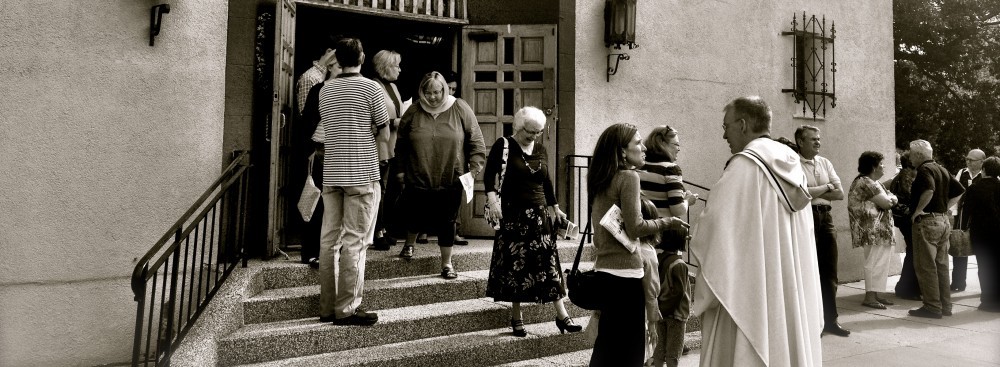
Read my latest article in Ministry and Liturgy Magazine. This month my column, “Bridge Work” is highlighted on the Resource Publication’s website. Click here to read, “Easter: the best for us.”
Triduum treasures
I remember walking into the dilapidated, former gymnasium next to Moreau Seminary at the University of Notre Dame in Indiana. I was an undergraduate preparing to enter our novitiate in Colorado. Graduate seminarians told me about an entire room filled with old steamer trunks. So I talked a classmate into going with me deep into the storage room in the old gym. We shoved an old wooden door out of our way. The musty door gave way to an entire room filled with large black trunks from seminarians and priests from the 1930’s and 1940’s Continue reading

I just received copies of my new book from World Library Publications in Chicago. The book, “Save Us, Send Us: Praying with Litanies” was written while I was serving at Saint Andre Bessette Church in Portland, Oregon. To order the book, CLICK HERE.
The editor writes, “The gospel call and challenge for justice and peace echoes through the insistent ryythm of these prayers, while the repeated responses call upon us to entrich own understanding of God’s presence and work in the world around us.” Continue reading
This article is published in Ministry and Liturgy magazine: December 2013/January2014 volume 40, number 10
From the souls of the forgotten: Lenten preaching
 Shortly after I was ordained a deacon, a mother of a mentally disabled man approached me after Sunday Mass. She told me that her son was not allowed to receive communion in the other parishes that they had attended. She begged me to work with her son. She grabbed my attention when she told me that her son was my age. She was a frantic, yet strong mother. Her grey hair was pulled back off her face, her shoulders tight from exhaustion and concern. She introduced me to her son, Dennis. He was extremely polite and seemed so interested in our conversation.
Dennis and I discerned his readiness for the Eucharist during the next months with catechists and his mother. After getting to know Dennis, I realized he was teaching me more than what I was offering him. He taught me to really need God, not in an intellectual way, but from the gut. The teacher-student relationship was blurring. He companioned me during those formative months as I learned how to preach and how to lead public prayer. He walked with me through Lent and those last minute preparations for priesthood ordination after Easter. Continue reading
Ministry and Liturgy magazine, August 2013 issue
Online version of this article: click here

Among dusty coins: preaching to the lost among us
Several years ago, I preached a parish mission in another state. At the early Mass on Sunday morning I noticed an attractive woman seemingly engaged in my homily. She was stately and well dressed yet she was rather jittery, shuffling her body from side to side in the pew. Her face carried a deep sadness that I noticed across the many pews that separated us. Her facial expressions changed rapidly as she reacted to my words. She wore a large, oversized, navy turtleneck shirt. The neck of the shirt was unrolled high up to her chin.
She attended the evening session of the mission as well. She wore a different colored turtleneck, jeans and boots. She seemed even more attentive to my words and I could tell even during the homily that she wanted to speak with me. After the session, she waited for people to leave. She approached me and began to open up about her story. Continue reading
Originally published by Ministry & Liturgy Magazine, June 2013
–PDF version-
I remember when I first started to speak about people living with HIV/AIDS in my homilies. I was serving in a parish community in Colorado Springs beginning in 1984. In the local hospitals during those early years, chaplains and clergy would stand in the hallway near the patient’s door and yell into the room at the person who was sick. Everyone in the medical and religious communities was afraid of this unknown, infectious disease. People who were in those hospital rooms were outside the boundaries of comfort, care and love from many people, organizations and institutions.
I started to learn more about AIDS when a young man knocked on my office door. He stood in the threshold of my door because he was afraid I would reject him. I then brought the issues of not only his life but of so many others who were ill to our community through the gospel message on Sunday mornings. I remember parishioners secretly handing me money after Mass to help with people who were losing their jobs, insurance and even their families.
I remember this complex mix of AIDS and preaching as I ponder these challenging sacred gospels from The Assumption of Mary through the Triumph of the Cross. Luke challenges us that the last will be first and the first will be last. We hear that many people are still knocking on our doors and saying, “Lord, open the door for us.”
As preachers we must realize that no person is out of the bounds of God’s love and mercy. We cannot claim in our preaching who will be first or last. The suffering of our people is fuel for our words as homilists. As the years go by, I realize to the depths of my being that people come to Mass in order to make sense out of their suffering. They not only hold up their pain to God but the pain of people in their families and communities. Preaching the issues of people who feel on the outside of God’s love is central to the mission of our ministry.
Today, I preach among people who feel outside of the institution of the Church and outside the boundaries of God’s fidelity. I am confronted with the narrow door every time our staff turns people away because we do not have the resources to help them. I understand the tight passageway into love when I hear a young mother who comes to our chapel just after her boyfriend has beaten her. I know the narrowness of the gate into the Kingdom when I still want to judge people who criticize other people living in urban poverty.
Jesus desires a fire of faith on the earth and yet knows there will be division among families. As preachers we keep the flames alive when we name the suffering of our people. We cannot just label people as “poor” or “sick” or “addicted” or “abused”. We must enter into the experience people face when these issues tear families apart and when housing is out of their bounds or when people cannot afford health care for their vulnerable children. We must then be prepared to face the criticism within our church families.
I hear from many preachers that it is easier to speak about official Church teaching than to open up the healing gospel for real people’s lives. It is easier to hide behind the door that names people as sinners than it is to search for the real reasons people sell their bodies, become addicted to drugs or even leave their wives and children. We cannot confuse obedience to the Church for the fire of faith that people need to find in the hurting lives. We all must touch suffering in order to heal it. When we all discover the truth of life we will all become more faithful to presence of God within the Eucharist.
Jesus reminds us in these gospels to invite the poor, the crippled, the lame and the blind to our banquets so that we will not receive repayment here on earth. This means that all people who stand at our doors are already members of our communities. Our preaching must break through the labels we attach to people. We must articulate and model that people suffering all forms of poverty are fed just as any other member of our communities. We live an illusion when we think God’s love is only for those whom we think are deserving, or who have enough money to support the parish, or who do not challenge our comfort, or who will repay us with clerical perks and a better lifestyle.
Jesus also confronts us with the reality that we must renounce all of our possessions in order to be a disciple. As preachers, we stand with people who have little so that we all may trust God more profoundly. These possessions are often our attitudes about our neighbors and our narrow mindedness about God’s fidelity on earth. When we stand with people who feel they are on the outside of our communities, we can help them by using our preaching to knock on the door of God’s faithfulness and on the closed doors of our worshipping assemblies.
Originally published by Ministry & Liturgy Magazine, May 2013
– PDF version –
Just a few weeks after I was ordained I gave a homily during a funeral. I did not know the person, an elderly longtime parishioner in South Bend, Indiana. After the funeral, as I was preparing to ride in the hearse, an elderly, quirky man resting on a wooden cane approached me by the car. He sported a worn, wool sports coat with a scarf hanging nattily around his neck. He whispered in a quiet voice, barely audible above the crowd, “You certainly have a way with words.” I thanked him cordially. Then he leaned closer into my earshot and said, “ Don’t get too big for your britches.”
I admit after all these years; I still hang on to the old man’s advice. His influential words still shape my preaching and give direction to my homilies, not only for funerals but every time I open my mouth to give perspective and witness to God’s word during the Eucharist.
I pass on this piece of advice as I listen again to the gospels between the Fourteenth Sunday and Nineteenth Sunday of Ordinary Time. The shape of the liturgy and the message of these gospels remind us neither to cling to self-importance nor to depend upon our physical possessions when preaching and living the word of God. Jesus sends us out along with the seventy-two to carry little with us; no extra sacks, sandals or money belts. With these few possessions and a reminder of the essentials of lasting peace and emotional and physical healing, we are bound not to get too big for our britches.
I now preach among people who have few possessions and who ache for this peace and healing. Preaching is a vivid and real expression of my own conversion as I try to let go of all that gets in the way of living a simpler, less cluttered life. These gospels shake us from our everyday, numbing patterns of life. The Holy Word invites us and even compels us into real action in the world. As preachers, we cannot be deaf to these gospels nor can we expect others to hear them without us reflecting upon the way we live them out ourselves in our everyday life. On many days I ask God that I may first be changed by the gospels. I want to model what I say, that my words will come from a life of integrity and honesty.
I long to make the connection that the love of God is manifest in how I love my neighbor. The Good Samaritan models for us who preach that our words must bind up wounds and our words must become a balm of healing and reconciliation. When I preach those words, I am confronted with how my words so often crush and offend and how my words separate and divide people in my daily life. These connections of action based on the words of Jesus in the liturgy are non-negotiable, especially for the reader of the gospel and the preacher of these God-given texts.
As preachers we must not think that our preaching and God’s message are just for other people. This is a real professional trap that I have noticed within myself and I hear among other preachers. The message of love is for others, but not for me. The message of fidelity, kindness and service are easy to speak but take a lifetime to live. I have learned to be more patient with myself but also to keep the challenge alive. I am no longer worried about the structure of the homily, the acoustics of the church, and the quotations from saints, popes and popular piety. I am no longer focused on rich sentence structures or a turn of phrase. Now that I am preaching among people who have few possessions, I am no longer worried about my delivery, my homiletic style or even a consistent theology or even precise exegeses. However, I do worry whether or not I can actually live the message I proclaim, the heart of the words Jesus spoke to those who followed him and those he sent out among wolves and naysayers.
I admit that the balance of Mary and Martha’s approach to Jesus’ presence is quite sustaining to me as a preacher. In order to serve with words from my mouth, I must first sit at the feet of the One who hears my woes, who challenges my status quo and who binds my wounds. If this connection is not made, my words will be hollow and untrue. If I do not rest my heart and all of my belongings and the feet of the Master my journey will be only into the depths of selfishness and self-aggrandizement.
As preachers we all must fit into our clothing. We cannot get too big for our britches in the name of the Kingdom of God. We must take to heart the call to sort our belongings, to let go of our attachments and to serve with our words unceasingly. I continue to learn these lessons long after that first encounter with an elderly man who had the courage to put me on the correct path and to send me out into the mission of preaching.
Originally published by Ministry & Liturgy Magazine, April 2013
– PDF version –
I preach among people longing for change and healing. I have learned a deep and passionate reliance on the Holy Spirit especially in the past eleven years ministering among people where answers elude everyone. Ministering among people in recovery from drugs and alcohol teaches that life cannot be forced or inauthentic. I cannot live another person’s life no matter how I may believe in or desire their talents. I learn among people without a home or shelter that I cannot live too far into the future, because life today is overwhelming and yet so full of grace.
I learn to trust the Word as bread as we all hunger for more. As a preacher of the Word, I trust in the Holy Spirit to tell us all the truth. The Solemnity of the Most Holy Trinity begins a series of texts proclaimed on Sundays that stretch us as homilists into a deeper trust that God still feeds us all. The Holy Spirit is here now, our guide into the heart of the Father’s love.
On the Solemnity of the Most Holy Body and Blood of Christ we hear this human hunger for something more. The people following Jesus were famished and the disciples insisted that they be dismissed in order to find food. Jesus says, “Give them some food yourselves.” This message is not only about ravenous people on a hillside but for those of us who preach. We are called to take seriously the deep hungers of our people. We are to provide nourishment from our preaching so that love, forgiveness and hope will satisfy their longings. This is the promise that the Spirit has more to say in our day. Preaching becomes bread and food, love and compassion, nourishment and pure grace if our hearts hear first and trust always the Good News.
We preach this Good News, but never in a vacuum. The Gospel is always rooted within the lives of real people. The moral teachings of the Church, biblical exegesis, sacramental theology, and even social justice cannot be the only source of our preaching. Preaching is a dialogue between the Word of God and the reality of people’s lives. This is the place that sparks the Spirit’s healing and satisfies hungry souls. The people of God need to hear from the preacher that their experiences are validated, that their pain is named and that their lives have meaning here on earth. People long to be free of guilt, shame and anger that come from life’s daily grind. The listeners need to recognize their stories of searching in the light of Christ’s passion, death and resurrection. The liturgy must always be connected to people and effective preaching bridges the sacred Word to the suffering and anxiousness of our worshipers. Good News heals and sustains.
We hear this Good News proclaimed when the woman from Nain lost her son in death. Jesus passed by and the dead son rose up and he spoke to his mother. This incredible miracle cannot be overlooked nor can the suffering of our people be hidden. We all need to hear the words of Jesus, “Do not weep.” “Young man I tell you to rise.” We not only need to hear these words from Jesus, but we need to encounter the person of Christ for our own lives. Sometimes canned words, stock phrases and quotes from Church documents are easier to rely on than to invest our time and our lives in prayer to discover Christ Jesus, but we need to take the time ourselves to listen.
We listen to the extravagant devotion of a sinful woman who drew near to Jesus at the table of the Pharisee. She approached Jesus weeping. Her tears bathed his feet. She wiped his feet with her hair. She anointed his feet from the expensive ointment in the alabaster jar. This incredible act of intimacy shatters the cultural barriers of their time. Relationship with God and the intimate nature of our prayer shatters in our day the impression that healing is for the well behaved, the moneyed and the well educated. For those of us who preach, we must spend endless hours at the feet of the One who freed the woman named a sinner. We must imitate her generous spirit, her humble presence and her lavish gift of tears.
Jesus invites all of us, “Follow me.” Like the disciples we come up with all kinds of excuses not to follow the deep, profound path that leads to trust and honesty. Jesus invites us as preachers to never let go of the plow and never turn back. The words that Christ invites us to offer come from years of practice, a life of profound prayer and the courage to speak among people who desperately need God.
The Holy Spirit reminds us that there is a deep well, a lasting reserve of trust for preachers. We will never run out of authentic words because we live among people who need God in a new way every day. We will never be short of something to say because we also depend on nothing else but the Holy Spirit every time we proclaim the Gospel and stand amid the assembly as believers and preachers.
Originally published by Ministry & Liturgy Magazine, March 2013
– PDF version –
On Easter morning I peer into the empty tomb along with Mary of Magdala, Simon Peter and the other disciple whom Jesus loved. I long to make my home in such emptiness. I long to hear for myself the proclamation of Good News from the surprise witness of Jesus’ friends. The meaning of such emptiness is still being realized in our world, within our Church and in the minds and hearts of all who survive poverty.
Emptiness is a way of life for people who make their home on the streets and who live in the shadow of our riches. Emptiness is a stomach that needs to be filled every day. Emptiness is a body that needs medication for disease and mental illness. Emptiness is the backpack that was stolen during the night. Most of all emptiness means the loneliness and absence of meaningful relationships for many people who either live in single-room occupancy hotels or under the bridges in our neighborhood. Emptiness, loneliness and isolation actually kill people not only in our neighborhood but also in rural communities and large cities throughout our country.
As a preacher in the Easter season, I peer into the empty tomb and my joy begins by learning how to articulate Good News to people who most need to hear it, to the people with whom Jesus gathered, ate and spoke during his ministry. The empty tomb is a rather clean slate, an open window, to explore how grace is given now, not just on the day of Mary of Magdala’s breathtaking observance. The Sundays of Easter give us who preach the images, the context and the love of Christ to continue proclaiming the Resurrection in our day and time.
The Second Sunday of Easter invites us all who preach to sit still behind the fear that paralyzes people. Jesus’ friends begin in isolation and in dread to begin the Easter message. The doors were locked and their lives trembled with worry. Then in their fearful emptiness comes the Risen One from out of nowhere. They touched the wounds of the Christ: the hands of graciousness, his side of salvation, and the feet of the journey. They believed and their fear melted before them. Thomas needed his own experience. He touched the Mystery of the Risen Christ, the redemptive wounds of love and the future of belief for us all.
No matter the context of our preaching or the people who worship in our pews, offering a homily within the Easter season must offer people this redemptive touch. We all must preach from our experiences of touching the Mystery of Suffering. We must know first hand the grace that is offered us when pain makes us turn toward God. Jesus is found when we name the pain. Freedom from this life comes in our hearts when we learn there is more going on within us than our own reluctance, stubbornness or doubt. As preachers in the season of Easter, allow Thomas to show you the way to unlock doors and to live a new life of freedom
On the Third Sunday of Easter, the disciple whom Jesus loved verbalizes his eye-catching miracle, “It is the Lord.” The emotion of this recognition cannot be lost on us who preach. We must feel the tenderness and the certainty. We need to look at our own lives for such a miracle and we must be able to draw people into this healing encounter so that we all may find the Risen One. Peter jumps into the sea, the nets are full and Jesus invites him to eat. After the meal then Jesus challenges Peter into a loving relationship with the Risen Christ and into love for the lowly followers, the lost ones, and the people who need Christ Jesus. As preachers who articulate the presence of Christ for others, we cannot discount the number of times Jesus asks Peter these things. We also must realize Jesus’ numerous commands to us to feed the emptiness of people’s hearts and lead others to the miracle of communion on the seashore.
For many preachers, the Easter season is exhausting and we may ourselves feel empty, exhausted and alone. The sacraments for students and weddings for adults demand much time. Preachers in large parishes seldom have time in this holy season for self-reflection, quiet prayer and solitude for homily preparation.
The Fourth Sunday of Easter claims the most familiar image for our people, the Good Shepherd. This image is not meant to build up the ego of the priest as one who searches and finds the lost here on earth. The image does not lessen people by claiming we are only sheep. The image is of the tenderness, caring and love of communion. We preach with this image beginning with our relationship with Christ, being found in the arms of the beloved.
As preachers we claim the continuing miracles of Resurrection from the emptiness we all find within our lives. Our communion is not just in the Body and Blood of Christ at the altar table, but within our words from the jaw-dropping love that comes from peering into the empty tomb on Easter morning until the day of Pentecost.
Originally published by Ministry & Liturgy Magazine, February 2013
– PDF version –

I prepare for the Triduum by sitting on the ground. I want to make sure that I do not miss anything. I make this physical gesture because that is where the scriptures and the liturgy seem to take me during Holy Week. I hit the ground because my preaching depends on me finding my authentic belief in the power of God to raise us all up.
Before Palm Sunday, I bend my knee to God according to Philippians to prepare for my homily. I am very conscious that people seldom see the priest get on his knees in prayer during the Eucharist of Ordinary Time. This is a place, a gesture for my personal prayer where the Word of God washes over me. Bending down alone to read the passion narrative brings me to the bodily pain of Christ Jesus and to the people who suffer alone. Here I recognize my powerlessness to really change or heal or mend anything.
As I prepare for Holy Thursday, I know I am not alone on the floor. The disciples responded to Jesus’ request and his gesture to bend down and wash their feet. I am confronted with all the ways I have yet to bend low and see people’s needs in front me. On the floor is a better position to encounter my Savior who invites me to extend my nakedness, my feet and my soul. I will encounter the feet of people who have the courage to extend them in public, but it is their faces that I will see more clearly.
The Good Friday liturgy begins with the priest on the floor. I have to be on the floor in my own prayer in order to feel the public posture of giving my all to God. I cannot give what I do not have. Prostration does not mean anything unless I feel the powerlessness well beforehand. The floor connects me to people who sleep on the sidewalk outside. The floor reminds me that I do not have answers for others’ problems or power to wield. The floor becomes a sacred space in which I am reminded that Jesus walked along a dusty path on the way to the cross. The floor, the ground reminds me that I will one day be dust.
If I do not spend time in prayer and reflection on the ground, I will never be able to peer into the empty tomb. My proclamations of new life will be stilted and softened by my own stubbornness and lack of faith. I want to run to the tomb on Easter morning. Easter will compel me off the floor as I peer in again to find Christ’s garment. I want to announce that healing will happen among our relationships and that freedom from physical and psychological pain is possible. I will get up and search and run and explore my own life in service and in ministry.
The preacher has much work to do during Triduum. The work must be centered on God. The homilies for the Triduum reflect our belief or unbelief. Our preaching will reveal our anger and our rage in life. People will notice our unhappiness, our tiredness and our unbelief. The homilies of Holy Week are an open window to the soul of the ordained. People will see everything, even the things we want to hide during the rest of the year.
Preaching during Holy Week must not be flimsy, sarcastic or full of jokes. We should not use stories that are not our own. The Christ Story must reveal the grace of people in the pews. Homilies must open up grace especially for people who feel that grace has eluded them. For people striving to find work, raise rowdy children or who have recently buried a parent, the grace of the ground of Jesus’ path must open up to them a new love. People must find themselves in the story of the Crucified; they must see their faces in the face of the Beloved who journeyed far deeper into suffering, into death itself.
The preacher must make the genuine connections of our faith in Holy Week. This is the week of all weeks for we who preach to really believe our spoken words and the written words of the gospel. This week there must be no silliness or props or cutting out homilies from a published book or pandering to the wealthy to raise money. People gather for the sacred week to find the deep and profound meaning of their lives.
People will know immediately if we have spent time in prayer on the floor. The deaf will feel the new conviction. The blind will understand with their ears. Those without a home will rest comfortably in the belief of the preacher. The mentally ill will find the rich calm of faith from the soft spoken words of a preacher who stands up from the floor and preaches the Easter message of love.
 Broken But Not Divided