Colorado Springs, November 2022, Violence and Response: “Would you at least listen to me?”

Colorado Springs November 2022: Violence and Response: “Would you at least listen to me?”

I just moved from Colorado Springs, Colorado this past summer. I ministered among people for nine years at Sacred Heart Parish, from 2013-2022. I listened to people’s pain. I sat among folks who were estranged from family, friends, and from the Church. I celebrated and grieved. I listened and consoled. I worked as any pastor does, in the unexpected and chaotic moments of people’s lives. I was honored to be present to people in Colorado.  

I also lived and served there in 1984-87. At that time, AIDS was beginning in Colorado. I found myself confronted by a young man who came to my office. He stood in the threshold of my office door. I invited him into my office. He said to me, “I have asked three other priests to listen to me. They would not listen.” Then he asked me, “Would you at least listen to me?”

I acknowledged his question and he came into my office and we talked for three hours. He died of AIDS a few short months after our conversation. That question became the core of my priesthood. I hold it in my heart. I have prayed with that question for nearly forty years. It has become an instrument for Jesus’ presence in my life.

That question also led me to becoming a founding board member of the Southern Colorado AIDS Project during my time there. I used this man’s insistence to listen to other people’s stories, to hear with newness the pain that they experienced. I remember the mothers of the men who died. The mothers wanted me to listen to them with the same awareness and compassion. The mothers, most especially, needed the presence of the church. They leaned on me to console them and to walk with them to the gravesites of their sons.

The question posed by a man dying of AIDS also led me to other cities and ministries among people surviving AIDS. I ministered across the country among families grieving much loss for the first twenty years of my priesthood. The question has not died. The question is a birth place into God’s deep compassion for people.

Colorado Springs is facing another tragedy. A man walked in a gay bar wielding a rifle on Saturday night. Many people were killed or wounded. He faces murder and hate crimes of five people. Somehow, we need to listen. We need to listen about our freedoms to carry guns from the families who have lost loved ones. We need to listen to the grieving families, especially the mothers, who have lost a gay child. We need to listen without our preconceived notions about who we think people are in this world. We need to listen because our world depends on us believing in the power of God’s love for all people. In death, divisions among us should cease. Love must bind us in grief and loss.

We need to listen to people who educate us about mental illness that causes a man to kill people without mercy. We need to listen to people who just want a space to live freely. We need to listen, period. I noticed that many of the wounded were brought to Catholic hospitals. The Church is there as it is for anyone. Yet, we need to listen even more deeply to the wounded and help them survive the tortures they face.

I ask everyone to listen from these events in Colorado Springs. Perhaps we can join our hearts in prayer and our lives in works of justice so that the fruit of our listening may be known throughout our neighborhoods.

God, give our beloved dead, peace.

REBLOG: “A Reading From The Prophet Bonnie” from US Catholic Magazine, November 2008

God’s messengers are often just as surprising as the words they bear.

Advent always opens me up. Just when I think I am in control of my life and ministry, I am confronted by the challenges of a new liturgical year. The prophets get under my skin. The gospels splash my soul to surprise and awaken me.

Never has Advent shaken my priorities as the year Bonnie camped out in front of the red doors at our urban parish. Our small chapel in Old Town, Portland, Oregon serves our low-income neighbors, our homeless friends, and people just getting on their feet after prison. Just before Thanksgiving Bonnie wheeled a shopping cart to the front door filled with her stolen treasures: picture frames and toys, extra sweaters and fake flowers.

Bonnie signed up for our hospitality center on her first morning in search of new clothing and a warm breakfast. Her boundless energy disturbed everyone’s routine in the small basement room. Suddenly our entire staff, volunteers, and the room full of guests awakened to her forceful presence. We panicked as she stuffed food into her pockets, paperback novels under her jacket, and rolls of toilet paper in her plastic bag.

Bonnie’s kleptomania unnerved the staff, her penetrating voice disturbed many of our shy guests, and her wiry presence evoked fear in me. Bonnie began her Advent journey by disturbing our entire operation.

She prayed during Mass on her first day with a voice that could stop a train, screaming out every liturgical response at the right time but with a dozen extra words. She threw off the rhythm of our common prayer so completely that the entire congregation stopped speaking. People erupted with complaints and tried to quiet her. Bonnie persisted with her prayer.

Many of us were left confused and bewildered in those first few days with Bonnie. She stirred up resentment among our neighbors, angered many parishioners, and even blocked people from entering our front door.

But I also began to notice something shift inside me. Slowly I opened my eyes to see her differently. I began to hear the message of Jesus in Mark’s gospel: “Be watchful! Be alert!” Bonnie shook me out of my own sleepiness toward people who suffer beyond my imagining. I started to interpret her disturbing actions and screeching voice as our Advent wake-up call, a real prophet in our midst.

She challenged our professional ideals regarding how we deal with crisis and how we try to keep order as we serve the poor. As the voice crying out in the desert, she echoed the words of Isaiah and John the Baptist to get our acts together and let go of our control. Bonnie was not going to let us get too comfortable thinking we were in charge of our lives or even of the parish. Once we all began to see her as a gift to us, she started to change our experience both of her and of the Advent season.

One day during Mass I heard Bonnie screaming outside the chapel. She was trying to stop people from stealing her things. When Bonnie started screaming, I saw one of our parishioners leap out of the pew to go outside. There was something about her scream that day that was raw and primal.

I felt deep sadness rise up in me. Bonnie was communicating to us that many things in our society are not right. Her haunting scream reminded me of all the ancient prophets who tried to get the attention of people to reform their lives and society. I heard in her scream the challenge to wake up and realize that addicts need shelter and sobriety, people need adequate housing, and the mentally ill need affordable medications. I felt in her scream the poverty of the world.

Bonnie also changed my perceptions of her loud responses at Mass. In the very predictable patterns of common prayer, I understood by her piercing voice that those who are marginalized by poverty or mental illness need to be heard. Mass could no longer be prayed on autopilot. We had to think about what, how, and why we were praying the liturgy. She made us think about our responses to the Word that was proclaimed. She halted us in the middle of blindly reciting the Creed. Like the biblical prophets before her, she was teaching us how to pray and live with new awareness and intention.

Bonnie still reminds me that most of the suffering around us remains hidden and secret. She helps me realize we all must take on the prophet’s role when disease, poverty, loneliness, and financial instability grab hold of our communities. People who suffer silently need the voices of the rest of us to speak up for the abandoned and neglected. The Advent season calls for courage and conviction to make faith real, inviting, truthful. Advent is a time to go deeper into our human condition, beyond the surface of relating to one another from our financial status or educational backgrounds or the styles of clothing we wear.

One day Bonnie approached a woman named Sally, who was born with one arm shorter than the other. Bonnie walked up to Sally and said, “Don’t worry about that arm, honey. When Jesus comes back, he will fix that right up for you!” Bonnie really believes in Emmanuel, God-with-us. She even voiced God’s consolation and joy announced in the prophet Isaiah: “Comfort, give comfort to my people, says your God.”

I thank God for our prophet Bonnie. Even though she washed her glazed donuts in our baptismal font, collected our hymnals in her shopping cart, and took hundreds of our plastic rosaries to wear around her neck, we all recognized that she carried Christ into our midst. She unstuck my notion that Advent is about the purple polyester fabric in the sanctuary or the flattened, artificial greens with faded, purple ribbons posing as the circle of life. She helped me break open the lie that Christmas is for the rich and well-deserving. God desires to be in relationship with all of God’s beloved.

Before Bonnie left our parish, she knelt down in front of the crèche on Christmas Eve. Several parishioners feared her kleptomania as she approached the newborn king. Instead, poised in prayer, she placed a clean, meticulously folded purple blanket in the small stable. It was her cleanest blanket, her source of warmth on the cold Portland streets.

I never realized I would find the birth of Jesus in the center of mental illness, homelessness, and my own insecurity. God gave us the gift of hope years ago in a small stable and continues to grace us with real human beings who teach us that faith is about relationship. I wait patiently for Advent this year to see if our prophetic sister returns. I wait for love again to awaken me.

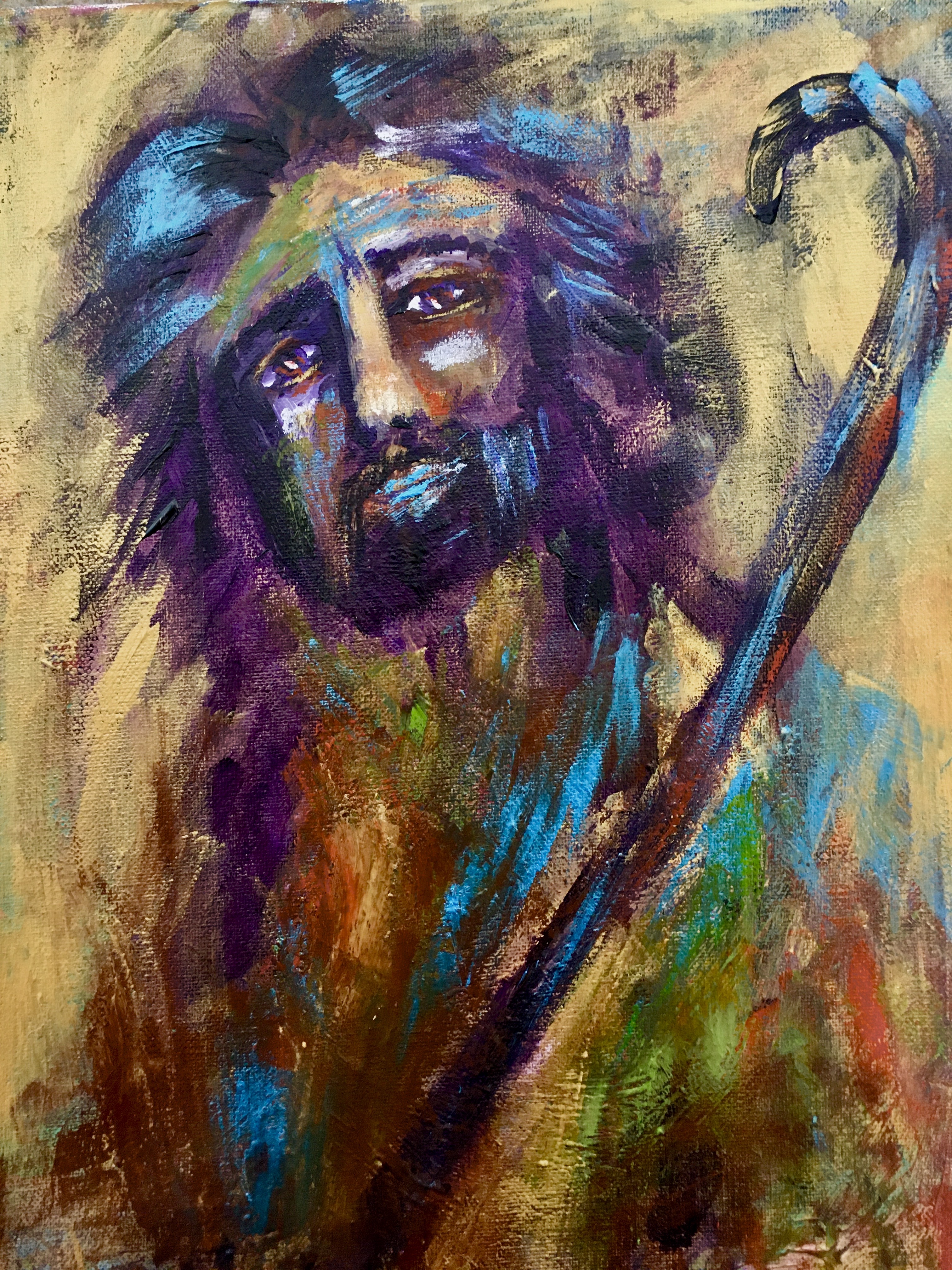
The Solemnity of Our Lord Jesus Christ, the King of the Universe, Cycle C, November 20, 2022, Luke 23:35-43, Reflection and Art

The Solemnity of Our Lord Jesus Christ, the King of the Universe

Luke 23: 35-43: Then he said, “Jesus, remember me when you come into your kingdom. “He replied to him, “Amen I say to you, today you will be with me in Paradise.”

On Friday, waiting to be seated at a restaurant, an enthusiastic grandmother introduced me to a vibrant boy who had been adopted earlier that morning. An adorable, red-haired lad, sporting red glasses and an incredible smile was jumping for joy. His two younger siblings were also adopted.

His face still opens my heart. He waited for family. He waited to belong. His grandmother believed Jesus had drawn the three children to their family. I believe Jesus remembered him. Jesus wanted the best for him. Jesus understood that he had suffered enough.

The conclusion of the liturgical year brings us to Christ the King. In the end, the repentant thief received Jesus’ forgiveness just before his death. In the end we all find what we need. We are adopted by the Savior. We belong to Him. He knows each of us. He wants us all to find such a grin and warm hugs on our adopted day; the day of baptism. No matter our sin, our heartache, our fear, Jesus reaches out to us, no matter what.

Christ the King lives in us. We are all different. Yet, we get what we long for. In the end, all will be well. In the end, we shall discover that only God unites us to others and ultimately to Himself. Jesus remembers us. He will provide what we need, to be adopted in Paradise even here on earth.

The Solemnity of Our Lord Jesus Christ, the King of the Universe, Cycle C, November 20, 2022, Prayers of the Faithful, Luke 23:35-43

Prayers of the Faithful

Let us pray to silence our sneering toward powerless people. May we silence our dislike of those who challenge us to think beyond our limits.

We pray to the Lord.

Let us pray to console the stranger.  May we tuck people’s suffering under the shepherding arm of Jesus Christ who tends every adversity and misfortune.

We pray to the Lord.

Let us pray to expose human loss under the shadow of Christ’s cross. May every anger be relaxed, every hardship be thwarted, every jeer be silenced, every unkindness be washed in mercy.

We pray to the Lord.

Let us pray to heal bitterness when unanswered questions poison us. May we cleave hate. May we trample forests of inner violence. May we surrender to love when we don’t know what is next in life.

We pray to the Lord.

Let us pray to whisper our sins into the ear of the Christ. May the blood of our Savior name every secret in the church. May every ill-intention be nailed to the cross of salvation. May freedom echo beyond our hurt.  

We pray to the Lord.

Let us seek forgiveness in the close of another Church year. May we bend our knees toward our enemies. May we find within our callused hearts only tender mercy.

We pray to the Lord.

Let us bring our grief to the feet of the King who accepts all earthly suffering, indifference, and loss. May we stand up and walk as children of the Light.

We pray to the Lord.

Let us pray our Redeemer will not forget us. May our loved ones who have died be remembered in the radiance of all good, gazing upon the face of Christ, our King.

We pray to the Lord.

Monday of the Thirty-Third Week in Ordinary Time: Luke 18:35-43, Reflection and Art. Healing of the Blind Man.

With my eyes closed before morning prayer in our chapel, I easily name the people gathering without seeing them. From these past few months, I recognize the shuffle of one man approaching his chair and the labored breathing of another. Without sight, I name a man by his walk, his cough, his voice, his cane, and even how he opens his prayer book.

The blind man knew more than people suspected. He felt others within him. He knew them, not be sight, but by their humanity, their love, their fearlessness. The blind man knew Jesus in this way.

He knew Jesus enough to shout out, “Jesus, Son of David, have pity on me!”

Jesus responded, “What do you want me to do for you?” The blind man responded, “Please, let me see!”

This holy encounter does not end with the restored sight of a blind man. This encounter continues in our blind hearts and lives. Jesus’ question is for every person.

With our eyes closed in prayer, may we see Jesus within us. May we know him by his gentle mercy upon our lives. May we be awakened to him by his approach to our closed minds, by his smell and his compassion walking to us. May we fully understand his desire to call us out of every blindness of body and soul.

So, what do you want Jesus to do for you this day?

Thirty-Third Sunday in Ordinary Time, Cycle C, November 13, 2022, Prayers of the Faithful, Luke 21:5-19

Sunday November 13, 2022

Thirty-Third Sunday in Ordinary Time Cycle C

For wise perseverance. May selfishness not rule our thoughts and actions. May apathy not override our talents.

We pray to the Lord.

For families overcome with burden. May we persevere in speaking love when we are bashful of its name.

We pray to the Lord.

For elders in dark loneliness. May we not pull the blinds on people’s talents. May the gifts of each generation shine with hope.

We pray to the Lord.

For people surviving poverty. May the struggling survive on the food of our empathy. May the Eucharist feed perseverance for all people.

We pray to the Lord.

For the exhausted. May we extend beyond cynicism to support the weary, the lost, and the grieving.

We pray to the Lord.

For people stripped of security. May we nail down our support to shelter people when natural disasters strike. May our perseverance shine like the sun.

We pray to the Lord.

For endless prayerfulness. May our grief-stricken hearts center on God’s Kingdom. May our hands forever be folded in faith and our hearts always laid bare.

We pray to the Lord.

For endless prayer for our dead. May souls that struggled on earth now know heaven’s delight. May we pray unceasingly.

We pray to the Lord.

Thirty-Second Sunday in Ordinary Time, Cycle C, November 6, 2022, Prayers of the Faithful, Luke 20: 27-38

For the fragile hearts of people who do not feel they belong among those they love. For wives who cry in the night and for children who feel lost in daylight and for husbands who question their decisions in life all day long.

We pray to the Lord.

For people who have lived through the difficult decisions of divorce. For children left in the wake of hurts and arguments. For unconnected families unstable about the future, uncertain about financial survival and distraught about how to love.

We pray to the Lord.

For the quest in our lives to make God first. May we not flatter ourselves about how we pray or the human techniques of accessing divine love. For people who search for something more in their uneasy relationships on earth.

We pray to the Lord.

For our loved ones who have died and their journey to heaven. May the obstacles of earthly relationships open a new door to God’s healing delight for all whom we have loved. May goodness abound in grief, may gentleness lead our hearts in loss.

We pray to the Lord.

For people who cannot bear their bodily pain on earth. May people surviving long-term illness and disease come to know the saving and healing hand of Jesus Christ. May we all learn to surrender to such love on earth.

We pray to the Lord.

For our November memories of our loved ones who have died. For the souls of relatives, strangers, and those who have died quietly on our streets. May every soul rejoice in home with God. May every soul that suffered on earth find peace in heaven.

We pray to the Lord.

All Souls’ Day 2022: Reflection on Matthew 5: 1-12

November carries extra weight this year. It rests heavier in my heart on day two. All Souls’ Day sings a haunting tune. This year, I remember my only brother who died in September. This year, I am still walking away from a parish community where I was at home for nine years. I also lost a job after a week. Now, I wait for something new, still listening to God to lead me beyond loss.

November connects us with our ancestors whom we follow in love. All Souls’ Day invites us to journey deeper into our human connections and not to be afraid of our past or our future. We listen carefully within our heart to find the rhythm and heartbeat of being alive in God.

November reveals the opposite of what we think is true. The Beatitudes call us to live humbly and not to exhort false power over people. Jesus calls us to mourn with faith, that in letting go, all heaven will be ours. Peacemaking will provide rich soil to plant our hearts in communion with other people. The poor in spirit, the meek, and the merciful will overflow with goodness and richness.

November teaches us that the end is the beginning. We learn to let go on earth, so one day we may enter the mystery that is ours in heaven. In the end, all will be healed, forgiven, and embraced. In the end, we shall be fully ourselves, fully aware, fully loving, in the place designated for us in Jesus Christ. This is forever our home.

CLICK here to learn more about All Souls’ Day from Franciscan Media.

Ministry and Liturgy Magazine: “In the name of death”, REBLOG from 2015

My column, “Bridgework” for August, 2015 in Ministry and Liturgy Magazine. I reblog this article to help us prepare for All Saints and All Souls this week.

In the name of death

In my first year as pastor in my present assignment, our parish community celebrated fifty funerals. I remember one funeral where only four people were present and yet the power of our ritual spoke so beautifully even among the empty pews. At another funeral, the sister of the deceased came to the parish carrying the cremated remains of her brother in a cardboard box. I slid my key along the masking tape of the box thinking that there was a container inside holding the ashes. I pried open the cardboard box and discovered the ashes were contained in a clear plastic bag.

At one rather large funeral, a son told the story of his father’s hands tucking him in bed as a child. As an adult, the son held his father’s hand while he was on his deathbed. The years in between the son’s childhood and the father’s death were cold and distant. The unnamed emotions between the child and the father seemed to hover over the congregation that day.

I also celebrated a funeral of a man who shot himself in his home. For many decades he faced the emotional patterns of highs and lows. He tried desperately to hide this pattern from the public. However, the emotional tide of depression overcame him and finally took his life.

People jammed into the church to honor him. Nearly another two hundred people waited outside. I tried my best to name the issues, the darkness he faced and our hope in Christ Jesus for all of us who remain. I kept coming back to the phrase in my own mind that there is no depression in the face of Jesus. The depression was not his fault. The suicide was not his fault. We cannot blame anyone who has a disease that sweeps us off the earth. Staring now into the face of Jesus, there is no depression for this man who left behind his mother, wife and children.

These human stories help form our faith. Each of these funeral liturgies teaches me that this grand mystery of death cannot be denied. Death is real and we must celebrate each person’s death with honesty and integrity. We must have the courage to tell the truth at funerals and share the honest stories at wake services. Death is not hidden among the flower arrangements nor can we pretend it does not exist by ignoring the details of the story so not to embarrass the living.

As so many families drift away from the rituals of the Church, the name “death” is also getting a facelift. People prefer to ignore the name of death altogether. “A celebration of life” has replaced the funeral. Funeral homes have removed the name, “chapel” from their signage. These interior spaces are just called “gathering” rooms. So many families just do not want anything that names the reality of death or the traditional rituals that surround the end of life.

The Solemnity of All Saints and The Commemoration of All the Faithful Departed or All Souls becomes an opportunity to help form our parish communities to face death. As Christians, we believe that death leads us to the face of God. We are called to acknowledge the truth of death because it leads to our eternal home. Those who believed in God on earth now teach us how to live in our passing world in faith and even joy. Our saints of the past are key to helping people in our communities tell the truth about death. These liturgies help us all believe that our loved ones are still in communion with us even in eternal life.

As parish leaders and liturgists, we are challenged to bring the reality of death back into the experience of our worshipping communities. We can welcome our parishioners to parish funerals, using our Facebook page, websites or other forms of social media and invite families to pray for the deceased during family dinners and other times of prayer. We are called to welcome families of the deceased even if they do not belong to the parish. We need to break down the notion that funerals are private events in our churches.

Isolating the community from our celebrations of death is never healthy for our children and families. Celebrating a funeral is an opportunity to involve our children in creating notes or cards of sympathy for bereaved families. Prayer becomes the opportunity for each member of the parish to connect with the reality of death. If we do not bring our communities into the reality of death, our denial becomes more devastating to families and communities than death itself.

The beauty of all fifty funerals we celebrated in my first year at the parish is that each human story of death teaches me how to live. I surrender each day to the reality of life instead of focusing on how I think life should be. Death helps me believe that grace guides each human life here on earth and I am filled with gratitude. The real name of death lives in our lives as believers in the passion, death and resurrection of Christ Jesus.