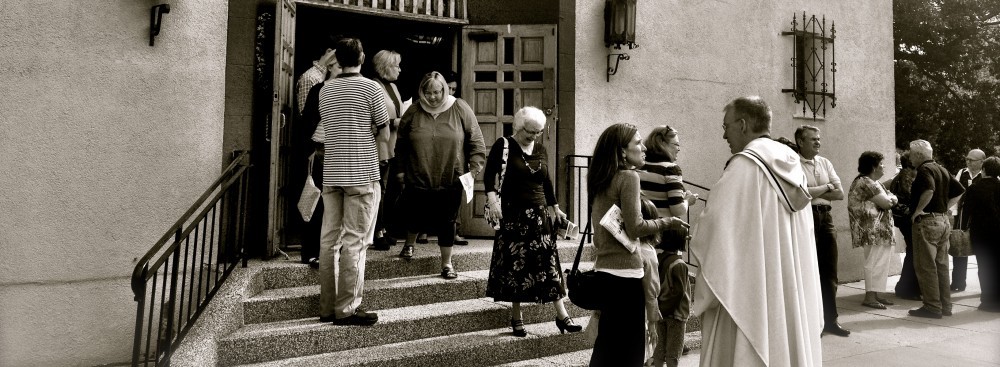
“From what perspective do we listen to Pope Francis?”

Click here to read this article in this week’s parish bulletin

Dear Friends in Christ,

Pope Francis arrives in the United States this week. This trip is his very first to our country, not just as Pope, but his first ever. There are dozens of articles about our preparations for the Masses, the security on the east coast, expectations of what he will say to the people of our nation and the ways Catholics and non-Catholics respond to our very popular Pope.

I take this opportunity to reflect on our response to Pope Francis. We will listen to many newscasts about what he says and does not say. We will hear many political commentaries about his challenges to us and to the world. We will hear on television and read on the Internet about who is on his side and who is not. We will be bombarded with commentary about how to put the Pope’s words, values and religion on a political spectrum.

How do we listen to Pope Francis this week? From what perspective or on what ground do we interpret his words, listen to his challenges and understand his consolation? How does our faith enter into receiving Pope Francis to the United States?

 I think these are important questions for us. I thought I would reflect briefly on how to listen to Pope Francis this week.

We listen to Pope Francis as Christians, as Roman Catholics. We listen to Pope Francis’ speeches with a deeper perspective than our political system suggests. We do not listen to Pope Francis as Republicans or Democrats or as Independents. We listen instead from the rich heritage we have as Christians, as Roman Catholics. This means our ears must listen to his words as belonging to the Church that is Universal, articulating the needs of people throughout the world. The Pope speaks out for the spiritual needs of people as well as the human needs of people across the globe. The Pope is concerned about the big picture, war and violence, food and freedom, peace and integrity, reconciliation and hope for all people.

We listen from the message of the Scriptures. The scriptures for today’s Mass are good examples for us to consider as the Pope arrives this week. The letter from James states, “ Where jealousy and selfish ambition exist, there is disorder of every foul practice. But the wisdom from above is first of all pure, then peaceable, gentle, compliant, full of mercy and good fruits… And the fruit of righteousness is sown in peace for those who cultivate peace.” Mark’s gospel becomes key for us to understand Pope Francis’ message, “If anyone wishes to be first, he shall be the last of all and the servant of all.” The message of Christ Jesus is not dead. We listen from these sacred texts as people of the passion, death and resurrection of the Lord. We listen from our faith, from our heritage as people who belong to the Word of God.

We listen from our belief in the Eucharist itself. The Eucharist is the center of our faith as Roman Catholics. The real presence of Christ means that our hope for new life is real. The Eucharist is a glimpse of the Kingdom of God. This means that God’s Kingdom is revealed to us in the simple presence of Christ Jesus is bread and wine. Jesus’ real presence invites us into the eternal messages of peace, forgiveness, unity, love, compassion and hope for all people. We listen to the challenges of Pope Francis because we find our place at God’s table. We must become what we eat, to live in the world what we share around the Table of God. We must work diligently for peace, for our belief in the real presence of Jesus in our world through our actions in the world.

We listen from our tradition of Catholic Social Teaching. The tradition of the Church has outlined some basic themes that include: sanctity of human life and dignity of the human person, call to family, community and participation and the pursuit of the Common Good, preferential option for the poor and vulnerable, the dignity of work, and the care of God’s creation and solidarity and universality of the goods of the earth. These themes come from various documents of the Church from the last several hundred years. In our diocese, Catholic Charities helps us implement the message of Catholic Social Teaching. Catholic Social Teaching connects the Eucharist and service in our world, an essential element of our faith. Learn more while Pope Francis visits our country about Catholic Social Teaching.

We listen to Pope Francis being aware of his life experiences. Pope Francis was a priest of a religious community, the Society of Jesus, commonly called the Jesuits. He has been formed by a life of prayer that is unlike other popes. He has served men in formation for the Jesuits and has served people in dire poverty. His perspective on the Church and how we live the gospel in the world is profound and his humility comes from his experience of being with the poor and marginalized on the streets of Argentina. He is first a man of deep faith and prayer. We need to learn to listen to life experience as well as his words.

 We listen from our own lives of prayer, from our own informed conscience. Our prayer forms our lives. Authentic prayer changes our perspectives on the world and allows us to change. Our own prayer is essential in our lives of conversion. I invite you to pray through the messages of Pope Francis while he is here in the United States. Pope Francis is a profound source of prayer for us all, a model of the mature believer and the leader of our Church.

I am confident that Pope Francis will not say anything new. However, his words and actions will reflect everything ancient, reflecting and living out the words and actions of Christ Jesus.

I hope you will take this opportunity to learn more about our faith as we listen together to Pope Francis during his US visit. I encourage you to pray for him and for us, to live out the message of hope from our gospel in our world and times.

Blessings,

Fr. Ron


On The Margins – Mark 9:30-37

fr_ron_and_kbvm_readingBWListen to  “On the Margins”. This broadcast comes from Mater Dei Radio 88.3. Jesus is inviting us to see that Jesus must die for us. The disciples have yet to see what this means. They have to die to themselves to be servant of the rest. We need to learn how to serve with our lives in Christ Jesus.  Twenty-Fifth Sunday in Ordinary Time, September 20, 2015.

LISTEN NOW: CLICK HERE

Stream live On The Margins on KBVM 88.3FM on Saturdays at 3:45pm and Sundays at 8am.

Pondering Hope: Stories Entrusted to Our Lady of Sorrows, Part Seven

(On September 15, the Church celebrates the Feast of Mary, Our Lady of Sorrows. Our Lady of Sorrows is the patroness of the Congregation of Holy Cross. I will be posting one of the seven sorrows each day leading up to the feast day. This is only part of a larger reflection that has not yet been published. The stories are meant to encourage your own reflection about each of the sorrows found in the gospels.)

The Seventh Sorrow: The body of Jesus is placed in the tomb

John 19:40-42

After this, Joseph of Arimathea, secretly a disciple of Jesus for fear of the Jews, asked Pilate if he could remove the body of Jesus. And Pilate permitted it. So he came and took his body. Nicodemus, the one who had first come to him at night, also came bringing a mixture of myrrh and aloes weighing about one hundred pounds. They took the body of Jesus and bound it with burial cloths along with the spices, according to the Jewish burial custom. Now in the place where he had been crucified there was a garden, and in the garden a new tomb, in which no one had yet been buried. So they laid Jesus there because of the Jewish preparation day; for the tomb was close by.

Miracles in red

 I have stood at the graves of many people who have died. I never take for granted this privileged moment of praying over a hole in the ground just before the casket is lowered into the earth. This is a sacred time in the life of every family and every group of friends. I have crisscrossed the country in my ministry and yet the gravesite remains a familiar and holy moment in my relationships with family members no matter in what state death takes place.

Each family comes to the gravesite with their own emotions and ways of dealing with death. Each person grieves differently. The actual practice of burial is becoming less frequent in our culture and Church. However, when we all stand near the open hole in the earth in the middle of the cemetery, the reality of death is made sure in our souls.

People react to this moment with their own stories and emotions. Some people are deaf to the prayers being said because of the guilt they feel concerning the dead person looking at the casket for the last time. Others come to the grave with a spiritual freedom that seems to hover lovingly among the other mourners. Sometimes in the stark cold of winter, the regrets of family seem to pile up along the casket higher than the snow drifts in the cemetery. In the summer months, the anger of grief is often more brutal than the summertime sun and heat in August days.

At the gravesites of loved ones, people wait for miracles. People wait for the miracle of grief to be removed from the young spouse of the deceased. They wait for a way to cope with the loss of child. Some people wonder how they will financially survive after a young father’s death. No matter the circumstances of death, the survivors often wait for something new to happen. People wait to know for themselves that death does not have the final word. The gravesite often brings reconciliation among siblings and forgiveness from children. Gravesites so often heal past aggravations and mend family battles. Miracles happen so often at the gravesites of loved ones.

My brother and his family and I buried our mother on a beautiful July morning in the Midwest. I was living in Portland, Oregon at the time and on the flight back to Indiana, I reflected on what the moment would be like to bury my own mother. I realized during the flight that I had said goodbye to her for over thirty years. I had left for the seminary at age eighteen. I had spent over half my life moving across the country and always saying goodbye to my mom.

As I reflected back on my relationship with my mother on the airplane flight home, I realized that in all of those years, my mother always waved goodbye to me with both hands. However, it took this moment of her death for me to realize that was her way of blessing me. I had never had the insight until I was preparing to say goodbye at her gravesite.

I told the story of her waving goodbye during the homily at her funeral in Edwardsburg, Michigan. After the Mass, we drove to the cemetery over the state line in Osceola, Indiana. After we gathered around the open grave, we collected our lives and prayer one last time for my mother. My mother’s sister and two brothers were seated near the gravesite for the final farewell. After the singing and the ritual prayers, I invited all of us to wave goodbye to my mother, Rosemary. It was a profound moment of prayer for the entire family and me. It was as simple, human gesture that every person there recognized. I only then realized that she had waved goodbye to all the family in the same way throughout the years.

Immediately after our wave goodbye, I took off the liturgical stole I was wearing and held it in my left hand along with the ritual book of prayers. In a flash, a woman approached me and grabbed my right hand. She took my hand and arm and placed it on her breast. She stood extremely close to me and whispered that she was a seer. She told me that she had felt my mother’s passing. She came to the cemetery to tell me two things that my mother wanted to tell me.

This African-American woman wearing a bright red dress told me that my mother loved the white flowers that I gave her for the funeral. However, she told me that my mother would have preferred pink. I stood there next the mound of dirt that would cover my mother’s casket in complete shock. In fact, I had sent my mom white flowers for years. I also knew that her favorite color was pink.

She also told me that I did not have to know her name or where she was from. The seer then grabbed my hand even more tightly and slowly stated to me that my mother wanted me to persevere in my priesthood. I stood on the artificial turf covering the uneven mound of dirt for my mother’s grave and tried to steady myself and took a deep breath. I could not believe what was happening. The woman clad in bright red then let go of my hand and walked away into the crowd of people, got into her car and drove out of the cemetery.

Mary waited by the tomb of Jesus waiting for the next move. The mother of Jesus waited for the miracle that would change everything, that would turn her pain into healing. Our Lady of Sorrows waited patiently for some new event that would change her suffering into perseverance.

I received confirmation that day from my mother’s wishes to persevere in my priesthood. This was the same message I received from Mary, Our Lady of Sorrows years before coming back into active ministry. I am grateful for the miracles at gravesites and new beginnings.


Reflection Prompts:

How can we learn from Mary, Our Lady of Sorrows to persevere in our vocations of prayer and service in the world? How can we rely on Mary’s fidelity to her son, Jesus?


How can we serve people with a new understanding that suffering and death gives way to life in God? How can we model our faith to people in doubt?


Pondering Hope: Stories Entrusted to Our Lady of Sorrows, Part Six

(On September 15, the Church celebrates the Feast of Mary, Our Lady of Sorrows. Our Lady of Sorrows is the patroness of the Congregation of Holy Cross. I will be posting one of the seven sorrows each day leading up to the feast day. This is only part of a larger reflection that has not yet been published. The stories are meant to encourage your own reflection about each of the sorrows found in the gospels.)

The Sixth Sorrow: Mary receiving the body of Jesus in her arms

Mark: 15:42- 47

When it was already evening, since it was the day of preparation, the day before the sabbath, Joseph of Arimathea, a distinguished member of the council, who was himself awaiting the kingdom of God, came and courageously went to Pilate and asked for the body of Jesus, Pilate was amazed that he was already dead. He summoned the centurion and asked him if Jesus had already died. And when he learned of it from the centurion, he gave the body to Joseph. Having bought a linen cloth, he took him down, wrapped him in the linen cloth and laid him in a tomb that had been hewn out of the rock. Then he rolled a stone against the entrance to the tomb. Mary Magdalene and Mary the mother of Joses watched where he was laid.

Rock away, my baby

Several years into my priestly ministry, I served in a parish that was close to a children’s hospital. There seemed to be a special relationship between the hospital and the parish community. Parents within the worshipping assembly were especially attached in prayer to the large hospital that served the needs of families from far beyond the crowded neighborhood. Most parishioners were profoundly aware that very dedicated staff members in the hospital were caring for very ill children.

I was not a full-time staff member at the parish but only in residence. However, I was part of the nighttime watch for emergencies for not only the children’s hospital but for several other medical facilities in the neighborhood. Before going to bed on the nights I was on duty, I would move the large, heavy black phone in my room to the floor next to my bed so I could easily reach it in case of an emergency.

I remember this particular night when I received a call from the children’s hospital. I could almost feel in the bells of the phone that that this ring would be for an emergency from a desperate parent. Somehow I could tell the terror and fear of the family by this ring that would beckon me to another child’s bedside.

The soft voice of a nurse on the other end of the phone told me that a newborn child was going to be taken off life-support. I jumped into my black clothes and walked over to the hospital fearing for the parents, the family and the child. I hurried through the shadows of streetlights reflecting on the broken sidewalks. I dashed among the headlights from cars piercing the darkness as they passed me by. I scurried among the fallen leaves on the sidewalk, feeling the fallen hopes of this family within my heart and imagination. I never wanted to go to this hospital in the middle of the night because I knew the outcome of this call would be great sorrow for so many people. However, I found my way through the emergency room entrance and into the neonatal unit and into the room where the child was struggling for life on earth.

I entered the room quietly and first glanced around the facility to try to figure out what was really happening. Several nurses where working diligently around the newborn. A couple of doctors where whispering to the parents in the corner of the room. The room was small and packed with emotion even though I could not hear one word of conversation.

The only thing I could hear was the sound of machines trying to keep the child alive. Even the piercing hum of the machines sounded incredibly desperate, trying to do the best thing, trying to do the very thing that they were designed to do, trying to work overtime to keep the fragile life here among the family.

I stood in the room silently waiting to meet the mother. She was sitting in a wheelchair, waiting in the corner. The father stood patiently next to her. She was drenched in fear and exhaustion. I made my way to the corner and stooped down to hold the mother’s hand. I do not remember any words between us, just our eyes meeting. I tried my best to just receive her fear.

After awhile the doctors and nurses invited the parents and me over to the tiny bed of the premature child. The sounds of the machines seemed to herald fear as our eyes gazed down to the tiny bundle. The doctors gave into me as a representative of God, in their desperate search for answers. They opened up a space for me to pray out loud.

I started the prayer singing a psalm refrain over and over again. The sound of my voice hovered over the room. Everyone knew this was a sound of a different remedy. The doctors unplugged the machines and then the only sound in the room was my voice calling out for the Shepherd’s care. After a few minutes, the child died.

The only sound that remained was the silence of all of our lives huddled around the body of the child. This silence was the most overwhelming sound of the night. This silence of grief and letting go was the sound these parents would never forget.

The nurses cuddled the body of the child in blankets. They handed the body to the arms of the child’s mother. We all sat and waited in silence for the mother to receive the body of the child that she had just given birth to hours before. The doctors left the room and the nurses cleaned up the space.

The nurses escorted the parents and myself into another room. There was an oversized rocking chair in the corner facing a window. The mother carried her dead child over to the rocking chair and began rocking the body of her beloved. The mother then invited me to sit in the chair with her. I went over and sat down in the rocking chair. I raised my arm over the mother’s shoulders to hold her as she held her dead son. We rocked and rocked. We rocked away the grief until I could see the sun rising through the blinds of the window. We rocked the nighttime away, waiting for the light of a new day.


Reflection Prompts:

How can we learn to receive in our arms and in our hearts the suffering of our world?


What stops us from reaching out to others who most need our assistance?


Pondering Hope: Stories Entrusted to Our Lady of Sorrows, Part Five

(On September 15, the Church celebrates the Feast of Mary, Our Lady of Sorrows. Our Lady of Sorrows is the patroness of the Congregation of Holy Cross. I will be posting one of the seven sorrows each day leading up to the feast day. This is only part of a larger reflection that has not yet been published. The stories are meant to encourage your own reflection about each of the sorrows found in the gospels.)

The Fifth Sorrow: Jesus dies on the cross

John 19: 25-30

Standing by the cross of Jesus were his mother and his mother’s sister, Mary the wife of Clopas, and Mary of Magdala. When Jesus saw his mother* and the disciple there whom he loved, he said to his mother, “Woman, behold, your son.” Then he said to the disciple, “Behold, your mother.” And from that hour the disciple took her into his home. After this, aware that everything was now finished, in order that the scripture might be fulfilled, Jesus said, “I thirst.”

There was a vessel filled with common wine. So they put a sponge soaked in wine on a sprig of hyssop and put it up to his mouth. When Jesus had taken the wine, he said, “It is finished.” And bowing his head, he handed over the spirit.

Among the permanent scars

   One of my cousins died when I was four years old. He was tragically killed in an automobile accident during his senior year at the University of Notre Dame. I do not remember him but I certainly know how his death left a permanent scar on his mother. From my perceptions and interactions with my aunt for years after his death, my aunt never fully recovered from his death. As I grew up, I saw within her deep brown eyes the sadness and anger she carried throughout her life. She tried to cover up her grief since the family never spoke of his death at least in my presence. The public death opened deep wounds for her, wounds of grief that she would have rather kept secret. My aunt carried his public death and her secret grief all the way to her own grave.

I always sensed that my cousin’s success in college was an identity that my aunt cherished and even wanted for herself. His life and abilities covered up for her the past mistakes she had made in past marriages and her struggles to make a living. His sudden death ripped apart any pretense of her life, leaving her only the grief to form the rest of her life. The death of her only son on the cross of an automobile accident became a wound that she later carried and pondered in secret. The secret revealed itself in her anger toward other people, restlessness toward life itself. I learned from her anger and her hidden grief even as a young child. I learned the sacred bond of death between a mother and her child; the permanent scar never fully heals in the mother’s wound. My cousin’s death and my aunt’s grief carved an awareness within me that allows me to be attentive to other mother’s who grieve their children.

Jesus’ tragic and raw death on the cross in front of his mother must have devastated her. The public death became the fulfillment of Simeon’s prophetic words, the prophetic words that Mary had pondered in her heart all those years. His words that she had carried within her heart were now fully known among her family and everyone who had known Jesus. There was no hiding her grief. Her life was stripped of all pretenses and her future with her only son. The public accusations, the scourging and now his bloodied, dead body for all people to see on the cross were more than she could comprehend. I am sure she could not have imaged the cross on which her son hung in death.

            Several years ago I celebrated the funeral of a man who committed suicide. He was a year younger than me. He shot himself in his home. His family was aware of his long-term depression, everyone except his mother. She is the person I focused on as I prayed at the altar during the very emotional funeral. Her fiery, black eyes seemed to stand out to me from the packed church. These eyes were full of grief and unbelief that such a thing could happen to her beloved son. At the same time, her tear-filled eyes shown to the rest of us that her faith was being tested but her profound faith would still win out even through the death of her son.

She was elderly and could not grasp the severity of his disease or accept the fact that he could do nothing more to change his suffering. She thought he could snap out of his disease or just have happy thoughts that might ease his pain. This sobbing mother lived in another state and was not directly involved in her son’s daily anguish and pain. She could not comprehend that her son had been hanging on the cross of depression for more than thirty years.

The sobbing, sorrowful mother could not understand that her son had to die on the cross of mental illness. The stigma of mental illness still permeates the perceptions of many people including the mother of this man who took his own life. Many people believe that depression can be shaken off by pulling ourselves up by our own bootstraps, by getting hold of reality and getting busy or by believing in God more and focusing on the good qualities of life. However, this cross of mental anguish does not go away from these common beliefs. The anguished mother’s son died because this disease of depression overcame him. His death was not his fault.

The crosses on which many people die seem so unfair and untimely. In that same year, I also buried a twelve year old child who died of a horrific illness that slowly took away all of his muscle control. The disease began taking over his life just as he was old enough to leave the house and start school. His family showed him Jesus, surrounding him with compassion and teaching him of Christ’s love. This cross was so visible to strangers as they witnessed his contorted body. The pain in the family brought some to a deeper reliance on God and brought others to walk away from the Church. His cross will remain among his extended family, splintering his family for many years to come.

The painful vision of a parent witnessing the death of a child never fades into memory. Life is not supposed to be that way. Parents are to pass life on to their children and those children are to pass life on to the next generation of children. However, that is not the reality of life for so many parents who loose their child in death, in the many ways the cross reveals itself in our day and time.

I admit that I stand with parents at the death of their children as an outsider. I will never fully understand the devastating grief. I can only focus my gaze with Mary on the various crosses where people die and empty myself as Mary did in the belief that death does not win in the end. In the years that it takes for people to let go of love, on the relationship between Jesus and Mary can heal the grief of parents and families. I stand by and watch as a bystander waiting for miracles.

Mary’s sorrow reaches its pinnacle on Calvary. She journeyed through her son’s life hearing from Simeon that sorrow would pierce her heart and change her life. Her son is dead, hung on a tree for reasons that seem unfathomable and unreal. At the foot of the cross, she gives her entire life to God once again. Her questions become hidden among her tears and anguish. In the conclusion of a child’s life, any mother comes to silence in the weight of her grief.


Reflection Prompts:

How can Mary help you stand among events, circumstances and dreams that have died?

Whose death in your family or friends do you stand next to and grieve?


On The Margins – Mark 8:27-35

fr_ron_and_kbvm_readingBWListen to  “On the Margins”. This broadcast comes from Mater Dei Radio 88.3. “Who do you say that I am?” One of the most important questions Jesus poses in the gospels. We all need to find an answer to that question, to find the living Christ. Twenty-Fourth Sunday in Ordinary Time, September 13, 2015.

LISTEN NOW: CLICK HERE

Stream live On The Margins on KBVM 88.3FM on Saturdays at 3:45pm and Sundays at 8am.

Pondering Hope: Stories Entrusted to Our Lady of Sorrows, Part Four

(On September 15, the Church celebrates the Feast of Mary, Our Lady of Sorrows. Our Lady of Sorrows is the patroness of the Congregation of Holy Cross. I will be posting one of the seven sorrows each day leading up to the feast day. This is only part of a larger reflection that has not yet been published. The stories are meant to encourage your own reflection about each of the sorrows found in the gospels.)

The Fourth Sorrow: Mary meets Jesus on the road to Calvary

  Luke 23: 27-30

As they led him away they took hold of a certain Simon, a Cyrenian, who was coming in from the country; and after laying the cross on him, they made him carry it behind Jesus. A large crowd of people followed Jesus, including many women who mourned and lamented him. Jesus turned to them and said, “Daughters of Jerusalem, do not weep for me; weep instead for yourselves and for your children, for indeed, the days are coming when people will say, ‘Blessed are the barren, the wombs that never bore and the breasts that never nursed.’ At that time people will say to the mountains, ‘Fall upon us!’ and to the hills, ‘Cover us!’ for if these things are done when the wood is green what will happen when it is dry?” Now two others, both criminals, were led away with him to be executed.

 Standing next to suffering

One of the images I use in prayer as an adult comes from my childhood. The image seems odd and even a bit crass. I remember being sick many times with stomach flu. My mother would always wake up in the nighttime and come to the bathroom and hold my forehead while I was vomiting. As I look back on my young days, that gesture stands out to me as one of the most comforting and consoling. That human, maternal touch while I felt so vulnerable and helpless still comforts me in times when I feel out of control and not sure what to do next in life.

This simple gesture from my mother speaks to me about Mary’s role in Jesus’ suffering and death. Mary stood next to Jesus’ suffering and she could not control the outcome or take his pain away. Mary could not fix her son’s destiny and change the pattern of grace in Jesus’ life. Her role was to simply stand among the threats on Jesus’ life and among those who would eventually put him to death. Mary could only reach out to his hurting body and touch his human wounds.

At the end of my sophomore year in college, I was asked to become an orderly at Holy Cross House, our retirement center and infirmary next to the seminary. I began my junior year learning my new role as an orderly for our priests and brothers who were very ill and close to death. It became my turn to make sure I held the foreheads of these men when they were sick, to change their diapers and bathe them in a shower chair.

Sue was the head nurse at the time. She ran the infirmary with great care, intention and compassion. Her reputation had filtered down to the seminarians and even those of us who were just starting our many years of formation. I reported for my first day wearing my new scrubs. I was totally out of my element and my naïveté was obvious to every one. Sue welcomed me as if I had been working with the sick all my life.

On that first Saturday afternoon, Sue invited me into the room of one of our priests who had been in bed for over twelve years. He was a victim of a hit-and-run accident. He was struck by a car while riding his bicycle along the main road into campus of the University of Notre Dame. He was wearing his long, all-black religious habit that made him invisible in the darkness. The authorities never found the driver of the car.

The daily staff schedule of Holy Cross House revolved around the care of Fr. John. Every two hours a staff member fed, turned and comforted the silent priest. Even though he had been in bed for twelve years, he had never had bedsores. He did have drop foot, the muscles in his legs and feet collapsed. He had ground his teeth down to the gums from his anxiety. He could not speak or move. His eyes could not focus on the people who cared for him.

At 2:00pm, Sue introduced me to Fr. John. We spoke to him as we would speak to any person because even the doctors were not sure if he could understand our voices. She taught me how to change his diapers, bathe him and how to oil and powder his body. Then she took a feeding tube and asked me if I would help her feed him by inserting the rubber tube into the hole in his abdomen. I felt squeamish and unsure. I told her no, that I could not help her do that.

Sue reassured me, “That’s alright, we will try again next Saturday when you are working again.” So the next Saturday came quickly. At 2:00pm, Sue took me again into Fr. John’s room. We changed his diaper, bathed him, changed his sheets, oiled and powered his body. She then took the rubber feeding tube into her hands and looked at me. “Will you help me feed Fr. John?” I looked at the tube and the hole in his abdomen and quickly responded to Sue, “No, I am not ready.”

So Sue said again, “Do not worry, we will try again next week when you come back to work with us.” The next Saturday came along quickly, we entered Fr. John’s room one more time at 2:00pm. We bathed him, changed his diapers and his bed sheets. We oiled and powered his body. We fluffed his pillows. We prepared him for the next few hours of his life. Sue then took the long, rubber tube into her hands and asked me once again to help her feed him. The thought of feeding him almost made me sick to my stomach. I said, “No”.

Sue came over to me, took my hands into her hands. She came close to my body and looked me in the eyes. She whispered to me, “Ron, you must remember just one thing. Fr. John is your brother.”

I felt the grace of those words whisk through my body. I realized my spiritual connection to this helpless man. I felt the beginning of my call to stand next to suffering. I picked up the rubber tube and we feed Fr. John together for the first time. I will never forget the patience and dedication of Sue. She waited for me to finally understand that feeding him was not just about the tube and the food. I had to come to realize, that if I was going to enter into this religious community even as a young member, I needed to know that Fr. John and all of the ill men in that building were my brothers. I needed to be in relationship with them, to care for them even when they were old and very ill. I needed to learn to stand along side of their suffering. I also prayed for the day that someone would stand by me when I was old and ill and in need.

Nurse Sue stood by the suffering of so many of our priests and brothers. She also stood next to my youth and naïveté. Sue will forever model for me how to stand next to suffering, to wait patiently for the ways healing may happen among patients and caregivers. Sue modeled for me the central mystery of my vocation, to bring hope among people who are in pain and isolated, among those who carry the cross of suffering.


Reflection Prompts:

What does it mean for you to stand next to someone who is suffering?

How is God calling you to offer hope and consolation to other people?