(REBLOG) US Catholic Magazine, 2010. Saint Andre Bessette.

Our world-wide Congregation of Holy Cross celebrates Saint Andre on January 7 because so many countries celebrate Epiphany on January 6. Here is a reblog of my article published in US Catholic Magazine in 2010.

Brother André Bessette didn’t need fancy degrees to know how to welcome the sick who came to the Holy Cross community. Now, he’s the order of educators’ first saint.

My path to the priesthood, as with all priests in the United States, involved many years of higher education. I earned two degrees from the University of Notre Dame before being ordained a priest in the Congregation of Holy Cross in 1983. Later I received yet another master’s degree from Notre Dame. I learned all the appropriate professional skills. I studied the correct rubrics from scholars of liturgical history. The vision of the Second Vatican Council prepared me for what I thought my work would entail.

The education that truly formed me, however, has been learning to pray through my own suffering and the inconsolable pain of others. I am now a student of an uneducated orphan and sickly man, Brother André (Alfred) Bessette, C.S.C., born 30 miles from Montreal in 1845. Ironically, the frail, illiterate brother is our first saint in the Congregation of Holy Cross, a religious order that is best known for our achievements in education.
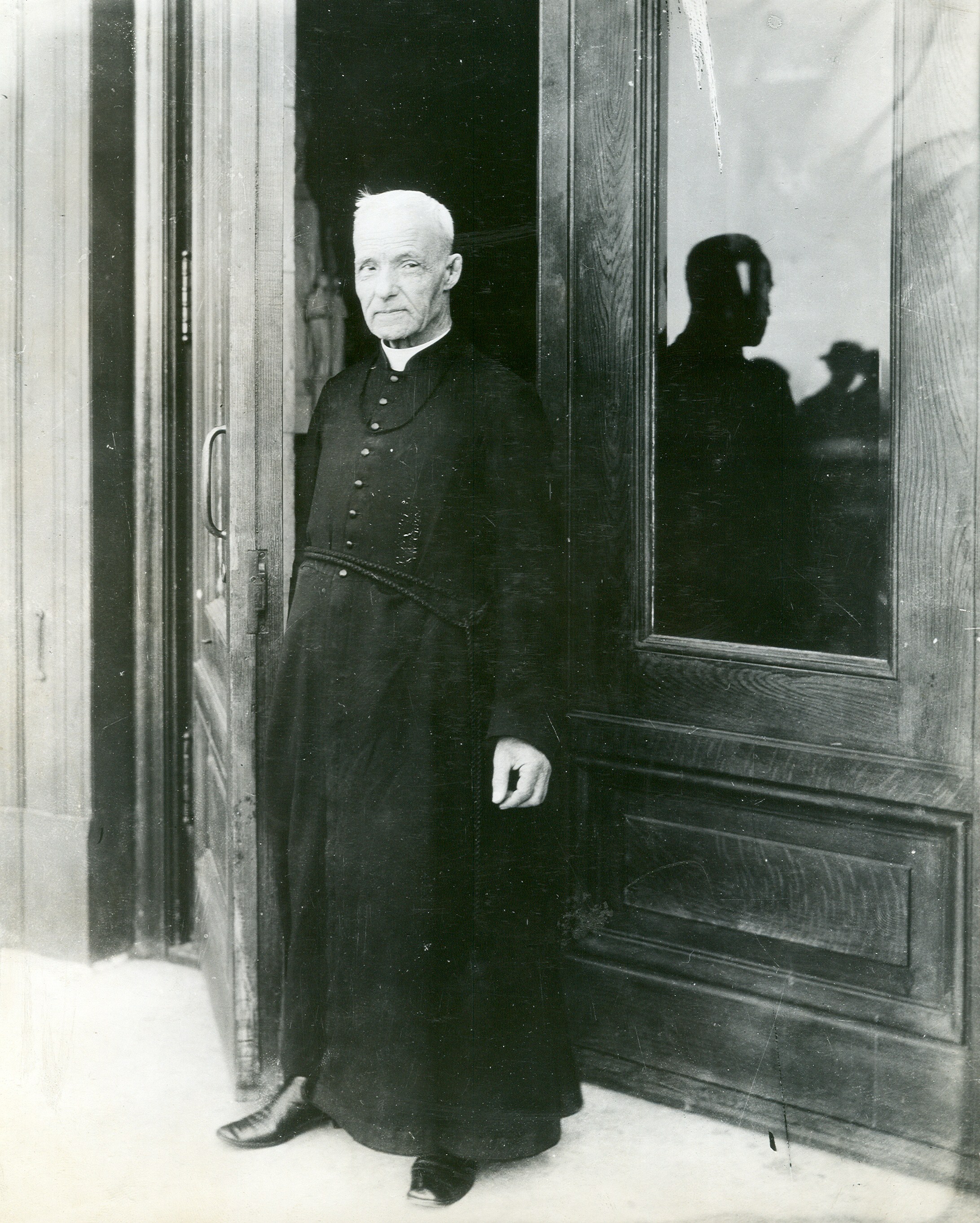
Brother André dedicated his life to St. Joseph and to people suffering from spiritual and physical illness. He convinced the Holy Cross community in Montreal in the early 1900s to build St. Joseph’s Oratory. Today, the oratory houses the many crutches, canes, and wheelchairs left behind by healed pilgrims who prayed to St. Joseph upon Brother André’s request.

Because of his ill health, members of Holy Cross did not initially want Brother André as a member of the Congregation. His novice master begged the community to allow him to stay because of his intense prayer. He professed vows and was assigned as porter at Notre Dame College in Montreal, the only formal ministry he held his entire life. He began to welcome the sick and the fragile, the ill and the outcast. His door became his entry into people’s deep suffering and isolation. André’s formally educated confreres quickly became displeased with so many sick people congregating around the schoolyard.

Brother André persevered in his devotions. He told people who were ill to pray to St. Joseph, to rub oil on their wounds, to believe in the miracles of Christ Jesus. He experienced God’s healing of thousands of people. He became known as the “miracle worker of Mount Royal.”

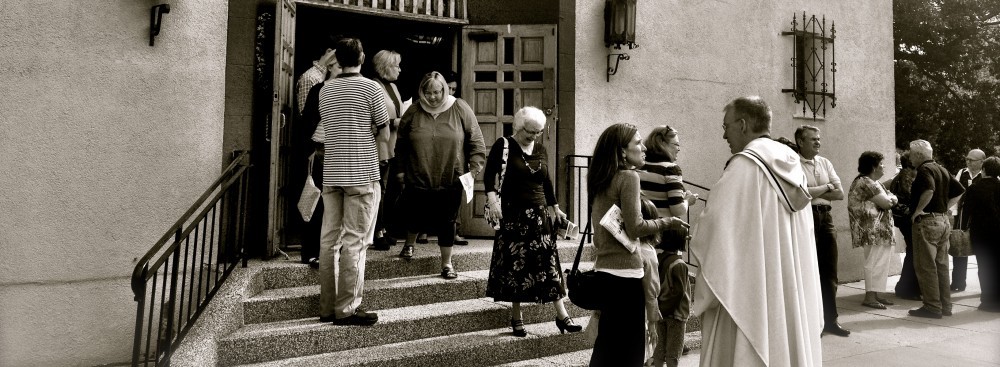
Now that I have come to the doors of the Downtown Chapel in Portland, Oregon, I have learned to pray and serve from Brother André’s example. These red steel doors open every day to hundreds of people who cry for help dealing with mental illness or who are consumed with unending loneliness.

Our parish staff and volunteers welcome to our daily hospitality center people struggling to get off drugs, the recently unemployed, and those who have spent their entire adult lives living outside. We welcome people who lash out at others because they cannot heal from their own sexual abuse. We welcome people with gangrene and people who have just been released from jail. Every day we are confronted with our insufficient answers to unsolvable problems.

I arrived here at the red doors of the Downtown Chapel more than eight years ago disillusioned with many aspects of the church. I arrived here in great need of spiritual healing. I turned to Brother André to welcome me, just as he welcomed others in need of healing and consolation in Montreal. Now I experience what André encountered, the inconsolable pain of people. People living in poverty are now my teachers.

Because he could not read, André memorized the Beatitudes and other passages of scripture that offer hope to people in pain. He believed that faith alone was the answer to real human suffering. Confronted with hundreds of people each day waiting to speak with him, André often lost his patience. He was often rude and curt with people who did not want to pray. His curmudgeonly style did not deter people from wanting to be physically touched and emotionally affirmed by God.

I lose my patience as well when I realize in recent years the church has moved away from its healing mission, relinquishing many hospitals, nursing homes, and orphanages. The personal touch of healing has been replaced by large corporations and impersonal technology. At our parish doors, I realize that faith alone can motivate people to give of themselves when other people hurt in so many ways.

Brother André died on January 6, 1937. More than a million pilgrims streamed to Montreal for his funeral. In those days before jet planes, the Internet, and cell phones, the real communication of faith and gratitude spread rapidly among believers.

The Catholic Church canonized Brother André Bessette in Rome on Sunday, October 17, 2010. On that day, I unlocked our red doors in Portland and praised God for André’s example.

(REBLOG) “Message in a Bottle”, Published in Celebrate! Magazine, Summer 2011, Memorial of Saint Andre Bessette, CSC

We celebrate the Memorial of Saint Andre Bessette on January 6, the day he died in 1937. In some countries, the celebration is moved to January 7, because of Epiphany. This article was published in Celebrate! Magazine, from Canada in 2011, when I lived in Portland, OR. Please pray for our marginalized brothers and sisters throughout the world. Pray fervently for people who are in need of physical and spiritual healing. Ask Saint Andre to intercede for the benefit of all people.

A friend traveled to Saint Joseph’s Oratory in Montreal in Quebec, Canada last autumn. My religious community, the Congregation of Holy Cross, commissioned him to journey to the site of the many healings attributed to Saint Andre Bessette, CSC. His task was to photograph the celebrations of Brother Andre’s canonization both in Montreal and in Rome. During his visit to Montreal he photographed pilgrims walking on their knees on the steep steps of the Oratory. He shot people praying in the chapels and gardens and the room where Brother Andre lived. My friend even photographed Brother Andre’s heart that is still enshrined at the Oratory.

When the photojournalist arrived back in Portland, we shared coffee, stories and the photos from his journey. As we sipped coffee at a local coffeehouse, he handed me a white paper sack and told me it was a special gift. I opened the wrinkled bag and took out a bottle of Saint Joseph’s oil from the Oratory’s gift shop. An artist’s sketch in blue, red and white of Saint Joseph carrying a white lily adorns the plastic bottle.

These words appear in several languages on the side of the 500ml container: “Brother Andre often advised those who came to him to rub themselves with some vegetable oil which had been burning in front of the statue of Saint Joseph. Even today, oil used in this manner remains a link with our tradition. It is an expression of faith. It is not the oil itself which cures, but the Lord who hears the prayers of the faithful.”

The unopened bottle of oil still sits on a bookshelf next to my bible in my bedroom. I admit I really do not know how to use it. I am not sure where this oil of devotion fits into the healing ministry of the Church today. In fact, I am deeply confused about many aspects of healing and how we carry on the tradition of Jesus reaching out to the leper, the blind man and the Canaanite woman’s daughter. I firmly believe there is a message contained in the bottle of oil. I just do not know how to get it out of the sealed bottle and into people’s lives.

Many believers question the use of such oil today within worshipping assemblies. Some people associate healing with snake oil salesman and sleight-of-hand trickery of fundamentalist preachers trying to make a living. Many liturgists frown upon such personal devotion because a bishop in the context of the Chrism Mass has not blessed this oil during Holy Week. This oil does not fit into the traditional sacramental life of the Church. This oil goes well beyond the clerical role of anointing the sick and forgiving sins within the seven sacraments of the Church. This bottle of oil used in the tradition of Brother Andre seems far removed from the sacramental, clerical and liturgical norms.

I know I am also not alone in my skepticism about physical, emotional and spiritual healing within the Church today. People are suspicious about healing because first of all we are all powerless over suffering. I have known and observed priests who refuse to pray with people individually because they are afraid to enter into the depths and uncertainty of people’s real suffering. Others are squeamish about body pain, surgeries, bloody accidents, physical abnormalities, paralysis and the fact that suffering itself is uncontrollable. Sacramental rubrics, liturgical rites and decrees from the institutional church cannot control suffering. For many clergy, if suffering cannot be controlled, the best form of healing is to avoid it all together.

I am also suspicious of healing based upon my graduate studies in our liturgical tradition and my training in pastoral and professional skills. The professional minister today is trained to avoid such attempts to heal because it does not fit into any field education requirements or competencies. In many ways the professional model of the church today has drained much of the Spirit’s presence out of any notion that healing happens with vegetable oil, scapulars, personal devotions, holy cards or prepackaged devotions of any kind.

During the lifetime of Brother Andre, the ministry of healing was a prime mission of many religious communities.  Religious communities of men and women in the past set out on horseback in the United States to found and build hospitals, orphanages, and care facilities for anyone who was lost, forgotten, ill or dying. Today the presence of priests, brothers and sisters in institutions of healing has given way to the latest technology and concerns over insurance coverage. Our church has lost much of its personal mission of healing.

I am desperate to find healing today. I simply do not know where to turn to discover answers. I stand daily amid the brutal chaos of people living with severe mental illness. Many people hear voices that tell them to kill themselves, to ignore their medications and to punish themselves. People sit in the rain around our building and cry out in the night. They lash out at passersby and refuse to speak with their counselors who are assigned to our streets.

I pray for healing for people who blame homeless people for being homeless. I want healing for every family so that our gay and lesbian children will not be abused or bullied. Hundreds of children have fled into the woods or the streets in Oregon because of domestic abuse. I lash out in the night to God that young girls are being trafficked in our suburban shopping malls or in upscale grade schools. I am not sure how much more I can take of the young mother diagnosed with breast cancer or the addict that refuses treatment or the honor student who cuts herself.

I realize I cannot control countries at war or how the institutional church treats people. If I can find my way into this bottle of oil, I may be able to focus my belief that God alone heals. I desire healing amidst the shambles of people’s stories and their regrets from the past. I am now realizing the message in the bottle is also for the cynic and the critic.

Hundreds of people came to Brother Andre every day during his ministry. I now sense his frustration about people’s lives. Andre first guided people to stay close the healing sacraments of the Church. However, so often people were not healed. They needed so much more than what he could give them. He reached for the oil that was there at the Saint Joseph statue because that is what was available to him. Brother Andre told some mothers to wash their children in dishwater and or to go to confession. He said all those things because he did not have answers to the depths of people’s suffering and anguish.

There is something in this bottle of oil that frightens me. I must come to terms with God’s healing love in the world that is more potent than my fear and more consoling than the oil from the Saint Joseph statue. God’s healing happens without our permission, rules or guidelines. God does not commit healing power only to the well educated, the immaculately dressed or the clean cut. God’s healing happens amidst the mess, chaos and confusion of everyone trying to figure out how to ease suffering, whether of others or their own.

God healed many people through Brother Andre’s intercession even though Andre was not a priest, not within the confines of the sacramental church.  The oil for so many was simply a reminder of what they already knew but had forgotten in the midst of their pain, that God alone eases suffering, forgives sin and offers new life for the body and the soul.

Someday I will have the courage to open the bottle of oil. I will take the risk of unsealing the bottle and opening my heart. I will risk that my relationship with suffering people allows God to enter and heal everyone beyond my imagining. I will take the step to pray with people upon their request. I will pour out the holy oil and believe in the miracle that Jesus’ passion leads to new life for me and for every person. Someday I will receive the message hidden in the plastic bottle on my bookcase.

The Epiphany of the Lord, Cycle A, January 8, 2023, Prayers of the Faithful

Sunday January 8, 2023 Cycle A

The Epiphany of the Lord

For people who carry the banner of leadership within the Church. May they seek the Christ in all times and ways. May they fearlessly lead us in faith.

We pray to the Lord.

For people who feel their gifts are not good enough. May the discouraged of heart find new life in Epiphany hope. May we affirm every human life and talent.

We pray to the Lord.

For people who follow the whim of the Holy Spirit. For artists, writers, dreamers and all who see most clearly the signs of the times. May we jump for joy in their courage.

We pray to the Lord.

For people who have lost homes, incomes, and health in dreaded storms, floods and winter accidents. May we welcome the suffering to safe shores of sustenance and safekeeping.

We pray to the Lord.

For people who put together puzzles of peace. May all who work with waring nations and battles in government find the solace and skill of lasting calm on earth. May their work bring us a new vision of humanity.

We pray to the Lord.

For people who bring gifts of schizophrenia in our worshiping communities. May we learn to listen to the fragile of heart and the love they offer us. May we search for God hand-in-hand with people suffering mental fragility.

We pray to the Lord.

For people who search diligently for the Christ Child. May we harken to the call of faith in this season of joy. May we not be lost in the darkness of our doubt and cynicism.

We pray to the Lord.

For people who have died and now bask in the Light of Heaven. May our loved ones rest assuredly in their eternal homes.

We pray to the Lord. 

The Solemnity of the Blessed Virgin Mary, the Mother of God, Luke 2:16-21, Cycle A, January 1, 2023, Prayers of the Faithful

Sunday January 1, 2023 Cycle A

Solemnity of Mary, The Holy Mother of God

Let us pray for healing in our Church. May divisive rhetoric become only words of forgiveness and endless hope for our future.

We pray to the Lord.

Let us pray to heal our lonely lives. May our Mother Mary ponder us in her heart with care for every human being. May we surrender to love upon her breast.

We pray to the Lord.

Let us pray for women who have given birth. May we learn from mothers how to love and how to embrace the lowly in swaddling clothes of justice and peace.

We pray to the Lord.

Let us pray to consecrate our New Year’s resolutions in love for others. May we decide this year to serve the least among us. May our healthier lives serve those who long for real nourishment and shelter.

We pray to the Lord.

Let us pray for a new rhythm of peace among us. May our actions bring harmony and not discord. May our words not put strangers down in shame. May our words only lift up those who suffer.

We pray to the Lord.

Let us pray to listen as Mary heard the angels. May we finally hear God more than our own cynical and fearful hearts. May our ears be attentive to joy and surprise.

We pray to the Lord.

Let us pray to examine our hearts in this new calendar year. May our regrets find healing. May we learn from past mistakes. May we embrace God-among-us to guide our future.

We pray to the Lord.

Let us pray for our loved ones who have died. May we treasure those who have taught us how to love on earth. May our beloved find true home in heaven.

We pray to the Lord.

(REBLOG) A Christmas Creed 2021

A Christmas Creed 2021

I believe wild grace connects heaven and earth.

I believe miracles rouse crazy love.

I believe cooing children imitate angels.

I believe tears consecrate forgiveness.

I believe hearts shelter hope.

I believe relationships name holy families.

I believe radical epiphanies.

I believe baptism never ends.

I believe John the Baptist faces the Son.

I believe Isaiah paints word pictures of heaven.

I believe Mary births unending hope.

I believe Elisabeth and Zechariah voice unimaginable love.

I believe Anna and Simeon wait to embrace us.

I believe a sword pierces our hearts and egos.

I believe we ponder mysteries of heaven within us.

I believe hope is freedom.

I believe the cross and the crib hold miracles.

I believe wisdom rising from humility and sorrow.

I believe the gifts we offer are hidden within us.

I believe love melts fear.

I believe Light.

I believe Wisdom.

I believe Peace.

I believe God-among-us.

Saturday of the Fourth Week of Advent, Mass in the Morning, December 24, 2022: Article from Give Us This Day, December 2022, from Liturgical Press

As Morning Dawns

Zechariah’s tongue is freed. With full voice, he praises God for his son, John. Zechariah cuddles his young miracle, proclaiming him the forerunner of the Messiah. From Zechariah’s mouth that had been hushed, his words ring out to us who wait in Advent hope. We too raise our voices on this quiet morning because we know what is to come—Jesus, the Incarnate Love of God.  

Our hearts ache to be freed. In Advent, we cultivate desire for God, both within us and in our world. As we wait for the Promise of Peace, we form long-awaited words to speak out against injustice. We shout from within the darkness of sin, addiction, self-loathing, and doubt, because we know that the dawn from on high shall break upon us. We care for the weary. We speak on behalf of people whose voices have been silenced by power, abuse, and corruption. We treasure gifts, not wrapped in cheap paper, but wrapped with the mercy, forgiveness, and love born within us.  

Quickly, God, free us. Come quickly, not just as infant, but as Messiah.

We beg Christ to come yet again, not just today, but at the end of time. Tonight, we shall settle into a quiet night, a silent night, and hear the echoes of Zechariah’s canticle ring in our hearts. We shall sing as morning dawns. The Messiah is born here in our human frailty, in our pregnant hearts. He shall guide our feet into the way of peace, one step at a time. Jesus Christ brings us home to Kingdom love, yesterday, today, and tomorrow.    

Fr. Ronald Patrick Raab, CSC

My thanks to Liturgical Press for the opportunity to write for Give Us This Day. This is the last Mass of Advent.