I received this note from five-year-old Violet this week. She attended the art show/sale last weekend. She is a great artist and usually brings me her work after Mass. I will leave the translation to all of you! So cute!
Next weekend, November 6/7, I will have another 60 pieces for sale after the Masses. If you missed last weekend, check out more of my work next weekend.
Carrying Grief: November is a time to face our own mortality
I carry in my heart smoldering grief. On most days, I experience the fires of loss that are never extinguished, it seems. November rouses memories of those I buried this past year, both parishioners and strangers. I am also confronted with my own fear of death. This fear is revealed in the many ways. I cling to power, false identity, and making myself look good. I often fear approaching Jesus as remedy for my soul, clinging to my ego. The deep fires of grief are inherent in my life as a priest.
This year has been exceptional in the ways we all carry grief. Our people bear the weight of job loss, of unexpectedly letting go of a parent or spouse to the pandemic. Business closures, teen depression, and career failures, have tested even the strongest families. We carry the weight of their pain. We stand among the fuming fires of what has been, and long to lift hope from despairing ashes.
November claims much in the heart of a priest. The scars of grief seem slow to heal. As we celebrate the closing weeks of the liturgical year, we must take stock of our own patterns of loss. Grief comes from the many unspoken issues we carry as pastors. We often become stuck when we accumulate illusions of power that we think will hide our loneliness. The trappings of priesthood cannot sustain our human and spiritual identity. We all experience the perils of life when we hide our grief behind alcohol, drugs, laziness, pornography, or rage.
November is a time when we are called to become honest with ourselves as we face our own mortality. Sometimes we grieve how our lives have turned out. When we were young, we thought we would make a difference. We thought our theology would change the world. We thought others would support our vocation. We assumed we would become someone special in the church. We thought we would share the perks of belonging among our peers. Sometimes life does not unfold as we wish.
We can also fall into traps when we think our perfection will make others love us. Sometimes we get caught in a web of pleasing others and even trying to copy other people’s lives. Shame and guilt may catch up with us in November. In the end, we are only accountable to God’s tender mercy and forgiveness.
In our stubbornness, we may hold tightly to the way things used to be. We white-knuckle our prayer, our profession, our lives, thinking that if we hold on tight enough, no one will notice our pain. As we pray the Beatitudes, we come to realize that God creates saints from the absolute truth of our human existence. We are all created from love so to love in the world. Saints become saints because they lived authentically on this earth.
We may lose our way when we grasp tightly to these illusions. We die from the inside out, unable to find joy in Jesus Christ. As we learn lessons from the fig tree and from the poor widow, then we see even our small deaths create a space in our hearts for God where his love may find a home. I rely on God to show me how to die to self.
We may easily fear the future. We worry about who will care for us when we are ill as we face our own death. Loneliness is real as we reflect on our mortality. In November, we bask in the truth of God’s care for us in the end. We also learn how to live, minister, and thrive today. We, too, are saints and souls. The tenderness of Jesus calls us into a well-lived life.
I have come to realize that the chaos of grief is a vital part of my ministry. Finally, after many Novembers, I claim grief as gift, a genuine path to relationship with Christ Jesus. This love helps me listen to the marginalized and my own emptiness. I am called to listen to the hearts of those who experience tremendous loss. I am also called to befriend my own longing and soulful grief. Caring for our souls becomes a lifetime of authentic reflection and prayer. It is easy for us to distance our lives from the grief of our people and to neglect our own. We may forget we are human as well.
Printed from The Priest Magazine, November 2021. Published by Our Sunday Visitor, Inc.
Mark 12:28b-34, offers us a divine blueprint for salvation. Once again Mark’s text offers us a connection with love and service. We are reminded that our relationship with God is foremost. However, how we express that love in our world is also essential. We are to manifest prayer, ultimately witnessing our own conversion by working for the common good and offering the basics of life to people in need.
God reveals hope within us no matter how old we are, no matter our backgrounds. We can find within us resiliency and love of life. Our essential relationship on this side of the grave is with God, to keep our spirits in tune with how to live, how to serve, how to become whole and generous people. Living apart from God is against our faith, the scriptures and our tradition, and our souls.
Prayer is essential to keep us afloat in life. Without prayer, we succumb to despair, hatefulness toward others, and we lose our direction in life. Without the Eucharist, the sacraments, and personal relationship with Christ, we miss our place in God and we miss out on love. Prayer for most people becomes a band-aid. When we hurt, then we turn to God to fix us. Then we are disappointed when God doesn’t do what we want. Then we leave God altogether. Prayer is not something of a quick fix. God is not a divine aspirin. God is not apart from us, looking down at us with a stern finger of condemnation.
For many Catholics, we were taught that God is a stern, authoritative figure who is waiting to pounce on us and condemn us when we don’t live up to the standards of the past. Frankly, I see the consequences of this nearly every day. I see the shards of this prickly understanding of God in the confessional, within conversations in the parish, within people’s lives at the time of death of a loved one. These shards of violence pierce our understanding of faith. We can never live up to the standards of this image of God.
Prayer is something very different. Loving God with our entire being, heart, mind, soul, and strength is a daily reality for us as believers. God does not carry a divine wand ready to discipline us. Instead, Jesus’ life on earth is our key to understand God’s will. We are called to live in the Father’s love just as Jesus did on earth. We are called to die to our stubbornness so to be converted in love, just as our Creator first loved us and gave us breath. Prayer is openness to divine love. Prayer is using our bodies, minds, and souls to capture the eternal embrace of our Creator while still on earth. Love is the reason for this gospel text, not condemnation. Love is the reason we come to worship at the Eucharist. We don’t worship because we worry about pleasing a stern, condemning figure in heaven. God is love and our mission on earth is to live within such a mystery.
The most difficult aspect of this gospel, I believe, is the sentence that invites us to love others as we love our selves. For most people struggle with self-love. We treat other people as we treat our selves. Therefore, hatred and violence exists. Fear of our past, of our decisions, of our role on earth, squelch our ability to offer love to others. This is the gospel which challenges us on earth to listen to the Father’s call to receive love, and then live that love for the benefit of other people. So, love God with your entire being, and your neighbor as yourself.
And when Jesus saw that he answered with understanding, he said to him, “You are not far from the Kingdom of God.” And no one dared to ask him any more questions.
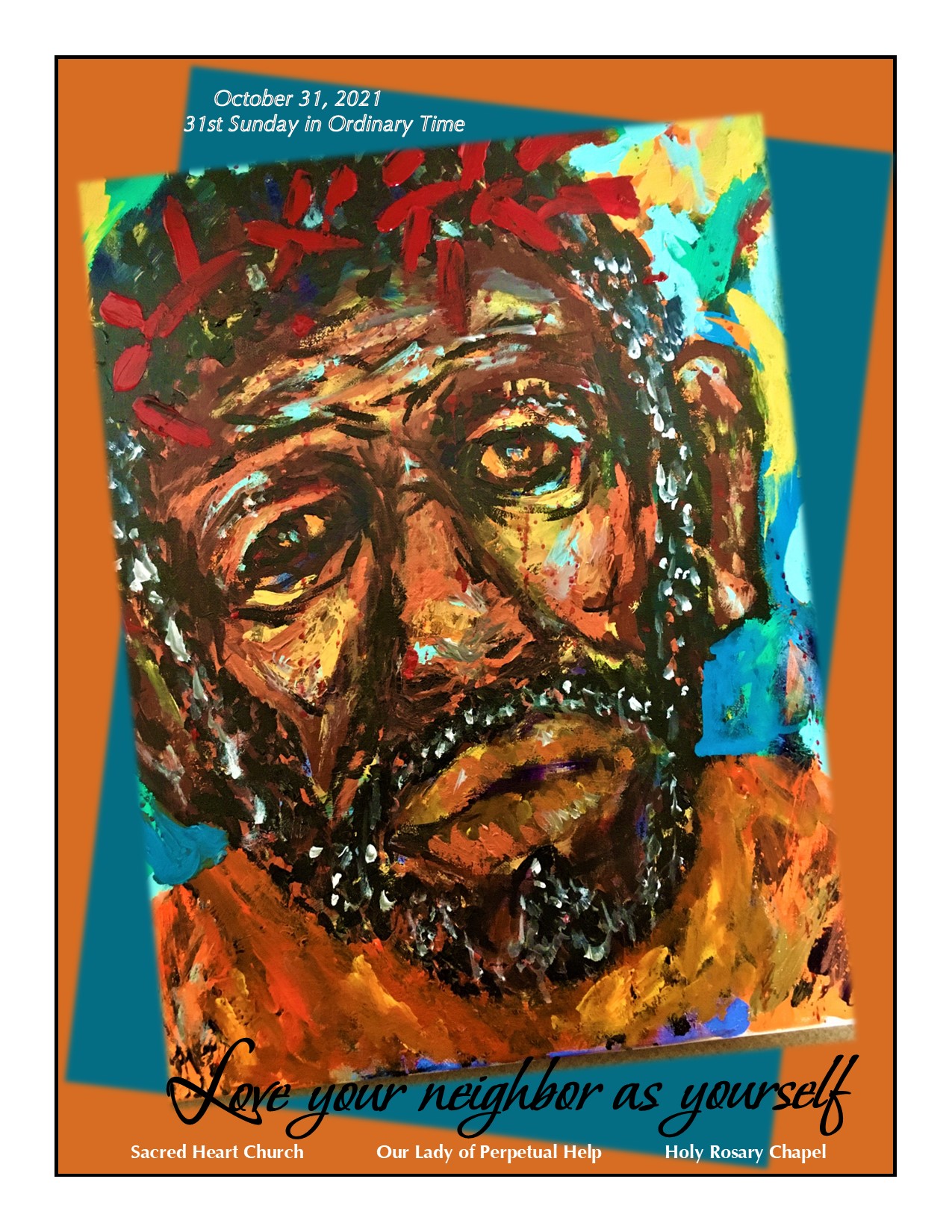
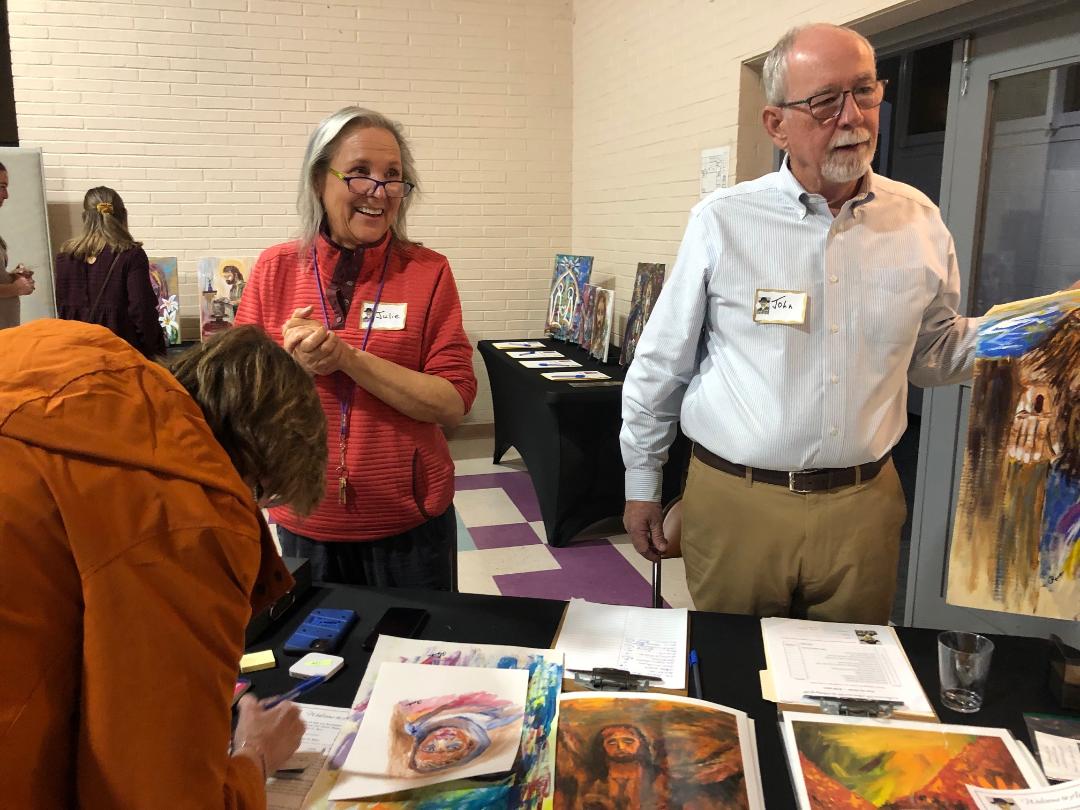
What a delightful evening! I have over 100 originals of my art for sale, in a drawing, silent auction, and simple donation. The art is a reflection of my time at Sacred Heart in these past eight years. I started painting only when I arrived in 2013 as pastor.
Some of these images have been reproduced in our bulletins and some across the globe. Some have appeared in magazines in Chicago and New Zealand. Others have appeared on parish bulletins or orders of worship in Manhattan and The Netherlands. My art has been used as our bulletin covers since Advent 2016. What a joy it was for me last evening to know the originals will be spread across the city.
Construction of Saint Andre House began this week. The former rectory will have accessible restrooms and meeting rooms. The completion of the project will be in Spring of 2022.
Mark 10:46-52 is one of my favorite gospel stories. There is abundant grace in hearing this text at Mass this weekend. A blind man is begging along the roadside. This man, however, is named in the gospel. His name is Bartimaeus.
It is rare for a poor man to be named in the scriptures. A name has power and recognition. A name reveals the dignity of the person. To call someone by name is honoring the person. I can imagine that in the early Christian community, the followers of Jesus must have learned to respect the man who had been healed along the roadside. I suspect that his name was passed down in the oral tradition and found its way into this story because people knew the man and wanted to make sure his name was always associated with the healing touch of Jesus. Bartimaeus is his name for all eternity. We, too, can learn to see him in his dignity.
I would love to find out how Bartimaeus knew who Jesus was before the encounter with him. There seems to be an incredible gift of the Holy Spirit at work here. The blind man knew who Jesus was and what he could do for him. Jesus, then, must have known this blind man, Bartimaeus. In my imagination, I want them to be classmates or perhaps their families were neighbors down the way. There seems to be a relationship even before this story begins. How else would Bartimaeus understand what Jesus could do for him? It seems to be more than hearsay.
Each line of this story is so rich. It demands of us a moment of prayer, taking each line of this text to heart. Bartimaeus calls out to Jesus. He gives voice to his need. He gives voice to his blindness. He gives voice to his faith in Jesus who he senses is near, “Jesus, Son of David, have pity on me.” He continues to call out even though the people around him want to quiet him. I love the gumption and the deep faith of this blind beggar on the roadside.
The people finally say to him, “Take courage; get up, Jesus is calling you.” Gosh, I love this. This may be the most beautiful thing anyone could say to someone who is hurting. So, he goes to Jesus. Jesus then asks him what he wants. First, though, he throws off his cloak. This garment is an image of his old life. It will be replaced with a new cloak, that of baptism. The garment is a sign to us that new life is happening.
Bartimaeus declares to Jesus, “Master, I want to see.” His request is so honest and so real. His answer does not only come from his physical limitations, but from his deep faith in the one he knows will set him free.
The divine question embedded in this text is not just for Bartimaeus, but it is also for us. Jesus says to him, “What do you want me to do for you?” I wonder what you would say if you had witnessed this exchange. I wonder what I would say to Jesus, if along the roadside, I had encounter him. This is one of the questions of Jesus’ life that we need to take into our deafness, into our blindness, and into our inability to speak. It is a question for all our hardships in life. I pray we can listen to this question with all our faith, our hope and our understanding of what Jesus can do for us.
Jesus said to him in reply, “What do you want me to do for you?” The blind man replied to him, “Master, I want to see.” Jesus told him, “Go your way; your faith has saved you.” Immediately he received his sight and followed him on the way.
Mark 10:35-45 is the gospel passage we pray at Eucharist this weekend. This text holds together many opposing realities. In many ways, it is a summary of faith, holding together death and life, suffering and hope, and prayer and service. It begins with James and John coming to Jesus and asking him to fulfill their desires. They want him to place one of them on his right and the other on his left in glory for all eternity.
At first glance, we may affirm James and John’s request to Jesus. After all, they had heard Jesus speak of the Kingdom of God. They watched him heal the sick and offer forgiveness to the sinner. They wanted to be in his graces for all eternity. In many ways, I don’t blame them for wanting to be at the side of Jesus, benefiting from all his promises for all eternity. If I am honest with myself, I want the same thing. I suspect we all do.
We can feel the hesitancy of Jesus in this text when he hears James and John. We can almost feel him cringe. Jesus knows the kind of suffering it will take to get to the Kingdom. Jesus is asking the two men if they are ready to suffer. They will have to let go of all earthly pride and ambition to be placed at the side of Jesus. There will be numerous forms of dying. They have a long way to go to discover how death will transform them. Drinking from the cup of suffering will bring about death, however, Jesus’ death will bring about a new covenant. Jesus is inviting them into a new covenant of heaven and earth. They will have to see for themselves if they are ready to enter such a mystery of dying and rising even in their lives on earth.
The text continues to hold together the authority of Jesus and his call to serve. Jesus tells the men that if they want to truly find a place in heaven with him, then they will have to act differently on earth. He warns them not to hold authority over the heads of others, but to learn how to serve in ways that will truly change people. This service is another form of dying. It is learning how to acknowledge the gift of people, not to put others down, and how to lift people into the richness of God’s love. The paradox of authority and service becomes another way in which we all are being led to the place of Jesus’ side in heaven. We die to self; we die to false power; we learn then to serve God among the lowly on earth.
In this liturgical year, which ends in November, the gospels lead us to the end of time and what it takes for us to live the message of Jesus’ dying and rising that we have proclaimed all year. Easter takes its course in leading us all to the Kingdom. We do not live with a sense of entitlement because we believe. We live instead with a spirit of humble service to welcome the Kingdom in our midst here on earth.
Our rewards are not for us to determine. We leave that to the Father’s will. In the meantime, we learn a gentle way of acknowledging the beauty of all life here on earth. We learn how to lift the poor out of despair and how to welcome the lost one into the center of the community.
So, what does your heart desire? For what do you ask Jesus? How is Jesus calling you into a deeper commitment here on earth?
Rather, whoever wishes to be great among you will be your servant; whoever wishes to be first among you will be slave to all. For the Son of Man did not come to be served but to serve and to give his life as a ransom for many.
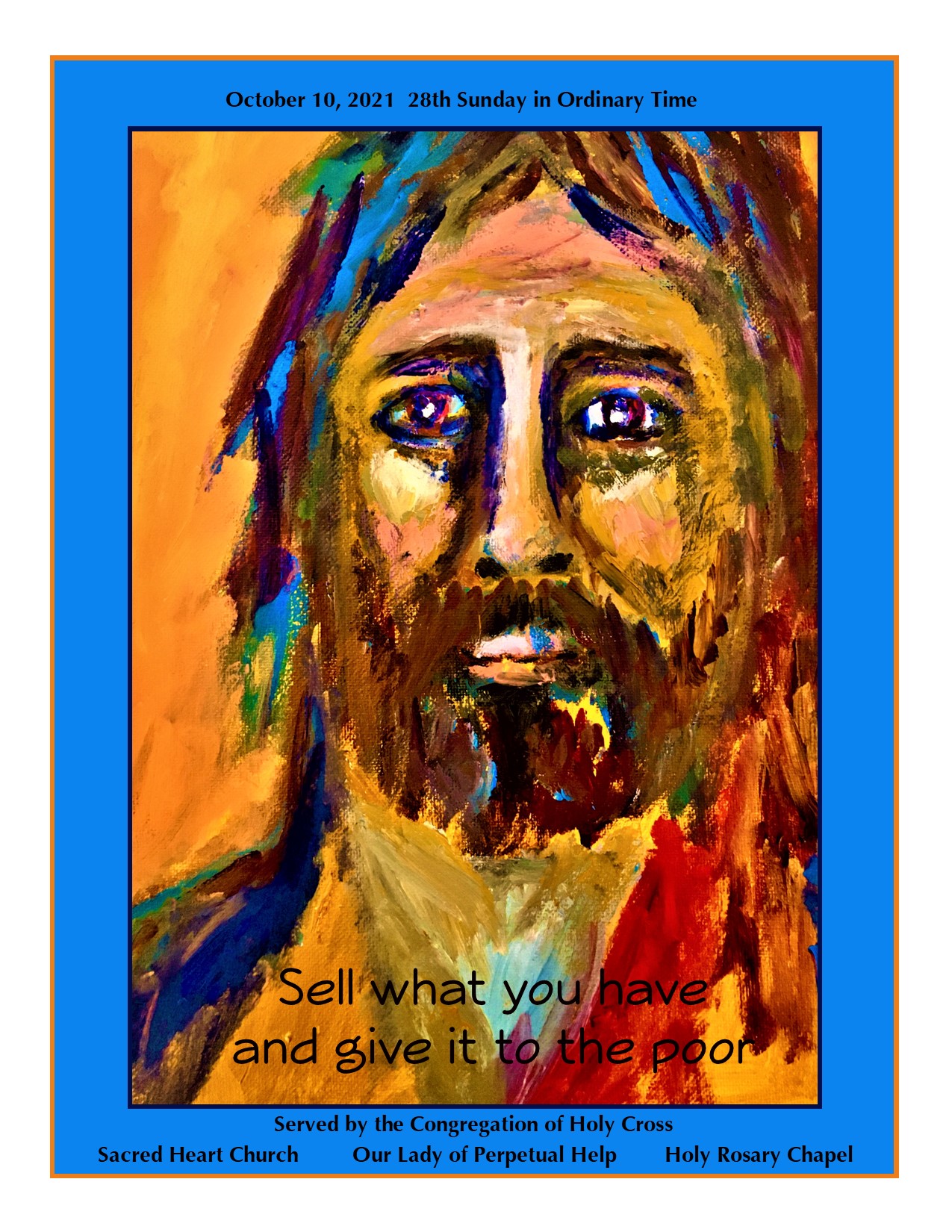
In Mark 10:17-30, a man approaches Jesus to find out if he can inherit eternal life. Jesus articulates the commandments and realizes the man already knows them. The man says that, in fact, he has lived the commandments since his youth. Jesus says to him that there is one thing missing. He must sell his possessions and give to the poor. Then, when he is completely powerless on earth, he will possess his desire to enter the Kingdom.
The liturgical gospel passages have been challenging us to the core. They command that we examine our earthly attachments. Our hearts are set on the love of the Kingdom, and nothing should get in the way of our life in Christ. We all know how challenging these gospels are in our personal lives. We all have responsibilities to others we love. These responsibilities mean we help provide for our children’s lives and futures, both financial and physical realities.
To what are our hearts attached?
I don’t take this question lightly. In most cases we tend to ignore these commands of Jesus because we all live busy lives with great responsibilities. However, when we quiet our lives and take stock of our personal identities, we realize we are attached to many things that become obstacles to love. We may be attached to our sense of entitlement, resenting even Jesus who challenges us to live with generosity. We may be overly attached to alcohol or food or making sure we always position ourselves to look good in every situation. We may be addicted to belittling other people. We may be attached to what others think of us. We may never fully appreciate our own gifts and talents. We may attach our self-worth to the car we drive and the job we have and what school we attended. We may strive to always be in charge and in control and never let life change us. No matter how we want to ignore these questions of Jesus, when push comes to shove, we need to examine our lives.
If we are honest with ourselves and with God, we come to terms with everything that is false. Pride is never generous. There is no job title that becomes our real identity. Our children’s lives are not the identity of the parent’s life. Examining the human heart takes time and energy and focus. We are challenged by Christ to give up our status and our control and instead delight in the life God has for us. We are to give what we own to those who most need us. We are to offer others supplies for daily survival.
Jesus tells the man that it is easier for a camel to pass through the eye of a needle than for a rich man to enter the Kingdom. Jesus says to us that all things are possible in God. This is the core of our existence, the possibility of God’s presence and love in our midst. The possibility of change, of forgiveness, of mercy, of true love and tenderness, all become God’s activity in our human lives when we finally rest in God and recognize the value of our humanity. Jesus invites us to clear away the debris in our hearts, in our attachments to disrespect and false power, and rest in him. God is within us. The Incarnation of Jesus Christ reveals life’s value and love. Being human is a pure and joyous gift in God.
Jesus looked at them and said, “For human beings it is impossible, but not for God. All things are possible for God.”





 Broken But Not Divided