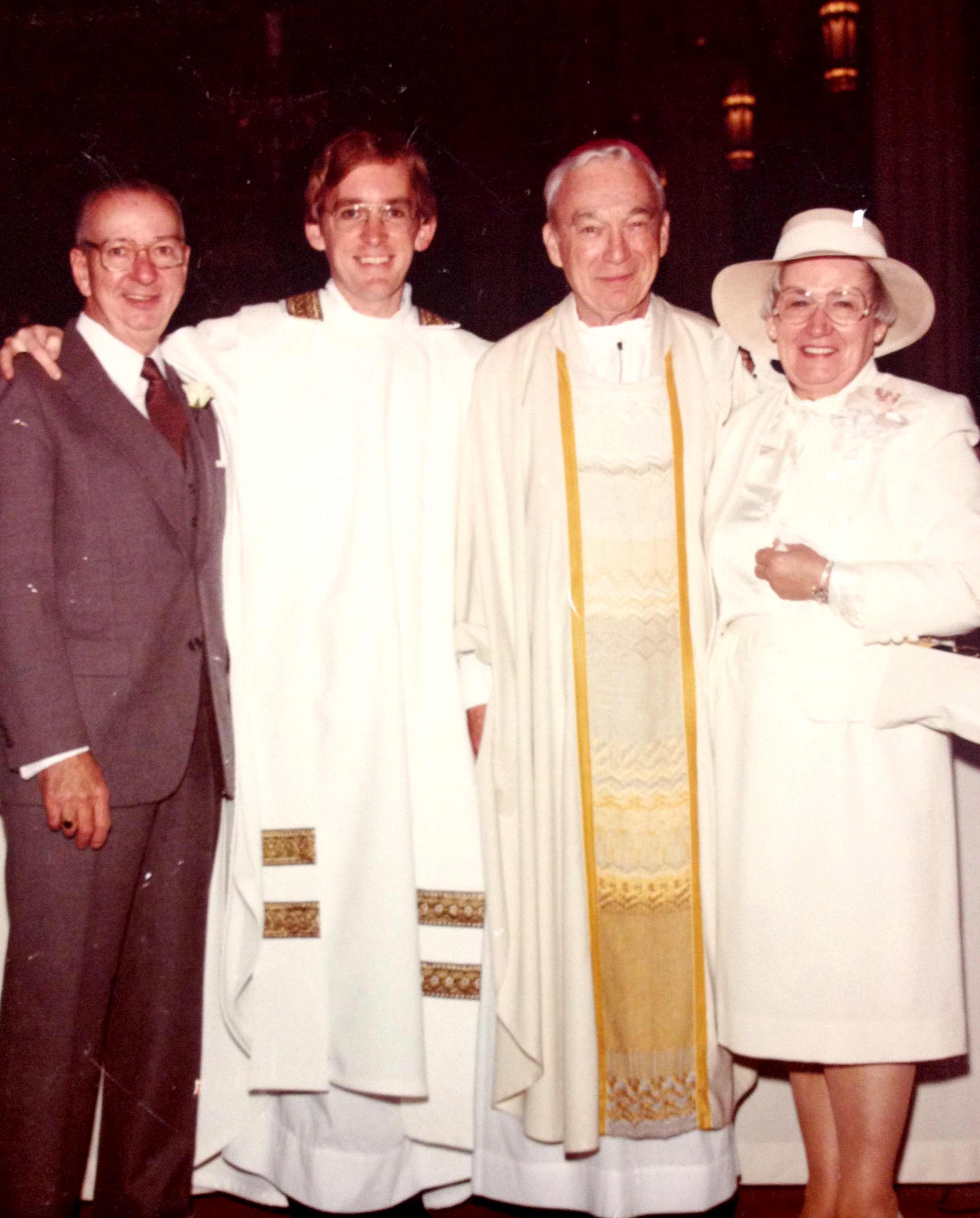
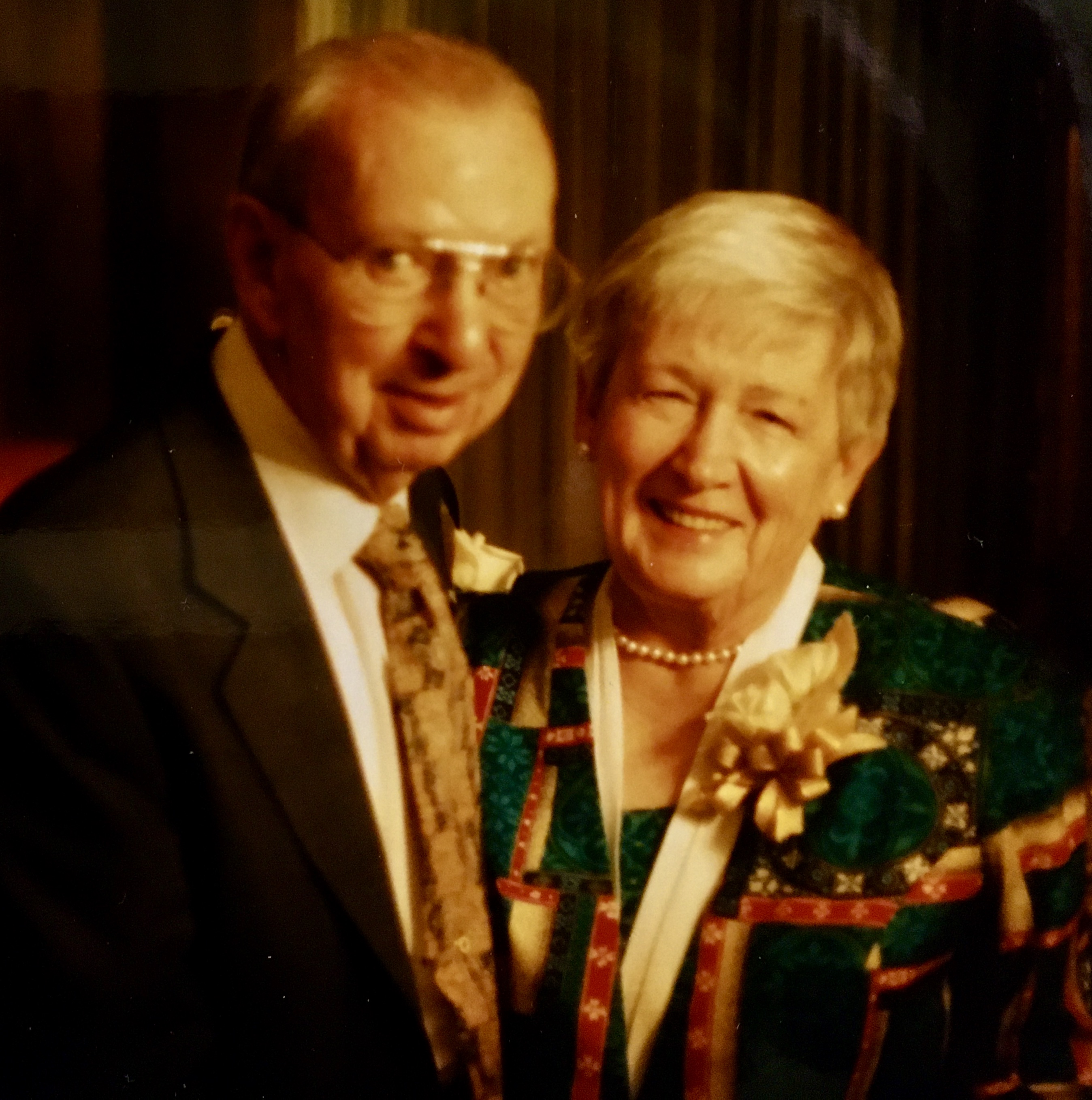
Rosemary Ella Raab, 1921-2004

John and Rosemary Raab, 50th Wedding Anniversary in 1996

Today would have been my mother’s 100th birthday, July 8, 1921. This article was published in Ministry and Liturgy Magazine in September, 2010. My mother died on July 3, 2004 and her funeral was on July 7, 2004. Rosemary Ella Raab, rest in peace.

Preference for Pink and Perseverance:

I caught the shade of a large tree as I waited for people to arrive at the cemetery. A gentle breeze blew through the branches of the oak. We gathered on the sunny July morning to commit my mother to her grave. Her sister and brothers and their spouses sat in the folding chairs near the large hole in the earth. Large bouquets of white flowers were propped up against the casket waiting for us to say goodbye. My stoic body straddled the green artificial turf covering the mound of dirt that created the opening for my mother’s grave.

The warm breeze felt refreshing after wearing heavy vestments during the funeral at the church some miles away. The moment caught me in a loneliness that I will never forget. Here, in this time and place, this cemetery, I had to say a last goodbye to my mother, the person who birthed me into the world.

After praying the rite of committal, we all waved to my mother with both hands. This was a gesture she used in all her goodbyes. I stood silently in this solemn moment that connected heaven and earth. I tried to feel the light breeze on my skin, the fake grass under my feet, and the ancient prayer book in my hands. I absorbed the vision of her siblings’ aching faces and the empty expressions of my brother and his family.

In that quiet second, something amazing happened. An African-American woman wearing a bright red dress darted up to me. She grasped my right hand and took my arm to her breast. Looking me in the eyes, she told me that she was a seer. She whispered in the breeze that she felt my mother’s passing. Holding tight to my arm, she told me that my mother told her two things to pass on to me.

The stranger told me that my mother enjoyed the white flowers, but she preferred pink ones. She then bent even closer to my face and said that my mother wants me to persevere in my priesthood. The strong-gripped sage told me that I did not need to know her name or anything about her. She let go of my arm and drifted into the crowd, got into her car and drove out of the cemetery.

I could not believe my ears or my eyes. No one overheard that she felt my mom’s passing and no other mourner experienced her grip or felt her words. When I arrived at the luncheon after the services I asked everyone if they knew the red-dressed guest. My relatives and friends assumed she was another friend of mine especially after hearing her sing during the rite of committal.

I reminisce about my experience in light of the gospels proclaimed during the last weeks of our liturgical year. As I look back on that sacred moment, I feel deeply the promise of Paradise. Standing on artificial grass that morning I experienced the beginning of a new heaven and a new earth. The line between this world and the next blurred with the words of a stranger. I never try to guess the sage’s identity or wonder from where she came. I take her at her words. I want to live in the mystery that I do not have all the answers nor can I control how the end of life will take place.

Standing under the shade tree at the cemetery also takes me to the time of Zacchaeus risking his life climbing a tree to glimpse Jesus. Instead, Jesus tells Zacchaeus he wants to stay at his home. On that July morning, I felt the invitation of Jesus to feel the shade of the oak and know that all of life was in his hands. I believe on that sunny morning salvation came to our family’s house.

I felt the humility of the tax collector praying in the temple. He humbled himself and was exalted. He knew his place in prayer in light of his life and sinfulness. Leading my mother’s funeral was indeed a humbling experience, especially hearing the red-dressed woman remind me to persevere in priesthood in good times and bad. Her words were especially humbling knowing that they reflected my mother’s intentions.

I do not know the real identity of the woman at the cemetery or the legitimacy of her words. However, I do know I always sent my mother white flowers, but in fact her favorite color was pink. I always felt my mother’s support and love in my priesthood when she was alive, even on days when I wanted to give up. In these November days, I carry myself back to the moment under the shade tree and remain grateful for my mother and my conversation with a red-dressed stranger.
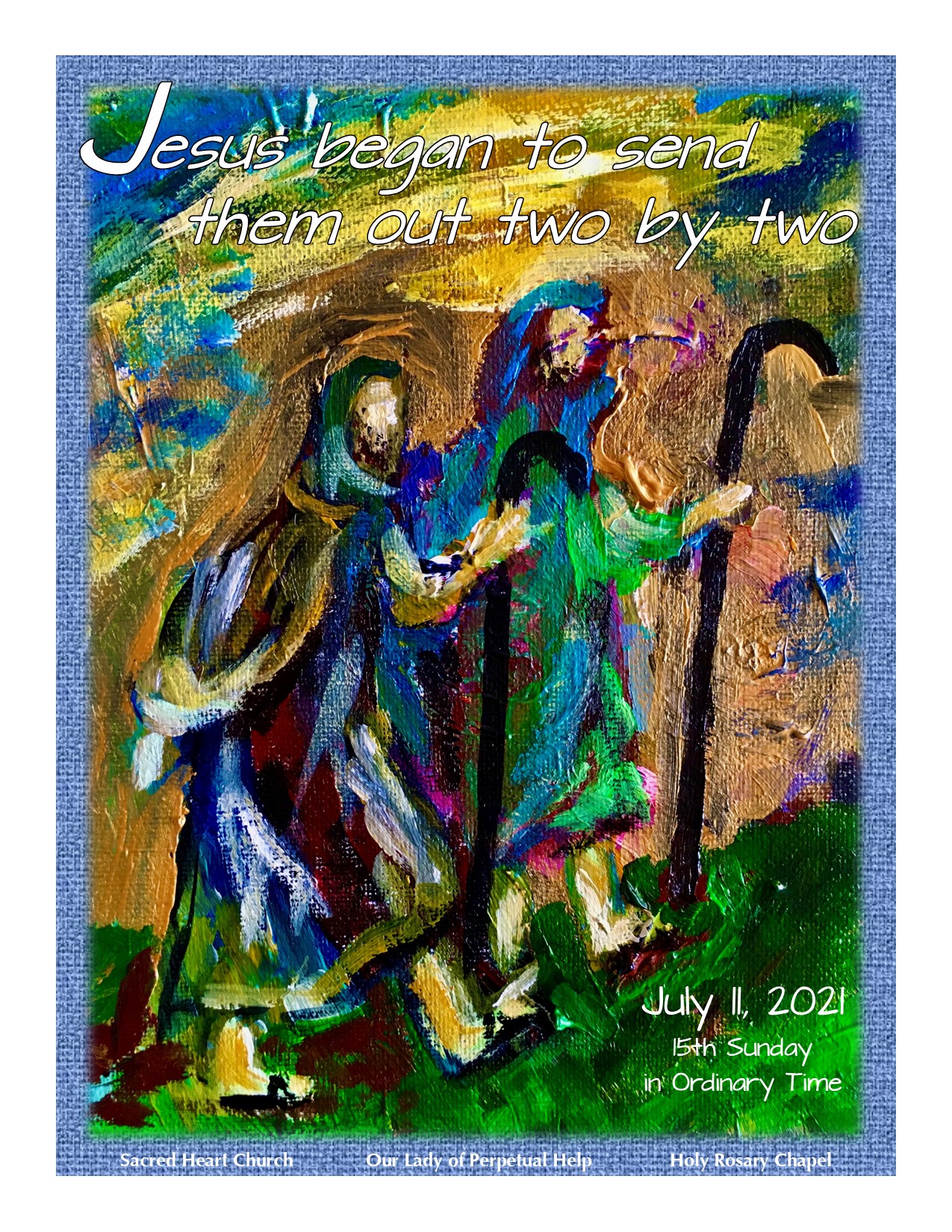
Fifteenth Sunday in Ordinary Time 2021: Bulletin Column, Art

Dear Followers of Jesus,

This week, on July 16, 2021, we celebrate the 99th Anniversary of Sacred Heart Church. This building represents the many generations that have been baptized, educated, married, and buried, in faith. Mark your calendar for next year, July 16, 2022, for our 100th Anniversary! So, as we begin our hundredth year, I am so grateful of our life here, creating and sustaining faith, purpose, mission, and service in Christ Jesus. 

In Mark 6:7-13, today’s gospel, Jesus summons the Twelve and sends them out into the world, two by two. He is very specific about what not to take on this amazing journey— no food, no sack, no money in their belts. They should wear sandals, however. This commission has certainly changed through the generations. Yet, the core of Christ’s life travels in our lives as people baptized to bring Good News to the world. 

I remember very well when my religious community, the Congregation of Holy Cross, sent Fr. LeRoy Clementich, CSC, Kevin O’Connell (deacon), and myself to Sacred Heart Parish in 1984. Fr. Clem arrived from Saint Edward’s University in Austin, Texas. I traveled from Saint Joseph Parish in South Bend, Indiana. This was Fr. Clem’s first assignment in a parish. I had only been ordained one year. 

I arrived first at Sacred Heart in the first week of June 1984. Later in June, all Holy Cross religious had to attend an assembly at Notre Dame. So, I went back to Notre Dame after only a week in Colorado. Then after our province meeting, Fr. Clem, Kevin, and I came to the parish. At that time, Lea Zorn was the only parish employee. Ed Zorn, owned Cy’s restaurant. He provided maintenance work at Sacred Heart on a part-time basis, mostly as a volunteer.  I remember Lea saying to me that she always had her work completed and her desk completely cleaned off at the end of a day. Then after we began our ministry, her work was never finished, and her desk was always full. We shared many laughs and good times with the Zorn family. Also, the very first meal Fr. Clem, Kevin and I had together was at Cy’s Drive-In. 

Fr. Clem and I have spoken often of how green we were to parish life. Yet, we both possessed a similar vision that people mattered, that life was important, that faith and community were wild experiments that needed to be tried every single day. Fr. Clem came with an unbelievable energy. He climbed mountains and flew airplanes. He was certainly a breath of fresh air. He opened the doors for many people; he listened to people’s pain; and he preached with a deep hope for this community, and always with a great sense of humor. I learned a great deal from Fr. Clem and still laugh at our antics as we implemented many changes from Vatican II. 

I didn’t exactly travel empty handed to Sacred Heart. We were a new religious community to Sacred Heart, replacing the Oblates of Mary Immaculate based in San Antonio, Texas. The furniture and accessories in the rectory had all belonged to the Oblates. There was very little furniture in the rectory when we arrived. At that same time, my parents were moving out of our family home in Edwardsburg, Michigan. So, we drove a U-Haul of furniture out here to the parish to set up the rectory. I left Sacred Heart in 1987, taking some of the furniture with me. I was so surprised when I arrived back to the parish in 2013, some of the furniture I left behind was still here. In my room now, I have the dresser I had when I was a teenager. 

The Diocese of Colorado Springs was established in January 1984. Bishop Hanifen asked the Congregation of Holy Cross to staff Sacred Heart Parish, including Our Lady of Perpetual Help in Manitou Springs and Holy Rosary Chapel in Cascade. Originally, Bishop Hanifen wanted Holy Cross to staff Saint Mary’s Cathedral. We desired to help in the parishes closest to our Holy Cross Novitiate in Cascade. We then began in the parishes of Ute Pass in June 1984. 

One of the great gifts I remember from those years was the joy of belonging to a new diocese. Everyone was struggling to find their way in organizing parish life in a new diocese. Bishop Hanifen struggled with shortages of priests and lay ministers. However, there was a sense of belonging to something beautiful. I met and became friends with many of the people who served in other parishes. We all began to rely on one another for advice in implementing pastoral life in a new, missionary diocese. I felt invigorated with the Holy Spirit. I felt I belonged to something greater than myself and greater than our local parish. The diocese had energy and vitality. We moved together in solving many issues and obstacles. Ministering here in those beginning years was inviting and creative. 

I remember the very first priest meeting in autumn of 1984. The small group of priests serving the diocese gathered in Buena Vista. On the first afternoon, we casually gathered in a meeting room. Bishop Hanifen, wearing jeans, a sweatshirt, and running shoes, entered the room where his clergy had gathered. He looked around the room at all of us in attendance and asked, “Okay, guys, now what do we do?” His humility and sense of humor roused joy and hope within us in those tender beginning days of the diocese. 

I look forward to July 16, 2022, when our parish will celebrate a milestone. We carry the mystery of Christ within our hearts and into the world. My hope is that we will look ahead and not just to the past, that we will celebrate our story so far, and yet anticipate our future. God has amazing plans for this community. The Sacred Heart of Jesus invites us continually to hold the hand of the lost, to welcome the stranger, and to befriend the weary as we rest fully in his love for us and the world.  

God give you peace,

Fr. Ron Raab, CSC, Pastor

Reflections on Art Exhibit 2021: The Stations of the Cross in Atonement for Abuse and the Healing of All

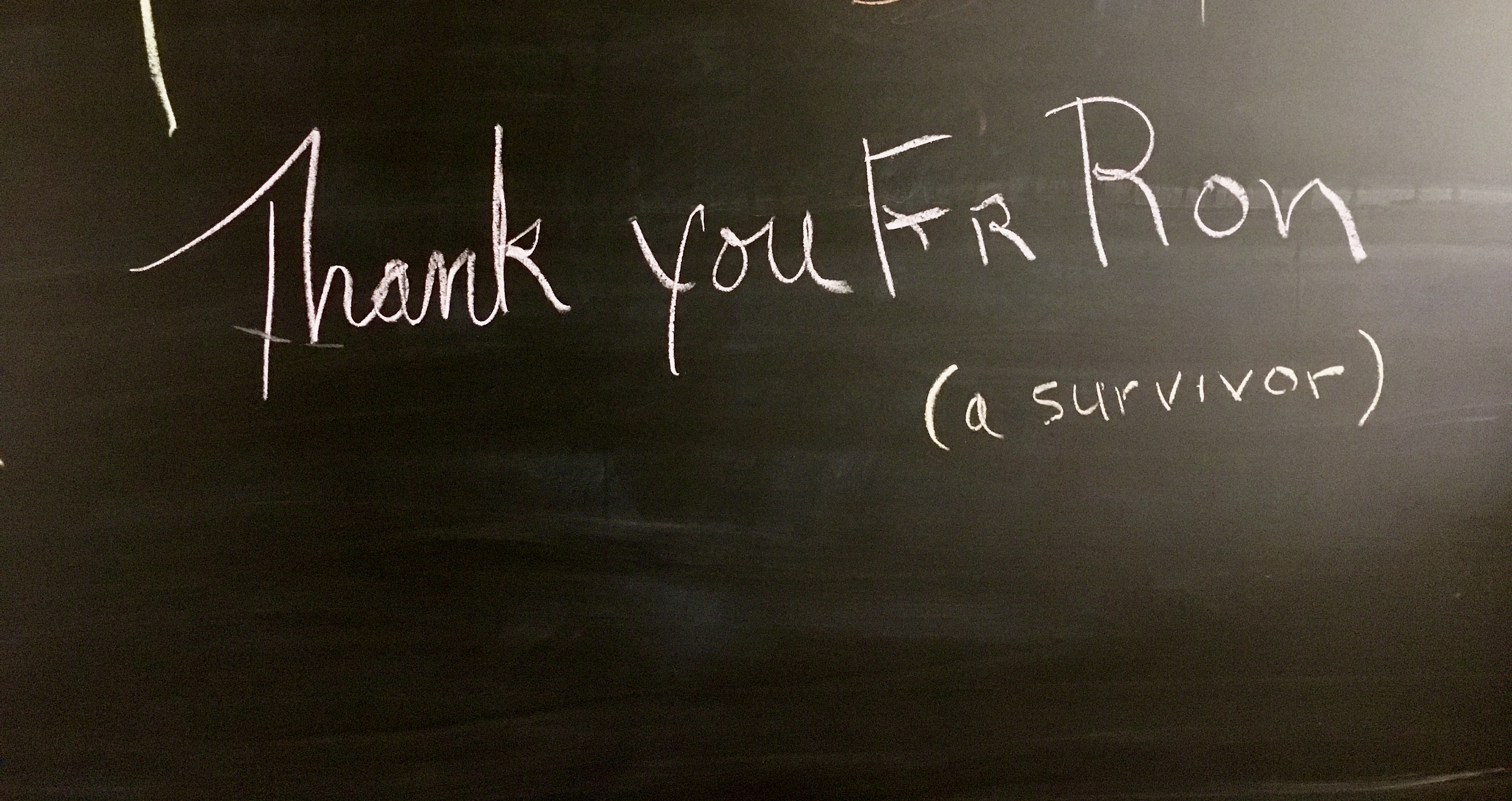
This thank-you note was written on the blackboard at the entrance of Cottonwood Center for the Arts in Colorado Springs during my May exhibit. It stopped me in my tracks one day as I walked in the gallery. From this note, I want to express my gratefulness to those who impressed me with comments and insights. Here is a summary of my reflections about my first professional art show of the fourteen originals from the book, “The Stations of the Cross in Atonement for Abuse and the Healing of All.”

“Fr. Ron, usually the image of Jesus is the same in each station. However, as I walked to the next station, I knew him! I saw him in my heart. You captured so many aspects of Jesus’ path to the cross” This comment came from an older woman as the opening of the show on May 7, 2021, was ending. There were only a few people in the gallery. I wish I could capture her body language as she spoke similar words to me. Her entire spirit recognized and captured the person of Jesus. As she said this, she put her hand to her heart. Tears formed in her eyes. She knew him. The art brought out her relationship with Jesus in a new way. I could not have asked for more as people walked around the room praying these images. For the Catholics who viewed these Stations, their hearts and souls were familiar with the handmade crosses that topped each image. Many people are familiar with how the images were displayed as prayer. They were used to walking the prayer of Jesus’ passion. As she held her hand to her chest, her complete body understood the pain of abuse and the path to Jesus’ death. Faith was revealed deeply from this exhibit, in ways I am still pondering from people’s comments.

“Fr. Ron, you said you allowed the images to emerge in each station. Yet, you traced the handprints in most of them. Could this be that children want to be perfect? And this perfection was a way to hide the abuse. They desired to touch the mystery, yet only in a way a child can without being overwhelmed.”  I thought this was incredibly insightful. I used the handprint as a tag, or a badge on the images. The handprints are a visual way to control the chaos, to allow access to children and the child within each of us to enter the overwhelming reality of Jesus’ death and the unspeakable nature of much of the abuse. The handprints tame the chaos. They put innocence in the art, which is both negative and positive. This person really captured the meaning of the handprint and her insight moved beyond my intention. I loved her ability to take this art seriously. The woman who suggested this knows family suffering. These were the kind of comments that filled the first evening of the show and the parish gathering on May 23. People took this exhibit seriously. It was far deeper than a simple show of illustrations in a book. Faith and real-life issues brought about much discussion.

“Fr. Ron, you said that chaos is an important character in the story. As I view all of them, the chaos seems to diminish toward the last images. Why” This is a key observation and question. I had never viewed the art as an entire series until seeing it at Cottonwood. First, as I examine this question, I see the surrender of Jesus in the last few images. I see how his face and body surrender to death, as if he knows that in the end, all will be well. I want to hold on to that. There is another aspect of this for me. Perhaps I grew more afraid the closer I got to the death. Perhaps, I did not want to face Jesus’ death and the horrific abuse of children the closer I got to the image of death and burial, so I started to control the images again. I think this is only a human reaction, one which is brought out in this incredibly insightful question.

“Fr. Ron, it is good to be in a room that admits harm was done. We need to see the reality of lament by the church beyond the boundaries of church walls.” This comment came from a young person. He names the reality that the Church does not want to admit sin and crime. This version of the Stations of the Cross is the first resource available to help communities pray through the issues of abuse. Our congregations need to hear that harm was done to families. We must cease the generational abuse that is past down to us in silence.

“Fr. Ron, I was abused as a child…” I heard this statement many times during the month of May. In the center of a crowded room surrounded by the paintings, I heard this from parishioners and strangers. The Stations, the art, the topic of abuse, all came together to provide a safe place for people to examine their own lives. Our families deserve such honesty. Many people commented to me that the exhibit was the first time they saw the combination of faith, provocative art, and the naming of abuse. I continue to pray for them and for all people who remain silent about the past. We all have much work to do, to name our experiences, and to help change the stigma of emotional and sexual abuse in our church and society.

These were a few conversations that opened me to the ongoing reality of connecting faith to the reality of life. There were dozens of times during the month of May that surprised me, brought me to tears, and revealed to me the beauty of faith in so many people. I want to thank benefactors and friends who worked so hard to make this exhibit possible.

Fourteenth Sunday in Ordinary Time 2021: Art, Column

Sunday July 4, 2021

Dear Believers,

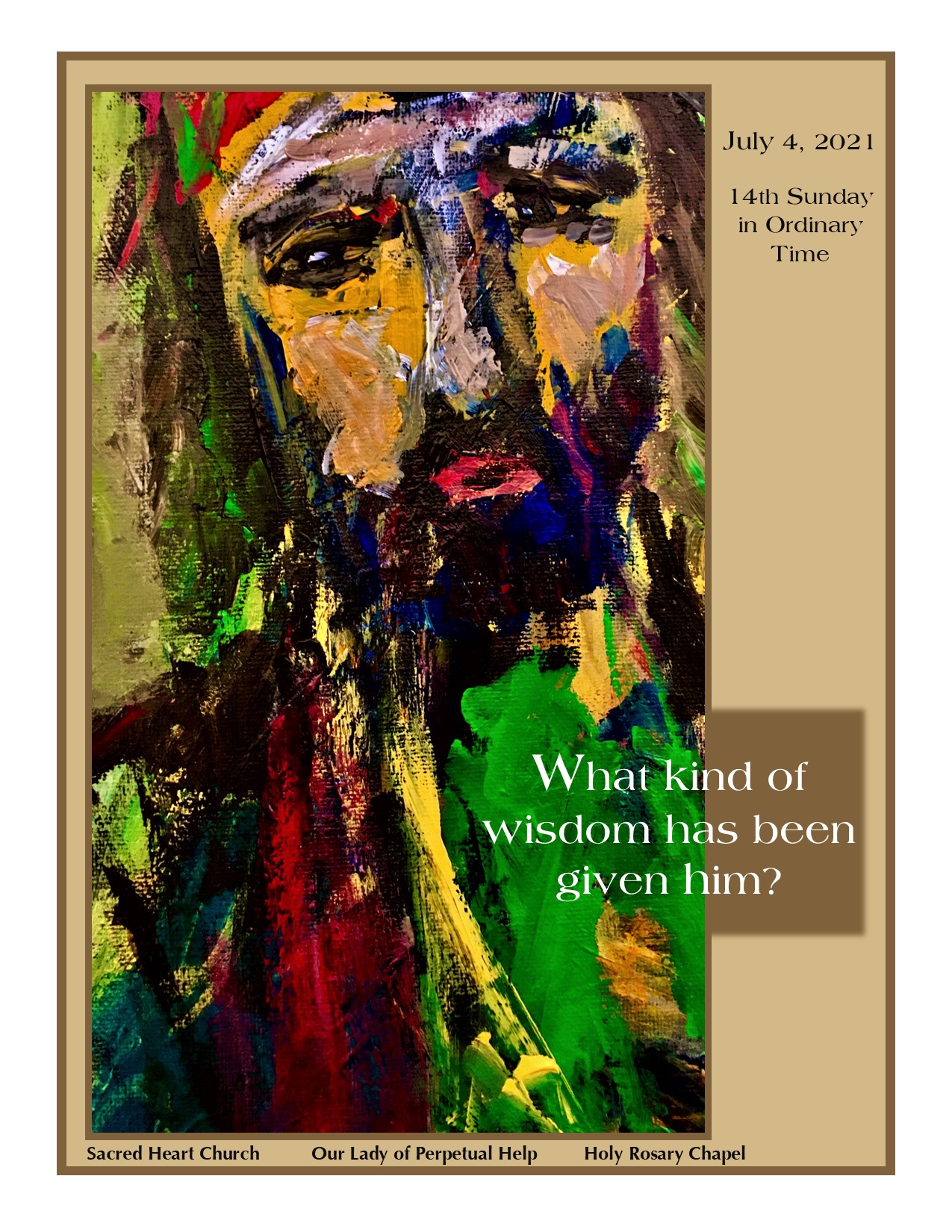
Mark 6:1-6, today’s gospel, invites us to reflect on wisdom.  Jesus comes back to his native place and people wonder how he became filled with such ease and authority, with such wisdom. People around Jesus were both astonished at his gift and also afraid of it. They questioned his beginnings. They thought they knew his roots being a carpenter and the son of Mary. They took offense at him because wisdom has a cutting edge. People familiar with Jesus   grew jealous because of the gift he was given and his expression of such a gift in the world. People were both curious and afraid. His folks were warmed by his wise heart and at the same time felt the heat of him seeming to be better than others. Wisdom changed many of Jesus’ relationships, including those who were closest to him.

Wisdom is challenging to many people. Many folks like mediocrity. Sometimes it seems to be a more comfortable place to be, because to engage in wisdom means change for everyone. So, in the middle of the summer, it is difficult to participate is such a profound gift of wisdom proclaimed by the gospel. Yet, this scripture invites us into such a reflection on this Fourth of July weekend.

We are unshuttering our lives from the pandemic. This weekend, our enthusiasm about life is flapping in the wind, in a weekend that for many people is carefree, a time away from the daily grind of work. However, we still live with responsibilities of caring for our families and our faith communities and our nation. Our common values are lived not in whim or fancy. They are grounded in love and hope. This is our faith, genuine care and concern for our neighbor and for the real issues of our lives. Wisdom, even on the waning months of a pandemic, remains challenging at best for all of us.

As we celebrate Independence Day, I wonder what it means for us to seek wisdom. For in faith, community means learning an inter-dependence, since the source of wisdom is community. Having a sense of community is a real starting place for many people as we eek our way out of the pandemic. What will community be like now? How will we learn to trust one another? What is it that we all want from our communities? Are we expecting too much? Can we grieve the loss of family gatherings, hugs, handshakes and socializing, all from this past year? How will wisdom form our lives, our churches and our world?

There is much to ponder as we celebrate the Fourth of July. Our common life is deeper than eating hot dogs and lighting sparklers. We have many roads and options to consider. Faith always deepens our lives and broadens our horizons. Wisdom helps us expand our notion of God and how to live in the world. Wisdom broadens our world view, expands our imaginations of caring for the planet, the earth, the sea, and every person under heaven. Wisdom is not a luxury, but a way of believing in God with our lives firmly planted on earth.  

Jesus healed people; these were miraculous actions. Jesus continues such awesome wonders.

“Where did this man get all of this?”

God give you peace.

Fr. Ron

Thirteenth Sunday in Ordinary Time 2021: Column, Art

June 27, 2021

Thirteenth Sunday in Ordinary Time

Dear Believers,

In Mark 5: 21-43, I can feel the press of the crowd longing for Jesus under the hot sun. Everyone seems to have caught a glimpse of what Jesus could offer. I so wonder how they knew. How did they get the word of his identity?  His healing touch seemed so different. His very presence seemed otherworldly, yet the earthiness of presence brought hope to everyone there.

I imagine the woman with the hemorrhage struggling to be well. Her body must have been exhausted, her search seemed meaningless after seeking so many doctors. I see her eyes cast down to the sand, her body and spirit rather lethargic.  Imagine the spark of faith inside her, the moment in her heart where she knew she needed to turn to Jesus. She was worn down, stripped of energy and options. Also, as a woman, she was culturally powerless, not having anyone else to help her.

Her faith sparked an inkling of Jesus’ care for her. She shyly approached him. I can feel her sincerity, her trust, her patience. “If I but touch his clothes, I shall be cured.”  I can feel her longing, for all she desired was a moment of his presence. I can see her hand reaching out to his cloak along the roadside. I feel her genuine desire to be well. She believed that Jesus would set her free. Hope made a home within her. In Jesus, healing could be her friend.  

In these summer days, we may experience such a longing for healing. If only during this pandemic, we could touch the mystery of Jesus. If but only a morsal of love from him, we could find our way through the tragedies and uncertainties of our human life and the exhaustion of our souls.

We can touch him. We can reach out to him with simplicity, and he will be with us. The Eucharist reveals to us that not only can we reach out to touch him, but we can receive his Real Presence, his loving care and his hope for all of us. We have more than his cloak. At the Eucharist, we also become what we eat, that is as we share in his divine meal, we are given the courage to reach out to others who need help and healing. Jesus invites us then to become instruments of love, healing and hope in our world.

Faith is not a spectator’s sport. This gospel opens us up to healing and also invites us into our world to become agents for Christ’s love. We may first be shy and unwilling to live our vocation of hope in our world, but if we can begin with the inkling of faith to reach out to him, that is all we need to change our lives forever.

I wonder how the woman spent the rest of her day. She must have spun with enthusiasm and her family must have shared her healing joy. I am sure she slept well that night and woke up to an entirely new life. She must have spent days telling everyone. She certainly models for us that all we need is a small moment of faith and our lives can be different.

We are not alone in our desire for healing. It is the world at large that really desires to touch the cloak of Jesus where we are assured of love and his ability to heal our ills.

“If I but touch his clothes, I shall be cured.” Immediately her flow of blood dried up.

God give you peace,

Fr. Ron

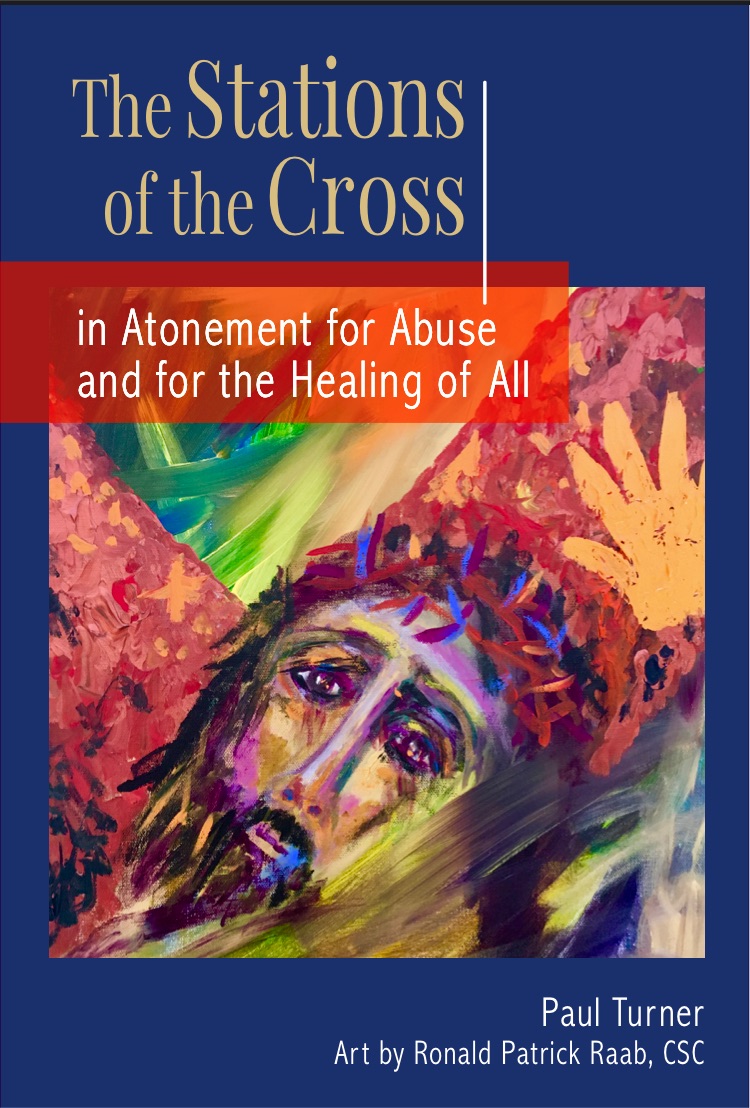
Catholic Media Association Awards: Honorable Mention, The Stations of the Cross in Atonement for Abuse the Healing of All

Liturgical Press has received Honorable Mention recognition for Paul Turner’s book, The Station of the Cross in Atonement for Abuse and the Healing of All. Details

To learn more about the book, click here.

I remain so grateful to be part of this important work in the church. The issues of abuse are not subsiding anytime soon. We must be willing to pray through the pain. This book is the only resource I am aware of that helps congregations face the severity of abuse and to place our common pain in the dying and rising of Jesus Christ. My illustrations speak boldly of our longing to touch such mystery. With appreciation to Paul Turner and John Kyler, editor, and everyone at Liturgical Press.

Twelfth Sunday in Ordinary Time 2021: Bulletin Art, Column

Dear Followers of Jesus,

In Mark 4: 35-41, we have the privilege of entering a scene with Jesus in a boat loaded with fearful disciples. In the center of a storm, they fear for their lives and are frustrated with Jesus who is asleep. In the center of the chaos, the presence of Jesus is calm and trusting. 

I remember some years ago I had lunch with Fr. Clem (Fr. Leroy Clementich, CSC) when I served in Portland, Oregon. We had served together here at Sacred Heart. I remember talking on and on about some crazy thing I was disturbed about. He listened patiently. Then he turned to me at the lunch counter and said, “Oh, Ron, be at peace. Ron, Ron, just be at peace.”

His kindness runs through my veins all these years later. If my faith was true and lasting, peace would flow. Within this gospel text, I find the tale of Fr. Clem and I sitting close together on stools in a diner in downtown Portland. My fret could not shake his faith; my worry could not disturb his peace. I realized how often I am tied to such fear outside of my own life rather than gazing upon the face of Jesus curled up in the corner of my heart. 

This gospel is remedy for the fear that rocks all of our boats. The disciples were beside themselves with anxiety. They could do nothing about the storm but ride the waves. The chaos did not even awaken Jesus. We all face much fear in our daily lives. However, I wonder if we ever gaze underneath our fear and find the person of Jesus who has been guiding us all along. 

Sometimes faith is seen as adhering to a set of guidelines that make us prideful and sets us apart. Faith is not something we memorize, or think is written in stone. Faith is utter trust in God. Faith is absolute belief that all will be well by the guidance of the Holy Spirit. This trust is not blind, but deeply rooted in our lives of intelligence and reality. The disciples learned in this situation that they could do little but ride the waves of the storm. They had to work the best they could to be safe, and in the end, they realized Jesus does not keep them from the storm, but is in the center of the storm all along. This is crucial to our lives of faith. 

The disciples deepened their wisdom in the boat in this scene of the gospel. We also must learn what to fight for, what to worry about and how to serve in the various storms that rock us on a daily basis. In the end, we have very little control over many of the storms that shake us up. Faith is not about relying on Jesus to keep the storms of doubt, grief, and hopelessness away, but to trust that he is within our hearts in every moment of life. 

Let us cast our worries on the Savior. Let us take our place among those who have believed before us, and even among the great mystics, that all will be well. The divine question that floats to the top of this gospel is so important in how we live and how we believe, “Why are you terrified?” This challenging question remains a lifeline in the chaos that gets us down on a daily basis. 

I pray we may listen to Jesus and to Fr. Clem. “Ron, Ron, just be at peace.”

God give you peace,

Fr. Ron Raab, CSC, Pastor