John the Baptist is one of my favorite personalities in the gospel next to his cousin Jesus. I am drawn to John because he knows entirely who he is in the story of the Christ. Even when he was in the womb, he danced in recognition that he was in the presence of the Savior. John grew up close to the earth and close to the realization that the world needs salvation. He spent his life pointing into the direction of Christ Jesus and calling people to ready their lives for his promise of salvation.
Today’s gospel, Luke 3:1-6, breaks through the silence of the desert so we may listen to the strong and bold words of John the Baptist. Again, the gospel is not about a cozy, domestic longing for the baby Jesus. Somehow, we are afraid to look at Christmas differently from the warm fires of family life. Christmas is not about domestic bliss; it is about the realization that the Word of God moves mountains, changes the directions of streams, and makes winding roads straight. In other words, there is nothing in our lives that cannot be redeemed, loved, and forgiven. This is the journey for us, to open wide our hearts even when we are filled with fear. We seek the glory of God becoming flesh within the world.
John is in the desert in today’s gospel. The wasteland is an important image in the gospels. Here’s why. The coming of Christ reestablishes the full presence of God. This abundant love is viewed in the original image of life in the Garden of Eden. In other words, the desert, which is devoid of lush green and flowing water, will become the second garden of life in the resurrection of Christ Jesus. So, John shakes us all up by saying that we must be prepared in the desert for something new to happen. Valleys will be filled in and rough roads made smooth. Lush green will become our home, an image of eternal life.
This image of desert is also about the human heart. There will be no sin or anxiety that will not be forgiven or made new in Christ Jesus. John has quite the task in Advent. He is bold, earthy, strong, and sure in his declaration that every human heart must wait for God. We all experience this dry wasteland at some point in our lives. We all know how sin, division and heartache can shrink or decay the potential of life. Our hearts in Advent are laid bare for love to enter to make them whole.
Our prayer during the Advent season must be inclusive and expansive. We are to pray for all the ways our hearts become withered and small. We are to take the voice of the weak seriously and to walk among the bewildered and the poor with unbelievable hope.
In this Year of Grace 2022, our parish will celebrate 100 years on July 16, 2022. I ask you to pray for our three communities, Sacred Heart, Our Lady of Perpetual Help in Manitou Springs, and Holy Rosary in Cascade. We will mark a century of prayer and service in this year, but we can only continue with your generosity, your commitment, and your joy. I am so grateful for this time of celebration and renewal.
Today’s gospel, Luke 21:25-28, shakes us by the shoulders. It is spiritual cold water in the face. This message of urgency begins the New Year of Grace, 2022.
Advent creates within us a desire for God. This is the message of our ancestors who waited for the Messiah. We know this urgency to wake up when we are confronted with severe illness or when our children are rushed to the hospital in the middle of night. We know it when divorce strikes our home or when a spouse is counted among job-loss statistics. We utter cries from the heart when life seems unfair. We raise a fist to heaven when we cannot control the outcome of life.
Advent begins with an eternal cry for justice. This is because our ancestors waited for the Messiah whose promise was peace, light and hope for all people. So, we begin this new liturgical season in deep human need, a condition we know well. We stand among others who ache for Jesus Christ. This penetrating longing of the heart is our food for prayer.
Advent begins with a wake-up call to not let our hearts become drowsy. We are to cease carousing. We are to stop drunkenness. We are to be vigilant. We are to stand on the earth and desire God in the deepest recesses of our hearts and in the visible needs of the planet.
God is nearby. God is here. God is within us. Advent allows us to see for ourselves the miracles of what God offers us and the world. So, let us calm our expectations. Let us put aside the frantic activity of December. Let us instead, wait in joyful hope for God to change everything in our hearts and on our planet. We begin the story of Jesus Christ over again. We wait. Pay attention to Advent. Wake up.
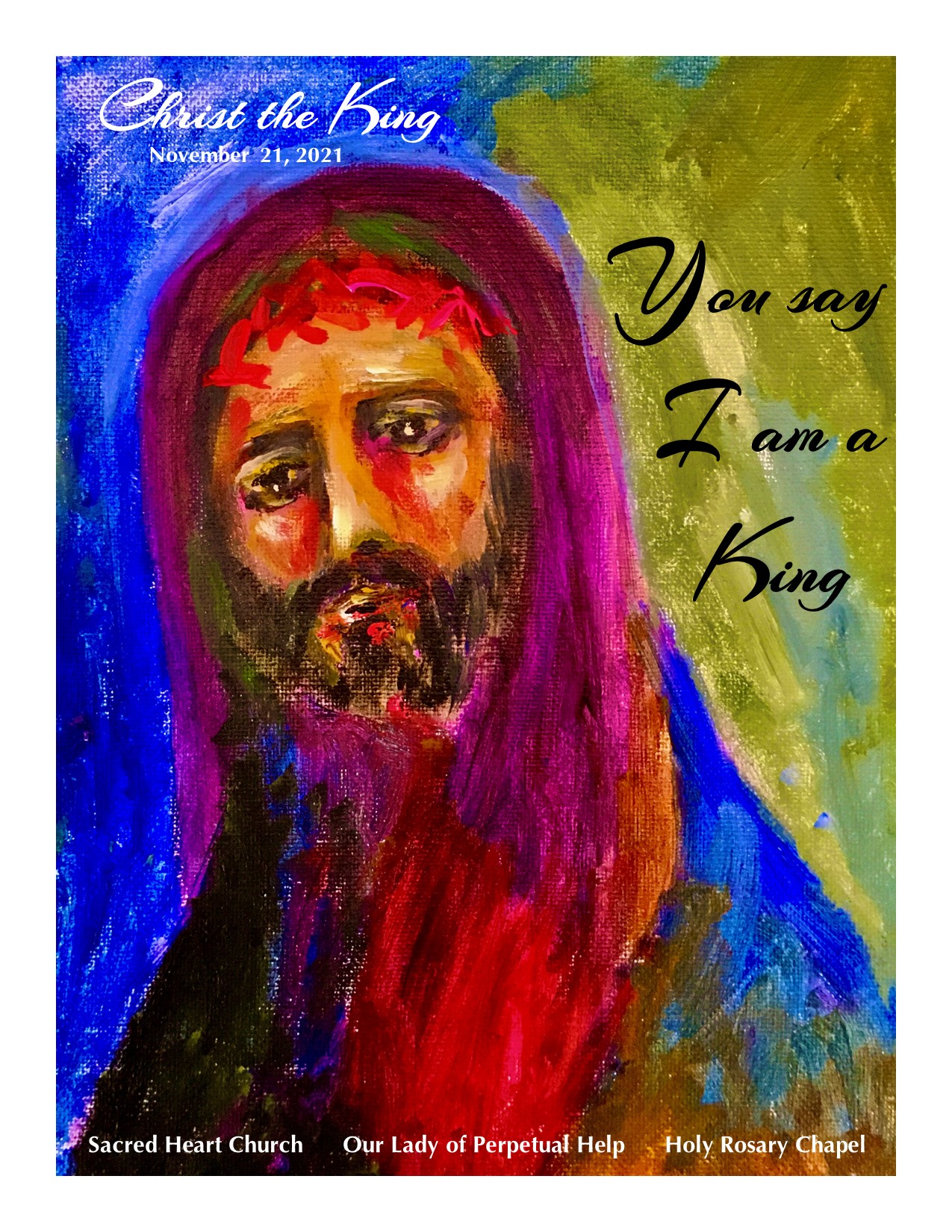
Today, we celebrate the last Sunday of the Church’s liturgical year. Christ the King is the conclusion of our celebrations of Jesus Christ. This solemnity concludes with the message of Jesus that in the end, we will know him, be with him in paradise, and find our home in his dying and rising.
I love this feast. It opens my heart because in the end, everything will be all right. In the end, redemption will be revealed for us, for the Church, and for each person. I cling to that. As a pastor, I ache for Jesus the King to love every person in every situation under heaven. There are days where I do not know where to turn except to the King of the Universe, to Jesus who died and rose for us and who waits for us in heaven.
Jesus becomes king then, of not only wayward folks, but of all the issues in life that seem unredeemable. Jesus takes to his heart our children who live in violence and chaos. Jesus is king over migrants and servants even when we are made think otherwise. Jesus forgives us and our enemies. Imagine that scenario. Jesus is king over our fear. He heals those addicted to cocaine and heroin. He is shepherd to all people who on this side of the grave cannot help themselves. Jesus is king who tends to the mentally ill. He is healer over those with throat cancer who will finally sing his praise.
He is the one who welcomes everyone around the table in the Kingdom, especially those who have never felt welcomed at their family table. Jesus is the kind-one who will bring all who have been abused into new and vital healing relationships. He will bring home the ones who fret and worry, those who are too stubborn to believe on earth, and those who cannot wait to get out of prison. Jesus the King is the servant for all people.
In today’s gospel, John 18: 33b-37, Jesus is before Pilate. Their conversation about whether he is a king reveals heavenly grace amid earthly power. In the closing sentence of this passage, Jesus says, “Everyone who belongs to the truth, listens to my voice.”
The redeeming love of Jesus is still being revealed. The truth Jesus speaks of his authority is within our hearts. Listening to such truth can be intimidating. We may resist listening to him. We may want to find our path only in our pretense and self-sufficiency; we may want to listen only to our own ability to build our own kingdom. Jesus reveals to us in his suffering that he desires to be with us. He wants us to listen to his life, his scriptures, his examples, and his voice within the human heart. He desires to be our everything, our consolation, our peace, and our way to the Father. He leads us by example. He prepares a place for us in our Father’s glory.
We have certainly been through a lot in these past couple of years. As we end this liturgical year, I want to thank all of you for your patience and perseverance. We can’t take anything for granted as we have all learned through these years of pandemic. Everything matters. Everyone matters. So now, we look forward to telling the story of Jesus all over again, to claim him in our hearts as if it were the first time, as we look forward to celebrating the longing of our ancestors in the opening weeks of Advent. So, we begin again, all over one more time, next weekend on the First Sunday of Advent.
Thank you for creating our communities. Thank you for living the mystery of Christ Jesus here on earth.
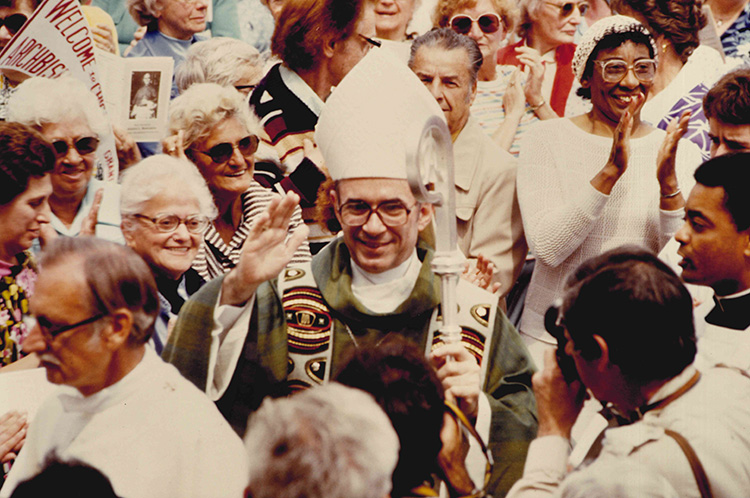
On August 25, 1982, Joseph Bernardin, was installed as the Archbishop of Chicago. He was a breath of fresh air, a kind man, a priest amid people. The following month, I was ordained a deacon at the University of Notre Dame. Later in September, I met Archbishop Bernardin in Fort Wayne, Indiana. He preached at Eucharist celebrating the 125 Anniversary of the Fort Wayne-South Bend Diocese. A deacon who was scheduled to serve that Mass became ill. I filled that role.
During the anniversary Mass, I had an idea. I thought if I could catch up with Archbishop Bernardin, I would ask him to ordain my class priests in the following April. Well, after Mass, he asked me to retrieve his homily on the podium from the arena. When I arrived back, we were alone in the same room. I asked him my request. He responded positively. I then had to go back to my superior and my classmates to tell them what I had done. They did not share my enthusiasm! As it turned out, Archbishop Bernardin did not want to ordain us before he had an opportunity to ordain his seminarians in Chicago. He later became Cardinal Bernardin.
In 1987, I accepted a position in the Office for Divine Worship in Chicago. As it turned out, I also spent three years on Bernardin’s priest council. At the time, there were 100 priests on that council. I listened to him lead and respond to criticism. I watched him support the efforts and concerns of the Archdiocese. I felt his love for God’s poor and marginalized. I watched him pray at Eucharist. His profound faith was inclusive and not harsh or rigid. He loved life and his priests and most especially the People of God. There was something very special about him as a man and as a leader.
The Office of Divine Worship was responsible for the large liturgies for the Archdiocese. Cardinal Bernardin had eight homily writers. He could not keep up with all his commitments in any given day. He wanted to make sure that what he said was accurate and inspiring. I remember filling out forms to give his writers about what to say at certain events. I felt deeply connected to him when I heard my words come out of his mouth at a Mass of Thanksgiving for the Neophytes one Easter Season.
His gifts of reverencing life from conception to the grave inspired me. His initiatives concerning the seamless garment of life were not accepted by other bishops. He worked tirelessly to support life in all its complexities, including the death penalty, homelessness, job concerns, nuclear war, and euthanasia. His willingness to step out in the rift of conflict over issues of social concern in a kind and generous many inspired so many faithful. His ability to listen was pure gift. His fearlessness loomed large to me as a young priest. In 1995, he received the Laetare Medal from the University of Notre Dame, given in recognition of outstanding service to the Church and society.
He suffered much after his diagnosis of pancreatic cancer. While he was ill, a former seminarian accused him of abuse. Bernardin’s life became extremely public as those two issues became known. He handled his cancer and the accusation with sheer grace. The accusation was resolved before his death. I remember his face on the cover of Newsweek Magazine and the article about how to die with grace and dignity. He also received the Medal of Freedom from the White House while he was very ill.
I still have his death card in my Bible. I stare at his picture often. His voice is needed so much today, in the center of great divisions in our Church. I pray with him and for him, still hearing his gentle, slow voice in my life as a priest. Twenty-five years after his death, Joseph Cardinal Bernardin, pray for us.
This text is published in our parish bulletin on November 7 and November 14, 2021. Artfor Andre fundraiser was an opportunity to articulate the story of my art in thesepast few years.
In these past couple of weeks, I have donated nearly 200 original pieces of art for a fundraiser for the remodeling of the former rectory to be called, “Saint André House.” During the event on the weekend of October 23/24, many people asked me what it was like to let go of the originals. Parishioners thanked me for being vulnerable enough to send my art into the world. They also wanted to know more about my art, the history of my art at Sacred Heart, and why I began painting.
When I arrived at the parish in 2013, Lisa Lundquist was offering art workshops for our Holy Cross novices. She asked me for space in the Parish Center because there was a large class of novices, and she was running out space in her home. I offered her space with one request, that I wanted to be part of the workshop as well.
Lisa was very sensitive to my desire to paint. She pondered how to start with me. Lisa knew that I carried a great amount of grief to my new assignment from Portland where I had served people in poverty. The transition into being a pastor in Colorado was not easy. Lisa decided to use that grief as a doorway into my creativity.
Lisa prepared two sheets of paper taped to a wall, dabbed some black paint on a Styrofoam plate, poured water into a cup, and washed out a brush. She brought me into the room and sat me down. She asked me to describe one of the people I missed from Portland. I described with words a woman who had been abused as a child, with curly hair, thick glasses, and who served as a janitor in a nursing home. I told her that she did not like herself, that the abuse had scarred her for life. Lisa took the brush, dipped it in water and paint and approached the white paper. In less than two minutes the woman appeared on the wall, with thick glasses, head downcast, holding a mop in her hand next to a bucket. I stared at the image and wept. Lisa had captured the woman perfectly in acrylic.
Lisa then asked me to describe a second person. I described a young man who lived in a tent in the woods in Portland. He, too, had been abused as a child, and could not keep a job. He had been received into the Church at an Easter Vigil. He always sat in the last row of our chapel with his arms over the back pew, wearing a baseball cap. Lisa handed me the brush with black paint and told me to paint him. I approached the white paper and in a couple of minutes an image of this man appeared. I dropped the brush in the water, stood back from the two images and cried my eyes out. I wept in grief. I wept in hope that they both would find what they needed.
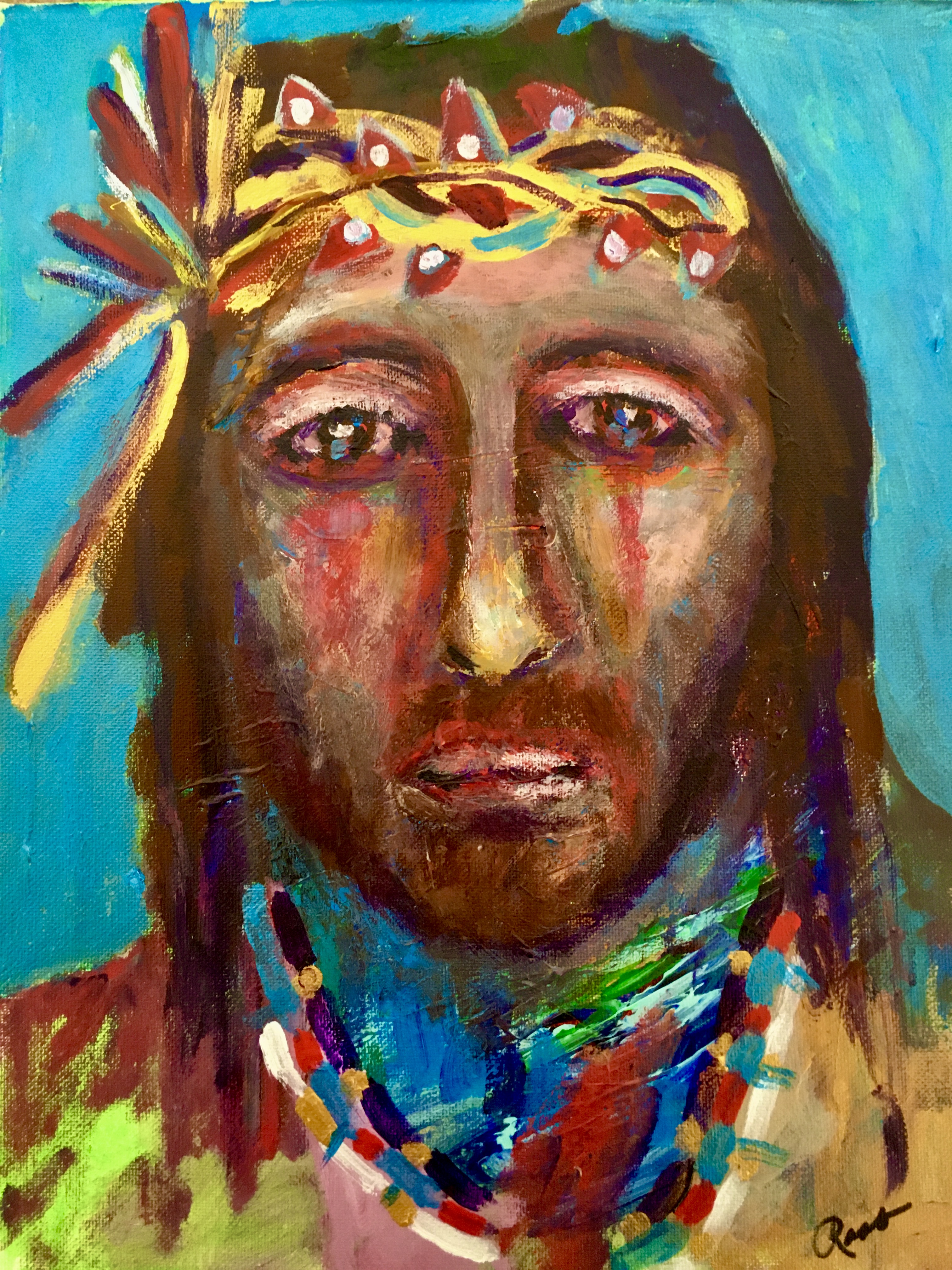
Lisa then looked at me and said, “See, everything you need is inside of you. All you need is to paint.” I go back to her words often. As I look back now, what is inside of me is my desire to see the face of Jesus Christ. I have painted my way into a deeper communion with Jesus, exploring my heart’s desire to encounter him, to hear his voice, and to see him not just at the end of time, but here every day.
The pinnacle of my art happened during the pandemic. Just before the shutdown, I was commissioned by Liturgical Press in Minnesota to illustrate the “Stations of the Cross in Atonement for Sexual Abuse and the Healing of All.” At first, I resisted the invitation because I knew that my art was not what the publishing house normally uses for their publications. I thought my approach was too abstract. However, the editor of the project, John Kyler, persisted. I painted all fourteen stations in the first weeks of the shutdown and handed in the project on May 1, 2020.
After the book was published in December 2020, I began to realize that I too, was abused by a priest. I had never put the pieces together before. A priest, a family friend, sent me to another priest because I was not attractive enough for him. I never put those pieces together until doing the illustrations for the Stations of the Cross. The art has healed me. It is no wonder I told the stories of the two people who were both sexually abused when I began painting. I am amazed that at 65 years old, I am still learning about my life in so many ways, still unveiling truth.
One of the highlights so far of my years at Sacred Heart was my art exhibit at Cottonwood Gallery for the Arts in May 2021. Sacred Heart Parishioners John and Sandy Goddard were instrumental in persuading the gallery to examine my work. The month-long exhibit of the originals was an incredible experience for many people. Over 900 people viewed my work during that month. I had many people tell me the story of their own abuse by family members or family friends. The effects of the abuse still linger as a cloud over present day relationships and activities for so many people.
During that month, I learned that the priest who led me to a different priest was convicted of five counts of abuse and sentenced to prison for 8-15 years. I still cannot believe after 45 years that the sentencing happened in the same month as my exhibit. Healing abounds. Now, I have come to believe the reason I started painting was to help me get to the realization that I had been abused as well.
I mentioned to many people during the Art for André fundraiser that my relationship with Sacred Heart Parish and the parish’s relationship with me is summed up in the art. These paintings represent our time together. They did not exist before I got here and will not exist after I leave the parish. These pieces of art are a segment in history of our time together. This is a beautiful reflection for me to ponder, to reflect upon in my art and in my prayer for everyone in the parish.
I never desired to hold on to the originals for long. I have found the search for my own truth and my faith more important than the final product. Over the past 8 years, I have given many of them away, donated others to fundraisers in the diocese, and sold a few. I don’t view the originals as possessions to keep. The journey of a blank canvas, the intuitive approach with paint on my fingers or brush, the quiet in my studio, the act of faith, all become prayer. The act of painting, the self-expression, and the truth are all keys to my heart.
I paint with immediacy. I don’t spend a long time at the canvas. It is finished when the prayer or insight is finished. I have realized in my art that I paint in a similar manner as I preach. I use words from my heart; I express them in the moment, then I am finished. I don’t keep a written version of my homily because it doesn’t exist. My paintings are similar; I paint them, then I am finished with that image. Words and images are immediate; they speak, and I do not cling to them.
Now, I do not know where art will lead me. I wait for the inspiration, the action of the Holy Spirit to guide my next moves into creativity and art. In the meantime, thank you for accepting my art and donating toward the next phase of our parish future for Saint André House. I look forward to celebrating our 100th Anniversary together in July 2022.





 Broken But Not Divided