Twenty-Eighth Sunday in Ordinary Time 2020: Bulletin Cover and Column

CLICK here to read complet bulletin for this weekend.

28th Sunday in Ordinary Time

My dear followers of Jesus,

Our New Testament text from Philippians from today’s Mass states, “I can do all things in him who strengthens me.” I stopped in my tracks when I read this again for this weekend. This statement is so timely because we are weakened in our Church by much fear and anxiety. So, I want to say a few things about fear in times of COVID-19, one more time. As we surround ourselves in this mantle of assurance from this text, how do we survive the fear that seems to overwhelm us as a people?

I want to start with this quote from Pope Francis, from 2016. Pope Francis says, “Where does fear lead us? The feeling of being closed in one oneself, trapped. Once we feel that way, our fear starts to fester and is inevitably joined by its ‘twin sister’, paralysis: the feeling of being paralyzed. Thinking that in this world, in our cities and our communities, there is no longer any room to grow, to dream, to create, to gaze at new horizons, in a word to live, is one of the worst things that can happen to us in life, and especially at a younger age. When we are paralyzed, we miss the magic of encountering other, making friends, sharing dream, walking at the side of others.”

This quote was before COVID-19. Yet, this quote names what happens when we are afraid. I have spoken with many people across the country, and fear has settled into our human consciousness and daily lives like never before. Parents are exhausted from negotiating school policies and trying to make a living. Our older population is just frightened to pieces about the possibility of being sick. Our young people, perhaps, are most afraid, because they wonder what the value of life really is and is life itself really worth it. Fear cripple’s leadership in the Church and it covers our family life. Fear is messy and thick, and it is difficult to walk through or just not let it get to us. Fear negates faith in Jesus’ message of hope, and it rips apart our ability to thrive. Fear keeps us short of breath and sometimes keeps us from knowing the value of our lives.

I believe fear can lead us into a deeper, more complete life of faith. First of all, in these complex times, we may believe that faith is a commodity. We can’t purchase our lives of faith. Mass or personal prayer is not just something we achieve or accomplish. It is something we become, growing closer to Christ Jesus in exactly how life is and not how we wish life ought to be for us or the world.

These times of fear may become for us also days of faith and surrender. COVID-19 may easily become for us a time of conversion. I hear so many folks say that they are waiting for everything to be normal again. I sure hope not. This is not a statement of faith. We cannot go backwards in our belief systems. I don’t want to go back to what we had; I want what God will do in us in something new. God is leading our lives now, and God will eventually lead us into something more beautiful and healing. If we believe in God, then we realize we learn constantly to surrender to the love God has for us. We do not always get our way in God. Our prayers are not always answered in the ways in which we think they should be answered. In these COVID-19 months, we might for the first time in our lives find God in the surrender of our hearts and not in the intellectual pursuits of our control, power and authority. 

Many people have given up on God and the Church in these COVID-19 months. They do not see the point of going to Church or receiving communion because they want God to be healing us and not keeping us apart. Many people have left the Church because of our country’s politics and the Church’s silence on many issues, including how to maintain our faith during the pandemic. Fear has made a home in our restlessness because every structure we have known in our society has changed. Fear collapses our hearts when we can no longer rely on the steadiness of routine and the surety of Church structure and authority. Fear creeps in every heart that is detached from the normal circumstances of routine and relationship.

We can never go back to what has been in our Church or society. This pandemic is real and has many consequences. This is not a hoax or a way for the government to weaken the Church. Real people have died across the globe and our scientific authorities simply do not know what the virus will do in the future and they do not know how the virus will affect our lives and bodies. The virus teaches us the reality that life is complex, and it is not to be controlled by us or anyone else. Life is fragile and it is real.

One aspect of our fear is that the virus has become a political football. This is so unfortunate for our common lives of faith. Fear and politics destroy our common lives of faith, love and service. I notice that when I say anything or do anything in the parish concerning our common life and the pandemic, I am immediately seen to be on one side of our nation’s political systems or another. In this reaction, I have been scratching my head. I am just trying to lead from the posture of a virus and to help us all live in the context of our faith in Christ Jesus.  

So how can we live beyond fear today? I have some simple ways to help us engage our fearful hearts and to help us stop engaging in the turmoil that keeps us from believing in God. First, we need to learn how to be silent, how to quiet our lives, hearts and thoughts. I suggest every morning, upon awaking, we find time to be alone. I don’t know how to foster faith without this kind of routine. We need to face the sins, obstacles and insecurities of our lives. We need to face the truth of who we are in God. Alone time is golden to reduce fear.

In our alone time, I suggest we all read and reflect on the daily scriptures of the Mass. These can be found online or in written resources. There is wisdom in these texts, the basic message of the readings teaches us a pattern in the Christian life and year. In this time of year, our gospels open us to the reality of the Kingdom both in the end of times and at our death. Grace is here for us in these readings. Take time to find this grace.

Deep beathing helps us find God and reduce fear. Intentional breathing exercises can bring about not only physical relaxation, but a spiritual depth and reliance on God. Being in our bodies reduces fear, feeling our bodies, helps us calm down and rely on the holy.

Exercise, eating healthy are not just doctor’s formulas, but also ways in which to help our lives of faith. We need to become what we believe and not just have intellectual pursuits of being on the correct side of Catholicism. Fear has penetrated us as Catholics and living only in the externals will not help us heal in the ways in which we need right now.

We need to talk through our fear. However, be careful about who listens to our fear. Sometimes our friends mean well, but they can also trigger more fear and then not be helpful at all.

We need the sacraments. We need to find ways to let go of sin, doubt and untruth. However, we so need to cultivate a real desire for God, to discover within our beating hearts the truth of Jesus Christ that helps us know who he is for us, and who we are for others. Let us leave fear at the door of our hearts. Let us live in Him.

We need to learn something from our fear, that Jesus is nearer to us than we once thought.

“I can do all things in him who strengthens me.”
 

God give you peace,

Fr. Ron

Twenty-Seventh Sunday in Ordinary Time 2020, Cover Art, Column

CLICK HERE to read this weekend’s complete bulletin

Dear Followers of the Anointed One,

We are very aware of the destruction of the fields, the crops and our food in late summer storms, droughts, hurricanes and floods. Our plans for such security come to nothing when natural disaster strikes. The basics of life are swept away, destroyed and our lives are at risk. In faith, we know that our true lives depend on the Kingdom of Heaven, the true source of hope. However, in light of the destruction, our view is of the earth, our survival, and the care of so many of our brothers and sisters.

Let’s look at today’s parable opening up another image of God’s Kingdom, our true and eternal home. This parable and image may seem so otherworldly, so out of place. Yet, we gain hope in our faith here in any destruction as we place our hope in God.

Today, we break open another parable about the Kingdom of Heaven in Matthew 21:33-43. Jesus tells the story about a landowner who carefully plants, protects and equips the vineyard, and about the tenants who take progressively more violent steps to usurp what is not theirs. Jesus issues judgment against the chief priests and elders. The Kingdom of God will be given to those who understand what is given, the promises made here on earth of the glory and hope of the Kingdom in Heaven.

There are many questions to be asked. What is the fruit of the kingdom? How are we to find it now? The only way to discover such a gift is to die to ourselves, to discover the life that is greater than our own plans, our own egos and our own desires. This is the fertile soil on which we plant hope, the breaking open of our hearts and lives.

We die to certainty on earth. This is a difficult way to find God and yet it is the only way. There are few people who are willing to risk security and a full ego to find the true fruit of the Kingdom of Heaven here on earth.

When we take the risk, God’s fidelity and love grow more deeply in the soil of our hearts, out actions and our decisions. Love only flourishes when we let go of our hatred, our violence and our illusions in order to discover a life of prayer and hope in God. The fruit of God’s Kingdom is lasting and true.

Some questions for this week:

What have you learned in the recent storms and natural disasters?

Where are you finding hope?

What lessons have you learned in such experiences of powerlessness?

How are you praying through these events?

What does it mean for you to die to self and discover the Kingdom within your life?

What does it mean for you to enter and care for the vineyard of God’s Kingdom?

God give you peace,

Fr. Ron

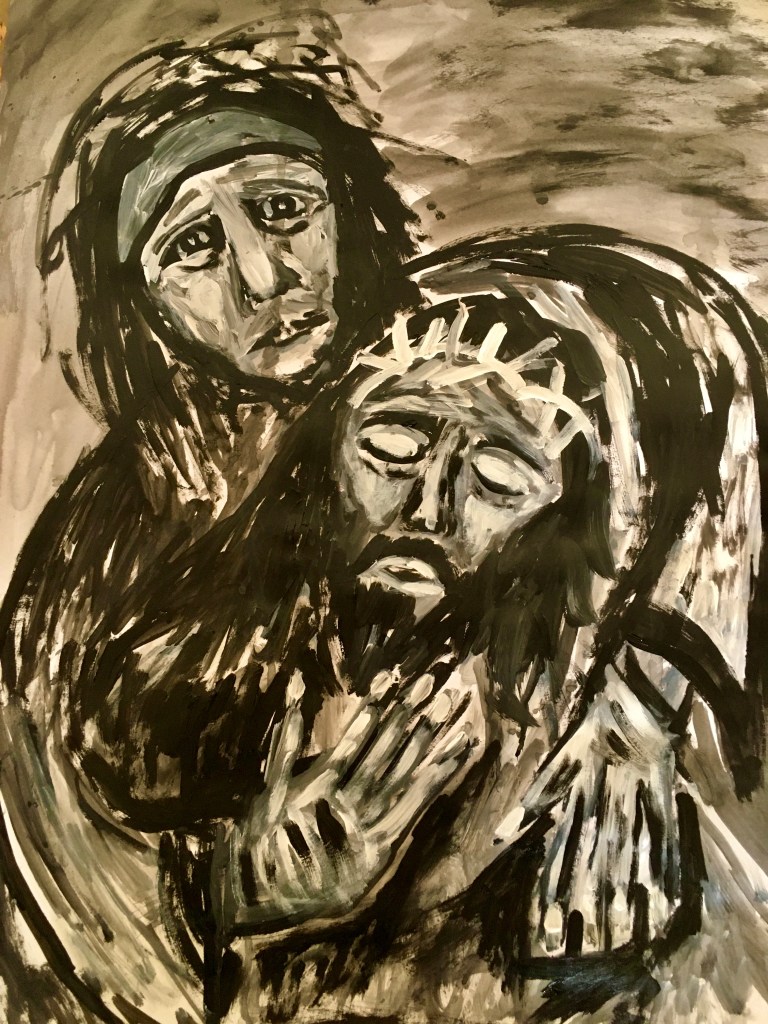
The Stations of the Cross in Atonement for Abuse and the Healing of All: By Fr. Paul Turner, Art by Ronald Raab, CSC

Please click here to order a copy of our Stations of the Cross that will be published in December.

This commission is one of the most important in my priesthood. I had to face the issues of abuse from the hands of my brother priests. My art is not traditional, in fact, chaos becomes one of the main characters. I hope you will pray these stations written by Fr. Paul Turner. The art provides another dimension of reflection, healing, and renewal for us all.

Many thanks and blessings,

Fr. Ron

Twenty-Sixth Sunday in Ordinary Time 2020: MT 21: 28-32, Homily

CLICK HERE to listen to today’s homily

MT 21:28-32

Jesus said to the chief priests and elders of the people:
“What is your opinion?
A man had two sons.
He came to the first and said,
‘Son, go out and work in the vineyard today.’
He said in reply, ‘I will not, ‘
but afterwards changed his mind and went.
The man came to the other son and gave the same order.
He said in reply, ‘Yes, sir, ‘but did not go.
Which of the two did his father’s will?”
They answered, “The first.”
Jesus said to them, “Amen, I say to you,
tax collectors and prostitutes
are entering the kingdom of God before you.
When John came to you in the way of righteousness,
you did not believe him;
but tax collectors and prostitutes did.
Yet even when you saw that,
you did not later change your minds and believe him.”

A pandemic reflection with Michael and Me

CLICK here to read this weekend’s bulletin

Hello Everyone,

I was born in Mishawaka, Indiana. I attended Saint Joseph’s grade school from first grade until fourth. My family lived just a few short blocks from the parish where they owned a small neighborhood grocery store. I remember walking to school every day along with classmates who lived nearby. The scene seems now like something from another era. Well, I guess, the romantic notion of such a serene neighborhood is just that.

That neighborhood is just minutes from the University of Notre Dame. After the fourth grade I grew up in Edwardsburg, Michigan, a few minutes away over the Indiana state border. A few weeks ago, I had an opportunity to visit all of those places. I drove around the familiar blocks in Mishawaka and sat in the car gazing at my parent’s old store. The blocks from the parish to my folk’s business seem smaller than ever. It all seems so long ago, but what a gift to remember my roots especially in this time of pandemic, when real reflection about our lives is so essential.

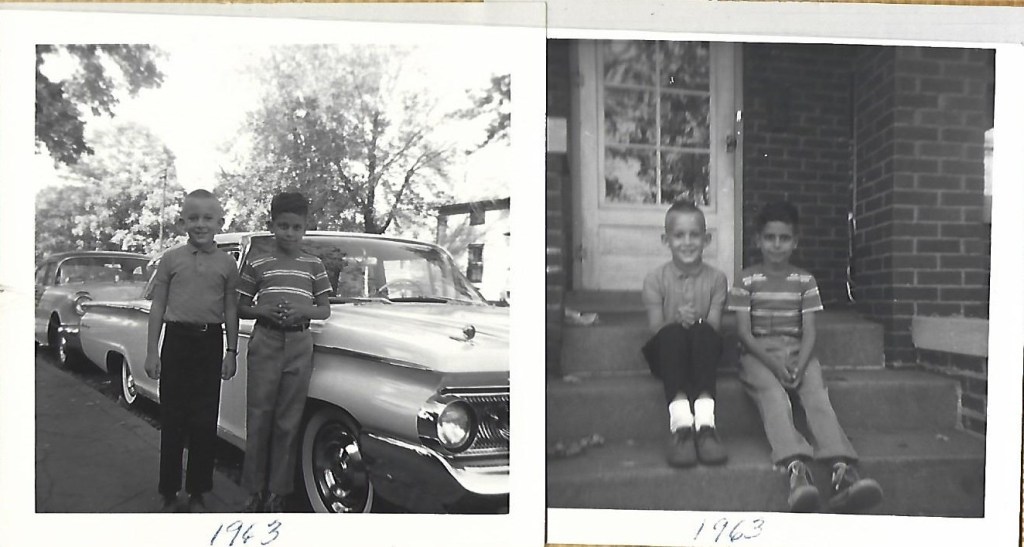
During my home visit, I received an email from Michal. He and I were in the second grade together. I remember him well, since he moved into the neighborhood, about three blocks from where I lived behind our grocery store. In fact, we made our First Communion together. He was the new kid in the class where we became fast friends.

I have not seen Michael since those early years. We never stayed in touch. So, you can imagine, how much I appreciated seeing these two photos of Michael and me. We are at his home, a duplex in Mishawaka. His email stirred much reflection for me. We bounced emails back and forth a few weeks ago struggling to remember some of the details of those early years. Since I was back in Mishawaka, I went back to his old house and took a picture. It is still standing and really does not look much different. There, I could still see the two of us in the shadows of memory and in the fading light of all these years.

When I got back to Colorado, I found our class picture from the second grade. I also found other class pictures and confirmed that we were only in the second-grade classroom together. For third and fourth grades, we were in different classrooms. I know there is a picture of us at First Communion, but I have not found that yet.

These photos are treasures for me. Since I move across the country as a priest, what a gift to see these small tokens of memory given to me by someone else who also remembers. I think our world-wide pandemic has given us time to think about our past, the value of life, and the consequences of all of our relationships. Michael was sorting through his old photos and decided to reach out to someone he had not seen since the second grade. I will take this as a great gift.

During these past months, I have cleaned out my closet and sorted my belongings one more time. I am not much of a saver. I don’t have much that would tell the story of my past. In fact, I try to make deeper cuts in my possessions as the years go by. Now that I paint from my years at Sacred Heart, I have many supplies. The magazines from my writing and publishing are in the basement of the parish center where I hope they can remain as an archive even after I leave the parish.

COVID-19 teaches us many things. If we take this time seriously, we can reflect on our past, what we truly hold as value and meaning. If we sit in the mystery of life, we can learn to value the truth of who we are and let go of meaningless possessions and even poisons we carry within our hearts. If we are truly living, then we can let go of how our lives have been possessed by the stuff we own. We need to sort through our junk, find the treasures and live freely in love on this earth. We just need some time alone and some time to reflect with our family members about things that really matter, far beyond the ordinary routines that numb the human spirit.

I worry about people who have not learned anything in this time of pandemic. They are missing out to find the real meaning of their lives and the meaning of our future together. I know many people are living in fear these days. I understand the threat of potentially being ill and the threat of losing a job or career. However, even our fear needs to be sorted through. Even our despair needs to be brought to the light of faith. We are living in a time when faith is real and actually change our lives. We can turn our loneliness into true solitude where pray makes a difference. This is the time in life not to just go through the motions of the every day. Today, we need to really come to terms with what life is truly about and our place in it.

We can overcome our differences in the Church and in society today. We can let go of our political arguments and differences about the earth we stand upon. We can learn to see beyond different skin colors or the differences in our speech patterns. Perhaps we all need to sort through the old photos we have tucked away in a trunk. Just maybe, we need to go back to the people we learned with in grade school and learn those basic lessons all over again. We need to learn how to treat each other, how to walk a few blocks with friends and how to befriend the stranger just like we did in the second grade. Life is not that difficult if we let go of our anger, our resentments, the old stories we tell ourselves, the hard opinions we harbor so to be better than others, the possessions we cling to, and the ideas in our heads that we think we cannot change. Change after all, is life.  

I hope our young people who are receiving First Communion at the parish this year will remember this time fifty or sixty years from now. I hope as a parish, we will help them believe that Jesus invites us into an amazing and beautiful life no matter the obstacles or disappointments. In this year of pandemic, I am sure these children will not forget the details. I just want to make sure they remember the miracles.

I am not sure if I will ever see Michael now as an adult. He has a family and is retired. However, I will leave all of that to God, who I know has a plan for me in these days of pandemic and beyond. I will still befriend the stranger and maybe I need to continue to sort through my photos and try to contact someone else I have not seen in many years. This pandemic is teaching me how incredibly beautiful we all are no matter the miles apart or the difference we think divide us.

Thank you, Michael for inviting me to your house in the second grade.

Peace in pandemic times,

Fr. Ron

Twenty-Sixth Sunday in Ordinary Time 2020, Cover art, Column, Prayers of the Faithful

CLICK HERE to read full bulletin for this weekend

September 27, 2020

26th Sunday in Ordinary Time

Dear Believers in the Messiah,

When I was in the seminary, one of our retired priests used to say, “Ninety percent of life is just showing up.” I admit the truth of his words the longer I am in the Church and struggle to become a person of prayer. Showing up is the gift to God. God can work with us only when our hearts become ready and willing, when our lives are given freely.

Matthew 21:28-32 gives us a story about our own stubborn ways and our own willingness to show up. Two sons are asked to work. One says yes and then no. The other says no then yes. This very human response is revealed in each one of us. The two sons are reactions we all have within our human attitudes and hearts.

It is always interesting to me how in so many human circumstances, we tend not to ask someone to do something whom we know will not show up to accomplish the task. We usually ask the person who is already incredibly busy and generous because we know the project will get done. The not so generous person can often get away with remaining distant and sometimes lazy and not involved.

God welcomes all people; sometimes it just takes time for us who are more selfish and stubborn to find our way toward God’s generous and inviting life. We have untold opportunities to accept the invitation toward God’s mercy and fidelity.

I remember when I first starting writing for publication. One of my writing mentors told me two things to remember when working with editors of magazines. He said, “Never say no to an invitation no matter how pressured you are with other work and always get the work accomplished before the deadline.” He told me that if I do those two things, editors would continue to ask me to write for that particular magazine. I have followed his advice and have published many articles in a number of magazines since 2002.

I may not be so successful in other areas of my life about showing up and allowing God to work within me, especially when I find the task tedious and not in my expertise.  However, I know that God is not finished with me or with any of us quite yet. We are all invited into the Kingdom of God, no matter how stubborn or selfish, no matter how we are awakened to the gift, no matter how we are taken by the love that is being offered us.

I say yes to God and then don’t follow through when…

I no to God when…

What brings me to change my mind is…

I remember when I felt so discouraged about showing up in prayer because…

Then God changed my mind through…

God give you peace,

Fr. Ron

September 27, 2020

Prayers of the Faithful

Let us pray not to do anything out of selfishness or out of vainglory but rather humbly regard others as more important than ourselves. May we serve people with truth and love.

We pray to the Lord.

Let us pray for our Universal Church, that we may learn to lead with respect and consolation for people of every race and nation.

We pray to the Lord.

Let us pray for people living with alcohol and drug addiction. We pray that God may set free all who long for integrity and emotional freedom.

We pray to the Lord.

Let us pray for people who have given up on the Church because of the sexual crimes of the clergy and the lack of integrity among those who follow Christ Jesus.

We pray to the Lord.

Let us pray for our children who struggle to learn during these months of pandemic and for all families who struggle to make ends meet.

We pray to the Lord.

Let us pray that God will receive our beloved dead into the glory of heaven. In this Mass we pray for…

We pray to the Lord.

Twenty-Fifth Sunday in Ordinary Time 2020: MT 20:1-16a, Homily

CLICK HERE to listen to today’s homily

MT 20:1-16A Jesus told his disciples this parable:
“The kingdom of heaven is like a landowner
who went out at dawn to hire laborers for his vineyard. 
After agreeing with them for the usual daily wage,
he sent them into his vineyard. 
Going out about nine o’clock,
the landowner saw others standing idle in the marketplace,
and he said to them, ‘You too go into my vineyard,
and I will give you what is just.’
So they went off. 
And he went out again around noon,
and around three o’clock, and did likewise. 
Going out about five o’clock,
the landowner found others standing around, and said to them,
‘Why do you stand here idle all day?’
They answered, ‘Because no one has hired us.’
He said to them, ‘You too go into my vineyard.’
When it was evening the owner of the vineyard said to his foreman,
‘Summon the laborers and give them their pay,
beginning with the last and ending with the first.’
When those who had started about five o’clock came,
each received the usual daily wage. 
So when the first came, they thought that they would receive more,
but each of them also got the usual wage. 
And on receiving it they grumbled against the landowner, saying,
‘These last ones worked only one hour,
and you have made them equal to us,
who bore the day’s burden and the heat.’
He said to one of them in reply,
‘My friend, I am not cheating you. 
Did you not agree with me for the usual daily wage? 
Take what is yours and go. 
What if I wish to give this last one the same as you? 
Or am I not free to do as I wish with my own money? 
Are you envious because I am generous?’
Thus, the last will be first, and the first will be last.”

Twenty-Fifth Sunday in Ordinary Time 2020, Cover Art, Prayers of the Faithful, Column

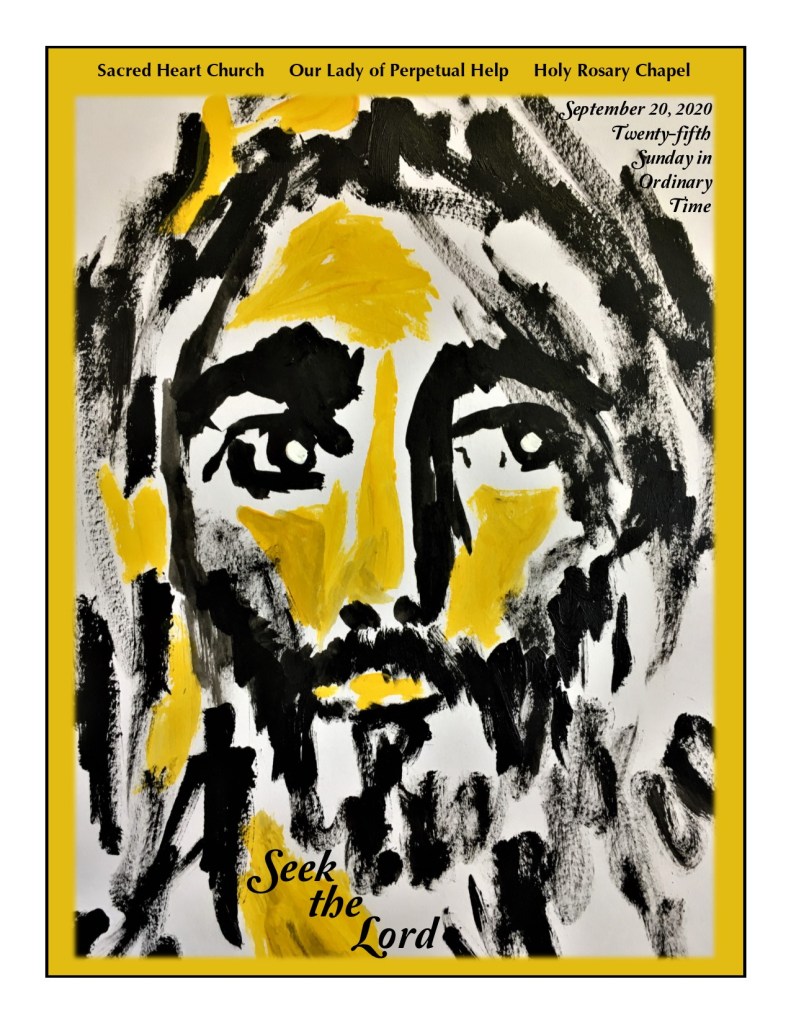
September 20, 2020

Dear Followers of Jesus,

To our human experience, today’s gospel may seem unfair. The parable presented in Matthew 20:1-16 shows that God waits for us and offers us opportunity and entrance into the Kingdom even at the last minute. God’s generosity is overwhelming to our finite and selfish approach to life. Let’s explore this.

The landowner hired people early in the morning for his vineyard. He also saw people waiting to be hired throughout the day, even at the very last working hour of the day. All of them received a daily wage. The workers who were hired first were jealous.

Our society is hardwired for a sense of entitlement. So often we raise our children with a sense that they can do no wrong and that they deserve the best. Sometimes our children do not understand that they have to work hard, to put themselves out in the world to take risks. Those risks often produce hardship and complications and no person ever gets only his or her way in life.

This gospel seems unfair, that the person hired last should get the same benefits as the person who worked all day. Yet, this is a parable about something greater than our earthly work. This parable is a story about our place in God, our place in the love, hope and forgiveness of the Kingdom of Heaven.

We all have a place in God. This statement often makes people crazy. We blame people for their sin, their poverty and their lack of education and we wonder how God could love them and accept them as well. We find it hard to believe that God loves the public sinner, the hardened criminal, the outcast and the marginalized.

God loves us far beyond the external of life. God treasures the human heart and wants to dwell within each of us. We are God’s creation and God has the right to enter into the mystery of every human heart. Our prayer always should be that of rejoicing, of gratitude that God is generous toward every human being. God’s love is extravagant.

Salvation is free. We do not earn our place in God’s Kingdom. We do not earn his tenderness here on earth. God’s mercy, forgiveness and presence is free, a real and treasured gift no matter who stubborn we are or how jealous we are toward other people.

I pray for us all that we could finally realize that salvation comes not on our earthly perfection or sense of entitlement, but on the true and inviting nature of God’s fidelity toward every human being. If we could internalize today’s parable, we could change the world.

The gifts that I offer for the growth of the Kingdom are…

My response to God’s generosity toward me is….

My prayer for when God is generous toward other people is…

God give you peace,

Fr. Ron

Twenty-Fifth Sunday in Ordinary Time

Prayers of the Faithful

Let us pray to seek the Lord with every thought, action and good intention. May we open our hearts to God’s peace for our world, and the love that inspires mercy.

We pray to the Lord.

Let us pray for governments through out our world, that leaders of nations may bring about justice that nourishes every human soul under heaven.

We pray to the Lord.

Let us pray for wisdom in our Church, that we may seek the tenderness of heaven in every situation on earth. We pray that hope will be the foundation of life for all people.

We pray to the Lord.

Let us pray for families who have lost loved ones, homes and jobs during recent fires in our western states. For all who face loss from the hurricanes and floods in the south. May God’s healing be from east to west. We pray to the Lord.

Let us pray for our elderly parishioners and family members who live in nursing homes and elder care facilities, that their lives may be connected to love, consolation and understanding.

We pray to the Lord.

Let us pray for people who are ill and for our family members who live with mental illness. May people suffering depression or schizophrenia find comfort and peace.

We pray to the Lord.

Let us pray for our beloved dead and for those whom we remember in this Eucharist. In this Mass we pray for…

We pray to the Lord.

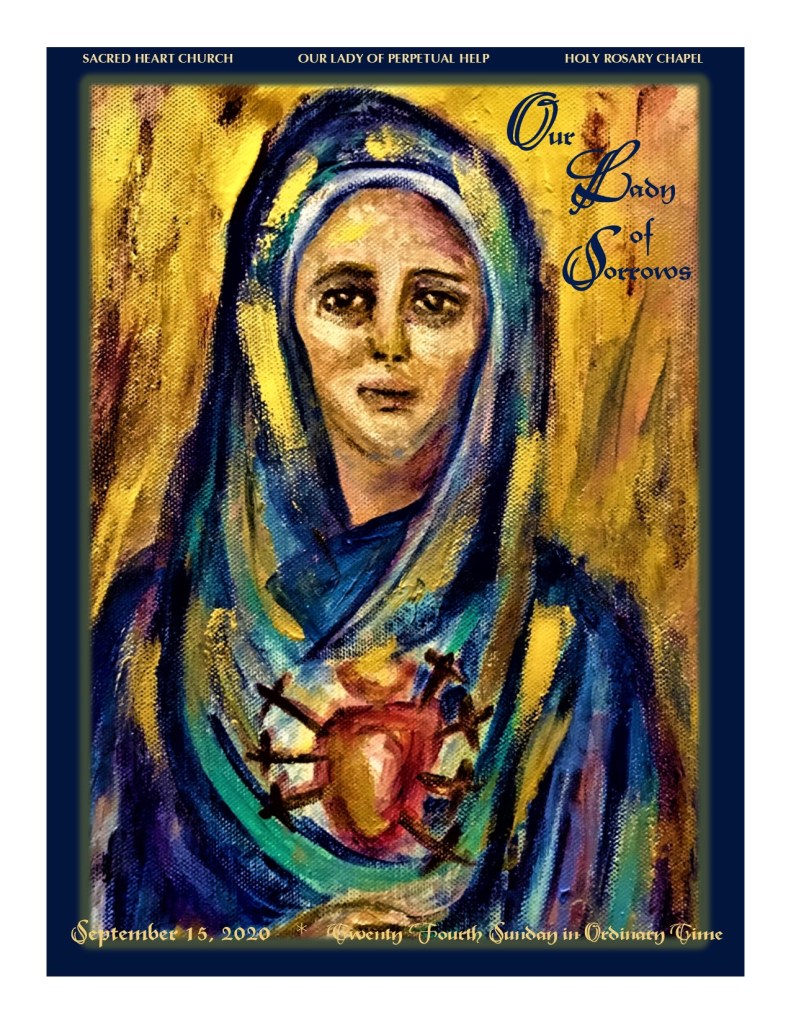
Mary, Our Lady of Sorrows 2020

September 15, 2020

Mary, Our Lady of Sorrows, offers us a tender image of faith. Mary, the Mother of Jesus, stood next to the cross of Jesus. Zachariah foreshadowed such a death after Jesus’ birth. Mary spent her entire life lifting up the suffering of Jesus. She was unable to change the course of Jesus’ passion, death and resurrection. She beheld for the rest of us that pain and suffering lead us to Kingdom love. Her motherhood gives hope even today.

I have lived my priesthood deepening this image of Mary in prayer. She speaks to me. She consoles me. This image offers me a healing balm when my own life is unsteady and unsure. She speaks loudly across the generations. All mothers seem to understand such a place and posture in their lives with their children.

I remember as a child my own mother coming to the bathroom in the middle of night when I was sick. She held my forehead. I still hold such a gesture in my heart. This was truly a mother’s place in the course of raising a child. I can still feel her hand on me when I am ill today.

Mary, Our Lady of Sorrows, is the Patroness of the Congregation of Holy Cross. She gives us consolation and helps us witness to the suffering of people. At Sacred Heart Church, there are several images of pierced heart of Mary with seven swords. The Seven Sorrows in the gospel reveals the many times Mary witnessed the suffering of her son.

I cling to the image that Mary stood next to suffering. This has become one of my sure foundations for ministry. I claim this posture in my priesthood when I anoint a child who is dying or steady my thumb to anoint a dying parishioner who I know has given his or her entire life to raising children and believing in Jesus.

I remember my twenty years of ministry among people with HIV/AIDS. In those early years, it was the mothers who would contact me to pray with their child. The mothers wanted the best for such suffering, especially when they felt so powerless because there was no remedy or cure. I have walked with many mothers to the graves of their children. They not only rely on Mary for help but also have become such witnesses in our world.

I pray for our children sleeping on concrete at our borders, perhaps we can go beyond the political and see them as Mary views them. Perhaps we can see again our children being trafficked around the world. We can really see differently even the mothers and daughters who survive the violence of war or the starvation from poverty.

I pray Mary will hold the racial tensions we face today in her care. I pray she will ease the hatred we hold under our skins for those whose skins also know Jesus. I pray she bends our hearts toward her Son, Jesus. I pray she will teach us how to live among those who have lost loved ones to the pandemic, those who need care to rebuild from fires. I pray she will wipe all hatred and blame from our hearts. I pray she will walk with us to political elections and open our hearts to see what Jesus sees. I pray she will help us mend the divides of the Church. I offer prayers and intercessions today that she will show us all how to stand next to suffering and not condemn the sinner, the outcast. I know I cannot change the horrific suffering of the world, but I can learn from Mary how to hold the hand of those who need me at the hour of death. I pray today that Mary, Our Lady of Sorrows will teach us all how to stand next to people’s suffering and help us all redeem every aspect of suffering in her son, Jesus.

Mary, Our Lady of Sorrows, is not a pietistic notion of faith, but she is a real model for how to live our lives in Christ Jesus. She becomes a radical mother bringing mercy and tenderness to lives when suffering cannot be changed. She could not fix Jesus. She could not take his pain away. However, she gives us the joy of putting our faith into practice among the vulnerable and lonely.

Lean into the mystery of Mary, Our Lady of Sorrows,

Mary, Our Lady of Sorrows: Painting by: Ronald Raab, CSC 2020