Originally published by Ministry & Liturgy Magazine, August 2009
– PDF version –
 I learn every day from people on our narrow, urban sidewalk. Many of our low-income neighbors line up in the very early morning to enter our hospitality center to receive clothing and hygiene products. From my third-floor bedroom window I overhear a man arguing about his place in line and another homeless man telling stories about being beaten up during the night. The sounds of the sidewalk echo back to me a simple truth – I cannot eliminate the reasons why people are hungry. Nothing that I plan changes joblessness, increases salaries or offers people adequate health care. Providing suitable housing or employment after prison is out of my bounds. Lessening money mismanagement of people suffering depression or alcoholism is beyond my expertise.
Our parish community nonetheless continues to learn from this simple walkway around our building. Since we have no parking lot or parish garden, no school or separate rectory building, the sidewalk becomes our place of hospitality. On Friday evenings, parishioners and volunteers collaborate from our small urban parish in Portland, Oregon to provide a simple soup meal outside our building. For a couple of hours our sidewalk becomes not just a passage to bars and strip clubs, but a place where people can find friendship and real nourishment. Even though we do not provide long term solutions to poverty, we respond from faith to provide a kind ear, a friendly conversation and a hot meal.
This outdoor meal is truly the work of many people. Parishioners and volunteers prepare a hearty homemade soup and dated packages of pastries arrive from a local grocery store. A parishioner from a produce company delivers boxes of fresh fruit and retirees spread peanut butter on donated bread. Volunteers set up our small chapel lobby with pots of hot water for chocolate and strong coffee. In summer the hot soup is paired with refreshing cold lemonade from large plastic containers. A volunteer sets up a couple of long tables and wipes clean the old plastic tablecloths already used dozens of times.
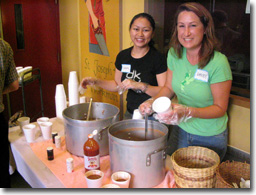 We serve the feast from the tiny confines of our lobby, the smallest public space in our building. Our guests receive their meal and sit in plastic chairs lined up against the green outside wall. Even in the cold winter rains of Portland, people wait in line for the 7:00pm opening of the red steel doors on the corner of 6th Avenue and West Burnside Street.
Amid the food set-up, the volunteers and guests gather cramped into this small lobby space and narrow sidewalk for many reasons. One reason is the name of the soup line. Our evening hospitality is called the Brother Andre Café, after Blessed Andre Bessette. Andre was a Holy Cross Brother in Montreal, Canadawho died in 1937 with over one million people attending his funeral. He was a man of small stature with an overwhelming dedication to Saint Joseph. Assigned by our religious community to be the Porter at Notre Dame School because of his sickly nature, Brother Andre became a healer. People with crippling diseases traveled for miles to stand in line in order to speak with Brother Andre for just a few minutes. Andre was the first member of our Holy Cross community to be named “Blessed” by Pope John Paul II in 1982.
We carry on the ministry of hospitality Brother Andre showed the Church. Members of the parish welcome friends and strangers with food at our front doors. Our guests may not be healed of illness or infirmity, nor are their crutches and canes left at our door, but strangers are welcomed and our friends are fed, named and appreciated.
This street meal is more than merely a handout. I find profound connections at the bottom of the empty bowls, in the evening interactions. When I first came to the Downtown Chapel, drug dealers stood on our corner convincing people that addiction would be their real food. We pushed the dealers aside. On Friday evenings we present people with an alternative beyond broken needles with friendship and a full soup bowl. This dynamic ministry speaks loudly on our corner as we witness also to onlookers, shoppers and corporate executives strolling by on Friday evenings.
Our narrow sidewalk extends well beyond our own neighborhood. Our ministry of hospitality reaches far into wealthy suburbs and many other parishes. Every week members of different parishes take turns preparing their recipes for soup. The visiting parishes provide some of the volunteers to set up and clean up, to host the evening and to welcome our neighbors. Many volunteers also bring blankets, socks, hygiene products and clothing to be handed out during the weekday hospitality center. I understand more profoundly with every passing week that our narrow sidewalk meanders into the consciences of many people in various parts of the city and beyond.
These volunteers appreciate that our sidewalk soup line becomes a place for people to become known. For many suburban people, these sidewalks are a place of fear and anonymity. Our Brother Andre Café remains a place where the poor have names, faces, life stories, real fears and dimly-lit dreams. The middle-aged soccer mom begins to understand the stories of a young former prostitute living in a single-room occupancy hotel in our neighborhood. As her fear diminishes, the mother relaxes about her children coming to volunteer in our parish. Creating relationships becomes a key source of change, hope and healing for everyone involved.
Our Friday evening outreach is also a place where high school and college students encounter a meaningful mission of the Church. Our parish staff connects with a half-dozen colleges throughout the year. Some undergraduate classes serve food on Fridays and some stay for a week-long plunge in the neighborhood. Nursing students wash people’s feet on Wednesdays. Some high school students meet their volunteer requirements by sorting canned foods for our daily pantry. Others volunteer in our daily hospitality center handing out laundry vouchers to a local Laundromat. They all experience interactions with people who suffer greatly and who live on the margins of our society.
However, nearly all the students go back to their families and schools telling stories of the reality of life. I hear later that they talk about foot fungus, the lack of housing for former prisoners, and the inadequate facilities for homeless women. Our students leave here realizing that the mission of the Church is about people. They admit to me the stereotypes about the poor that their parents and classmates have been passing on to them and their growing realization of the injustice of many aspects of our culture.
Our food-stained sidewalk also helps give direction to the future clerical leadership of the Church. Graduate school seminarians are placed here by the seminary of the Archdiocese of Portland for our Friday night ministry. I lead undergraduate seminarians in a thirteen hour immersion into our work once a year. I watch as the soup begins to break down the notion that the Church is for only the well-educated and well-deserving.
By the end of the academic year the seminarians realize the terrifying issues of people locked in poverty, ill health and sustained unemployment. I watch barriers tumble down and I see that these future clergy gain real insight that ministry involves building real relationships with people. They are stripped of thinking their future priesthood will be about living apart from unemployment, adequate health care and alcohol abuse.. As always, food becomes the vehicle to bring all people together on the same level, the sidewalk becomes a place for equality and authenticity.
Our parish is not the only place that serves food on Friday evenings. In fact I tell new volunteers that food is not the real problem in our neighborhood. The true misfortune, perhaps the real hunger or disease, is loneliness. Social isolation among the homeless and especially people living in the single-room occupancy hotels feeds continuing addiction and crime. People who suffer any form of mental illness may also lack the desire or motivation to remain on medication, to take care of their personal hygiene or to make necessary financial decisions. Loneliness spirals people into further depression. Loneliness creates a path of hopelessness about the future. This isolation also destroys trust, keeping people from reaching out when they are most in need.
However, our volunteers often arrive believing they can change people. They want to solve their situations or zealously promote food or blanket drives. Some become visibly angry that we are not doing more to get people medical help and dental care.Miracles become visible to me when our wealthy volunteers realize that our staff know the names of our guests. Volunteers gradually understand people when they get to know their human stories. Poverty is not easily solved. The issues of mental illness and homelessness are a tangled network of real issues not solvable by any good intentions. Our volunteers who share a bowl of soup realize that if poverty is to be changed, relationships are the key ingredient. This recipe for change starts with broth, onions, carrots, chopped meat, and a warm smile.
The source of these relationships on the streets comes from inside our chapel building. The Eucharistic Table, the center of any faith community, provides the risk to take love beyond the sanctuary. Our community is loved into service. Every day as I celebrate Mass, I break the hosts and pray that grace may sustain everyone present. There is grace enough for everyone because of Christ’s relationship with all believers. God also provides grace which compels us into feeding people who hunger for food, love and a sense of belonging. I realize that God’s love is plentiful if only we can give it away. I ask God every day for the courage to put Eucharist into practice, to take love to the streets of the city and into the households of everyone – even unbelievers.
Even though our parish community serves from God’s love, we still do not have the resources to change policies concerning health care for everyone, adequate housing for the mentally ill and decent employment for veterans. However, I believe that if policies are ever going to change in our cities or for the rural poor, we must first be in relationship with people who are poor. And the source of all these relationships is the sanctuary in all of our churches, the place in which we profess our belief in the Resurrection of Christ Jesus.
Leaving our sanctuaries to minister on street corners is never easy for any worshipping assembly. Entering into the unknown is always risky. Leaving the security of ritual and breaking down even the invisible communion rail takes deep and profound faith. The priorities for every faith community must remain in service to people who suffer. The call of Jesus to wash feet, heal the sick, touch the leper, and encourage the sinner is not a false piety. This call is not for warm-hearted liberals or staunch conservatives, but for us who pattern our lives after Jesus’ passion, death and resurrection. This mission is Christ’s love made flesh, to build community, engage the suffering, and sustain the orphan and widow.
The sanctuary is the place where service and justice are birthed. The sacred liturgy calls us to live beyond the threshold of our comfort, to open doors beyond our ignorance. Our parish community continues to call us into our streets and neighborhood even beyond serving soup. Our community processes to a murder site when violence strikes our neighborhood. We sing a litany that names forms of evil on the sidewalk where the stabbing or shooting occurred. It is the very same litany we sing when we celebrate the Scrutiny Rite for our catechumens. Members of our staff take people on tours to educate volunteers and strangers about the issues of poverty we learn from being in relationship with people inside our chapel walls. The sanctuary and streets are both places of conversion and hope.
I realize sharing soup and stories on the streets does not solve every aspect of people’s suffering. Our staff did not have the insurance or medical care to keep Jane from dying on our streets from gangrene. Our parish cannot solve Jim’s problems of severe mental illness which keeps him in the same clothes for months without showering. We cannot clean people’s teeth or offer a root canal. We cannot fix the ongoing problem of bedbugs in the single room occupancy hotels.
The sidewalk outside our chapel building is more than a corridor to the neighborhood. The concrete path is an extension of the Eucharist itself. The food we share gives us hope when everything else fails. The soup served from the cold streets unites lonely people on Friday evenings and changes priorities of volunteers. The common walkway leads right back to the sanctuary when we are all exhausted from our efforts and need to be fed again with real sustaining food, the Body and Blood of Christ Jesus.
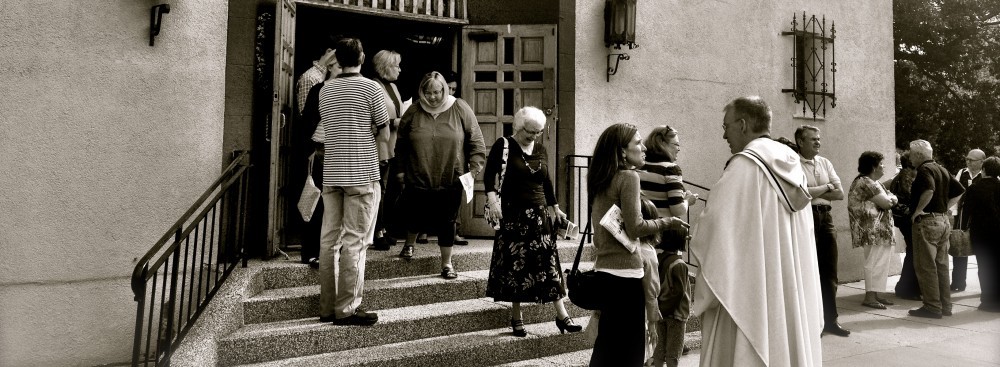
 People from our neighborhood pour into our small lobby for a Friday evening meal. Our neighbors living in single-room occupancy hotels socialize on the sidewalk outside the Downtown Chapel. Members of other parishes volunteer monthly to create their special recipes for soup. They provide sufficient welcome with sandwiches and fruit at our red doors in downtown Portland. Our parishioners pour lemonade and brewed Fair Trade coffee. We welcome familiar faces that live outside and make sure people know they know they are more important than even the food.
 People surviving poverty sign up for some life essentials on weekday mornings at the Downtown Chapel. Some people need a heavier coat to protect them from the Portland rain. Others need clean white socks and shoes. Walking is the primary mode of transportation for many of our guests. A man whispers to a volunteer that he needs clean underwear because he could not find an open bathroom in the early morning. Socks, underwear, jeans and jackets become essential for people who live under bridges or in doorways of local businesses.
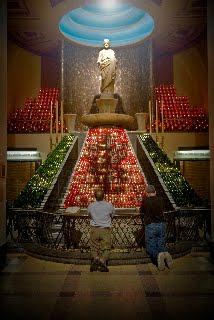 I arrived at the Downtown Chapel in March of 2002. My two and a half day journey from South Bend, Indiana was filled with anxiety and restlessness. I wasn’t sure I wanted to be here in the first place. I left my previous assignment emotionally fragile and quite uncertain about my life within the Church. I questioned my own abilities, gifts and even my desire to continue in ministry.
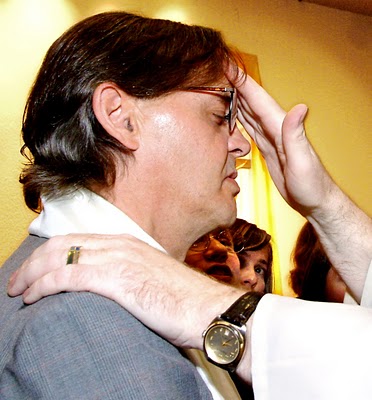 I cleaned out the cabinets in our parish sacristy last month. I sorted through all the lost-and-found items that had accumulated in a drawer over the past few weeks. I returned several extra glass vases to the florist across the street. I discovered one item at the back of a large cabinet that stopped me in my tracks. At the bottom of an old box, I uncovered a small glass bottle of oil. The unopened bottled had an image of Saint Joseph molded into the glass. A small folded brochure from Saint Joseph’s Oratory protected the antique glass container. I unfolded the yellowing paper and I saw a handwritten date at the top of the page. The date read, “1939,” just two years after Brother Andre’s death.
 Every morning I witness people surviving the ravages of chronic unemployment. Job opportunities may never come along for many of our guests who face severe mental illness and depression. A middle-aged man holds back tears as he explains to our volunteers that his wife left him because he recently lost another job. A young runaway teen stresses about his survival as he explains to me that his foster brother sexually abused him. An elderly man just arrived in town from another city hoping to break his three-year streak of unemployment.
 Every weekday morning at the Downtown Chapel our parish staff and dozens of volunteers open our red steel doors to people longing for companionship and a few essentials for survival. People stream from local shelters and wait in line at the parish for clean socks or money for prescription drugs for their mental illness. A young twenty-something man just released from jail wears flip-flops and needs clothing for protection in the Portland rain. One person waits in line for a yearly haircut. A young woman cuddles her infant hoping to secure a package of diapers in our Hospitality Center.
 Last month a film crew from Salt + Light Television Productions from Toronto, Canada filmed aspects of our ministry at the Downtown Chapel. Their cameras rolled for two days here because they are producing a documentary about Brother Andre Bessette, CSC. He will be officially named a saint in the Roman Catholic Church this October 17, 2010.
 Broken But Not Divided