Unknown's avatar

About Ronald Patrick Raab, C.S.C.

Ronald Raab, C.S.C.,serves as religious superior at Holy Cross House, a medical and retirement home for the Congregation of Holy Cross, Notre Dame, Indiana

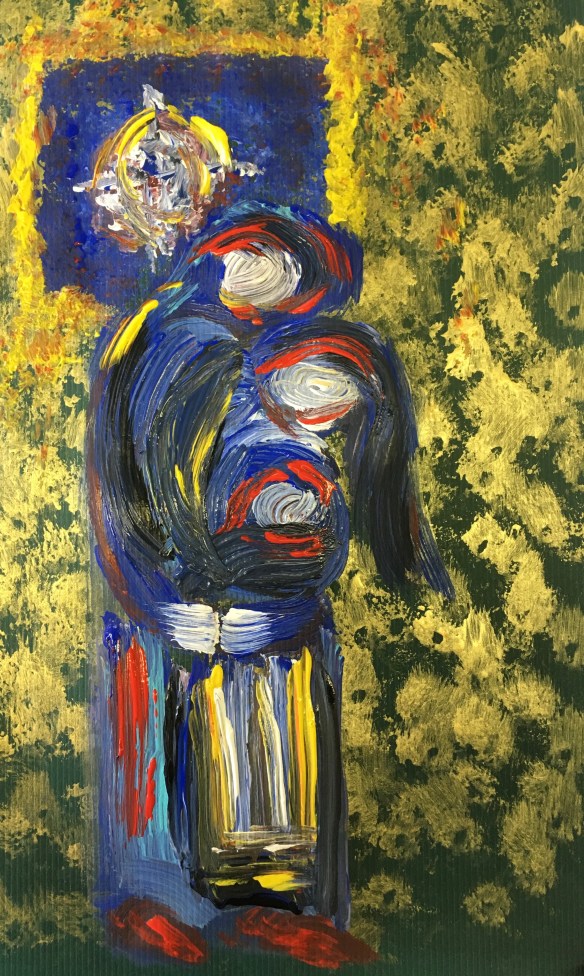
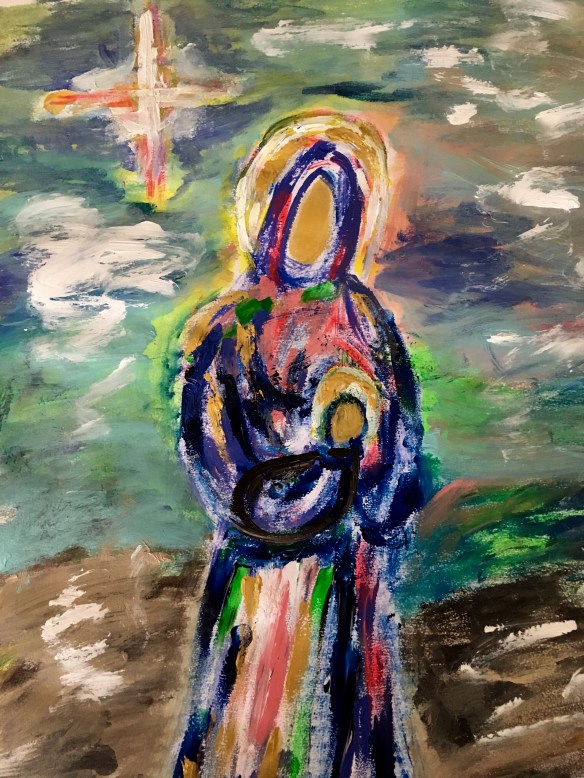
Mary: The Fifth Sorrow 2017

Mary, Our Lady of Sorrows, is the Patroness of the Congregation of Holy Cross. As we prepare for the memorial on September 15, I will offer a new image and a short reflection based on each of the Seven Sorrows of Mary.

Version 2

Mary: The Fifth Sorrow 2017 Painting by: Ronald Raab, CSC

John 19: 25-30 Standing by the cross of Jesus were his mother and his mother’s sister, Mary the wife of Clopas, and Mary of Magdala. When Jesus saw his mother* and the disciple there whom he loved, he said to his mother, “Woman, behold, your son.” Then he said to the disciple, “Behold, your mother.” And from that hour the disciple took her into his home. After this, aware that everything was now finished, in order that the scripture might be fulfilled, Jesus said, “I thirst.” There was a vessel filled with common wine. So they put a sponge soaked in wine on a sprig of hyssop and put it up to his mouth. When Jesus had taken the wine, he said, “It is finished.” And bowing his head, he handed over the spirit.

Amid this day’s grief

 My priesthood began shortly after AIDS was named as a killer among people in our country. I would never have predicted that a disease would so form my early years of ministry and carve a deep wound within me as I faced the sudden and tragic crosses of such suffering among family members.

I find myself at a loss in this present generation of priests and young families to explain the angst and the fear of those years when a diagnosis was an instant condemnation of death. I can only paint a few pictures with words of the broken relationships, humiliation, shame and grief that tore so many families apart in my early years of ministry.

I especially remember the mothers who stood next to their son’s suffering during the early days of AIDS. These women straddled the demands of other family members as they cared for and worried about their ill children. They had to deal with the shame that often accompanied the diagnosis of AIDS. They had to defend their dying child when so often so many families were not aware of the disease or the struggles of sexual identity. In many cases sons had to come out of the closet as homosexuals in the same conversation that also informed parents that they were dying. Mothers even had to protect their ill children from the anger of the father’s of these children who could not admit they had gay sons

There seemed to be little warning of this disease that drained the bodies of seemingly perfectly healthy people. The “wasting disease” caused men to lose drastic amounts of body weight. The initial, multiple diseases that appeared under the label of AIDS were also new and considered contagious during various times. This health crisis produced mass amounts of fear among doctors and nurses, hospital janitors and researchers, and among professional chaplains and social workers. There was also much fear within Christian churches as how to respond to people living with AIDS and there families.

I was called one afternoon to the hospital to anoint a man who was dying of AIDS. I was asked to welcome his parents to the hospital who would be arriving that evening at 7:00pm from their travel across the country. They were arriving to be at the deathbed of their son. I had no idea of their family story or what I would be facing as I arrived a few minutes early in the quiet room.

I sat by the dying man’s bedside and waited for his parents. The nurse and I decided not to wait for his parents to anoint his emaciated, tormented body. She and I prayed on their behalf, a prayer of letting go and of reconciliation. We prayed not knowing any of the stories of the relationships with his family, not understanding the hopes and dreams, the skills and talents of this man who was very close to leaving this earth. We prayed with a pregnant silence and a few words of Scripture. I dipped my thumb into a small metal container of sacred oil and dabbed it on his forehead in the sign of the cross. I could feel his breath slipping away as I reached across his face.

I then remained at his bedside and waited. Finally, his parents arrived in the room carrying with them a flurry of emotion. They were exhausted from the day’s journey. I became aware of his mother first. She seemed full of anger as she threw off her heavy coat and she seemed so restless next to her son’s quiet presence. I tried to welcome them both, but something more was happening. I made a quick decision to invite them into an empty room next door. As we settled into some comfortable chairs, the story unfolded.

His mother admitted to me after taking a deep breath, “I am not angry that my son has AIDS. I am not angry that my son is dying. I am angry that my priest at our home parish told me yesterday not to come to my son’s deathbed because he was going to hell anyway.”

I tried my best to calm them both and to invite them to sit at their son’s deathbed so to let him go in peace without anger and regret. I encouraged them to get some rest for the night. The next day, his mother called me and told me that her son had died in the early morning. She asked me to offer her child a funeral service and that the rest of the family would be coming from all over the country for the burial. I spent the next few days immersed in their family stories. They were all afraid of the public shame of the collective name of the diseases that had killed their son and brother, AIDS. They had never admitted that their strong, well-educated and successful son held on to so many secrets in the years before his death at age thirty-five.

We buried this son on a sunny day in November. That day happened to be my birthday. We all arrived at the church with a collective ease and even joy. The week had brought many miracles of acceptance from the hours of storytelling we shared. The funeral became a true celebration of faith and of a son’s life that was filled with hope. The family admitted out loud the cause of his death and the label that their son was gay. The funeral became a celebration of the fact that God’s love is unending.

For many years after the funeral, this lovely, Midwest mother sent me a birthday card to thank me for being with the family during her son’s death and burial. Every year until her death, she gave thanks that her son’s death brought the family into a deeper relationship, into a more truthful bond. Even though her grief never left her, her gratitude helped ease her own suffering.


Mary: The Fourth Sorrow 2017

Mary, Our Lady of Sorrows, is the Patroness of the Congregation of Holy Cross. As we prepare for the memorial on September 15, I will offer a new image and a short reflection based on each of the Seven Sorrows of Mary.

IMG_0287

Mary: The Fourth Sorrow 2017 Painting by: Ronald Raab, CSC

Luke 23: 27-30 As they led him away they took hold of a certain Simon, a Cyrenian, who was coming in from the country; and after laying the cross on him, they made him carry it behind Jesus. A large crowd of people followed Jesus, including many women who mourned and lamented him. Jesus turned to them and said, “Daughters of Jerusalem, do not weep for me; weep instead for yourselves and for your children, for indeed, the days are coming when people will say, ‘Blessed are the barren, the wombs that never bore and the breasts that never nursed.’ At that time people will say to the mountains, ‘Fall upon us!’ and to the hills, ‘Cover us!’ for if these things are done when the wood is green what will happen when it is dry?” Now two others, both criminals, were led away with him to be executed.

Standing next to suffering

One of the images I use in prayer as an adult comes from my childhood. The image seems odd and even a bit crass. I remember being sick many times with stomach flu. My mother would always wake up in the nighttime and come to the bathroom and hold my forehead while I was vomiting. As I look back on my young days, that gesture stands out to me as one of the most comforting and consoling. That human, maternal touch while I felt so vulnerable and helpless still comforts me in times when I feel out of control and not sure what to do next in life.

This simple gesture from my mother speaks to me about Mary’s role in Jesus’ suffering and death. Mary stood next to Jesus’ suffering and she could not control the outcome or take his pain away. Mary could not fix her son’s destiny and change the pattern of grace in Jesus’ life. Her role was to simply stand among the threats on Jesus’ life and among those who would eventually put him to death. Mary could only reach out to his hurting body and touch his human wounds.

At the end of my sophomore year in college, I was asked to become an orderly at Holy Cross House, our retirement center and infirmary next to the seminary. I began my junior year learning my new role as an orderly for our priests and brothers who were very ill and close to death. It became my turn to make sure I held the foreheads of these men when they were sick, to change their diapers and bathe them in a shower chair.

Sue was the head nurse at the time. She ran the infirmary with great care, intention and compassion. Her reputation had filtered down to the seminarians and even those of us who were just starting our many years of formation. I reported for my first day wearing my new scrubs. I was totally out of my element and my naïveté was obvious to every one. Sue welcomed me as if I had been working with the sick all my life.

On that first Saturday afternoon, Sue invited me into the room of one of our priests who had been in bed for over twelve years. He was a victim of a hit-and-run accident. He was struck by a car while riding his bicycle along the main road into campus of the University of Notre Dame. He was wearing his long, all-black religious habit that made him invisible in the darkness. The authorities never found the driver of the car.

The daily staff schedule of Holy Cross House revolved around the care of Fr. John. Every two hours a staff member fed, turned and comforted the silent priest. Even though he had been in bed for twelve years, he had never had bedsores. He did have drop foot, the muscles in his legs and feet collapsed. He had ground his teeth down to the gums from his anxiety. He could not speak or move. His eyes could not focus on the people who cared for him.

At 2:00pm, Sue introduced me to Fr. John. We spoke to him as we would speak to any person because even the doctors were not sure if he could understand our voices. She taught me how to change his diapers, bathe him and how to oil and powder his body. Then she took a feeding tube and asked me if I would help her feed him by inserting the rubber tube into the hole in his abdomen. I felt squeamish and unsure. I told her no, that I could not help her do that.

Sue reassured me, “That’s alright, we will try again next Saturday when you are working again.” So the next Saturday came quickly. At 2:00pm, Sue took me again into Fr. John’s room. We changed his diaper, bathed him, changed his sheets, oiled and powered his body. She then took the rubber feeding tube into her hands and looked at me. “Will you help me feed Fr. John?” I looked at the tube and the hole in his abdomen and quickly responded to Sue, “No, I am not ready.”

So Sue said again, “Do not worry, we will try again next week when you come back to work with us.” The next Saturday came along quickly, we entered Fr. John’s room one more time at 2:00pm. We bathed him, changed his diapers and his bed sheets. We oiled and powered his body. We fluffed his pillows. We prepared him for the next few hours of his life. Sue then took the long, rubber tube into her hands and asked me once again to help her feed him. The thought of feeding him almost made me sick to my stomach. I said, “No”.

Sue came over to me, took my hands into her hands. She came close to my body and looked me in the eyes. She whispered to me, “Ron, you must remember just one thing. Fr. John is your brother.”

I felt the grace of those words whisk through my body. I realized my spiritual connection to this helpless man. I felt the beginning of my call to stand next to suffering. I picked up the rubber tube and we feed Fr. John together for the first time. I will never forget the patience and dedication of Sue. She waited for me to finally understand that feeding him was not just about the tube and the food. I had to come to realize, that if I was going to enter into this religious community even as a young member, I needed to know that Fr. John and all of the ill men in that building were my brothers. I needed to be in relationship with them, to care for them even when they were old and very ill. I needed to learn to stand along side of their suffering. I also prayed for the day that someone would stand by me when I was old and ill and in need.

Nurse Sue stood by the suffering of so many of our priests and brothers. She also stood next to my youth and naïveté. Sue will forever model for me how to stand next to suffering, to wait patiently for the ways healing may happen among patients and caregivers. Sue modeled for me the central mystery of my vocation, to bring hope among people who are in pain and isolated, among those who carry the cross of suffering.


Mary: The Third Sorrow 2017

IMG_0296

The Third Sorrow: Painting by: Ronald Raab, CSC

Mary, Our Lady of Sorrows, is the Patroness of the Congregation of Holy Cross. As we prepare for the memorial on September 15, I will offer a new image and a short reflection based on each of the Seven Sorrows of Mary.

Luke 3:41-50 Each year his parents went to Jerusalem for the feast of Passover, and when he was twelve years old, they went up according to festival custom.

After they had completed its days, as they were returning, the boy Jesus remained behind in Jerusalem, but his parents did not know it.

Thinking that he was in the caravan, they journeyed for a day and looked for him among their relatives and acquaintances, but not finding him, they returned to Jerusalem to look for him. After three days they found him in the temple, sitting in the midst of the teachers, listening to them and asking them questions, and all who heard him were astounded at his understanding and his answers.

When his parents saw him, they were astonished, and his mother said to him, “Son, why have you done this to us? Your father and I have been looking for you with great anxiety.” And he said to them, “Why were you looking for me? Did you not know that I must be in my Father’s house?” But they did not understand what he said to them. He went down with them and came to Nazareth, and was obedient to them; and his mother kept all these things in her heart.

Searching backward to belong

 Jake sat across from me in a neighborhood coffee shop and slowly sipped his way through some horrifying moments of his story. While his coffee was still hot, he began to tell me that his mother sold him as a child to men for sex so she could get money for drugs. I noticed Jake’s hand beginning to tremble as he recalled the details he held only in his mind. I felt deeply humbled to receive even a piece of his story in the busy, music-filled room.

During the next several years over many cups of coffee, I learned more about his search to heal. Jake has searched his entire life to find his father and to put the broken pieces of his past together. He is so aware that those pieces are so shattered and devastating. Nevertheless, he wants to make sense out of his past, to finally feel and ponder the truth in his heart, no matter how painful the truth might be for him.

Jake was tortured and raped by many of those men that purchased him for sex. He was also bounced around to several foster families where the sexual abuse continued. His body carries the scars where men would burn his young skin with cigarettes. He was deemed “unadoptable” by the state as a child after he was gang raped in a barn by a group of teenagers. Jake still longs to find peace in his life after years of violence and neglect.

People made fun of him as a child because he was physically small and effeminate and so emotionally lost. Other kids called him, “Mary”. He was bounced around even over state lines and there was still no peace for him, no healing so that he could have a decent childhood. As Jake grew older, he became a heroin addict like his mother to escape his pain. His addiction was inevitable because that is all he knew growing up from the adults around him. He began to sell his body so that he could support his own heroin addiction. His adult life became a continuation of his childhood.

Jake found his way somehow to the Church as a young adult. His search for real parents led him to seek God. He found God through Mary. Jake came to believe that Mary would not abandon him. Jake knew that Mary had searched for her lost son. He wanted that for his own life. Jake discovered that Mary would search for him even when he was so wasted from drugs and alcohol. He believed that Mary could find him even on those nights that he had sold his body one more time. God drew him into the Church slowly and miraculously.

Jake overdosed on heroin just before his scheduled baptism at an Easter Vigil in a parish somewhere in the South. He was later washed in the Holy Spirit several weeks later during the Easter season after he had a few weeks of sobriety. To mark his entry into the Church, he had a large tattoo inked in elaborate calligraphy on his chest, “MARY.” This tattoo marked his body for the woman who walked with him to baptism, Mary the Mother of God. Jake’s tattoo was also a statement that he was claiming his own power from having been made fun of during his childhood. He wanted to own the fact that he had been made fun of and repeatedly called, “Mary.”

Jake turned to Mary because she could not explain to Jesus about his real, heavenly father. Jake believed that Mary would help him forget about his own mother and console him about not knowing and not understanding his biological father. He wanted a relationship with Mary, Our Lady of Sorrows because he wanted Mary to chase him down, to finally find him in his misery and call him back to his boyhood.

Jake’s adult life is consumed in hatred for his parents and his childhood. Jake’s suffering continues because he also lives with AIDS from the many years of sex and sharing needles. Jake is still addicted after many years of entering various recovery centers. His pain is too intense to forget. He holds on to Mary in his heart, however, even on the many days where his addictions scream at him to take his own life.

Jake’s story breaks my heart. I realize in the many years that I have listened to him that this scene of Mary and Joseph searching for the child has profound meaning across generations and places. The unexpected loss of a child for Mary becomes a rich and powerful story for so many people in our day and age that feel lost and separated from parents and family. This story is ongoing in so many people’s lives, especially for people who have been abused and neglected by their own parents.

I have no idea what happened to Jake. I do not know where his mother lives or if his father is still alive. I take to heart his story when I read again this Third Sorrow of Mary because the search for intimacy and union is life long; the search is profound in ways in which I cannot comprehend. Mary is the mother of a lost child, a broken relationship that lasts for even just a moment in time. The fact of this severed relationship offers hope to many people who search backwards in time to make sense out of their childhoods in order to find a place on earth in the present in which they can belong.


Mary: The Second Sorrow 2017

IMG_0286

Our Lady of Sorrows: Painting by: Ronald Raab, CSC 2017

Mary, Our Lady of Sorrows, is the Patroness of the Congregation of Holy Cross. As we prepare for the memorial on September 15, I will offer a new image and a short reflection based on each of the Seven Sorrows of Mary.

Matthew 2:13-15. When they had departed, behold, the angel of the Lord appeared to Joseph in a dream and said, “Rise, take the child and his mother, flee to Egypt and stay there until I tell you. Herod is going to search for the child to destroy him.”

Joseph rose and took the child and his mother by night and departed for Egypt. He stayed there until the death of Herod, that what the Lord had said through the prophet might be fulfilled, “Out of Egypt I called my son.”

The Second Sword

 An elderly father whispered to me in the parish lobby,

He trusted my heart to bear the mystery of his lost son.


His only boy graduated from Notre Dame year’s back,

Today surviving somewhere in an Indiana woods.


The father’s lost child suffering from undiagnosed mental illness,

Torments his father’s dreams disoriented among regret and disease.


Carl whisper’s to me his prayer to Our Lady of Sorrows,

Hoping that his child will remember his past parental love.


From a small church lobby in a strange city a few years ago,

I carry the father’s dreams aching for Mary to accompany the searching family.


Mary: The First Sorrow 2017

IMG_0281

“The First Sorrow” Charcoal drawing by: Ronald Raab, CSC

Mary, Our Lady of Sorrows, is the Patroness of the Congregation of Holy Cross. As we prepare for the memorial on September 15, I will offer a new image and a short reflection based on each of the Seven Sorrows of Mary. 

Luke 2:  Now there was a man in Jerusalem whose name was Simeon. This man was righteous and devout, awaiting the consolation of Israel, and the Holy Spirit was upon him. It had been revealed to him by the Holy Spirit that he should not see death before he had seen the Messiah of the Lord. He came in the Spirit into the temple; and when the parents brought in the child Jesus to perform the custom of the law in regard to him, he took him into his arms and blessed God, saying: “Now, Master, you may let your servant go in peace, according to your word, for my eyes have seen your salvation, which you prepared in sight of all the peoples, a light for revelation to the Gentiles, and glory for your people Israel.” The child’s father and mother were amazed at what was said about him and Simeon blessed them and said to Mary his mother, “Behold, this child is destined for the fall and rise of many in Israel, and to be a sign that will be contradicted. (and you yourself a sword will pierce)* so that the thoughts of many hearts may be revealed. ”


The First Sword

Sheltering his toddler between his tattooed arms,

The new father presented me his son from the blue chair.


The body builder stumbled over words that named male abuse,

Greg storied his wounds leaving them in the lap of Mary.


Silence between the words spoke paragraphs of pain,

As he vowed to let Mary, Our Lady of Sorrows, ponder his wounds.


Tears became a line in the sand of generational abuse,

The father welcomed the Holy Mother to teach and heal him.


He lifted up his little guy once again,

The tender child sleeps fearlessly in his father’s colorful embrace.


Twenty-Third Sunday in Ordinary Time: Cover and Column

Our Lady of Sorrows

Original art: Ronald Raab, CSC

Click here to read the full bulletin

Dear Followers of Jesus,

Forgiveness is a life-long process. Forgiveness is at the heart of love, the real message of Jesus. Every person knows well the emptiness and the hollow feeling in our guts when we know we need to forgive one more time. Our wellbeing calls us into healthy, loving relationships.

Matthew 18:15-20 calls us to a deeper forgiveness than we can imagine. We are challenged to move beyond our fragile egos, our hurt feelings, and our sense of entitlement and forgive not just seven times, but seventy-seven times. We all have a long way to go to discover the grace of true and genuine relationship.

The mission of Jesus is the essence of forgiveness. He breaks down walls, steps over boundaries, and creates unity in the most unexpected places. In today’s gospel we hear that when genuine forgiveness is present, he is at the center of the riff and the fraction. He is the core of love. We are to follow that love. His death and resurrection is the heart of his mission, the reconciling of heaven and earth. He brings to us, in our human and fragile lives, the healing that we all desire.

Forgiveness lives among us with many faces. My experience with prayer and the sacraments in our Church suggests that the first place where forgiveness needs to happen is deep within our selves. Many people carry within themselves much regret, unhappiness and anger. We are sometimes incapable of searching for and resting in God’s forgiveness. Many people think that if other people really knew them, they would not like them. Many people are lost in their secrets. We are challenged to take to heart that God’s love is for every person, including our very lives. Jesus wants the best for us. He wants every aspect of our personal lives to rest in his forgiveness and mercy. Forgiveness is not a head-trip.

Is there a limit to our forgiveness toward others? Well, in some cases, the answer is yes. We certainly need to be careful for the safety of our lives. There is a limit to forgiveness when we are being abused. When the illness of another is hurting our children or us. If there is deep alcohol or substance abuse creating the hardship, we need to be careful not to just forgive because our faith calls us to. Forgiving again does not mend addiction or abusive behavior. Forgiveness alone does not mend our co-dependency or lack of self-esteem. Jesus alone heals.

Here are some questions to consider this week:

What is the role of forgiveness in your life? How can you invite Jesus into your broken relationships? How can you celebrate the healing of your relationships when forgiveness happens? How can you pray for others, for your family and even the Church so that we all learn how to forgive and how to be forgiven?

Blessings to you,

Fr. Ron

Twenty-Second Sunday in Ordinary Time: Bulletin Cover and Column

My Soul is Thirsting for You

Charcoal drawing: Ronald Raab, CSC

CLICK here to read the full bulletin

Dear Followers of Jesus,

Today’s gospel, Matthew 16:21-27, demands much of us. “Whoever wishes to come after me must deny himself, take up his cross and follow me. For whoever wishes to save his life will lose it, but whoever loses his life for my sake will find it.”

Last week flying back to Colorado Springs from Bill Wack’s ordination as Bishop of the Pensacola-Tallahassee Diocese, there were several infants on the flight struggling in the cramped spaces. As the parents tried their best to comfort the children, I could not help but focus in on the relationship between the parents and the children. Today’s gospel brings this relationship into the open for me.

Most parents put their own lives on hold to care for their children. Love just does that. The father grows beyond his thirty-inch waistline as the well-educated mother learns to speak baby talk. Letting go of much self-care, career plans and sleep is just what a parent does. Love changes everything. I so admire parents.

As I kept my eye on the ways in which the parents were trying to console the crying children, I saw everything from sheer exhaustion to resentment toward the children and giggling-joy when the little ones finally settled down. Parenthood is a bouncing ball of emotions. This is exactly what happens when love changes us and we are called to live for other people.

I am not a parent. I really don’t know anything about being a parent. However, I just want to say to all parents that we need you now more than ever. We need you to witness to the rest of us exactly how to care for one another even when we are not in a good mood. We need you to show the rest of us how to give our lives away and to make it real. We need you to show us what real commitment looks like. We need you because our children, all of them, need to find the consolation, the shoulder, the heart, and the home in which to rest.

The last thing we need today is another child who is not loved. Within our parish boundaries, we have children who are given away, sold for sex, bruised and battered, or who are starving. Really. We need ever-visible models of care, love and hope. We need people who can give their lives away, to lose themselves in love. We need parents who will stick with their kids when they are slobbering, throwing toys and fits on airplanes. We really need people who are going to stick with love and not think that love might come from other places, especially from secrets and addiction. Loving your children is a step toward peace.

Thank you parents for being parents. You make this gospel come alive for me and for so many other people. The crosses you bear of struggling to make a sufficient living, putting food on the table and fully educating your children are all sources of sheer love. Parents, you find you life in love.

Blessings,

Fr. Ron

On the Margins: Matthew 16:21-27

fr_ron_and_kbvm_readingBW

On the Margins from Mater Dei Radio, Portland, OR

The Twenty-Second Sunday in Ordinary Time

CLICK HERE to listen to today’s edition

Gospel MT 16:21-27

Jesus began to show his disciples
that he must go to Jerusalem and suffer greatly
from the elders, the chief priests, and the scribes,
and be killed and on the third day be raised.
Then Peter took Jesus aside and began to rebuke him,
“God forbid, Lord! No such thing shall ever happen to you.”
He turned and said to Peter,
“Get behind me, Satan! You are an obstacle to me.
You are thinking not as God does, but as human beings do.”

Then Jesus said to his disciples,
“Whoever wishes to come after me must deny himself,
take up his cross, and follow me.
For whoever wishes to save his life will lose it,
but whoever loses his life for my sake will find it.
What profit would there be for one to gain the whole world
and forfeit his life?
Or what can one give in exchange for his life?
For the Son of Man will come with his angels in his Father’s glory,
and then he will repay all according to his conduct.”

Twenty-First Sunday in Ordinary Time: Cover and Column

CLICK here to view full bulletin

Aug 27--Matthew 16

Dear Believers in the Christ,

Who is Jesus for you? What is your relationship with him and how would you define him? Our faith invites us into a relationship and not just doctrine. We need to know Jesus, not just know about him. This is an important distinction.

The gospel today, Matthew 16:13-20, reveals this question from the mouth of Jesus. He asks one of the most important questions of his life on earth, “Who do you say that I am?” In this text, Peter understands who Jesus truly is, responding “You are the Christ, the Son of the Living God.” This is the beginning of a new relationship between Jesus and Peter. Peter then receives the keys to the Kingdom of God. Peter is called upon to lead, to put his life on the line as Jesus did.

We cannot be Catholics in name only. We can certainly memorize texts; learn about issues in the Catechism, but the grace of knowing Jesus, to really know him, changes our lives. The scriptures proclaimed in the Mass reveal grace that invites us into relationship with Christ Jesus. Grace floods our lives when the words are opened up in the Mass. Jesus is present in the Word, really present to the aches and pains of our lives.

We belong to Christ Jesus by the authority of our baptism. Our hearts yearn for his presence. We are called to simply be open to receive his love and mercy. We often put up obstacles from receiving him. We may think we are not good enough, or moral enough. Our pride gets in our way when we hold up all the obstacles of our hearts to hide his presence. We even blame Jesus sometimes for the outcomes of our lives rather than allowing him to simply enter the mystery of our suffering.

Jesus offered Peter the authority to create something new on earth. Jesus is still offering us the opportunity to create the Church, to become the Church, to live the Church on the earth. From our openness to others, from our willingness to serve the lost and forgotten, from our ability to forgive others and ourselves, from moments of love and acceptance, we come to realize our relationship with Jesus.

I invite you this week to enter into the question Jesus is asking of us today, “Who do you say that I am?” Sit in quiet prayer. Believe he places the answer within you. Hope that your answer may find its way to the surface of your life in how you live, love and serve. We cannot hold Jesus at a distance or think he must be for the holy, the ultra pious and well deserving. Seize his love for you.

Jesus invites us to create something new, just as he invited Peter. Who knows how love within our lives will change the world? Give in, and allow Jesus to be in relationship with you.

Blessings,

Fr. Ron