Feast of Saints Michael, Gabriel and Raphael, Archangels

IMG_0904

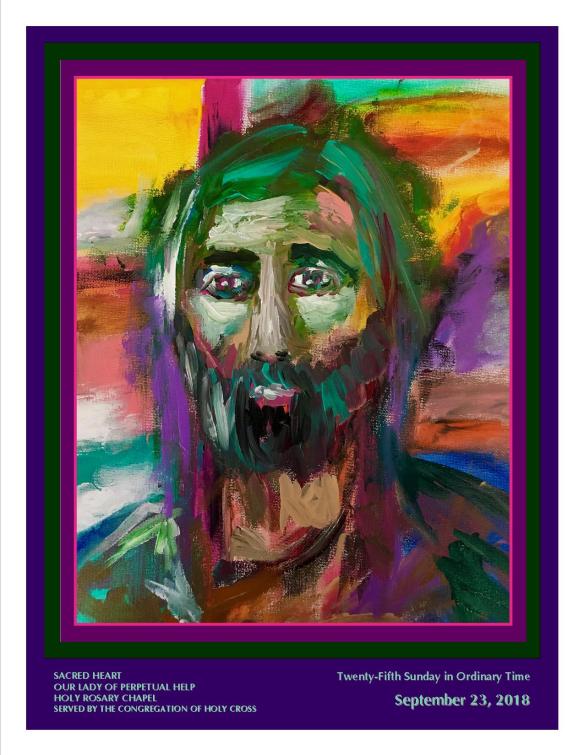
“In the sight of the angels…” Painting by: Ronald Raab, CSC


O God,

In the sight of the angels, I will sing your praises.

O God,

Send forth your angels

So we may sort through the realities of abuse in our Church,

So we may seek union in our racial divides,

So we may learn how hungry the poor really are,

So we may not scapegoat the powerless,

So we may seek justice among those who seek entry in our nation,

So we may teach our children how to believe in you,

So we may not divide with our tongues,

So we may learn how to listen to the marginalized,

So we may speak the truth of our lives,

So we may heal our wounded cities,

So we may show others that love is possible.

O God,

In the sight of the angels, I will sing your praises.

Text: Ronald Raab, CSC

Twenty-Six Sunday in Ordinary Time: Cover art and column

Sept. 30, 2018 Bulletin Cover

Cover art by: Rev. Ronald Raab, CSC


Dear Followers of Jesus,

There is a new statue in Sacred Heart Church. The new bronze statue is an image of Saint André Bessette. The statue came from the artistic hands of Rev. Anthony Lauck, CSC who died in 2001. Fr. Lauck was a priest and artist at the University of Notre Dame. I considered him a spiritual and visual mentor when I was in college. Copies of this statue are located in many of our Holy Cross institutions. I am so proud to have this art welcome folks through the doors of Sacred Heart Church. André’s hands extend down to welcome the weary and unfortunate.

Saint André Bessette is important to this community for many reasons. Not only was he the very first religious to be canonized, but also his relic is in the new altar at Sacred Heart. I also painted an image of Saint André that hangs in the main enterance and that image was published in AIM Magazine a couple of years ago.

Saint André was illiterate and his ministry as a porter drew the attention of many people. He became a healer in Montreal. He ministered at the door for over forty years. His ministry was to welcome people but in that position his faith drew others to Saint Joseph and his healing potential. He lived a very simple life. He believed that small things would lead him to God. This belief led him to receive over 600 people a day. He slept only an hour or two and spent the night praying for the people whom he had met during the day. Many people were cured of their ailments and diseases.

Saint André died January 6, 1937 and over one million people came to his funeral in Montreal during that snowy winter. His reputation extended throughout Canada and the United States. His legacy of simplicity, hospitality and healing forms our ministry and lives as members of the Congregation of Holy Cross.

A Prayer for Healing to Saint André Bessette

Saint André,

I come to you in prayer for healing. (…state your need…)

You were no stranger to illness.

You were an orphan and homeless.

You questioned your strength and place in life.

You were illiterate and your body was weak.

You received thousands of people at the door.

I come before you today in need.

Pray that I might be restored to health in body, mind and soul.

With Saint Joseph as my guide,

Strengthen my faith and give me peace,

That I might accept God’s will for me,

No matter the outcome.

Amen

Saint André Bessette, pray for us.

Twenty-Fifth Sunday in Ordinary Time: September 23, 2018

Sept. 23, 2018 Bulletin Cover

Dear Followers of Jesus,

Today’s gospel shows us the true meaning of following Jesus. Mark 9:3-37 begins by Jesus telling the story of his future suffering and death. The disciples just do not understand his message. Even further, the disciples really do not comprehend the meaning of his presence among them.

The disciples are arguing over many things. Jesus asks, “What were you arguing about on the way?” The disciples thought for sure that they were going to have new personal identities in the new “age of the messiah.” In other words, they thought they would be the cool kids on the block because they were close to Jesus. We can just see Jesus rolling his eyes. They still did not understand that to follow Jesus means service toward others, living in a profound humility and helping the helpless among them.

So to demonstrate his point, Jesus takes a child and says, “Whoever receives one child such as this in my name, receives me…” The child becomes the window in which we see all of what it means to follow Jesus. Let go of self and get a clue in Jesus.

Sadly over the years, not much has changed. We still think just because we follow Jesus that we are better than other people. Just because we have rules to follow and commands of the Church, we think that our identities are about power, separateness and strength. Even the clergy who follow Jesus in the Church rest more on power than humility, more on ego than Divine love, more on strength than on the power of Jesus’ death and resurrection.

When power and greed become the source of our following Jesus, the children suffer. In this day of purification of the Church’s power, authority, and clericalism, humility must be the call of the day. The reason we educate children today is so that they will grow up to find a place where they can rest their pain, their sorrow and their suffering. We do not hoard our power in following Jesus or abuse the innocent. We must not discuss along the way who is the best, the brightest or who is more Catholic by how we rigidly we follow the rules of the Church.

In today’s gospel, the children are an image of liberation for the followers of Jesus, for the children are the reality of humility and honesty. I pray that we all may learn to follow Jesus with such humility. Jesus still asks us the question, “What were you arguing about on the way?” because we are still struggling to get it right.

Blessings along the way,

Fr. Ron

Memorial of Our Lady of Sorrows: Patroness of the Congregation of Holy Cross

IMG_0069.jpg

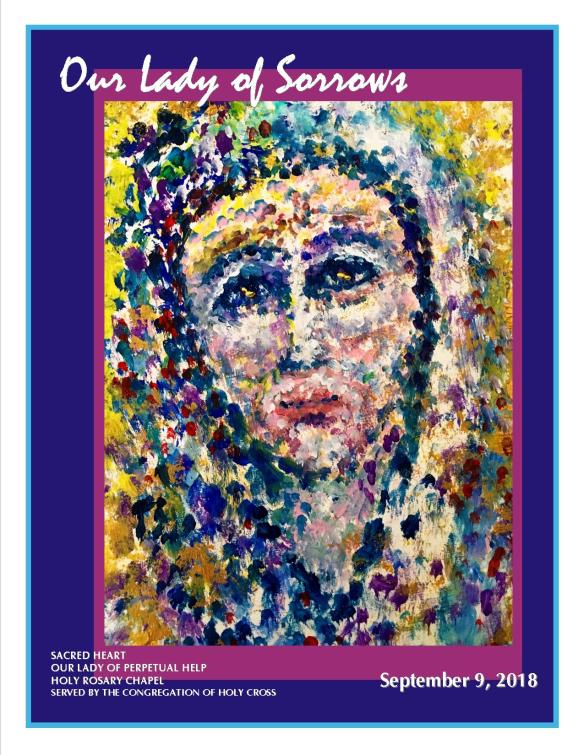
Our Lady of Sorrows, Painting by Ronald Raab, CSC

This image of Our Lady of Sorrows was published in AIM Magazine by World Library, Autumn 2018.

Mary, Our Lady of Sorrows is the Patroness of the Congregation of Holy. She stands next to all the suffering of the world. This painting is intense and bold since she carries all of our suffering. She stands by our children who were abused, those who fought in wars but still carry the wounds and those who live with intense pain and bodily wounds. Mary, no matter our suffering, stands next to our incompleteness and our longing for mercy. She leads us to Jesus, the healer and redeemer, the one who is our only hope.

Read more from the Congregation of Holy Cross

Gospel Jn 19:25-27

Standing by the cross of Jesus were his mother
and his mother’s sister, Mary the wife of Clopas,
and Mary Magdalene.
When Jesus saw his mother and the disciple there whom he loved
he said to his mother, “Woman, behold, your son.”
Then he said to the disciple,
“Behold, your mother.”
And from that hour the disciple took her into his home.

The Exultation of the Holy Cross

Version 2

Reading 2 Phil 2:6-11

Brothers and sisters:
Christ Jesus, though he was in the form of God,
did not regard equality with God something to be grasped.
Rather, he emptied himself,
taking the form of a slave,
coming in human likeness;
and found human in appearance,
he humbled himself,
becoming obedient to death,
even death on a cross.
Because of this, God greatly exalted him
and bestowed on him the name
that is above every name,
that at the name of Jesus
every knee should bend,
of those in heaven and on earth and under the earth,
and every tongue confess that
Jesus Christ is Lord,
to the glory of God the Father.

Twenty-Fourth Sunday in Ordinary Time: Column and cover art

Sept. 16, 2018 Bulletin Cover

Dear Followers of Jesus,

The questions of Jesus throughout the gospels are incredibly important to our faith. These questions come directly from Jesus’ mouth and they are some of the most challenging aspects of the four gospels. Questions open us to new possibilities. They are not rigid statements from Jesus’ life. His questions take on a different tone that invites us to respond to him.

Today’s question from Jesus is no different. “But who do you say that I am?” (Mark 8:27-35) In fact, this might just be the most important question Jesus asks not only of Peter, but also of ourselves. If we are truly followers of Jesus, then his question also penetrates our soul, as it must have done for Peter. Peter is always carrying the initial burden of many of Jesus’ questions; questions that are proposed to us even today.

For many of us, being an acquaintance of Jesus is enough because we do not desire to be formed or changed by his life or questions. It is easy to walk into our churches and never think about how Jesus demands us to live our lives or what to change in them to make us better people. Sometimes it is easier to follow a set of prescriptions or rules that is the life of the Church, but never come close to the source of what the Church is really about. Jesus’ questions begin to peel away the layers of anger, rage, apathy, denial or disgust we carry within our lives. These questions form us like no other teachings of Jesus.

For all baptized Christians, these questions of Jesus are bread and butter of faith. They are essential that we use them for our prayer, our daily experience of coming closer to Divine love, forgiveness and peace. These questions in the gospels form our conscience, ease our inner burdens and satisfy our hungers for justice. If we can really live from our answers to these divine questions, our Church and world would truly become a place worth living in.

To answer today’s question that Jesus poses to Peter, we need to sift through our life experience and come to terms about our faith and what it means for us. This question implies that we have an answer. This question also suggests to us that we have had the ability to pray, to learn, to experience God’s grace, even in our past. Do we have a deep enough relationship with Christ to even begin to answer this question?

The entire point of Jesus’ ongoing question to us is to get us to live in him and not to cling to our own tight egos and certainty. We shall lose our lives in his love and his mercy and not live in only our own righteousness and self-denial. “Whoever wishes to come after me must deny himself, take up his cross and follow me. For whoever wishes to save his life will lose it, but whoever loses his life for my sake and that of the gospel will save it.” Take some time for deep prayer this week and ask Jesus to help you find the answer to his question, “But who do you say that I am?”

Blessings,

Fr. Ron

Twenty-Third Sunday in Ordinary Time: My Cover Art and Column

Sept. 9, 2018 Bulletin Cover

Dear Believers in the Christ,

Mark’s gospel (7:31-37) is evocative and challenging. Jesus clears the ears of a deaf man and releases his tongue to hear and to speak. “Be opened!” is not just a command from centuries ago. This phrase becomes a foundational posture to live as a believer in Christ.

The Church needs all of us to wake up, to clear our throats and speak the truth. I believe this is one of the most challenging times in our Church in recent centuries. We need our ears opened and voices strong in dealing with issues of secrecy, abuse and cover up. We need to seek God in this crisis and I hope you will not walk away from worship and from Christ Jesus.

We celebrate this week two feasts that give us a new clarity in how to deal with the hypocrisy of the Church. The first is the Feast of the Exultation of the Holy Cross on September 14. All pain and suffering is offered to Christ. The victory of the cross is lived in us, and we need to live this reality with unbridled trust and love. We have nothing to lose in Christ Jesus. He is the source of healing, forgiveness and strength.

The Congregation of Holy Cross also celebrates its feast day this week. It is not the Exultation of the Holy Cross because we were not named for the cross. We were named after a village in France named Holy Cross. So our Patroness is Our Lady of Sorrows celebrated on September 15. My painting on the bulletin cover is an image of Mary, Our Lady of Sorrows.

Mary stood by the suffering of her son, Jesus. There are seven sorrows in the scriptures where Mary is present and unable to change the suffering Jesus is going through. She cannot wish it away. She cannot control the suffering of her son. She cannot heal it or change that it would not happen to him.

I offer Mary, Our Lady of Sorrows as a model of how we deal with suffering. We stand by such immense suffering and we offer it to Christ Jesus. This posture of fidelity is really real in our day. We know that sex abuse is about power and not about sex. This understanding we need to bring to Mary so that Jesus may help us recognize that only his power will change people, including the hierarchy of the Church.

Mary also helps us find our voice. Although she patiently stood by suffering, she waited with a full heart of prayer, love and hope. Our voices find real meaning when we are able to wait in hope, to challenge structures, to speak boldly about the truth in Christ Jesus.

Like Mary, we need to pray for our children. With absolute abandon, we need to pray for all of our abused children and all of our children who abused others. Mary, a rock of prayer, is sure-hearted in her love of her child, Jesus. He is the one who receives our anger, rage and frustrations.

Mary will help us bless our anger. We need to turn our rage into actions of prophecy, becoming a prophetic witness to God, of truth, fidelity and beauty. Mary steadies our anger, gives us perspective and leads us to the glory of her Son, Christ Jesus.

Blessings,

Fr. Ron
Twenty-First Sunday in Ordinary Time: My cover art and column

Aug. 26, 2018 Bulletin Cover

Dear Followers of Jesus,

In John 6:60-69, we hear the last of Jesus’ narratives on the Eucharist. We have listened to this discourse for six weeks. We enter into these reflections with Jesus and the disciples because we constantly need to be reminded that the Eucharist transforms our lives within our complicated world.

Many of the disciples are coming to him saying that his teachings are too difficult. They wonder who can accept the real meaning of it all. Some of his followers are just walking away from Jesus and pursuing their former way of life. Jesus says to the Twelve, “Do you also want to leave?”

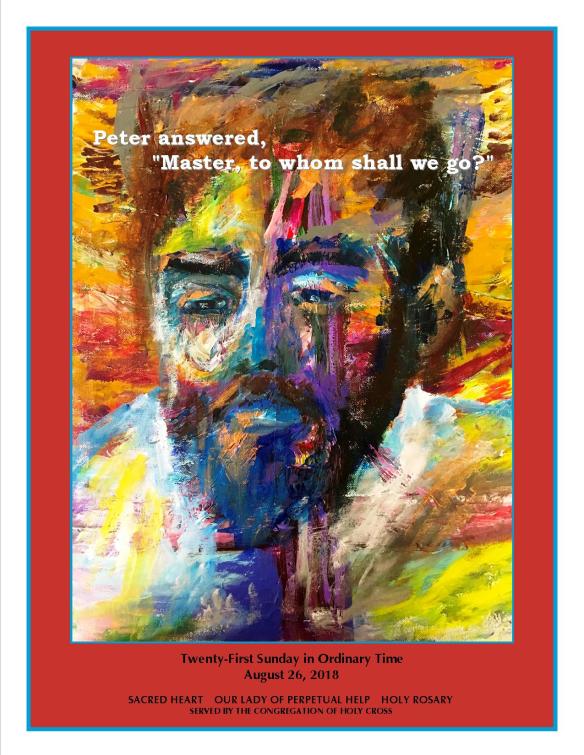
Peter responds to Jesus, “Master, to whom shall we go?” My painting on the cover of the bulletin attempts to reveal Peter’s feelings about this question of Jesus. Peter is conflicted, yet deep down he knows that Jesus brings healing and concord. Peter understands that following Jesus leads to eternal life. This is a turning point for Peter. Peter begins to understand that following Jesus costs something. Following Jesus leads to a radical change of perspective and attitude. Love is not flimsy or whimsical. This love is transformative. For Peter, following Jesus will inevitably confront his own betrayal and sin. This tension of faith shows on the face of Peter, his eyes cast down and his thoughts roaming within his mind. We have similar decisions to make, whether or not we will stay with Jesus or leave for power, greed, addiction or ego. A similar expression settles on our faces as well.

The Eucharist costs us our lives because we witness love to our world. Faith challenges the status quo. Jesus turns life upside down. Love is not cheap. When we take a stand in God, we become like Peter who struggled to find new life in following Jesus. We celebrate Eucharist in the midst of war on our streets, during conflict on our boarders, when we prefer selfishness rather than self-giving. We celebrate Mass when hatred knocks on our doors and when violence seems to identify us. If we maintain our faith, we shall stand among people in loss and poverty and hold fast to the assurance that Christ is with us. The Eucharist is profoundly counter-cultural. Where else can we go to create awareness, offer consolation, renew our love of all life or invite people into a life of genuine integrity?

The Eucharist is not a tidy little ritual we perform. The Eucharist is a radical posture of love in a world that does not want such an inclusive love or a call to justice or people transformed into people of peace. The Eucharist is not something to just adore or hold at a distance but a presence of God that changes everything. I pray we may all have the conviction of Peter to say to Jesus is our prayer, “Master, to whom shall we go?

Peace and Blessings,

Fr. Ron