The Deep Prints of Secrets

Originally published by Ministry & Liturgy Magazine, April 2010 –
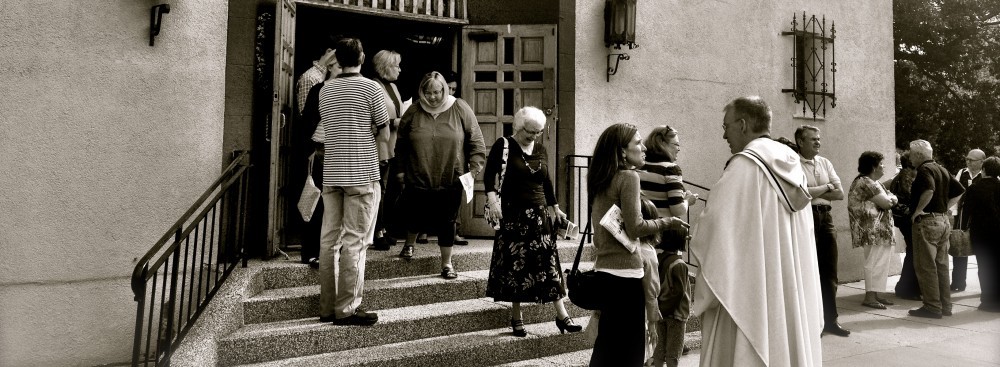
I hold sacred many people’s secrets. The elderly mother whispers in my ear after Sunday Mass her dreams for her handicapped son. The eye-shadowed addict stops me on the street and confesses amid the blurring noise of a passing bus the reasons why he does not enter a church building. I hear the hushed voices in our confessional on weekdays admitting with deep wounds their personal grievances of the past. The parish volunteer catches me before the morning opening of our weekday hospitality center to entrust to me the secrets of his weekend.

All these holy encounters teach me to walk the path toward God’s healing and mercy. The only path I know to carry these fragile encounters is the path toward the Eucharist. Some days I am weighed down processing to the foot of the altar. There I find the deep prints of the secrets I carry with me. Often I am overwhelmed with love for the people who share their complex lives of suffering with me. I also worry about many people who are asked to carry burdens beyond which their hearts can bear. At the foot of the altar, I leave the dusty prints of my body carrying the grief, hardship and tragedy of so many people.

I carry people’s heart disclosures to the Eucharist because the Gospel of Luke teaches me to do so. These stunning passages we proclaim during the Sunday Eucharist in June open up for me the profound grace hidden in each of the secrets I carry.

A woman from the city comes to the table where Jesus is eating at the home of a Pharisee. She carries an alabaster flask of ointment in her arms and her secrets in her glass heart. Her secrets seem to be known publicly in the village. Word is on the street about her life and how she lives. Nevertheless, she carries with fragile reverence her secrets to the place where Jesus is sharing a meal.

She makes her way to his feet, grasping her flask at her chest to protect what is inside of her. At the sight of Jesus, she breaks through; her secrets spill out along with her bottled-up tears of regret, shame and years of being isolated. The sacred flow of water and secrets intermingle and together cleanse the dusty feet of Jesus. She seems to understand already that her life will be carried by Jesus along with other people’s lives to the cross. The path to the cross will bear the deep prints of sin, known and unknown. She realizes already the depth of forgiveness and mercy that comes from his unflinching presence.

Jesus also reveals love to the Pharisee. Simon believes the woman’s identity comes from her sin. Simon sees her only through the label that he and other people have placed on her. Jesus says to Simon that he did not wash his feet or give him a kiss or anoint his head. Jesus reminds him that the woman bathed his feet with tears, kissed them and anointed them. In this encounter, Jesus teaches Simon and everyone at the table, that the woman crying at his feet is worth more than her sin.

This profound story teaches me that Jesus wanted the woman to be restored to real joy. This joy is not a label nor is it fake or flashy. This joy comes from the honest love of God where all of us are more than our sinfulness and more than the everyday mistakes we make in our relationships. This joy is not a label. This joy comes from being at the feet of Christ and knowing and believing in our inherent worth as a child of God.

I know firsthand how our labels keep people separate, at a distance from our sense of belonging. The person with mental illness is easily labeled incapable of understanding life so is not taken seriously by others. I hear a wealthy executive blame a man experiencing homelessness for the man’s inability to keep a job. I see a responsible parent not wanting her child to associate with people living in poverty because her child might be exposed to “those people”. The long-time parishioner’s opinion is cast aside, the young tattooed youth who meditates daily receives disparaging looks at Eucharist and the pregnant thirteen-year-old absorbs her portion of stares – and more. We easily cast our worries on others and put public blame on the weary and the downtrodden.

We are all servants of God who asks us to lose our lives so to find the joy of life. Even our deepest secrets and unresolved pasts cannot keep us from the tender heart of the merciful Body of Christ. At the foot of the altar we learn to rest our pride, our arrogance, our prejudice and our corruption because of those who teach us that tears and remorse reveal the real presence of Christ Jesus.


Scripture

Scripture and preaching led me to ministry and priesthood. I remember a young priest who preached in the aisles of my home parish when I was in high school.  I heard the stories of Jesus in a new way. I was compelled to explore ministry because of what I heard in that small parish in Michigan.

I have been preaching myself now for thirty years. Preaching has led me to various church aisles throughout the country. The Word has formed me in ways I cannot articulate. Preaching now among people living in poverty continues to change my heart and how I approach and pray the Word of God. I have been deeply humbled by people’s stories of surviving addictions or living through years of mental illness. All the issues of urban poverty teach me an even greater dependence on God’s love and mercy.

+++

FEATURED ARTICLES

The Yellow Pages
September 2008, Ministry & Liturgy Magazine

Sock Exchange
November 2009, Celebrate! Magazine

Sacraments

I stand at our parish altar feeling overwhelmed on most days. I have to catch my breath when I see the faces of people who really need God. People in poverty reveal to me that grace is not bound by a communion rail or church door. People in dire need open my heart to trust Christ’s real presence among people’s real suffering. People gather for Mass because of the violence in their lives. We all encounter at the altar table a profound need for something greater than ourselves.

I realize with all my heart that sacraments compel us back to the streets from the altar to work for justice. We feed people who line up in our hospitality center because we have waited in line to be fed in the communion line in our chapel. Volunteers wash feet because our feet have been held by God and washed in the liturgy. We take to the streets the grace we receive in the Eucharist. Sacraments are not bound by our infidelity, our hopelessness or our inability to receive the love God has for us. Sacraments teach us how to love in the world. I now crave the Eucharist in ways that continue to change and form both my heart and my ministry.

+
+
+

FEATURED ARTICLES

Line Dancing – December 2009, Ministry & Liturgy Magazine

A Beautiful Supper – April 2009, Ministry & Liturgy Magazine

Someone Else’s Clothing – April 2010, Ministry & Liturgy Magazine

Service

I realize every day that so many people are never emotionally free from the slavery of generational poverty, multiple addictions and long term mental illness. The longer I am in the midst of people’s stories, the more I depend on God to heal the souls of people who cannot find their way out of darkness, loss and grief. God’s love compels us into the messiness of service, rolling up our sleeves to find healing to situations that may never be solved.

The work of justice begins with building relationships with people. These relationships will determine how things need to change for society and the Church. Our community realizes on a daily basis that we cannot fix people’s lives. We cannot solve the mystery of long-term poverty or all the ways people are marginalized by addictions and mental illness. I now realize that only God’s fidelity can heal people. Our actions toward serving people is a mutual realization that healing comes from being in relationship with people who suffer the tragedies of being shunned, put down and disregarded in life. We all experience a personal poverty, the ways in which we all need God and one another in order to survive.

FEATURED ARTICLES

Foot Crossing – March 2011, Ministry & Liturgy Magazine

Sidewalk Soup – August 2009, Ministry & Liturgy Magazine

Personal Poverty Retreat – February 2008, Ministry & Liturgy Magazine

Saint André Bessette

The patron of our parish community is Saint André Bessette, who was the first member of the Congregation of Holy Cross to be canonized in the Catholic Church. He is also the first male saint from Canada. The canonization took place in Rome on Sunday, October 17, 2010. Saint André Bessette Catholic Church continues his ministry in Old Town, Portland, Oregon.

I have written many articles connecting the life, faith and service of Saint André to our parish ministry of hospitality, healing and hope. I invite you to share in prayer and reflection as you read about the inspiringly simple life of a man who welcomed people and prayed for them.

Saint André has inspired my life and approach to the healing power of God. In our ministry among the marginalized, I realize more deeply that only God can heal, reconcile and comfort. Join in us prayer and in a profound reliance on the grace of God for people surviving urban poverty.

In the following articles, I explore the connection between Saint André’s legacy and the mission of our parish through ten common themes:
Home | Hospitality | Honor | Holy Oil | Healing
Humility | Hunger | Holiness | Heart | Hope

In 2012, I wrote a six-part series celebrating the
Feast Day of Saint André and the changing of our parish name:
Part 1 | Part 2 | Part 3 | Part 4 | Part 5 | Part 6

+++

FEATURED ARTICLES

Door Man: St. André Bessette
December 2010, U.S. Catholic Magazine

A Foot in the Door: A Community Modeled after Brother Andre Bessette, CSC
October 2010, Ministry & Liturgy Magazine

Saint Doorkeeper
September 2010, Celebrate! Magazine

+

+

+

+

+++

This video is from the documentary, “God’s Doorkeeper | Saint Andre of Montreal.” In July of 2010, staff producers and writers from Salt and Light Television from Toronto, Canada filmed portions of our ministry at Saint Andre Bessette Church here in Portland, Oregon. This six-minute section shows the connection of our prayer and service. We are grateful to Salt and Light Television for permission to view this video clip. I invite you to pray for our parish as we continue to learn about our patron, Saint Andre Bessette and strive to live out his healing ministry in our parish community.

Heavy Lifting

Originally published by Celebrate! Magazine, March 2010
– PDF version –

I often feel embarrassed standing at the altar alone on Sunday morning. I lift my arms out from my sides, hold my palms up and offer verbal prayers on behalf of the community. My body assumes this posture while everyone in the community is kneeling. I sense my feet on the ground, my hands raised up, my voice projecting and so often I feel alone.

I experience this deep loneliness because I take seriously this responsibility to offer people’s lives to God. When I feel my arms weaken and hear my voice quiver, I know that the emotional weight of people’s lives bears down on me. Every Sunday I feel this profound body workout as I lift up my heart in prayer standing at the altar of celebration and communion.

Ministering among people who suffer poverty and loss in our urban parish has formed in me a deeper understanding of celebrating Eucharist. Praying with people who have no power in our culture strips me of any assumption that being at the altar is about my own authority, talent or ego. I come to realize that the gesture of opening my arms in prayer is my real work, my daily confrontation with God and myself.

At the altar I come to grips with the fact that people suffer beyond my ability to offer solace, change or even consolation. Praying amid people suffering homelessness connects me to real human need. Here, I am united in heart and soul with people who kneel in prayer. I do not think more of myself as the only person standing.

Looking into the faces of people bent over the pews during Mass changes me. I stand at the altar on behalf of people who do not know where to turn with their pain, uncertainty and challenges of life. I feel in my bones a deep connection to people’s unanswered questions. I pray every Sunday that there will be enough grace to fill the void in every heart.

I look to the Solemnity of the Most Holy Body and Blood of Christ for solace among people starving for the basic needs of life. The disciples knew of the hunger of the crowd gathered to hear Jesus. They approached him, scratching their heads about how to feed the vast number of people. Jesus tells the disciples to give people food, taking responsibility for helping people get through their hunger. Of course the disciples complain to Jesus that only a few loaves of bread and a couple of fish will not be enough. Jesus offers a blessing on the measly portions. Everyone finds satisfaction, and leftovers fill twelve baskets.

I complain weekly to Jesus that people need more than what I can offer them. In our small parish, hunger for companionship fills the chapel on Sunday. I often wonder if Jesus is listening to the parents who have just lost their lonely, gay son to suicide. I question the compassion of Christ when I hear of the gang rape of a teenager after a school dance. I want Jesus to be around for the elderly man who was beaten by his son for a measly inheritance.

Standing at the altar on Sunday, I feel the weight of all these needs on my outstretched arms. This is the heavy lifting of my ministry as a priest. I learn from the hungry disciples to bring these needs to the person of Jesus. I trust even in moments of profound hunger and need that together we will all be fed; we will all discover love and we will all find the healing we need.

As I pray at the altar on Sunday, I also view people torn apart by the judgment of other people and the condemnation of society. This need for reconciliation bears down even more on my extended arms and open hands. I realize every Sunday that my posture at the altar remains so countercultural. Here, my open hands must also be a gesture of hospitality and welcome. This goes against our human instincts to clench our fists at drug users, prostitutes, street teens or people who threaten the status quo.

In Luke’s Gospel, a woman comes uninvited to the home of a Pharisee. She arrives with an alabaster flask of ointment because she knows that Jesus is dining there. Her reputation as an outcast threatens everyone. She bends down to the feet of Jesus and weeps. She dries his feet with her long hair and kisses them. She anoints the person of Jesus, the feet of the Savior. She peels off the labels that people have placed on her as she reveals the love within her. Her action of love and tenderness becomes our moment of reconciliation.

I learn from this woman that if I am to remain at the altar with open-handed prayer, I must also wash the feet of our culture’s outcasts. I must learn even more to bridge the gaps among people who judge others. I must anoint people’s fear when unkind labels condemn them. I must kiss the feet of people abused by our society’s outpouring of hate.

My arms outstretched in prayer modeling the sign of the Crucified also tells me that I must take up my cross daily. I carry this burden when I welcome the lost sheep and embrace the homeless veteran. This heavy lifting will never end. I see in my gestures at the altar on Sunday the connection of how I live the limits of my life during the week. I discover at the altar that I am to lose my life in order to save it.

I understand now amid drug users and people suffering mental illness that standing at the altar on Sunday is not just a perfunctory rubric. This is the place of genuine love. Jesus tells me to keep my hand on the plow and never look back. So I keep my arms out from my side and my palms empty. I keep my eyes on the faces of people kneeling in the pews. I enter more deeply into my loneliness and discover again the people of God, the Body of Christ.

The Spirit’s Note

Originally published by Ministry & Liturgy Magazine, March 2010
– PDF version –

When I lived in Southern California, I walked every week along the promenade between Santa Monica and Venice Beach. The famous beach pathway is not only well-known for its sunshine and beautiful sand, but for all the colorful people who make their living selling unique items. Many people will also offer their small or individual talents in exchange for a money offering. Some people who are homeless ask for a donation of coins or paper money dropped in a bucket or hat or tossed on a blanket.

One Friday morning as I was making the return trip to Santa Monica, I noticed a homeless man blowing on a trumpet with a small, rusty coffee can at his feet. He caught my attention because his trumpet looked as if it had been run over by a truck. The smashed instrument looked unplayable at best. However, my fascination became centered on the fact that he was playing just one musical note. I stopped in my tracks and watched him play for awhile. I could not believe my eyes or ears. After listening to his one note concert for a few minutes, I moved on along the path back to my car.

After walking about a half-mile away from the horn player, I stopped cold. All of a sudden something dawned on me. I said out loud on the path, “Now I get it! It was not that he was playing just one note on his trumpet, the man had the courage to play his note!” I am not sure what the people around me must have thought when they heard me talking to myself. However, the new insight sent me racing back to the one-note gentleman to put some money into his rusty container. Unfortunately, he disappeared before I could make a donation to his flat trumpet.

As I look back to my experience on the beach that day, I hold this man’s courage firmly in my heart. He was so humbled by his communication with his trumpet, yet he was fearless in offering to the world what only he could offer. This note speaks to me now of our upcoming celebration of Pentecost.

On Pentecost Sunday, we will proclaim from 1 Corinthians, “To each individual the manifestation of the Spirit is given for some benefit.” This is manifest in my friend’s trumpet playing. The cumbersome note grasped my attention. It was not a note from a wealthy person, or an educated musician, a cleric or a teacher. This sound of belief and even longing came from a homeless man struggling for a dime in the hot sun.

Because I heard this man’s trumpet, I only imagine how many people I have ignored before him. His dire poverty struck me. I catch myself judging people for expressing themselves, or discounting their voice because of their background, their financial status or their lack of formal education. His humble poverty changed me and my belief about how the Holy Spirit changes me.

At Pentecost we must reconsider the people crying out to us who long for our attention, who beg to be heard, understood and accepted. We must welcome the teenager lost in the foster care system, the elderly suburban woman being abused or the manic housewife caught in addiction. If we believe that the Spirit is not dead, then we must be able to hear the Spirit in the lives of people we have ignored, shunned or have turned a deaf ear.

Many parish communities are paralyzed with fear faced with people in poverty. We have built fences around our schools, locked our church doors and protected our parish gatherings from strangers. We are called again this Pentecost to break free of our fear to welcome the lost, the smelly, the ragtag and the neighbor next door. Pentecost is not a past experience; it is an explosive grace capturing the hearts of people today, in our time and generation.

The Spirit still blows the hinges off our doors, still knocks us off our pedestals, still whips the wind out of our preconceptions and heals our hurtful judgments of one another. The celebration of Pentecost must create the Church from the lives of those who are waiting for a new dignity of life, for those who long to be accepted and for those who cannot wait to pray with us.

The golden age of the Spirit does not exist. We must not believe that a certain time in history is more infused with grace than another. We cannot get stuck in our parish communities believing that the Spirit was more present when we had the cute pastor, or when we had stricter rules, or when priests wore cassocks, or when we wore tie-die.

The gift of Pentecost costs us our thinking that we are in charge, that life will be better without the stranger or that our false security will bring us peace. Pentecost reminds us all as individuals and worshipping assemblies that our lives are a mystery and we are made lovingly in each note of the Spirit’s love.


Pastel Breakthroughs

Originally published by Celebrate! Magazine, March 2010
– PDF version –

Every month a large brown cardboard box arrives in the mail in our parish office. Every member of our parish staff recognizes the return address immediately. The container is postmarked from Boston, Massachusetts and travels the miles across the country to Portland, Oregon. The box is shipped from Holy Cross Family Ministries, an apostolate owned by my religious community, the Congregation of Holy Cross.

Without opening the box, we all know that the delivery contains three hundred plastic rosaries, each one enclosed in a small plastic bag with paper fold-out instructions on how to pray the rosary. The rosaries come in white, as well as pastel colors of pink, blue, and green.

Even though we are a small parish of only a hundred or so people, the large number of rosaries is a welcome sight. Every weekday morning over a hundred people come through our doors searching for the basics of life. Unfortunately, we simply do not have the resources to meet every person’s needs. Some people come enraged that they stood in line for hours only to be turned down for a bus pass to travel out of town or money for medication or resources to find shelter for their children.

Often when people are most frustrated, some of them may still select a pastel rosary from a small wicker basket placed at the office window and something happens inside them. They begin to feel connected to us anyway, even though we were not able to provide them with the item or assistance for which they stood in line.

I find in these small plastic bags many connected moments of miracles. These encounters with strangers become pastel breakthroughs that awaken my heart to the real needs of people. Not many of our guests will ever actually sit down, take out the instructions, read the small print, and learn how to pray the traditional prayers. Some of our guests are lucky to find a relatively safe place to sleep or to be able to find a quiet moment at all in the neighborhood single-room occupancy hotels. It is the message of the rosary itself that counts. Every day I learn that the Paschal Mystery comes in shades of anger, hopelessness, discouragement, frustration and uncertainty. I rely on the plastic beads to be more than mere objects, to be genuine moments of faith and hope somehow strung together.

As I ponder the Gospels for March and April, I notice a string of awakenings, breakthroughs that unlock our search for God. Jesus tells us a story of a simple fig tree, one that people have ignored because of its lack of fruit. Jesus is patient, cultivating the soil, fertilizing, waiting and believing in the natural process of growing fruit. The Lenten Gospels tell us that God is not finished with us. We cannot give up on people in poverty whom we judge, ignore or insist that they are not living up to our standards. This acceptance of other people in these Lenten days shows us that Christ’s dying and rising still produces much fruit in our human hearts.

A woman weeping in our chapel told me she just wanted a blessing for her children. I sat with her, listened to her abusive story and prayed with her for our Father’s care. I handed her a packet with the pastel beads and she pondered them as if heaven had opened. I could not help but see in her tears the woman standing in the sand accused of adultery. Her friends had given up on her, people turned their backs on her actions and others could not take responsibility for their own decisions. Her tears still teach me that women remain ravaged by rumors, finger pointing and accusations in our society and church. Jesus, bending down to write an unknown message in the sand sets her free with words that breakthrough the lies.

Our staff realizes that not everything goes according to plan. When we first received the rosaries some years ago, one staff member noticed that the rosaries themselves were being left in the lobby. However, the plastic bags were always taken. It dawned on us that some people were discarding the rosaries and using the plastic bags for drugs. Not every moment comes out perfectly as the father realized with two lost sons. In the least-predicted places and times, we can all wake up to our sin and misfortunes. We can find our true inheritance by finding our way home to God’s love. Jesus welcomed sinners and ate with them and even today among people in every parish community. Even when the drug users took the rosaries for their purposes, I must believe in these unexpected moments that the faithfulness of God rests upon them as well.

Jesus threatened many people and was sentenced to death because he disturbed people’s comfort in order to welcome outcasts, sinners and strangers. I think of Jesus’ reputation when I see for myself rosaries hanging from the necks of people living in poverty in our neighborhood. I notice them at bus stops and street corners, in coffee shops and while riding the streetcar. The rosaries reassure me that we had some contact with people who need the basic message that God cares for the people living in poverty on the streets of Portland.

Some people may be disturbed that many of these rosaries are not being prayed as they were intended. However, I see them as glimpses of faith, real breakthroughs of love that unite us with people suffering homelessness, incredible addictions and various degrees of mental illnesses. Perhaps their example of wearing faith on their bodies for everyone to see is really an extension of the prophet not being accepted in his own native place, or street corner, or homeless shelter.

I remember when Bonnie camped at our doorway for two months. Because of her kleptomania I estimated that she took nearly four hundred rosaries during her stay. I am convinced that Bonnie poked her head into Jesus’ empty tomb and wanted for herself the warmth of the white garment left in the corner of the grave. She became a sign for so many people in our community that Christ is still near, that death still gives way to the breakthrough of compassion and hope for people. I wait for the day when we will all find ourselves wearing our baptismal garments witnessing to Christ breaking bonds of apathy, injustice and insincerity.

I saw a commercial on television for a local CBS affiliate that asks people on the street about the needs of Portland. One gentleman wearing layers of clothing responded by saying that Portland needs more public restroom facilities. If you notice very closely under all the layers of clothing you will see the pastel rosary beads around his neck. “Peace be with you. As the Father has sent me, so I send you.”

Jesus revealed his resurrection among fisherman along the shore. He told Peter to remain in love and to act justly toward all people who remain lost and forgotten. When I see people wearing the rosaries all over town, I discover deep within my own heart the true presence of Christ. The rosaries and the people remind me to open my heart further, to follow more closely and believe in the pastel Easter presence of Christ our Savior.

Almost White Garments

Originally published by Ministry & Liturgy Magazine, February 2010
– PDF version –

I relish a moment of quiet in the chapel early on Easter morning. Every year at the Downtown Chapel I sneak downstairs, flick the switch of a single altar light and sit on the sanctuary steps. I relax in this sacred space as I have done in various other places in the 27 years of my priesthood. I savor the prayer and excitement, the longing and grieving, and the memories and peace of the Triduum. Every year the Triduum captures the real life of every parish, and I try to soak up the lingering hope of people who believe in the dying and rising of Christ Jesus.

Last Easter morning I tried to recall the names and faces of our friends who courageously extended their feet to be washed on Holy Thursday. I captured again the longing on those faces that ache for Jesus to truly wash them of suffering, poverty and loss. I remembered the fresh smell of the bleached towels. I heard again the gentle music, the soft singing. I felt again the anxiety of some people worried about publicly exposing their imperfect feet. The naked feet reminded me again of the sinners and outcasts who ache to be called among His followers. These memories help me realize one more time that everyone longs to be cared for and acknowledged as followers of the Christ who still washes us clean.

I remembered the folks who processed down the chapel aisle to kiss the cross on Good Friday. Some people from our hospitality center reverenced the cross for the first time. Other people who live on the margins of society hoped that this gesture could spark healing for them and for the Church. Still others sought out the wood because it has been a deeply significant ritual all the way from their childhood. Last year I sensed my own fear of death as I remembered an elderly woman who hobbled up to the cross. She died just a few short weeks later.

I also held up to the Divine my memories of celebrating the Easter Vigil. I smelled the Chrism now mingled among the bright aroma of the white lilies. I pondered the wax from the peoples’ candles now on the carpeting. I remembered the new fire capturing excitement on the faces of the Elect and the Word of God echoing our ancient history in our small chapel. I remembered the joyful faces of people renewing their baptismal commitments. The deep joy of new life echoed back to me on the quiet step.

My reminiscence ended abruptly last Easter morning with a knock on the chapel door. Julie, a volunteer and parishioner, arrived in the rain with a load of clothing donated from her coworkers. As I opened the door she said that a young man she encountered down the block really needed help. We invited him through the lobby doors. He was in his early twenties and told us he was just passing through town. He stood in front of us wearing jeans, a T-shirt and filthy, wet white socks. He explained that while he had slept in a doorway all of his possessions were stolen, even his shoes. He begged us for at least a pair of socks and any kind of shoes.

Julie and I escorted him into our men’s clothing pantry, a small dark space in our basement. I assisted him in sorting out some options for shoes. Julie ran upstairs to acquire a new pair of white sweat socks. His name was Chris, and the smell of booze covered him as he sat down on a bench to try on his new shoes. We chatted as he peeled off the soaking wet, filthy-grey socks from one foot then the other. His face lit up as he slowly put on his new socks and tried on a couple of pairs of shoes to find the right size. The donated canvas shoes fit him perfectly.

Julie and I engaged Chris in conversation as he relaxed on the bench enjoying the warmth of his new socks and shoes. He was alone, seeking a job, lost in alcohol, running from family issues and not sure he would stay in Portland long. He thanked us over and over again, for the new white socks and the shoes that felt even better than the boots he had been wearing.

As we were leaving the men’s pantry, Chris picked up his old white socks and tossed them to the side of the room into a small waste basket. I saw the gesture in slow motion, this young man tossing the white garments off to the side. I slowed down and took a second look at the socks in the trash can. I turned off the lights to the small windowless room, acknowledged his smile, closed the door and gave thanks for the Easter morning memory.


Block Blessing

Originally published by Celebrate! Magazine, January 2010
– PDF version –

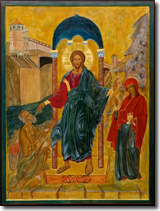
Icon of Christ the Healer

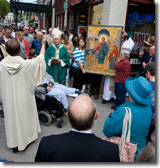
Last summer our parish community welcomed Archbishop John Vlazny of the Archdiocese of Portland in Oregon to bless and dedicate our new icon. The icon of Christ the Healer was written for our parish community that serves people living in poverty in Old Town in Portland. The writer of the icon, Rev. Jon Buffington, incorporated images unique to Portland so that many members of our community could better relate to and pray with the healing Christ offers to every person.

Christ touches a crippled man wearing a backpack sitting in front of the Burnside Bridge. This sacred gesture calms many of our people who sleep under that same bridge. Christ casts out seven demons from Mary Magdalene who holds a jar of perfumed oil. Many of our people suffering from mental health issues take refuge in her beautiful, serene appearance. Many people suffering chronic illness also come weekly to the chapel to be anointed for such unrelenting anguish. A series of roses under Christ’s feet calls to mind the City of Roses, a trademark name for Portland. That same image can be found in our Cathedral just a mile from our parish community.

After the reception of Eucharist, the Archbishop blessed the artist, and called everyone into a silent moment of heartfelt compassion for our parishioners and neighbors who live in dire poverty. The central piece of the dedication was a sung litany which washed over the assembly rousing deep prayer and passion for many people in the assembly.

I offer now this Litany of Blessing so that every community may learn in any time of year to enter more deeply into the healing message of Christ Jesus. This blessing prayer spoke to the particular needs of our parish community. Other parish communities may name their own poverty and suffering in addictions, elder abuse, divorce, or rural unemployment. Every parish community must be truthful and name their experiences in real, honest and authentic prayer.

The assembly responded in song, “Heal us, O God” to each chanted line of the litany. I felt the emotional tug of each statement settling into the hearts of the people. Each line seemed to go deeper into the truth of how we experience life every day in our parish. The bold statements opened our eyes to reality and profound trust in God. I felt a sacred hush under the chant. The prayer touched tender places of compassion and faith for all of us. We seemed humbled by our heartache and even more so by taking the risk of opening our lives to God. We listened, prayed and received the words sincerely in our hearts as we cried out in response.

We lift up our prayer in the healing touch of Christ….
We lift up our community in the healing touch of Christ…

Protect us when we cling to revenge and violence………..
Transform us when hatred overtakes our actions…….
Teach us when we jump to false conclusions…………….

Lead us when we are afraid to follow……..
Inspire us when we fear our own talents…..
Sustain us when we turn from your mercy……

Unite us when we would rather go our separate ways…..
Clarify our thoughts when our thinking becomes destructive….
Bond us together when prejudice tears us apart…..

Create life in our culture of death and destruction…….
Penetrate our stubbornness when self-hatred makes a home in us….
Discover new potential in us when we grasp power and authority…….

Soothe our hearts when illness claims our bodies…..
Rest in us when anxiety penetrates our souls……
Cleanse our consciences when sin overtakes us….

Refresh our hope when we are absorbed in doubt and guilt ….
Wash our feet when we stumble and walk away from love….
Believe is us when we no longer trust in your love….

Forgive us when we do not serve our neighbors….
Provide for us when we loose our employment…
Shelter us when become homeless…..

Recover our lives when addiction and compulsion overpowers us….
Touch us when we cannot bear our pain…..
Cry for us when we grieve those we love…

Weep for us when sorrow blankets our hearts and futures…
Anoint us when our bodies are too weak to pray….
Live in us when we are dead to ourselves….

We lift up our prayer in the healing touch of Christ….
We lift up our community in the healing touch of Christ….

After the litany, the Archbishop prayed the words of blessing for the community and the icon itself. He then sprinkled the icon and the assembly with blessed water. Archbishop Vlazny knelt lovingly on the concrete floor and dipping his thumb into the Oil of the Sick, anointed the four corners of the icon. His humble posture created in me deep concern for all the people we serve and longing for our reliance on God alone.

After the final blessing and dismissal of the Mass, we carried the icon immediately to the outside of our chapel. The entire assembly gathered on the corner of 6th Street and Burnside for the procession around our block to offer Christ to the four winds, for the needs of the entire world. This moment really captured my imagination and the awareness of our assembly. Taking this healing message literally to our neighborhood certainly was a new experience for many visitors and parishioners. Even though we pray at sites of murders as a community and even feed people outside, this was a special way of bringing the message of the Eucharist to a waiting neighborhood in need of love and tenderness.

We huddled silently on the first corner. When people gathered we sang boldly the next texts of the litany. After pausing to allow the prayer to sink into our hearts we then processed along the sidewalk to the next corner and continued the same process on each corner. We sang our truths, anguish and reliance on Christ in the midst of passersby, people pushing their belongings in shopping carts and strangers staring at the large group of us. A few patrons of the local gay bar thought we were condemning gay and lesbian people and drug dealers and several parishioners assured them we were praying for love.

We stand in our streets and offer Christ to the south…..
We pray for immigrants and refugees……
We pray for all people in third-world countries……..

We cry out for the needs of the prisoner, the veteran……
We carry on our shoulders the weight of unemployment….
We ask you to guide our homeless youth and pregnant teenagers….

We carry the cross for people who line up daily for our hospitality center…
We bring Christ to people who line up here for Brother Andre Café…..
We ask you to heal the people who do not trust this community….

We stand in our streets and offer Christ to the east…
We pray for the end of war…
We pray for reconciliation among all faiths and religions…..

We ask healing among agencies serving people experiencing poverty…
We ask healing for the elderly, the crippled and bedridden….
We lift up drug-dealers and pimps who roam our streets…..

We carry the cross to those who cannot help themselves…
We bring Christ to those who feel judged by our faith community….
We ask you to heal the divisions within our neighborhood….

We stand in our streets and offer Christ to the north……
We remember Brother Andre and the people of Canada….
We pray for our Holy Cross institutions of learning…….

We pray for people struggling with sexual identity….
We pray for adequate housing and employment….
We pray for the safety of all women in Old Town….

We pray for reconciliation among neighbors housing the poor….
We pray for all businesses in Old Town……
We long for the unity of believers and the consolation of the oppressed

We stand in our streets and offer Christ to the west….
We pray for navigators of the sea, travelers and sojourners…
We pray for our dead who have traveled to the eternal shore….

We pray for all people suffering mental illness…..
We pray for people living in the sunsets of depression and loneliness.
We pray for all the grieving and lost…..

We pray for patience for a new day of love and concern for people…
We pray for all our neighbors, benefactors and believers….
We wait in joyful hope for the coming of Christ Jesus…….

We offered back to God the healing that comes from God. We gathered as believers who know all too well the pain of life and the unanswered questions of suffering. We took our pain and our faith to the streets. We extended the healing of the Eucharist to the neighborhood and revealed our concerns in public. We blessed the block because we are confident the suffering does not have the last word among us.

After we prayed circling the block, we processed back into the chapel. The artist and some helping hands hung the icon above our Tabernacle. Everyone present burst into applause with sheer emotional release.