
Solemnity of All Saints 2020: Link to Scriptures, Homily
Reply
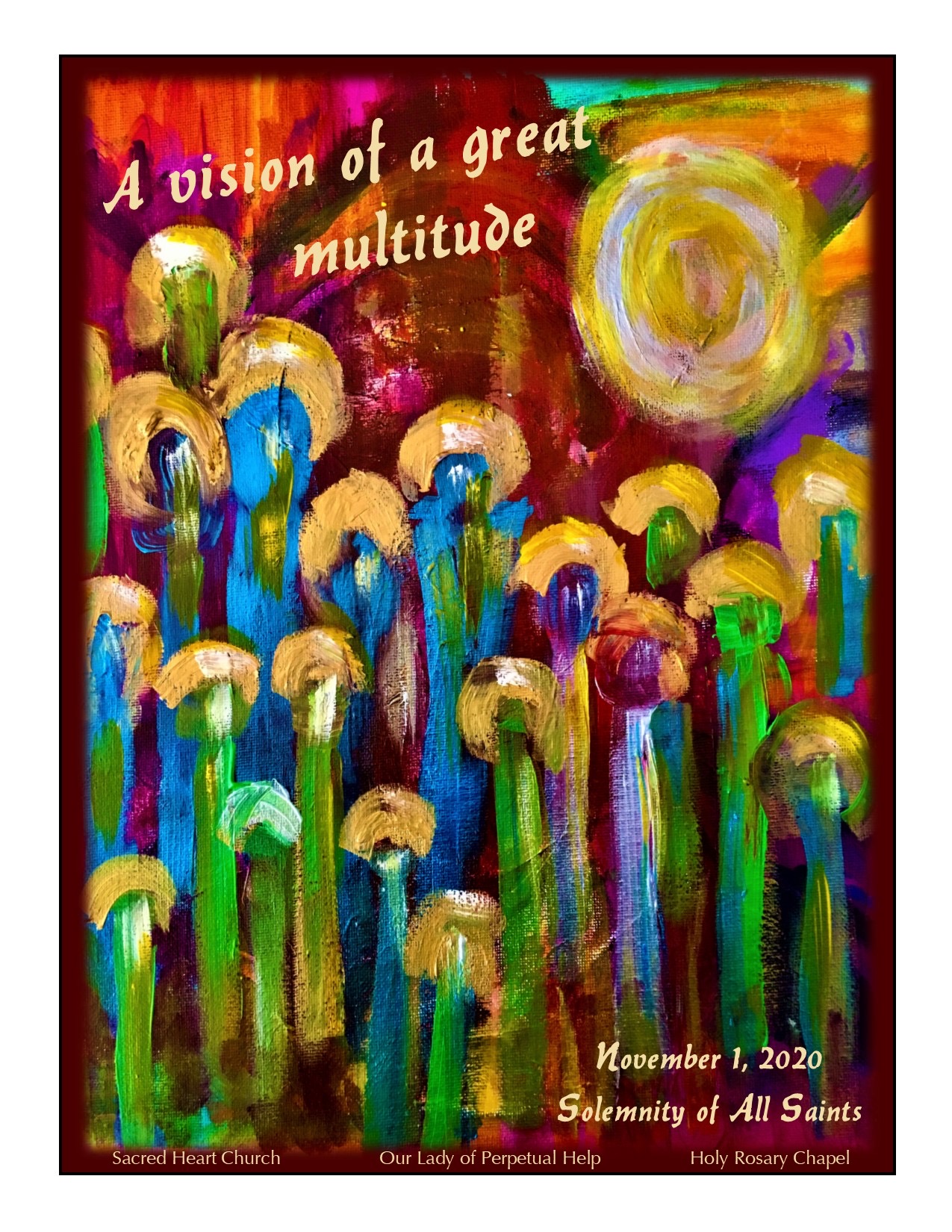
CLICK here to read the complete bulletin for this weekend.
Dear Followers of Jesus,
Today is All Saint’s Day. This year, November 1, falls on Sunday. So, we celebrate the gift of our saints in Christ Jesus in our Sunday Masses. I love the official catalogue of canonized saints. I take great consolation in their commitment. I am inspired by their lives here on earth. Some saints are quirky, and many may even seem weird. Yet, they all gave their lives to God in the ways in which they were called to love and serve.
The saint is really someone here on earth who discovers love of God and love of neighbor. Saints discover an intentional life, that is, they pray in the moment, they love with integrity and they act with great discernment. Saints reveal that a relationship with God is absolutely possible here on earth. They learned in the deepest places of their hearts to trust God, to surrender everything to the mystery of God’s love for them. The amazing thing about saints is that we can’t imitate their lives. We can learn from them about God’s fidelity and grace, but to imitate them exactly does not make us saints. We have to do the work of prayer in our own lives. In other words, we can’t live someone else’s life. That does not make us a saint.
The only way into the depths of God’s love and fidelity is to live the truth of our own lives. This may take us years to discover. Theresa of Avila and Oscar Romero show us that it takes many years to finally realize our call and act upon such a reality. Some people know it early in life or give up all they possess in order to carve a new path. Francis of Assisi is such an example. Mary Magdalene had the privilege of gazing into the eyes of Jesus and many other saints came to know the face of Christ in the poor, the suffering or disabled. Some saints are intellects and some are hermits. Some are clerics and some are widows. Each life on earth is a mystery, and each life on earth has the potential of becoming a mystic, that is a person who realizes that God’s love is the guide for his or her life. In many ways, each of us is called to become a mystic, to live a life of prayer and service and to realize that God is our true identity.
The road map to becoming a saint is today’s gospel, Matthew 5: 1-12. The Beatitudes are always read on All Saint’s Day. We may hear this gospel at a funeral or even an ordination. These Beatitudes are the commandments of Jesus given to the disciples in his voice on the side of a mountain. They are often overlooked as a path to holiness because they are not as dogmatic as the Ten Commandments. This list is centered on Christ Jesus and at its core is love. Love is often dismissed as a way to faith because it is often seen as only romantic silliness. However, this list gives us the real mission of the Church. This list is far more difficult than the Ten Commandments.
The Beatitudes offer us a path to heaven and a saintly life here on earth. They do so because they first lift up the poor. They affirm our challenge to offer mercy and not hatred, love and not violence. This list is the most radical statement of faith in the gospels and it is the list that is seldom trusted or made real. It changes not only hearts, but society and the world. It overthrows what we may think life should be and what justice is all about. It turns the tables on our notions of how to live and how to survive in society. Perhaps the Beatitudes are the reason why there are so few saints today, because at first glance, they turn life inside out.
How difficult today it is to act mercifully. Mercy after all is not a commodity; it is a result of knowing God from within our hearts. We can’t manufacture mercy or peace or comfort toward the grieving. The Beatitudes are lived in hearts that first know and understand the fidelity of God. The Beatitudes carve an empty place within our hearts only to be filled with God’s love, integrity and power. These words from Jesus are radical and the concepts are countercultural. Yet, they remain a blueprint for sainthood.
We all desire to live in the love God has for each of us. We can’t duplicate a life set free in God’s faithfulness nor can we copy exactly how God desires us to serve and to act in our Church and world. The fire of faith is given to each of us as God desires. Collectively in the Church, we call people who know such fire, saints. We celebrate such a gift and mystery this day on the Solemnity of All Saints.
“Rejoice and be glad, for your reward will be great in heaven.”
God give you peace,
Fr. Ron Raab, CSC, Pastor

October 25, 2020
30th Sunday in Ordinary Time
Dear Followers of the Holy One,
Today’s gospel, Matthew 22: 34-40, reveals a two-fold action toward holiness. We are to love God and then learn how to love people. This is the foundation of the Christian life. We may easily learn one or the other. However, putting both into practice changes us and the world.
My years of priesthood have taught me many things. My ministry has been a form of spiritual direction for me. Learning to love is never easy in any commitment. I am still learning how to love God with all my heart, soul and mind, and my neighbor as myself. I am no model of fidelity. Yet, the purpose of the Christian life is to learn how to love.
Sometimes we get caught in thinking that love is the fidelity of keeping rules in the Church. They may be guides toward love, but we do not have an intimate relationship with rules. Rules and dogma do not replace the person of Jesus Christ. Unless Jesus is at the center of our lives, what we do in the Church has little meaning.
One of the most touching encounters with people who have taught me such fidelity came from a woman I met while in Portland. She had been severely abused as a child and gave up on the Church. She gave up because she always thought she needed to heal her own life. She showed up in our community that served people every day. Service was obvious and real. Yet, she needed to learn how to do that.
I listened to her for many years. Every inch of her pain was exposed to God. She spent many decades in therapy, but never spoke to any one of faith in the Church. I have never heard with my own ears the ache in a human soul like hers. God had her in his hand. Every inch of healing was a struggle, yet she believed with her entire being that God was with her. That was a very slow and arduous process. In our conversations, I helped her realize that God does the healing and not her. She was flabbergasted at such a notion. Once that damn broke in her, she allowed God in and God moved her toward an incredible fidelity of prayer and service.
As I would listen to her, I wept. She moved me so much as a human instrument of pain and love. She absolutely understood the message of today’s gospel, that love has to be at the center of life, that only God can heal, satisfy and claim our souls. I know in her as I reflect on her suffering, that life had given her such raw pain and that God had revealed a depth of love to heal her. When I knew her, she was in her sixty’s, so I know it is never too late to discover the love we are searching for in God. God’s timing is not our timing. I know that she helped me discover God’s faithful love in my own life as I listened to her.
So, years have gone by and I don’t know what has happened to her. I do know that her search for God’s love and her search to love people are still with me. Especially in these difficult times in our world, I go back to such people who reveal to me that the message of this gospel is real in every human heart. The message of loving God and loving people may very well be hidden among people we least expect, people on the periphery of life, people suffering from mental illness or addiction or in some way out of the norm of what we think the center of life is or should be.
We all have faced uncertainty and fear in our world in these months of pandemic. Such fear within us may very well be the door that is opening for us to claim the love of God. If our hearts remain in prayer, reflection, and we sort through the fear that evolves in our hearts, we may walk through these dark days becoming a people of hope. I so desire that for my own life, and I am sure you do as well.
Please, don’t let fear make a permanent home in you. Today’s gospel reminds us that love is the way to prayer and service. Only love through the complexities of fear, grief and loss may lead us to another side of life and the other side is love itself. God is in charge and God is in charge of the healing we need. So, please, allow God to do God’s work in you and in us.
Love is the greatest commandment. This is the rule to follow, love God and love neighbor.
God give you peace,
Fr. Ron

10th Anniversary of the Canonization of Saint André Bessette
On Sunday October 17, 2010, Pope Benedict canonized the first member of the Congregation of Holy Cross, Brother André Bessette. Alfred (André) Bessette was born near Montreal, Canada on August 9, 1845. He was sickly, poor, and a man of faith. When he joined the Congregation of Holy Cross, he was assigned to serve as porter. He welcomed people at the door for over forty years. His hospitality turned into healing the sick and offering consolation for the hungry, the destitute, and crippled. He died on January 6, 1937. Please visit our website http://www.sacredheartcos.org to learn more about Brother André.
At Sacred Heart Church, a first-class relic of Saint André Bessette is housed in our new altar. His life as healer remains at the center of parish life and worship. His simplicity speaks boldly today as we ache for healing from a pandemic and the violence of our divided society. Through the intercession of Saint André, pray for healing for our loved ones who have died of COVID-19 and those who grieve. Pray for the healing of racial divides, for those who have lost jobs, for people who live outside, for the unborn, for reconciliation among families and those who survive domestic violence. Pray for our children who have lost hope. Ask Saint André to intercede to God for what your heart aches.
Saint Andre, pray for us:
You welcomed the lost.
Shelter those who travel in fear.
You embraced the weary.
Calm the storms of our anguish.
You lived simply.
Guide us through our complicated lives.
You healed the sick.
Give us hope when we are in pain.
You trusted Saint Joseph.
Open the door to God’s providence.
You embodied hope.
Give us respect for every human being.
You lived every day with body pain.
Heal our bodies during this pandemic.
You trusted your life to Jesus.
Show us how to live beyond selfishness.
You prayed for the ill.
Change our agony into courage.
You comforted the sinner.
Love us in our anguish.
You offered hospitality to all people.
Help us heal our racial divides.
You prayed during sleepless nights.
Reassure us when we are restless.
You were illiterate.
Help us read the signs of the times.
You were orphaned.
Form our communities with respect and dignity.
You were short in stature.
Pray that we may stand tall when politics wearies us.
You gave your life to others.
Guide us to build the Church on trust.
You allowed compassion to guide you.
Show us the tenderness of the Sacred Heart.
Amen
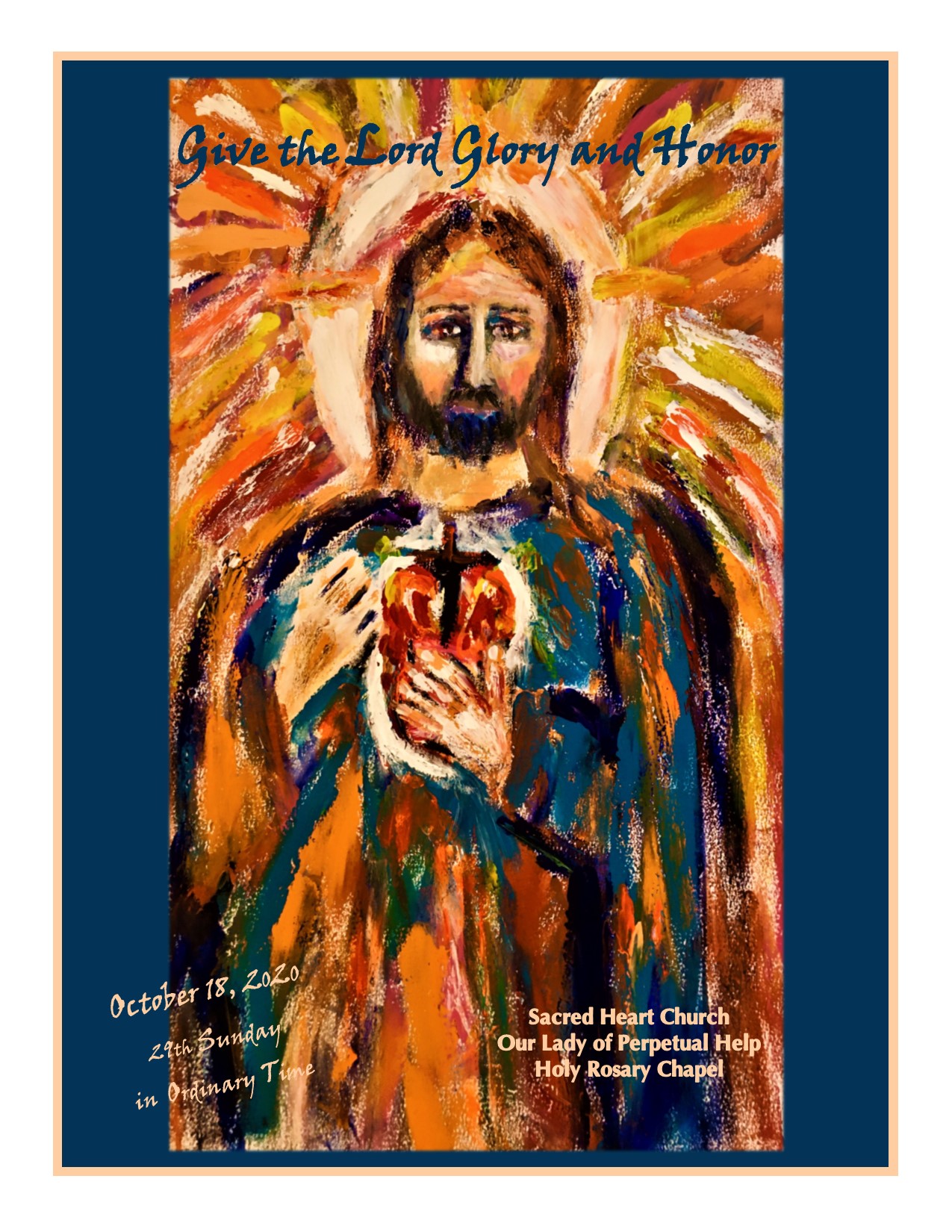
CLICK HERE to read complete bulletin for this weekend
Sunday October 18, 2020
29th Sunday in Ordinary Time
Dear Believers in the Christ,
In today’s first reading from Mass, Isaiah 45: 1, 4-6, we hear, “I am the Lord and there is no other, there is no God besides me.
I love this simple reminder. Our Christian identity flows from the gift of our baptism. We are born again in God and sustained in the Holy Spirit. We may live, especially in uncertain times, clinging to many other things we think may replace this identity. For example, we often use cultural power to replace God, that is money, authority, politics, greed, lust, ambition, education and our own opinions.
This sense of power controls our opinions about how other people should live. We may look to the poor and want them to pull themselves up by their bootstraps and get a job in order to justify their existence. This is using power over others instead of using our gifts and talents to better understand our neighbors and their suffering. We can make our own lives greater than God’s life. We can turn our cultural power into a god. We can even make our opinions of other people real truths. These opinions can then lead to condemning people, especially those who are different from ourselves.
This text from Isaiah not only tells us who God is but reminds us that our false gods are not our real source of life and love. In these months of pandemic, we all have to be careful not to create new gods. We may think our political opinions are a solid identity upon which to build a life. We may take great delight when some people win, and some people lose. We may be waiting for a vaccine god, so to put our future in its hands. We may fight for the common good and believe that our fights are gospel truth. We may even create gods out of our fear, our distress and our economic uncertainty. We can make a god out of just about anything, even our education or our reputation or our employment.
In these days of great emotional stress and strain on family life and personal uncertainty, we settle into the mystery of God. I invite you to learn from these days of pandemic, to sort through your life and to not settle for hopelessness. Only God provides genuine hope for our future. There is no other god we can muster that will sustain us and give us direction in our lives of worry. God is here to offer us real grace, mercy, and forgiveness.
One of the beautiful outcomes of pandemic and the incredible natural disasters we face is that we need God. It is alright for our lives to need something greater than our own lives. We need love, mercy and hope. In fact, this is the spiritual life, to finally come to the conclusion that we need God. In such suffering, we have options, we can abandon God altogether, or finally surrender our own personal power to God who has nourished us to this point in life.
Some people view our younger generation as having given up on God. I don’t really think so. I think they have given up on the rest of us who have not come to the conclusion that we need a spiritual power. The Christian institutions may not look the same in future, but I believe we are going through a great time of transformation and renewal. The younger generation will lead us and lead us to live a greater spiritual life. Young people are calling the rest of us into lives of genuineness and living the truth of what we claim to believe.
I hold on to the Real Presence of Christ Jesus to lead us into lives of compassion, tenderness and forgiveness. Only God’s fidelity can soften hearts and heal our mistakes. Only God who has begun this great work in us will bring it to completion. I look forward to the future with great hope, when we can finally turn toward the One who created us, the One who loves us, the One who spurs us forward to bear witness to the world that love is real.
“I am the Lord and there is no other, there is no God besides me.”
God give you peace,
Fr. Ron

 Broken But Not Divided